When we take photos, we have the sense that we're capturing reality as it is.
But of course, reality is three-dimensional and a photo is not.
To get that third dimension back, or at least to simulate it, photographers use the technique of layering.
And I don't mean Photoshop layers, I mean composing an image in camera with elements in the foreground, middle ground and background to create a sense of depth and visual interest.
I've been thinking a lot about layering and layers, looking at the work of Tseng-Kwang Chee, how there are layers everywhere in his extraordinary photographs, both visible and invisible.
Tseng was a photographer active in the 1980s, based in New York City and friends with artists like Keith Haring, Jean-Michel Basquiat and Andy Warhol, all of whom he photographed for various projects.
He's not as much of a household name as these contemporaries, but he should be.
His work is just as fresh, incisive, and playful.
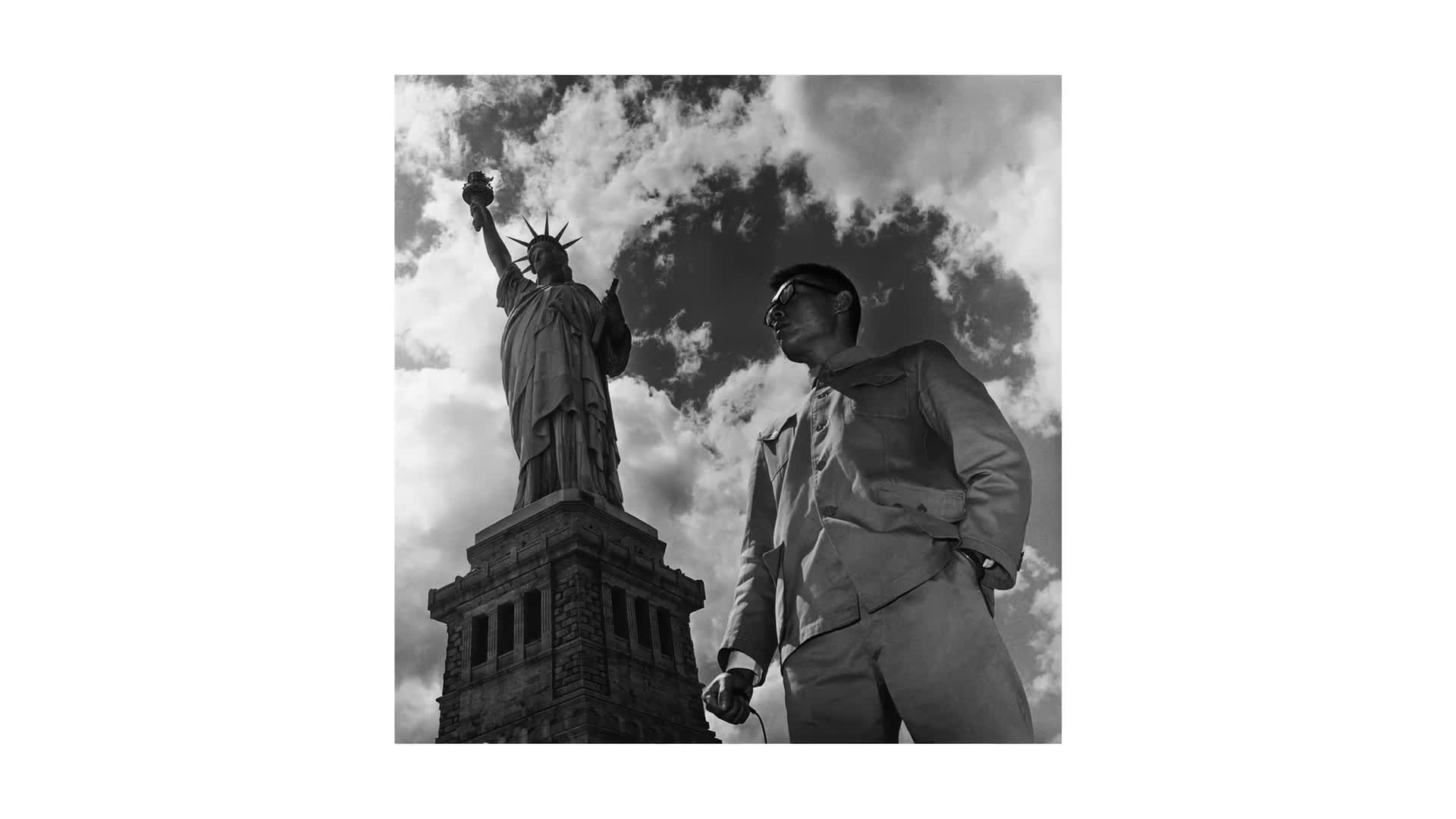
Tseng's masterpiece is a series of self-portraits called East Meets West, taken from 1979 to 1989, in which he poses in a Mao suit in front of American and international landmarks and landscapes.
Landmarks like the Hollywood sign, the Golden Gate Bridge, the Eiffel Tower and the Statue of Liberty.
Tseng layers these photos to put himself or the character he's playing, who he called the ambiguous ambassador, into a dramatic relationship with these national icons.
And he's asking us to consider and interrogate this relationship.
I mean, if you knew absolutely nothing about this series, how would you make sense of these photographs?
Maybe you'd think this was a real Chinese diplomat getting snaps of himself at famous US tourist sites.
In 1979, that wouldn't have been a totally unreasonable assumption.
The eyes of Texas were on Deng Xiaoping today, as the Chinese vice premier continued his tour of this country.
That year, the new Chinese leader, Deng Xiaoping, made a historic visit to the United States, the first official visit of a Chinese leader since the founding of the People's Republic of China in 1949.
The trip symbolized a turning point in relations between the two countries after decades of hostility, indicating Deng's desire to open up China for a new era of economic and cultural exchange.
Much like the ambiguous ambassador, Deng toured the US, visiting DC, Atlanta, Seattle.
He even went to a rodeo in Texas where he was presented with a cowboy hat another icon of American culture, which he proudly wore.
It's important to understand that in 1979, Americans simply hadn't seen any Chinese tourists, because there were none.
If anything, they saw government officials like Deng, most likely on TV and not in person.
After decades of Cold War antagonism and then a gradual warming of relations, American sense of Chinese identity was complex and layered.
Tseng experienced this firsthand.
Shortly before starting East Meets West, Tseng's parents visited him and his sister Muna in New York and wanted to take them to the fancy restaurant atop the World Trade Center called Windows on the World.
The restaurant had a dress code, but Tseng didn't have form-aware.
All he had was a Mao suit that he had thrifted in Montreal, so he wore that.
Incredibly, the restaurant staff, seeing this, treated him like a visiting dignitary, giving him and his family the best table in the place.
In this experience, seeing how differently he was treated based on his attire East meets West, was born.
By putting on the Mao suit, Tseng activates in the viewer this deeply layered perception of Chinese identity, just as he sparked a reaction in the restaurant staff.
Equally layered is the suit itself.
I've been calling it the Mao suit because in the West it's most associated with Mao Zedong, founder and first leader of the People's Republic of China.
But a more correct name is the Jiangshan suit, named after Sun Yat-sen, leader of the 1911 revolution that overthrew the Qing dynasty and ended 2000 years of imperial rule in China.
Sun was looking for a modern form of dress that separated itself from the Manchu robes of the Qing dynasty, settling on a design partly inspired by Japanese cadet uniforms.
The suit went through a number of variations, but the final design features a stand and fall collar, five buttons down the front, said to represent the five branches of government, and four flap pockets symbolizing the four virtues of Confucianism.
Shortly after Sun died in 1925, his Nationalist Party entered into a civil war with the Communist Party, which ended with the victory of the Communists and the elevation of Mao.
But when Mao proclaimed the foundation of the People's Republic of China, he wore a Zhangshan suit, indicating that he still wanted to borrow some of Sun Yat-sen's authority, even while breaking from his party.
Soon, the suit became the de facto attire for all officials, party members and workers in China, a vital part of the country's visual identity.
When Seng wears the Jiangshan suit in East Meets West, he's wearing all of its many historical layers and he's setting that potent symbol against the symbols in the background of his photos symbols of America's engineering triumphs, its economic power, its cultural influence.
Symbols of opportunity.
Symbols of despair.
What do these symbols of national identity mean to Americans?
What would they mean to an actual Chinese dignitary of Mao's era or Deng's era?
What do they mean to the ambiguous ambassador, this mysterious tourist?
And what do they mean to Tseng Kwan Chee, the artist who's put himself in the foreground of all these photographs but, at the same time, has hidden himself under all these interacting layers of meaning?
Tseng was born in Hong Kong in 1950 when it was still controlled by the British.
His father had been an officer in the Chinese Nationalist Party and fled the country when the Communists took power.
When he was 16, Quang Chi's family moved to Canada.
Later, he went to Paris to study painting, but soon gave it up for photography.
In 79, when he was almost 30 years old, he landed in Manhattan's East Village with his sister, where he met other like-minded artists and began the East Meets West series.
Despite the stoic pose in many of his self-portraits, Tseng was playful and light-hearted in person.
If you look, there's evidence of that scattered throughout the series.
Breaking free from the suit, the monuments, the layers of national histories.
Tseng's personal history was as layered as any of these things, as you can see, but he didn't want to be defined by unchosen identities.
He didn't want to be known as a Chinese artist or an Asian American artist or a gay artist.
He just wanted to be an artist because that was the identity that he selected for himself.
In the later part of East Meets West, Tseng travels into the American and Canadian countryside.
In many of these photos, the ambiguous ambassador is no longer in the foreground of the image, no longer taking up as much space as massive man-made monuments.
Here, the layers are collapsed and he becomes a part of the landscape.
He still sticks out, but the ambiguous ambassador's relationship to what's around him is less confrontational now and more contemplative, more well ambiguous.
That's really what identity is, national or personal.
It's never solid or stable.
Identity is the tension between layers.
That tension, that ambiguity, is what Tseng Kuang-Chi captures so brilliantly in East Meets West, and it's a theme he would have continued to explore had he not died from complications related to AIDS in 1990 at age 39, just 22 days after his friend Keith died of the same thing.
Who knows what layers he was going to show us next.
It's hard to say because I always wanted to be on the ambiguous.
Is this real?
Is this unreal?
Is this funny or is this serious?
Is this a critique or is this a glorification?
That way, I think, gives my photographs much broader meaning.
You can read it one way or another depending on what you want to see in it.
But so far, It is not.
It has not really been accepted in the mainstream.
Although I hope this year it will be.
Hey everybody, thank you so much for watching.
This episode was brought to you by Squarespace, the all-in-one website platform for entrepreneurs to stand out and succeed online.
To get started, you can use Blueprint AI, Squarespace's AI-enhanced website builder, to get a fully customized site in just a few steps, or choose from their library of professionally designed templates that are sleek and engaging.
Every website you make will be optimized for SEO, so you'll show up more often in search results.
And you can do so much within Squarespace, like creating members-only content videos, blogs or courses, creative work that you can monetize via one-time payments or subscriptions.
The bottom line is that Squarespace is going to make a home for your products or your work that looks and feels professional, something that will impress your customers and fans.
Head over to squarespace.com for a free trial.
And when you're ready to launch, go to squarespacecom.
Slash nerdwriter for 10 off your first purchase.
Thanks, guys.
I'll see you next time.