Hello and Happy New Year.
It's Michelle Martin from Morning Edition.
Thank you to everyone who donated during our end-of-year fundraising campaign.
2025 dealt a big blow to NPR and local stations with the loss of federal funding for public media, but we are so heartened by the outpouring of support and we will get through this together.
Thank you for keeping NPR strong moving into 2026 and beyond.
You're listening to Shortwave.
This summer, I got to go on a grown-up field trip.
I got in my car and I drove a little over four hours to the Carnegie Museum of Natural History in Pittsburgh.
I was so excited to learn about dinosaurs.
And I'm not the only one.
People have been coming to this museum since 1895 to see all the dinosaur bones on display.
Most of what you see in the dinosaur gallery are real fossils, so there's about roughly 250 specimens on display and about 75 of those are the actual fossils.
That's Matt LaManna, the curator of vertebrate paleontology at the museum.
He'd just come back from a dig in Wyoming and he was nice enough to walk me through the dino exhibit when I first arrived.
So not all the creatures that you see in here are dinosaurs.
Those two are, and that one is.
But this guy is a croc relative.
Almost immediately, I was in awe.
The ceilings were high, the plastic greenery was lush and the pieced together dinosaur bones.
They towered over me.
It's so big.
It's so, like, I don't think people understand how big this is.
Yeah, this animal's about 85 feet long, probably a good 15 feet tall at the hips.
And as we walk around here, you can see those whiplash-like tails.
And one of the coolest things about the Carnegie Museum is that it holds special dinosaur bones.
They're called holotype specimens.
So they're the specimens upon which a fossil species is based.
It becomes like the gold standard for that species.
Meaning these fossils are the reference point.
Scientists can compare other similar bones to them and figure out are they part of the same species or distinct enough that they're a different, sometimes new, kind of dinosaur.
We have about 500 of these, these original gold standard fossils, these holotypes.
On display, we have probably between 10 and 20 are up here in the gallery.
And what I didn't expect was to see the holotype of one of the most famous dinosaurs ever.
Believe it or not, and this is my big reveal for the tour, this is the holotype of Tyrannosaurus rex.
And these are like the real bones.
They are the real bones.
Every real bone that we have of this animal, with the exception of the eight bones from the skull which we keep downstairs, are built into this mounted skeleton.
So all these people that are in here right now are looking at most of what we have, of what is, by definition, the world's first fossil, the world's most famous dinosaur.
And after I heard that, I needed to see that fragile T. rex skull downstairs.
I wanted to know what happens even deeper inside the museum, to those specimens in the basement.
So I headed downstairs with the director of museum experience, Sarah Crawford.
Most of our collection are things that people probably never see, if you're just the general public but scientists see them.
And guess what?
So did I.
So today, on the show, I'll be taking you with me to learn about what science is happening in the bowels of the museum basement and touch a fossil from around 67 million years ago.
I'm Regina Barber, and you're listening to Shortwave, the science podcast from NPR.
What's in store for the music, TV and film industries for 2026?
We don't know.
But we're making some fun bold predictions for the new year, plus setting some personal pop culture resolutions.
Listen to Pop Culture Happy Hour in the NPR app or wherever you get your podcasts.
NPR's podcast Trump's Terms is your source for same day updates on big news about the Trump administration.
Short, focused episodes, one topic at a time, about five minutes or so.
We carry out reporting from across all of NPR's coverage, so you are always getting the biggest, most urgent stories.
Listen to Trump's Terms on the NPR app or wherever you get your podcasts.
Okay, short wavers.
We have descended into the research and archive basement of the Carnegie Museum of Natural History, where I was chatting with Sarah Crawford and Sarah Davis, a paleobiologist.
While it surprised me that I would be directing my questions across two people with the same name.
So what was your, so Sarah Davis, Sarah Crawford.
Yeah.
Sarah Crawford.
It also surprised me just how much I suddenly was privy to.
Everything that I and all the guests in the floor above were completely unaware of.
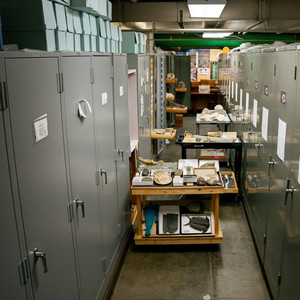
As you walk down the hall, this is the big bone room and we have a little bone room.
That's the size of the room, not the size of the bones.
Most of the dinosaurs are over here, but then we have things like mammoths and mastodons and rhinos across the hall.
So our big stuff is spread out.
And the other kind of factor is there's just so much.
There's so much.
And so this is something that visitors are always surprised by.
Like, you have 22 million objects in your care.
Like, you know, when are those going to go out on floor?
You know, they're not here just for exhibition.
They're mostly for research purposes.
It's also kind of a math problem.
22 million objects is a lot of objects for any place, even a large museum.
We only have 100,000 square feet, roughly, of space.
And so you know, anytime we, you know, take something out on the floor, we have to pretty much put something else away.
So it's just a lot of choices.
One of the first things Sarah Davis showed me was the T-Rex jawbone.
The one that was missing from the display upstairs.
Oh, here we, oh my gosh, that looks so cool.
So this diagram here is showing the entire, what we have from the skeleton of that individual.
And the whole body is on exhibit upstairs in Dinosaur Hall.
But the skull is down here.
The jawbone was a little shorter than the length of my arm and browned with age.
It was laying flat safe in a drawer.
And that's for several reasons.
One, it is very heavy.
It takes two people to lift this.
It takes about three people to lift this one.
And then we actually do flip these so you can see both sides, and it's a whole ordeal.
And like we mentioned earlier, they're not just tucked in the basement because of their weight.
So people come here specifically to study Tyrannosaurus rex, and they want to see the holotype.
So the skull has a lot of really important information on the biology, the identity of these animals.
And so keeping this down in the collection makes it more accessible for science.
And again, this is the T rex holotype, the reference point that scientists use for every other T rex fossil that gets discovered ever.
So, given how important the bones were, I was shocked to my core when Sarah Davis reached out and touched them.
You straight up touched it.
Oh my gosh.
No, the bone.
That's my job.
But also that, there are certain things like this I know is relatively stable.
Can I touch the bone?
You can, yeah.
Okay.
Oh my god!
Okay, I'm done.
That's right.
I touched a 67-million-year-old fossil, something other paleontologists came from around the world to study in this bone room.
But that line between research and public consumption isn't always so clear as it was with the T rex skull.
Sometimes the bones that scientists need to study aren't in the basement or easily accessible.
They're already on display in an exhibit, maybe in a pile of bones, to accurately represent the world millions of years ago.
We actually do have scientists go on exhibit and study things while visitors are around.
What?
Yeah.
So actually this week we've had a visitor come in looking at Coelophysis, which is a small theropod Triassic age from New Mexico.
It's like about Great Dane height.
One of the earliest known theropod dinosaurs.
I think very cute.
So cute.
How could they not put them on display for all these adoring, curious kids and adults?
They lived in like groups and we actually have these huge fossil assemblages of them where they've died and been like swept into a river basin.
So there's piles of skeletons.
We have one of those piles of skeletons on exhibit in the dinosaur hall.
And our visitor that's here all week is studying Coelophysis.
He had to go in the exhibit yesterday, like crouch down in the exhibit, look at the bones.
And so I was like standing outside the exhibit as kids were coming up, being like that guy's not supposed to be here.
And I'm like, tell him to get out.
Well, no one kid wanted to join.
They were like, well, I'll see the dinosaur.
And I was like, we'll see the dinosaur from over here.
And that got me thinking.
When the curators want to put these fossils on display, when they're pulled out of the basement and placed in an exhibit, how are they protected from damage?
But Sarah Crawford told me not to worry.
The scientists are thinking all about that all the time.
I mean, you have to think about all these things before something goes on exhibition, but then after it's on exhibition, we also have to keep an eye out for sound levels in the space um, and other things.
Why?
Because the the, you know, even vibrations of sound can like, move the specimens and over time, could cause damage.
We just had a evening event a couple weeks ago and we had musicians playing violins and i was like violins, you know, like that should be fine, but we had very specific sound levels.
They can't go above that or the bones could vibrate and that could cause some damage.
Yeah, But okay, let's get back to the treasures in the basement.
After the T-Rex bones we went through a series of rooms to check out more stuff, like all the ways the bones are cleaned and the sandboxes the fossils rest in in between.
I even saw a whole room that housed just one animal.
This is kind of a holding room.
Oh, my God.
What is that?
That's so huge.
That was terrifying, and it was, like, dark.
I know.
It was spooky.
Oh, my God.
Okay.
This is a mastodon, American mastodon, very old.
And it comes from Indiana, but was found on a farmer's land and then donated to the museum.
A surprising amount of fossils get acquired that way.
At least, I was surprised how common it seemed.
What was less common was the dinosaur skin I saw.
And then rounding out our basement adventure, fossils from a recent expedition in Antarctica.
And then a lot of marine reptiles.
So this is a plesiosaur or a long-necked marine reptile.
This is one of their vertebrae.
It's broken here and here.
But it would have also been a really large animal.
And crustaceans.
So this is a lobster.
That's really...
Oh my gosh, it's a lobster claw.
Oh my gosh.
Okay, how old is this lobster claw?
66 million years old.
What?
About, roughly.
End of the Cretaceous.
Looks so delicious.
I know.
But to Sarah Crawford, it isn't the individual fossils that give her that awe she feels when she comes to work every day.
It's that feeling when we were turning the wheel and you're hearing that sound of the shelves moving, like the smell of going into collections.
It's like, I'm an art kid.
I'm not a scientist.
I don't have the kind of background that Sarah has or that Matt has.
You know, I never expected in a million years to be hanging out here with dinosaurs.
Never, ever, ever.
And there's just so many details and so many feelings that you get when you walk into a collection that it's just like impossible to communicate.
That sound, that smell of the mothballs, these drawers that have these like really ornate handles.
Yeah, they're like Victorian handles.
Yeah.
And you have, like little details, like handwritten labels with you know, reams of scientific information.
It's just like that feeling of going behind the scenes into collections is something that I wish I could communicate to every visitor.
And that's what I'm chasing after with every exhibition is like how do I give people that feeling that I feel so privileged to have going behind the scenes and being this close to like these amazing specimens?
As I left the bone room and walked back to the main floor, I saw more visitors walking through the dinosaur exhibit that I had seen in the morning.
Little kids were smiling and running up to certain displays.
And it felt like the perfect end to my journey, seeing the whole museum ecosystem science community, play and gift shops.
Because, you know, you always exit through the gift shop.
If you like this episode, check out our episodes on how realistic movie dinosaurs are and our episode on how scientists know birds are dinosaurs.
We link to them in our show notes.
This episode was produced by Hannah Chin and edited by our showrunner, Rebecca Ramirez.
Tyler Jones checked the facts.
Robert Rodriguez was the audio engineer.
Bette Donovan is our vice president for podcasting.
I'm Regina Barber.
Thank you for listening to Shortwave from NPR.