Grownups, Wondery Plus subscribers can listen to Wow in the World early and ad-free right now.
Join Wondery Plus in the Wondery app or Wondery Kids Plus on Apple Podcasts.
Hey, Wowzer fans, Mindy here.
And before we start the show, I gotta let you know that this November, with a special new episode featuring our friends at Circle Round and Terrestrials on Radiolab for Kids,
And don't miss when Elmo from Sesame Street stops by Wow in the World to make us all belly laugh on November 24th.
Oh, but that's not all, Reg.
On December 1st, we are sharing our 250th episode of Wow in the World with all of you.
We think this one is going to be music to your ears.
Literally.
Did I mention it's a musical?
And if you're a member of the World Organization of Wowzers...
Oh boy, do I have a surprise for you.
You can listen to our 250th episode early with me and other members from around the world on Saturday, November 22nd, at 7 pm.
Eastern.
That's right, we are throwing another listening party.
Join us as we dance along to our new songs.
React to the episode with other members in the chat and more.
Grownups.
If you want your wowzer to join this members-only listening party, you can sign up to become a member today at Tinkercastcom.
Slash wow.
Already a member?
Well, you can find the link and password to join the event when you sign in at Tinkercastcom.
Slash wow.
That's it.
It's going to be a November to remember.
But for now, let's get on with the show.
Woo!
Welcome to Inside Tinkercast Studios, the show where I reminisce and revisit my favorite episodes of Wow in the World.
I'm your host, Dennis.
And that's my co-host, Reggie.
What?
You're not?
I thought you wanted to be my co-host.
Executive producer, Reggie.
Fine, let's move on.
Today's episode of Wow in the World comes to us from Season 3, Episode 10...
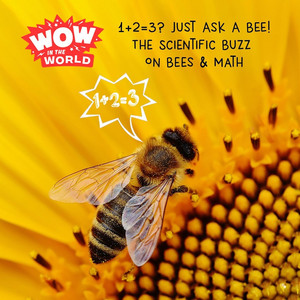
One plus two equals three?
Just ask a bee.
No, Reggie, that episode was called The Buzz on Bee Bar from Season 4.
This is a different one about bees.
Because bees are awesome.
Well, in this episode, Mindy and Guy Raz are out looking for examples of the Fibonacci sequence when they come across a bee doing its math homework.
Then they...
I am not spoiling the episode.
I'm providing insightful commentary and synopsis in order to... You know what?
That's actually a good point.
We haven't done the Q&A segment in a while.
Let me just get the old answering machine pulled up here.
Okay, there we are.
Hi, you've reached Dennis from Inside Tinkercast Studios.
That's me.
If you've got a question, well, I do too.
Lots of them.
And who's going to answer all my questions?
You?
Probably not.
But I guess I can answer yours.
Leave me a message.
My name is Aiden.
I'm from Kyoto, Japan.
I have a question for Dennis.
How many seeds are in one dandelion, Puffball?
Huh, I don't know.
I would say definitely more than five, but probably less than... The answer is about five.
You called in with a question and an answer.
Pretty sneaky.
Next message.
Hi, Dennis.
This is Will from Georgia.
How many Static Man capes do you have?
Oh, I have lots of them.
Let's see.
There's the original Static Man cape 1.0.
Then there's the high security cape, which is really more of a cloak, I suppose.
Then there's the cape of disappointment, which was a failed experiment where I tried to.
I mean what?
Capes?
What capes?
Who's Static Man?
Next question.
Hi, Dennis.
My name is Rihanna, and I'm from Woodstock, Georgia.
My question is, what is your favorite kind of food?
Hmm, my favorite kind of food, huh?
I'd say, uh, hot food.
Hot food is a kind of food.
Fine.
Maybe then burritos.
I like burritos, hot ones.
Yeah, now I'm hungry too.
We better move this along so we can go eat.
Thanks for your calls, everyone.
If you've got a burrito, I mean a question for me, call and leave me a message.
The number is 1-888-7-WOW-WOW.
I just might answer your question on Inside Tinkercast Studios.
Okay, that takes care of that.
Good idea, let's play the episode.
And now, Inside Tinkercast Studios, brings to you a special encore presentation of one of my favorite episodes of Wow in the World.
One plus two equals three?
Just ask a bee.
You'll be left in the dust, Unless they're stuck by.
Ya, You're a sunflower.
You're a sunflower Every time I'm leaving on.
Ya, You don't make it easy.
No no, You don't make it.
Hey, Guy Razzi.
Oh, hi, Mindy.
What are you doing out here in the community garden so early?
You know what they say.
Yep, the early worm gets the bird.
Then it can't eat it because it doesn't have teeth.
Uh...
I hadn't heard that one.
So what are you doing out here anyway?
I was just doing some math exercises.
Math exercises?
Yeah.
In the sunflower patch of a community garden.
I know.
Isn't it perfect?
Well, I'll tell you what I'm doing here.
I am collecting sunflower seeds for a new energy bar recipe that Reggie and I are working on.
Energy bar?
Oh yeah.
There's a big opportunity in the energy bar for birds industry.
Thinking of starting a little business.
Oh yeah?
What's that?
Energy bars for birds.
Huh.
We're going to shove a bunch of sunflower seeds inside each bar.
Call them paleo.
Birds going paleo?
I
Genius, right?
Reggie came up with the idea to turn this concept for bird energy bars into a business after he had been listening to episode after episode of this one podcast called How I Bird This.
Have you heard of it?
Can't say I have.
Oh, yeah.
It's nuts.
It features all of these birds and all the cool stuff that they've built like bird houses that you can rent out to other birds for a night.
Oh.
And then there was this one episode of this bird-owned company called Werbler Parker, where you can get these flying goggles to try on at home, and if you don't like them, you send them back.
Anywho, you should totally check out the show.
It's called How I Bird This.
I think you're really going to like the host.
In fact, you kind of remind me of him.
Hey, Roz, where are you going?
Wait up!
You never explained why you were in the middle of all these sunflowers doing math exercises.
Or what those...
Exercises even are.
That's right.
See you later.
Wait, wait, wait, wait, wait, wait, wait.
Guy Razd, I don't know that look anywhere.
You are up to something.
Guy Razd, were you in here doing a scientific investigation without me?
Well, what makes you think that?
Well, for starters, you're wearing the handy-dandy 5D sensory hat-dy.
Oh, this thing, I didn't even notice.
I just grabbed the first hat I could find as I walked out the door.
You know, with the strong sunlight, always better to be extra cautious.
Extra cautious?
My math.
Guy Raz, you are totally up to something.
I'm Indy.
Hi, Guy.
Hi, Dennis.
Hi, Dennis.
What you doing?
Oh, you know, we were just about to, um... Search for the Fibonacci sequence.
Yeah, see?
Nothing too exciting.
The what?
Oh, you two.
Liberace had a lot of sequins.
You shouldn't have to search for them.
I mean, unless he was walking around here back in the 70s and some loose sequins fell from one of his exotic costumes and into the yard.
Huh, interesting.
Well, I'm actually talking about a mathematical concept known as the Fibonacci sequence, where each number in the sequence is the sum of the two numbers before it.
Oh, yes, yes, yes, yes, yes, yes.
I understood none of that.
Now my brain hurts, so I'm going to go lay down.
Okay.
Well, thanks, Dennis.
Bye.
Yeah, peace out, Dennis.
That was close.
Okay.
Guy Raz?
No.
What is going on?
First I find you in the community garden.
You're standing in the midst of all of these sunflowers.
Then you say that you're here to do math exercises.
Plus, you're wearing a full lab coat and the handy-dandy 5D sensory hatty.
And now there's something about sequins and nachos.
No, no, Mindy, not nachos. the Fibonacci sequence.
Though I do have to say, I made a pretty mean batch of kale and tofu cheese nachos last night.
You gotta try them next time I make them.
Yeah, I think I'll take a pass.
So, you were saying something about Fibonacci?
Well, Fibonacci was an Italian mathematician who lived more than 800 years ago in the city of Pisa.
Oh, like where the Leaning Tower of Pisa is.
Exactly.
Wait, do you still have leaning tower of piece of jello sculpture you made that one time?
Don't you remember?
You ate it.
That's right.
I did eat it.
Anyway, Fibonacci was particularly interested in patterns.
I love patterns.
Plads, stripes, polka dots, paisley.
Well, not exactly those patterns.
More like patterns that he noticed in nature.
Zeppe, Leonardo, come quickly.
You must look at this apple.
What?
What is it?
The red delicious?
It is delicious, but look at what happens when I slice it across its hemisphere.
You see?
It is right here.
I just see the inside of an apple.
Ah, but you see at the center, there is a star.
And?
And that star has five points.
It's a part of a sequence.
Don't you see?
Everything in nature is connected to the sequence.
Oh, Fibonacci, I'm afraid I don't understand.
Well, if I take the number zero and add the number one, what do I get?
Well, of course you will get one because one plus zero is one. is correct.
So, now, let's say I take another one and I add it to one.
Easy.
One plus one is two.
Now, what happens when I add two and one?
Well, two plus one is three.
Where is this going, Fibonacci?
Aha.
Now, it gets interesting.
What if I add three and Two.
Three plus two is five.
And that is the Fibonacci sequence.
You start with a number and then you add to the number before it and you get a new number.
Fibonacci, I'm still not following.
Well, it's like this.
Zero, one, one, two, three, four.
5, 8, 13, 21, 34, 55, 89.
You catch my drift, eh?
Oh, of course!
Each number is the number you get when you add up the two numbers before it.
And Leonardo.
You can find these numbers represented in things like flowers in pine cones, even inside the human body.
Oh, yes!
So this guy Fibonacci, who sounds awfully familiar, figured out that there's a mathematical pattern in almost every part of nature.
Well, yeah.
And in fact, Mindy, that's why I'm in this sunflower patch.
Okay, so how do we find the Fibonacci sequence in a sunflower?
Ah well, that's precisely what I'm going to try and find out using my handy-dandy 5D sensory hat deed.
Of course, because the 5D Sensory Hat D helps to magnify or increase all your senses.
So that way, That way I'll be able to see the parts of the sunflower really well and I won't need a magnifying glass.
Well, good thing I brought along my own 5D Sensory Hat D Just get it out of my adventure toolkit here.
Put it on.
Now...
Let's go find some Fibonacci numbers.
All right, let's see here.
Look at this beautiful sunflower.
Just a perfect specimen of a flower.
And look how many petals this sunflower has.
One, two, three, four, 55.
I've counted 55 petals.
That's it?
Fibonacci number.
Fifty-five is a Fibonacci number.
What in the wow?
Guy Raz, it is bonker balls that we can find math all around us, all the time, 24-7.
Get away.
Ouch.
Mindy, watch out for that bee.
It seems a little aggressive.
Get away from me, bee.
Stop being all up in my bee's nest.
Choo, choo-bee, choo.
Hey.
This is my flower.
I was here first.
Uh, Mindy, who just said that?
I think it was the bee?
Hang on.
Hang on a minute.
I think the handy-dandy 5D sensory hat is giving a superpower hearing right now.
As I said, this is my flower.
Get lost.
What in the... Uh...
Oh, uh, well, Mr. B, sorry, we didn't realize you were here first.
We were just searching for some mathematics in nature, and we didn't intend to disturb you.
Well, you did disturb me.
I'm just minding my own buzzness, and you humans are droning on and on like drones.
Why don't you buzz off?
Uh, Mr. B, uh, Are you trying to tell us something?
Wait a minute, Guy Raz.
I think we may have hurt his little bee feelings.
Mindy, what in the world are you talking about?
You know what?
Let's just ask the bee, OK?
Excuse me.
Hi, little bee.
What are you doing right now?
I was doing my homework.
Math homework, to be exact.
Math homework?
Wait a minute.
What is going on?
Guy Raz, this is that study I was going to tell you about.
What study?
The new study I read about in the journal Science Advances.
Well, what's it about?
You ready for it?
Yeah.
It's amazing.
Okay.
This one's really going to blow your mind.
All right, spit it out.
I'm so excited to tell you.
Mindy, just tell me.
Bees can do math.
Bees can do math?
What's the matter?
Never seen a bee count to zero before?
Here Guy Raz, you gotta check out this study for yourself.
I even brought along the journal with me.
Heads up!
Mindy, this is amazing!
Tell me about it.
So we've known for a long time that doing math requires a certain combination of brain power mixed with a scoop of memory.
And scientists have known that some animals like chimps ravens, even spiders, can understand basic math.
Yeah, but some scientists at the RMIT University in Melbourne Australia, wanted to find out if bees could also understand basic math.
Like addition and subtraction.
Like one plus two or three.
Three minus one.
Exactly.
So one of the scientists named Scarlett Howard decided to see if she could train bees to add and subtract.
This is amazing, Mindy.
It says here that Dr. Howard made a special enclosure or bee house shaped like the letter Y. Yeah.
And if the bee went to one arm of the Y, it would taste delicious, sweet sugar water.
But if the bee went to the other arm of the Y, It would taste bitter water made with something called quinine.
The researchers then decided to put five different shapes on a piece of paper that the bees could see as they entered the bee house.
And each shape was blue.
Blue represented addition.
In other words, each time the bees would see blue shapes, they were supposed to add another shape to the picture.
So when the bee flew into the bee house and saw two blue triangles, It would have to decide what two plus one is.
Which of course is three.
Right.
And so at that point, the bee would have to either fly to a picture of three triangles, Which would be the right answer.
Or a picture with one triangle.
Which would be the wrong answer.
And of course, if the bee picked the right answer...
It got sugar water.
And look, Guy Raz, they did the same experiment with yellow shapes.
But the color yellow was supposed to represent subtraction.
So every time a bee saw two yellow triangles, it had to find the answer with one yellow triangle.
Because, of course, two minus one is one.
Right.
But here's the crazy thing.
After about three hours of training the bees and trying to understand math, the researchers started to mix it up.
Sometimes the problems were 5 minus 1 or 4 plus 1 or 3 minus 1 or plus 1.
Which is slightly more complex.
Yeah, and what the researchers noticed was that after three or four hours of training, the peas were getting the answer right on the first try, 70 of the time.
Wow, that's like being right seven out of ten times.
That's amazing.
Totally.
So what this means is that maybe even creatures with teeny, tiny brains can understand and perform basic math.
I may be a bee of little brain, but your behavior downright zings.
Oh, sorry, little bee.
Yeah, sorry.
We had no idea you were out here doing math just like us.
Ha!
You're over there counting to three and I'm BZ calculating the beeswax efficiency of the hexagonal prismatic honeycomb.
And I'm very bee-hind.
Now, choose.
Wait, did he just say... Oh, sure.
We were just on our way anyway.
Yeah, we were just going to collect some sunflower seeds for my bird paleo bars.
Looking at the recipe here, it looks like we're going to need 4,181 seeds.
Hey, that's a Fibonacci number.
2,584 plus 1,597.
Wow.
Or, if we're really ambitious, we can collect, say, 6,765 sunflower seeds.
Another Fibonacci!
2,584 plus 4,181.
Or, if we wanted to, we could just go back to my house and make some Fibber Nachos.
I could.
I got it.
How about we take 89 tortilla chips, add 21 jalapenos, 13 olives, 55 grams of beans and make it jalapeno?
Wow in the World will be right back.
Grownups, this message is for you.
Hey, grownups.
It's Mindy and Guy Raz here from Wow in the World.
Mindy and I have some problems. from our 100 experiments that wow kit to the telescope and astronomy kit Our Wow in the World toys help your wowzer learn about their world through play.
Plus, you can hear exclusive audio content from me and Guy Raz to help your wowzer discover even more wows.
Grownups.
Give the gift of wow and wonder this holiday season with our latest Wow in the World toys designed with your curious wowzer in mind.
You can shop our Wow in the World toys at Tinkercast.com slash toys.
That's Tinkercast.com slash toys.
My name is Andrew and I'm from Northern California.
And my wow in the world is that the Great Wall of China is held together by sticky rice.
Bye.
I don't like your show.
I love your show.
Hello, Mindy and Guy, Roz and Reggie.
My name is Eleni and I live in Washington, D.C.
And my wow in the world is is that you can only catch the chickenpox once.
Love your podcast, XOXO.
Hi, my name is Hannah.
I live in Tampa Florida and my wow in the world is that baby alligators' gender depends on the temperature.
Hi Mindy and Guy Ross.
My name is Mia.
I'm from Ontario in Canada and my love of the world is that dogs can smell diseases like cancer.
Hi Mindy and Guy Ross.
My name is Carmen and my name is Gabby.
We live in Providence, Rhode Island and our oak and poison ivy is part of the cashew family.
Hi Minnie and Guy Raz.
My name is Josie Olsen and I'm from Sydney, Australia.
My wow in the world is that lizards drop their tails when they're scared.
Bye Minnie and Guy Raz.
Love your show.
Hi Minnie and Guy Raz.
My name is Julian and I live in Glen Falls, New York.
My wow in the world is that an ostrich's eye is bigger than its Bye.
Hi.
My name is Nora.
And my name is Emerson.
We live in St.
Louis Park, Minnesota.
And our round the world is.
In Chicago, Illinois, there is a restaurant where they make edible balloons out of sugar.
And they float.
Thanks.
Thanks.
P.S.
We love to ride in your motor pickle so much.
And we love your show.
End of messages.
And to keep the wow rolling, check out this week's scientific conversation starters at our website wowintheworldcom.
And grownups.
There you can find more info on how your kids can become members of the World Organization of Wowzers shop, our wow shop.
Upload photos and videos to us and check dates for our upcoming live events.
That's wowintheworld.com.
Our show is produced by Jed Anderson.
Who provides the bells, whistles, and silly characters.
Say hello, Jed.
Hello.
Our show is written by me, Guy Raz, and Thomas Van Kalken, who also provides silly characters.
Tom?
Hello there.
Thanks also to Jessica Bode, Casey Koffer, Rebecca Caban, Kit Ballinger, and Alex Curley.
Meredith Halpern-Ranzer powers the wow at Tinkercast.
Our theme song was composed and performed by The Pop-Ups.
For more info on their two-time Grammy-nominated all-ages music, find them at thepopups.com.
And grown-ups, you can follow Wow in the World on Facebook, Instagram, and Twitter at wowintheworld.
And our email address is hello at wowintheworld.com.
And if you're a kid with a big wow to share with us...
Call us at 1-888-7-WOW-WOW for a chance to be featured at the end of the show.
Also, if you haven't already done so, please subscribe to Wow in the World on Apple Podcasts or wherever you get your podcasts.
Yeah, leave us a few stars, a review, or just tell a friend about the show.
Thanks again for listening.
And until next time, keep on wowing.
Jinx!
And before you go, tell us about yourself by filling out a short survey at wondery.com slash survey.