Fashion is a circle.
Now it's a fashion comeback again.
People are getting a better appreciation for the stability of Chinese culture.
It is actually a rejection of the demonization of China.
Synology's audience sometimes circled.
Bigger and smaller wax and wing is being a Yang theory as well.
They happened because of the hollowing out of meaning in contemporary commodified Western capitalist societies.
And this trend of becoming Chinese is a very hopeful sign for our future, our children's future and the planet's future.
The Chat Lounge. issues in a more casual way.
Why is everyone on TikTok suddenly becoming Chinese?
Not joking.
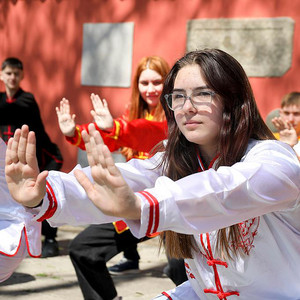
People are learning Mandarin, practicing calligraphy, cooking Chinese food and even saying this is the life they want.
So what's going on?
Welcome to the chat lounge.
I'm Tian.
Join us on the topic of becoming Chinese art.
Dr Chu Chan, a professor and fellow of the Belt and Road Research Center at Minsu University of China.
Dr. Warwick Powell, an adjunct professor of the Queensland University of Technology, Australia.
And Dr. Harvey Zoden, a senior fellow at the Center for China and Globalization.
It's great to have you all back on the show, gentlemen.
So let me begin with Harvey, who's now in Vienna.
What was your background?
First response when hearing or seeing the phrase becoming Chinese on social media and if you can pick one, which post or move impressed you most well, actually too young on myself, I was puzzled until I learned more about this, But on reflection, it's a reaction to what President Xi Jinping has called changes that we haven't seen in 100 years, because I think it's an even longer timeline than that.
The global order is morphing to might makes right in the U.S.
And the trends being discussed in Davos this week.
As we've seen, China represents the long sweep of the generally stable history and wisdom, such as, for example, traditional Chinese medicine successfully performed by barefoot doctors well before Christ was born.
In my country, I would say the U.S. represents the shredding of norms we've grown up with.
But China's had a stable hand on the global steering wheel for millennia.
And while Melania's husband is flooding the zone with instability and chaos, I'd say we're seeing a longing, especially in young people now, for cultural warmth instead of culture wars.
So we're seeing people-to-people exchanges going viral, especially after COVID.
And which post impressed me?
Well, there's an influencer named Emma Hong.
And she said I see a bunch of Americans drinking hot water with lemon and honey, eating congee, eating hot pot, drinking more soup and eating Chinese vegetables.
So me, I was touched when she said my culture can be your culture.
And she got over 3 million views.
So Emma, to me, is a prime example of a world citizen who's from Henan province, who studied in Florida.
And she's a world citizen, like my wife, who's sitting next to me today, who's from China and has come to Vienna and lived in many places countries, and tries to make me more Chinese.
Unfortunately, she's only half successful, but we're still working on it.
Yeah, that's very interesting.
This episode of drinking hot water warm water is kind of like promulgated, like to I don't know if it's into like everybody's heart and those who are trying to turn it into like Chinese.
So to Warwick as an Australian Chinese, right?
What's your take there?
Look, I think it's very interesting.
And thanks very much for inviting me to join the show today, because for me it's also a lot of fun, because it allows me to, in a sense, reflect on my own life's experiences, but to also see a new generation of people not Chinese people who are exploring aspects of Chinese cultural practice and incorporating them into their own everyday lives.
And perhaps, as Harvey mentioned, there is a reaction to a sense of disconnected, meaninglessness in many contemporary Western societies.
You know, philosophers talk a lot about the emergence of social enemy, the disenfranchisement and alienation of many people that they feel from the world around them and a yearning for a sense of uh connectedness.
And these cultural practices and i'm thinking particularly around dietary practices are part and parcel of, i think, a turn to explore other ways of connecting with the world around us.
But we also see that in the exploration of tai chi and other aspects of Chinese cultural practice.
And a lot of it relates to this sense of promoting well-being.
Right.
So Western societies have been so helter skelter for so many decades, where consumerism has been an increasingly dominant feature of cultural life, where speed sort of dictates the rhythms of life.
You know, nothing's fast enough.
And I get the sense that people are saying, actually, this isn't quite right for me.
And I'm just curious to see what these other possibilities are.
Look, I drink hot water myself, so I don't think it's that unusual.
But certainly when my Australian friends you see me drinking hot water when they're having a glass of cold water, i do get some odd looks.
But as i say to them, look.
There is a sense of wellness that comes with all of this and i think that it simply says something about our times that maybe things are a little bit disconnected from the world around us, that people are seeking that warmth and seeking a way in which their own wellness can be part and parcel of being reconnected to the world Right.
Like Warwick and Harvey, both mentioned actually the Chinese culture, including like practicing Tai Chi, are there for many years.
Chang, from your perspective, from a Chinese perspective, how different is this time?
And what's so unique about this trend?
Are you to any extent surprised?
Well, I'm not surprised.
China is a civilization continued for like in the past 5,000 years.
And among all the ancient civilization, China is a civilization slash, a state you know, continued for so long and basically unchanged.
I think it's the only one.
If you go to Egypt, you'll find out Egypt right now is basically an Arabic country.
It's not an Egyptian country.
They're not using, you know, their picture kind of, you know, ancient language anymore.
If you go to Rome, basically you will see the Rome and its relic scattered in America and Italy and France and Germany and Spain.
But where is Rome today?
But if you go to China, you will find out basically, Chinese like China, like 5000, 2000 years ago, when you know our emperor in Qing dynasty, in Song dynasty, in Tang dynasty, if they can wake up from the tomb, they basically find out.
Okay, they're using the same language, same people, same territory, same culture, unchanged.
So that shows you.
The point is, the Chinese culture is very resilient, vibrant and also very lively for all the time being.
And I think there are several times in the Western history that Chinese culture has become, you know, I think, very popular among all the crowds, including the novelties and, you know, vast majority of the community people in there.
Chinese china and ceramic wares, Chinese painting, Chinese silk.
You know, from the Roman period of time has become, you know, the top luxury products there.
And also in the Ming Dynasty and the Qing Dynasty.
The Chinese not only use silk and ceramic wear, but also the lifestyle has been adored by, you know, the Pallas and Eric Starosy.
So I think that is, you know, another would say, you know, fashion as a circle.
Now it's a fashion come back again.
I think the trigger is that through the TikTok, through the Little Red Note and also On Axe and YouTube, there are so many bloggers or just ordinary people.
They're filming their daily life on the V-blogs every day, put them on the internet.
And then people started to see what is the current Chinese people and their lifestyle it is.
And they find out, wow, it's very, very interesting.
Well, in a larger sense, they're providing another lifestyle option besides the current quote-unquote mainstream Western lifestyle.
They find, hey, we have some other choices.
We can cook our egg in another way.
It's not only sunny set up and omelet.
You can have tomato egg.
You can have steamed egg.
You can have all that.
And water.
You know before China's impact of water goes outside everybody.
They only know one thing is that they grab a water out of the fridge and drink it up.
Now you see we can cook the water.
We can boil it with tea, with so many things, and with herbal herbs, you know, connotation inside of it, for example.
It's not only tea with milk you can have, you know.
Well, i mean, in america people think english people are already civilized quote, unquote enough, because to put tea and a milk inside of it this is already very, you know, stylish.
But when they come to china you will find out This is just far from being enough.
Chinese people will find, you know, goji bear.
They will find ginseng.
They will find danggui.
They will find huangchi.
And everything, put them into the water just to boil it, to make this water not only quenching your thirst, but also to make sure that you can keep yourself healthy.
And this is just one example of it.
And also they find out Chinese, you know, internet community is very large.
We have so many digital nomads all over the world.
Basically, there's nomads only herd or hunt in the western turf of the digital world.
But now they find, hey, we have another option.
It's the oriental places.
We're not only talking about China.
We have so many oriental lifestyle population in Malaysia, in South Korea, in Vietnam, in Japan, so they find out there's a very large market.
That's the reason why they're following it, for not only the traditional way, but also following the modern reason the chat lounge.
The chat lounge unpacks views and opinions on hot issues in a more casual way, but this time, would you say, it's kind of a like a superficial, if you will because uh, this time what we've seen most in those posts are like drinking warm water or wearing slippers at home or having congee for breakfast.
It's not like they're into the Chinese philosophy or anything deeper than that.
Would you call it just some superficial pursuit?
No, no, it's not superficial.
Well, every little window, like a water, like a leaf, like a bonsai or like a weiqi, every little window is just one way to look into the grand, comprehensive and utterly most sophisticated Chinese philosophy.
Well, you will see, they probably find just a little bit improvement in the warm water into their life, but they will use it as the window to face in and watch into the chinese philosophy of yin and yang and the unity between the heaven, the human and also the earth.
This is the same thing.
Look, in China we say heavenly, humanly and earthly in unity.
For example, in traditional Chinese medicine we say there is a unity between the three elements and that you have to adjust your body, your lifestyle, according to the change of the period of time.
Change to the seasons change, change your activities into your different environment, the feng shui.
So warm water sometimes when you're feeling cold inside your stomach, we said is about the five fortune and the six qin, which means if you feel in your guts cold, which means the chilling feeling.
Qi is invading your body.
So you need warm water to driven it out, right?
And also because this is happening because the weather is getting cold in the winter.
That we say you need to collect in autumn and hidden in the winter, according to traditional Chinese medicine.
So you cannot just give them a whole bunch of the Chinese philosophies of the heaven, of the earth and people.
You need to give them a small, touchable and fillable examples so that they can feel they can ease into those bigger concepts.
So I don't think warm water just superficial, or steamed egg is superficial, because steamed egg can actually show you that boiling or frying your egg through you know the butter sometimes will add up into your cholesterol, but steamed egg is as delicious as it can be but also very, very healthy, and then it will make you feel very light after this dinner and then you will start to think about another way of a healthy lifestyle to treat yourself.
So I think this is a continuity system, you see.
So I really encourage that kind of example to happen as more as it can be.
And then people will start to feel every little bit about Chinese philosophy and way of life.
And then, before they realize it, they already get used to that kind of the healthy lifestyle and really will fall in love with it.
Okay, Chinese wisdom in everyday life.
To Wu, it goes, A lot of becoming Chinese content I've seen so far comes from the U.S.
So what about in Australia?
And what's your interpretation of those imitating Chinese lifestyle to some extent?
People are saying it's kind of probably kind of humor or parody or even sometimes probably irony.
How sincere or ironic do you think they are?
Look, there's always multiple dimensions to these sort of cultural practices and artifacts.
But I think it's worth bearing in mind two things.
It's actually not the first time that things Chinese have captured the imagination of the West.
And I think back to the 1700s and 1800s, for example, when the likes of Leibniz and Voltaire spoke highly of China and we had all sorts of fads around Chinese aesthetics porcelain, silk And, of course tea, as you mentioned before.
So it's not the first time that things emerging from China has captured the imagination amongst both Western elite and also the Western public.
The second thing that I'll say is that I think that there is something very interesting about this in this particular moment historically, and that is that over the course of the past Maybe 10 years, maybe a little bit less
There has been an active attempt, certainly at a political level, to cultivate a popular culture that inherently demonizes China and Chinese things and the fact that people are, even if playfully, talking about this being my Chinese day or my Chinese moment, actually showing a willingness to speak of China and Chinese things in a positive tone.
In other words, It is actually a rejection of the demonization of China.
Right.
So the attempts by the mainstream, the political forces and the mainstream media that has been part and parcel of shaping public attitudes in the West in many ways have turned people off and turned people away.
I haven't seen so much of it in Australia.
You asked about Australia.
But it is hard for Australia to compete for airspace with the United States, in large part because for every one Australian there's about 12 Americans.
So whatever happens in the United States has a lot more just numerical heft.
The other thing too, of course, is that because of that, it also has a much stronger cultural impact footprint across the globe.
Media and social media.
So even if there was some Australian emulation and I'm sure there is it certainly won't be doing the rounds in the way that these sorts of things happen in America.
The last thing that I'll say about all of this is that and I think this was touched on earlier that the experiences of almost this time last year, maybe about 11 months ago, with Little Red Note, in some ways, I think, opened the window and opened the door for this kind of cultural engagement.
And again, it is a demonstration that at a foundational level, at a civil society level, the attempts to demonize China have not been entirely successful.
And so I think not only is it fun you know people are obviously having a lot of fun with this but it's also showing that there is something a little bit more sophisticated and resilient about public cultures that the attempts to demonize a culture and a people and a place simply struggle to overcome.
All right.
Harvey, from an American perspective, would you go that far, like Warwick just did, and interpret it as some rejection of a demonization of China from the younger generation?
Then
Yeah, absolutely.
I mean, you can look at public opinion polls and you see that young people are much more accepting of wanting to make the world a better place.
Young people are rejecting all the nonsense that we see going on every second from people like President Trump.
So these young people, Generation Z, whatever you call them, They're sick of politics.
They're sick of saber rattling.
And the people of that age want to have love, not wars.
And they're people who want to be healthy and have a long life, based on thousands of years of Chinese history.
So you take the basis of, we talked about traditional Chinese medicine.
This comes from the Yellow Emperor's Canon from the ancient Warring States period.
And this same book is still being read by students who study TCM these days.
I'm sure Professor Chu probably teaches it.
So I think what we're seeing is a sea change now.
And I believe that it's a very good moment among a very bad moment.
A very good moment because young people are our future.
They're going to have to deal with all the problems that we've left them problems like the environment, problems like drugs, war and peace and things like that.
And if they're willing to look further afield for inspiration, especially inspiration that comes over the course of thousands of years, this is a very good sign.
And I can see here in Austria, where I live, that there's much more interest in Chinese culture.
Even if you talk about tea culture, for example, people here are really getting into tea.
You see so many TCM centers now in Vienna.
I think this is a really wonderful antidote for the politics that are flooding our minds and our airwaves every second of the day.
I really think on one level, trends, it's going to grow.
Sorry, I'm going to give away some of your personal information.
You said you haven't been converted by your Chinese wife in terms of drinking hot water.
You always ask for water with ice.
Why do you believe that this generation, the younger generation, can change or convert when it comes to their lifestyle or their belief or their culture they feel they're connected to.
Is it just some three-second hobby or something like that?
Or some people are saying it might link to dissatisfaction with conditions at home like rising living costs, social polarization or uncertainty about the future.
Do you believe so?
I think what's driving it is.
First of all it's been talked about already and you mentioned it the Little Red Book phenomenon, when President Trump tried to kill TikTok in America so that people went to Chinese alternatives and saw that there are alternatives.
And I would say it was important because this was a virtual event, people-to-people meeting that we need to have civilizationally between cultures to get to know each other as people, not as seen by devious politicians or whatever.
So I see this as a real thing.
I see it as young people wanting to deal with some existential problems that we've left them or are leaving them.
Just take the environment, take public health.
You can name a dozen different problems that they're going to have to deal with.
And I think, because of the stability of Chinese culture over the millennia, I think that people are getting a better appreciation for the stability of Chinese culture.
I think Warwick talked about this as well.
The stability of Chinese culture over time.
And I think, in our crazy disjointed, jumbled up world, having this kind of order and sense that something that is very old is now, in a way, new again and presents us with new paradigms for trying to live our lives and trying to save our world from so many of the problems which can destroy it.
But how long will this trend last?
That's when we come back.
Stay tuned.
The strong wind was howling and whistling.
He was the first Chinese citizen to graduate from Yale University in the mid-19th century.
I was born on the 17th of November.
She had prominent features.
Three of us were old enough to lend a helping hand.
He navigated between two vastly different cultures and moved further to realize his dream and promote understanding between the people of China and the United States.
Xie Minxin was a native of Hanyang.
I realized no danger.
China is really awakening.
Come and join us in discovering the incredible journey of Yong Wang in his autobiography My Life in China and America.
Check out the audible stories on radio.cgtn.com and all major podcast platforms.
Just search for the podcast Books and Beyond and find My Life in China and America.
Welcome back to the chat lounge.
We continue our discussion on becoming Chinese going viral overseas chung.
Your take here, please.
It's very complicated issue basically, when it comes to the chinese culture is always very complicated, but we can make it a symbol.
Um, i think i agree with harvey very much.
Uh, currently people just get sick and tired of you know being so politics oriented.
We just don't want to buy those things about political correctness.
We don't want to get into the sensitive issue.
We don't want to get into this kind of you know the eye or whatsoever complicated.
I don't quite understand.
You know, people just want to have a simpler life, especially against the current, you know, very complicated backdrop of the whole world.
So many things are happening.
Politics, war, conflicts and terrorists.
Now people just OK.
I want it just to get quiet.
Meditation. herbal tea, peace, and tranquility.
And all that everything will actually nourish me instead of depriving me.
So I think they found there are.
You know ancient, deep oriental wisdoms are being there, like always.
Why?
I failed to find out that there are something you know a whole different, a whole new, different but very helpful kind of a wisdom.
And lifestyle system has been there like always for so long.
I need to resort to that.
And then when they come to China well, not physically, but also sometimes digitally when they come to China, they find out yeah, This probably can't be the answer that I need, because Chinese people have been living in this kind of the China universe for like 5000 years.
And they always make things work, no matter it's going up or going down with the circle of economy, or when it's stable or when it's turbulent or when the politics are changing, the atmospheres are changing.
So that's a reason why everybody rediscovered chinese wisdom in current, you know, modern life, no matter it's in china or in asia or even in america.
I think this has been beginning ever since two years ago, three years ago i think.
During the covet, a lots of uh international friends find out, herbal tea and herbal medicines can really help.
Very affordable, but also very helpful.
And then they find out China's all kinds of ritual and a ceremony, for example, sending your ancestor, your passed away ancestors, with you know those ritual money, by burning them, by lighting the incense and praying to them.
They find they can find their inner peace by doing so.
And then what we find out later is last year, we have little a red note on that app.
We have all kinds of the conversation between you know the real people, the real working class, real people.
They find out actually a lot of idea in China and their lifestyle can actually work.
And now the latest thing you know is what we've been finding out today.
People are not getting enough by just a little piece of Chinese lifestyle.
Like we just mentioned, only drink hot water, only boil the egg, or only do some little ritual.
It's not enough.
They want the full package.
They want the whole experience.
Try to find their peace, especially the inner peace, again by being Chinese.
Well, we totally opt for that and we root for that.
And we want to just introduce more of this kind of knowledge and the Western of Chinese traditional life about that.
Actually, Chinese lifestyle is like a very, very large pagoda or it's a very large building.
But with many doors, like we just mentioned, every piece of door, every little window is just one way to look into the whole thing.
And you won't miss the whole thing no matter which door you choose to enter it.
Eventually, you will feel the whole system and the whole philosophy.
So I think that's the beauty of it.
It's never too late to get into that, okay?
I think the best moment is 10 years ago, and the second best moment is now.
Get into that and re-find yourself.
You know love and peace and all this kind of longevity continually.
It will make you really, really happy, not in a crazy way, but in a very warm and a peaceful way.
I think John is a very good ambassador for Chinese culture.
So you don't believe it's all just because of this younger generation being rebellious or trying to find some three-minute passion for themselves.
Okay um i, i think everybody are rabble.
I'm still rabble right, but um, i think you need a clear definition of you know, rabble while doing things they're not satisfied with their, their current life or uh, the environment.
Well, following the mainstream or not following some mainstream is just your own choices.
You cannot just label someone who refused to follow the mainstream, or everybody's doing, as a rebel.
Sometimes people just want their own space.
They don't want to be different.
Well, being a rebel means you try to be purposefully different, to get other people angry, you know, to make them feel uncomfortable, so that you can revenge on something and make yourself feel happy.
Or sometimes you're doing so even at the cost of yourself.
We define that as rebellion.
But if you just want to be different, To find your own way that suits yourself, make yourself happy and cozy.
And you're not targeting at anyone else.
You just want to be yourself.
That's not rabble.
That is what we call it.
You know, you want to find inner peace.
You just want to be yourself.
And that's not rabble at all.
So I think they, in Chinese wisdom, find, re-find themselves.
This is just, they suddenly sobered up in the whole matrix, in the whole system.
Wait a minute.
Do I need the consumption?
Do I need to be a material girl or material boy?
Do I really need to, you know?
Follow the expectation of the whole system to get rich, successful an Ivy League, a super big company and a CEO.
My charity found my luxury brand and my yacht.
No.
Actually, I can be happy. with the nature, with the unity between heaven, earth, and a human.
You know, that is going to be a healthier and a more sustainable way to do so.
And after they find out they suddenly understand why in China people have the concept that yin and yang.
Because we say when yin maximized it, they will decay to the yang.
And when yang triumphed, they will just wither into the ying.
It's always a circle.
There is nothing called more, higher, stronger, and richer.
Everything is just a delusional and the reality lesson between.
That's the reason why we call it the middle way, the balance between yin and yang.
And when you find it, you will shake off all the delusions imposed by capitalism, by the social expectation.
You can be a natural person of yourself.
And the beauty of it, it's not rubble.
If those who are saying that we're pursuing this trend or becoming Chinese, they are so sincere.
I bet a lot of Americans or some Westerners, including Americans, have long been Japanese, because in the 1980s, during Japan's economic boom, there was also a wave of a fascination with becoming Japanese.
So I'm going to turn to Warwick.
Do you remember that period or can you tell us what happened there?
Is what we are seeing now a repeat of history with just China replacing Japan this time?
Well, it's an interesting parallel because prior to the trend of becoming Japanese was a period in which Americans would jump on top of Japanese made motor vehicles and smash them with baseball bats and destroy Japanese made radios and televisions, because Japanese manufactured products were seen as a threat to American industry.
So there's some interesting parallels in terms of those experiences.
Look, I think there has been for a long time across societies generally, but certainly in Western societies and particularly ones in which financialised capitalism has become a dominant feature of life and commodification of just about everything in life is now the principal mode of existence.
So there's been a fetishisation of commodities that humans see themselves as consumers foremost, And all of that leaves a sense of hollowness.
And that has been the case for a long time.
And many have spoken about this over the course of the last 40 or 50 years.
This leads to a number of reactions.
One is a nostalgic reaction.
And we see that in imaginaries about a previously better time.
And in the Western public consciousness, those better times can be invoked around traditional values.
They can be invoked around some sense of a previous golden era, etc., etc.
But there's also another kind of reaction, and that is one that seeks to explore alternative ways of thinking about one's own being in the world and the world itself.
And the philosophies from Asia, whether they were the philosophies and aesthetics of Japan or whether they were the philosophies and aesthetics of Buddhism, broadly speaking, have played an important role in that attempt by Western populations, an alienated population, to try to find new groundings in the world.
And this in some respects is a continuation of those sorts of patterns.
They happen because of the hollowing out of meaning in contemporary commodified western capitalist societies and clearly, the attempt to find meaning in the turn to Japan and Japanese aesthetics and Zen Buddhism.
I mean, I remember all those books about, you know, Zen Buddhism and motorcycling Zen Buddhism and blah blah.
And of course Zen Buddhism has strong Chinese origins anyway, in Chan um, so so.
So in some ways, the return to Asia, which goes back to the 1700s, is an attempt to transcend the limitations of the Western Enlightenment imagination and the constraints, if you will, the aesthetic constraints, the ethical constraints and ultimately, the affective constraints that now leave people yearning for more, you know.
So we, we see people talk a lot about the secularization of western societies and i think the key issue here is is a sense of meaning, And this is an attempt to find meaning and purpose.
And some of that comes from self-reflection, comes from cultivating new habits of life and ultimately, comes from transforming one's own mind and body and the relationships between the two through new forms of practices.
So is this a return to Japan?
Well, you know, I think it's actually a continued reaction to the hollowness and the absence of meaning in what is financialized capitalism.
Then would you expect it to be some turn into some niche online subculture?
Well, the one thing about online world is that it enables all sorts of niches to form.
And I will have no doubt that.
You know, subcultures will emerge from this, you know, with people who have deep passions about particular things.
So the digital world enables people with relatively niche interests to connect with others who share similar interests.
And I won't be surprised at all if that happens.
I'm hopeful though, that what it will also do is prick curiosity about other parts of the world, particularly in America, where it is widely understood that the American population tends to have a very insular perspective of themselves, of America, American society and its relationship to the outside world.
And if this is a means by which people in America, particularly younger generation coming through, have their curiosity about the rest of the world provoked and which then encourages them to actually go and discover things for themselves, then I think that'll be a good thing.
Where that ends up in five or 10 years time, specifically in terms of people becoming Chinese.
That's a different question.
But I think more importantly, It is about provoking people to be more open about the possibilities of the world and be more open about the possibilities of others in the world playing a role in their lives.
The Chat Lounge.
The Chat Lounge unpacks views and opinions on hot issues in a more casual way.
Like you all mentioned, more ordinary individuals are actively presenting China in their always like what we just mentioned, maybe in a more open-minded way.
But could this signal a transfer of narrative power, like very different from dominant Western media narratives?
Could this turn into a bottom-up rediscovery of culture?
Harvey?
Well, I don't know that I consider it bottom-up.
But I consider the fact that we have these new tools that we didn't have when we were talking about, let's say, Japan's rise.
We have social media.
We have the Internet.
We have algorithms that for good or for bad drive people to topics that they may be interested in.
And I believe that with those tools now, the world is opening up.
It's there.
We can almost touch it.
We can almost feel it on our phones, on our computer screens and so on.
And, I think, going back to something we talked about moments ago, this fact that President Trump tried to kill TikTok and gave rise to Americans who loved TikTok.
TikTok wanting to preserve the interactions that they had with others and with Chinese people, that they went to some Chinese apps and that they had a people to people connection, even though it was an online connection.
But that connection was very strong and it made people learn more about each other.
It made people learn that, yes, we're different, but we're all more or less the same.
We want the same things.
We want to live a good life.
We want a clean environment.
We don't want war.
And, instead of the demonization that comes out of the mouth of some politicians and rabble-rousers, we started to see a commonality.
And I think that this is a really a very good trend.
I believe that it's actually going to continue.
And I'm hopeful that, because of this, we are going to be building more and more bridges to China and other cultures, so we can work together on the problems that unite us rather than the problems some of them manmade which divide us.
That's what we all hope for.
But, Chiang, from your perspective, how long do you expect this trend to last?
Well, it's going to be last for quite some time.
Like always, sinology is always a very important study in the Western society for a very long time.
But I think it's audience sometimes, you know, circled.
Bigger and smaller wax and wing is yin and yang theory as well.
I think currently we've been entering a stark period of time, like back in 60 years ago uh, when hippies started to pop out in america, and now i call it, you know, the confucius style hippie period of time.
People just want to love and a peace again because, as we just mentioned, people just get sick and tired of everything because everything are happening, not because of the vast majority of people.
It's not what they're doing it's, you know, the top or the elites.
You know people don't want a war, people don't want to greenland and only the few families and establishment they want so, but all the consequences need to be imposed on ordinary families.
So people get sick and tired of all that.
And plus of the long-term impact of the capitalism you know consumptionism has actually been also on the ordinary families inflation shopping, frenzy and everything.
People suddenly get sick and tired.
They want to weigh out, So they want a different way of life we just mentioned.
So I think currently we've been reaching another climax of this kind of the Oriental Western or some kind of lay down hippest spirit of life.
And well, I'm not going to lie, it's going to.
Have this wax and whey moment as well, for sure.
For example, when you're hitting another golden period of time of economic growth.
People will just rush into this kind of a massive economic opportunities again if it will benefit every ordinary families.
So I think in the 1940s and 50s, people don't buy things like that because everybody will have their bigger car, bigger house, and a bigger family. so people believe that they can have and they're awesome they believe their self are awesome and to follow the mainstream can be the only answer and an important result but when you reach 1960s and 70s people find out wait a minute it's all delusional we're nothing but a unconsciousness chess on the board and then we need to redefine and refine ourself define the wisdom from you know the oriental society remember steve jobs find them in india and some other you know very iconic people find buddhism find yoga find confucianism back at that moment right and now this is a history coming back again So my foresee, if you wanted me to do the forecasting, my foresee is that this trend is going to stay all lasting for another 10 years before a climax.
And then when business opportunity come back, and probably people will forget about it a little bit.
But don't worry about that.
But the seed of the wisdom has already been implanted in the whole world.
By that moment, people will know that they always will have another choice of lifestyle besides the current lifestyle they been living in.
So this will always be here, like china, like chinese culture, 5 000 years, never disappear and always thriving and longer lasting.
So this is going to be the truth of this Western and our civilization.
Right.
Then last question from an international communication perspective.
I know you're an expert in this field.
Should China respond to or engage with this kind of a grassroots interest?
I want to opinion from all of you.
Maybe we start with Harvey.
Well, it depends who in China.
Do you mean the government?
Do you mean the people?
Is it all of the above?
But however you define that, I believe that China should engage with this trend.
If engaging in this trend means promoting Chinese culture, promoting health, promoting happiness, promoting enlightenment and trying to bridge this cultural divide which now has been breached because of technology.
And the more China does to promote the things we've been talking about today on the show, the better the world is going to be.
And I would urge all our listeners who have never visited China to go to China, because there's so much politics that's coloring the narrative.
I think people need to go for themselves and see what's been accomplished in this ancient society.
That is still ongoing and it's still going from strength to strength in a very precise way, while some of the rest of the world is unraveling.
And I think now we can see more clearly through social media, even through this trend of becoming Chinese, that we have alternatives And since we're all connected, we can pick and choose what's the best of the world.
And this trend of becoming Chinese, I think, is a very hopeful sign for our future, our children's future and the planet's future.
So, even though in a way this seems like a very trivial topic, To me it's inspirational and it's extremely important because, if the trend continues, whether it's for 10 years or longer, I believe it's going to result in the world being a better place, result in the world being a more peaceful and harmonious place.
So I'm all for it.
So I really think it's very, very important that we pay attention to it.
And I hope it grows and has a long life.
All right.
Thank you very much, Harvey.
Well, from my view that if anyone are interested in the Chinese way of life and philosophy, just be our guest.
I think every Chinese people, If they're capable of it, they will try their best to answer your questions and show you how to be a quote unquote Chinese and live this kind of a life.
Trust me, it's going to be very interesting.
Very much worth of it.
But I don't think in our nature and personality we would like to hard sell and push this kind of things to you.
Because remember, China have a very strong culture and civilization.
But in a 5000 years of history, trying to never send even one missionary or priest to another land, to heart cell our way of thinking and lifestyle to other people, our attitude is always welcome to us.
If you want to be us, you know welcome, but if you want to be yourself okay, also be my guest.
Our philosophy is that every culture, every civilization, every people have their own beauty.
So this kind of diversity is always worth a celebration, and if you respect our thing, we will do the same thing vice versa, And there's always a room for peaceful and harmonious coexistence.
This is always our philosophy.
Very chill, you see.
So I think this is also one of the beauty that our international friends love to China.
Do you remember any one time there is a Confucian teacher?
Just go to Africa and force them to learn Confucianism.
No, never do that.
Well, if somebody invites us to go, yes, we will go.
Or you send overseas students to China to learn from us.
Yes, welcome.
But never hard sell.
So yes, we're going to be a very cozy and very friendly mentor or tutor to help you.
But we wouldn't hard sell you anything.
We will just be us.
And we also celebrate you being you.
And we will celebrate and welcome you being us.
Or just to try to, you know, learn some lifestyle from it.
Always been very great thing to do so.
But that is the boundary.
Clearly said, we will never trespassing and step over.
Yeah, I think the key all lies in respect, like what John just mentioned.
Okay, last but not least, Warwick, please.
Look, I think there are two dimensions from where I sit.
Firstly, this recent turn to becoming Chinese, or being Chinese, raises more questions about the state of Western societies and public culture than anything else.
And it really speaks to a continual yearning within Western societies for something more than what is being provided for in the dominant cultural norms.
And this has been the case now for many, many decades.
It has been an accumulating set of problems.
They relate to problems in economies, problems in spirituality and problems in what I've generally described as an absence of meaning and purpose.
The second thing though, that this speaks to is that it says that there is an openness to the other, that demonization which, of course, encloses you off to others, is not complete, is not permanent, and there is an openness to the other, and in this case the other is Chinese culture.
And that leads me to, I guess, two general remarks to close off this thought, and that is firstly, that the openness to Chinese cultures will nonetheless always see Chinese cultures and practices interpreted through the lens of the dominant culture that is approaching the chinese culture.
That's natural right, that there will always be a local setting, and the chinese cultures and practices and thinking will be viewed through those frames, so there is never a one-to-one cultural emulation.
The second thing though, is that, that notwithstanding, it does speak to the fact that an openness to the other also opens up new frames of how to think about the world and how to ask questions about the nature of our being and our relationship to others and to the world around us.
And that in and of itself is vitally important when there are so many things around the world that actually change, demand a collective sense of responsibility rather than a sense of irresponsibility.
True, very true.
And with that, we've come to the end of our chat for this session.
Many thanks to Dr. Warwick Powell, Adjunct Professor, Queensland University of Technology.
Dr Qu Jiang, Professor and Fellow of the Belt and Research Center, Minsu University of China, and Dr Hori Soden, Senior Fellow Center for China and Globalization.
We'd love to know what you think.
Drop us a line anytime at radio at cgtn.com.
I'm Tuyen.
Join us for more chat at the chat lounge next week.
With a history of 5000 years, it's no surprise that China has created a fabulous treasury of folktales.
Once a year, on the seventh day of the seventh month, all the magpies fly up to heaven and form a bridge.
So many amazing worlds to discover.
I want a new palace, said King Mu of Zhou one day.
Chinese folktales retold for audiences He asked.
And with little hesitation, she said, Yes!
Five thousand years of amazing Chinese folk tales.
My father must not go to war.
Someone must take his place.
You'll find Chinese Folk Tales Season 3 wherever you discover your favorite podcasts.