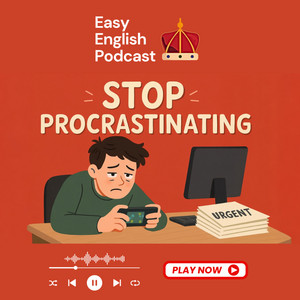
Do you ever say, oh, I will do it later?
Well, that's called procrastination.
Hey everyone, I'm Oliver and welcome back to the Easy English Podcast.
The best place to learn English for new vocabulary, phrases and practicing your listening skills.
As always, I'm going to talk in slow and clear English about a very interesting topic today.
Today we are going to talk about a very common human habit that affects so many of us.
And that is procrastination.
Procrastination.
This is the act of delaying or putting off a task or a duty, even when it's important to do it.
So, for example, like I will do this work task later, or I will do the washing up later, or some kind of household chore that you don't want to do,
Have you ever thought about putting off homework, cleaning your room or maybe sending an important email until the last minute?
You think, oh, I'll do it tomorrow, or I've still got time, right?
These are the types of thoughts that we have.
If you've experienced this, you have definitely experienced procrastination.
It can make us feel stressed and even guilty.
But don't worry, we're going to talk today about it and why we do it and, more importantly, some ways to stop.
Because I think that we all suffer a little bit from procrastination sometimes.
Even I do with this podcast.
Sometimes I say, oh, I will record later.
I feel a bit tired today.
I'll record tomorrow.
But of course, it's not always the best strategy.
So as always, we are going to dive in and look at our key vocabulary for the episode.
If you're new here, this is the part where I read you five key pieces of vocabulary and I give you the definitions, and these are related to the topic.
So then I want you to actively listen for these during the episode.
So during this main episode of the podcast.
Okay, so let's have a look at this vocabulary.
So the first word is one which we all know.
I have heard already in this episode, and that is procrastinate, procrastinate, procrastinate.
And this is, as I said, to delay doing something, especially something important that you should do.
I often procrastinate when it comes to cleaning my apartment, for example.
That's a good phrase.
And the next is task.
Task.
This is a word I will use quite a bit in this podcast.
A task is a piece of work or maybe an assignment or something that you've been given to do.
My main task today is to finish this report.
That could be an example sentence that you might hear in your job.
And I have a task for you.
So if you're new or you've been listening for a while and you're not following or subscribed to the podcast, make sure that you do so.
That's the task for today.
The next word is overwhelm.
Overwhelm.
And this means to feel like there is too much to do or too many problems for you to handle.
So, for example, when I have too many tasks, I sometimes feel a little bit overwhelmed.
Our fourth word today is distraction, distraction, distraction, distraction.
Something that takes your attention away from what you're doing.
For me, my phone can be a big distraction when I'm trying to study.
So it can take my attention away from when I'm studying some language words, some vocabulary.
And finally, motivation, motivation, motivation.
And this is the desire or a reason to do something or want to do something.
And sometimes it can be hard to find the motivation to learn English.
I totally understand why many people can get that feeling from time to time.
Okay, those are our five pieces of key vocabulary for today's episode.
And I want you to listen out for those words in the episode.
So, before we get into our main topic, I want to tell you that today we are talking about procrastination, but on the Patreon I have another episode that is focused on the opposite.
And that is something called the flow state.
Now this is a more complicated topic, so I decided to put a more advanced episode on Patreon available for Patreon supporters.
So if you would like more bonus advanced episodes every week, as well as the full transcripts and vocabulary lists for episodes, then check out the Patreon.
The link is in the description below.
Okay, so what exactly is procrastination?
It's not necessarily just being lazy.
It's a psychological habit, so a bad habit, where you consciously, you almost choose to delay doing a task.
So I don't think it's being lazy.
I think it's bad habit and bad routine.
And you do this even though you know that there can be negative consequences for delaying a task.
So negative impacts or effects.
And that can even be simply mental.
So feeling bad that you haven't done something yet.
It's not a nice feeling.
We love to have that feeling of completing something, of accomplishing our tasks.
And it can be so simple simply something for school or work, or even personal things like going to the gym or whatever.
I don't know, booking your car in to get a repair.
And some common examples of procrastination that maybe you might have experienced could be one of the following
So perhaps you've started a project the night before it's due.
So you've waited and waited until the night before, maybe with homework or a task for work, and you do it late at night, at the last minute.
Perhaps as well you decide to clean your house or do something else instead of the task that you don't want to do.
This is quite common, a very common method of procrastination.
Maybe you watch a TV show or use TikTok Instagram, YouTube instead of what you're meant to be doing.
These are very common ways to procrastinate and finally, checking social media every five minutes instead of focusing on a task.
And at the beginning, when we decide to not do a task for a while, we can feel a feeling of relief.
We might feel good, maybe a little bit more relaxed for a very short time, but then this feeling quickly disappears and it can become stress and maybe feelings of regret or guilt later on.
So why do we procrastinate?
What are the reasons for procrastination?
And there are many, there are many different reasons.
And it's often more about our feelings than about laziness.
Maybe our feelings about the task or about what we have to do.
So the first, which is very common particularly with large projects or work for school, this can be, you know, the feeling of the task being too big.
So you feel overwhelmed.
It's overwhelming.
It feels too large or too difficult and we don't know where to start.
How do I start this?
Where do I begin?
It's so much.
And instead of taking a tiny little piece or just picking apart, we delay it.
We push it back, right?
And the next is a fear of failure.
So the fear of actually doing something badly, right?
So not being able to do it well, which you can see that this is a silly way to think about it, because by not doing the task, we will automatically fail.
We will not do it well and we will give ourselves less time, right?
But this fear can stop us from even beginning.
We then have a lack of motivation.
Of course, if you have a boring task And we don't have much motivation to do it, like household chores, for example, cleaning your, your room or your house
It's not fun.
It's not exciting.
And therefore we don't want to do it.
We don't feel motivated to do it.
We might also have distractions.
So I mentioned that in today's world there are There are so many distractions on our phones and all around us advertisements, everything.
There's so many distractions.
And finally, when we feel tired or low energy, it can be very easy to procrastinate.
We want to rest instantly. sorry, pardon me, we want to rest instead.
So with each case of procrastination, understanding why you do it is the first step.
You know, why do I not want to begin this right now?
And we can call this the procrastination loop.
So a cycle, right?
So step one is the task that you have to do.
So what is it you have to do?
Step two is the delay, right?
With procrastination.
So you feel some anxiety or something that tells you that you don't want to do the task.
And then step three is the reward.
You decide to do something else instead, maybe to relax or distract yourself with a distraction, and you feel temporary relief or pleasure.
Oh, this feels better, for example, right?
And then we reach step four, which is the stress or the guilt.
So you realize that you're behind and maybe you feel stressed or guilty about delaying the task.
And it makes it hard to even enjoy the distractions, to enjoy relaxing or delaying.
And step five might come at the end.
So when you rush or deliver maybe poor quality for the task because you're doing it quickly you're not giving it the time and attention that you should have, or maybe you just don't do it at all.
And then into step six, the cycle continues.
You remember how bad you felt and the next time you might procrastinate again because you have even more negative emotions associated or connected to that task.
So it's quite a dangerous cycle and a very easy one to fall into.
But breaking these steps, this cycle, is the key.
It is the solution.
And now we're going to look at a few ways that you can do just that.
A couple of tips to stop procrastinating.
But first, I just want to remind you that my new book is now available.
The link is in the description below.
It's called phrasal verbs are easy and it teaches you English phrasal verbs.
Some of the most useful that I've picked and selected in the book.
So you're gonna learn 50 of them, and each one is reinforced and taught using a short story and some exercise questions.
So if you want to help improve your phrasal verb knowledge and learn them using context to help you remember them, you can check out that book in the description below.
It's an ebook.
And of course, it helps support this podcast as well.
OK, back to our episode.
So the first thing that I want you to do if you try to break this cycle of procrastination is, of course, to think about why you're procrastinating.
It's good to recognize it.
Am I scared of not completing this task?
Do I feel unmotivated?
What is the reason?
If then, for example, it's a big task, and you're scared of, you know, how do I start this task?
Maybe that's why I'm procrastinating.
You can try and break the task into smaller pieces and start one of those first.
The second tip is something called the five minute rule.
And you can almost trick yourself by using this.
You can tell yourself, I will just do this task for five minutes and you start something, anything.
And often, once you start the task for five minutes, you'll discover that it's not so bad and you'll want to continue doing it.
You'll finish it and do much more than five minutes that you expected at the beginning.
It's a really great trick and strategy.
The next is to use rewards.
So don't give yourself those distractions and pleasures until you finish your tasks.
It sounds simple, but you want to hold them for after.
So after I do this practice or after I do this work task, I will get myself a coffee, or I will eat this chocolate bar or relax.
And then when you get the reward at the end, it reinforces that good behavior, that good practice and work ethic.
And finally, another why question.
You want to remind yourself why this task is important.
Why are you doing it?
Is it for your job and it's important?
Is it going to help you improve your English?
Is it just to keep your house tidy and clean?
It's important to remember why we're doing something.
And if you do these little steps or implement some of these strategies, it will help stop your procrastination or limit it.
Of course, at times we're going to all procrastinate a little bit.
Yeah, it happens.
But with trying our best to minimize it, we can really reduce it, start to be more productive and enjoy the work that we're doing.
Most of the battle, most of the problems, the struggle is in our mind.
It's not real.
And once we begin to work, we find that it's actually fine.
So now onto my favorite part of the podcast, and that is our listener spotlight.
So I recently asked, a while ago, what's one common daily habit that you've successfully changed or started?
And I had some very interesting replies.
The first I had a reply or a comment, and it was from Amelia, I believe from Italy.
And she said, my main challenge was waking up early.
I used to hit snooze many times, but I started putting my alarm clock on the other side of the room.
So now I have to get out of bed to turn it off.
So by changing this habit, it's allowed her to get up earlier every morning.
That's an amazing answer, Amelia.
So very, very, very good.
And that's a great strategy for waking up earlier. and very well written comments, so good job.
I have another commenter.
They haven't put their name, but they are from Japan and they have said I wanted to read more.
My distraction day to day was always my phone.
So I started leaving my phone in another room for 30 minutes before bed, and I decided to read a book instead.
It has helped me to focus.
That's a great strategy.
I also think I like to hide my phone or put it away in the evening time before bed.
It's very important because it will allow you to unwind, to relax before sleep.
So great comments.
Thank you amelia, and thank you, our commenter and listener from japan.
So my next question that you can answer in the comments on this podcast episode, on the video, or you can email me through the, the link or instagram, whatever you want um, is Do you procrastinate?
If so, what is an example of something that you have procrastinated with before?
Simple question.
You can comment your answer below and I will select a couple of answers in a future episode.
So today we have talked all about procrastination, why we delay tasks, the negative cycle that it creates this loop and some powerful strategies to overcome it.
You can apply this to your English learning, to your work, or whatever you want in your life.
So look out for those key vocabulary pieces day to day now after this episode.
So procrastinate, task, overwhelm, distraction, and of course, motivation.
Some great pieces of vocabulary.
If you enjoyed this episode, make sure you're following or subscribed and that you've rated the podcast five stars.
It really helps.
You can support the podcast on Patreon for bonus content, or you can check out my book as well in the description below.
Thank you so much for listening and I will see you in the next episode of the Easy English Podcast.
Goodbye.