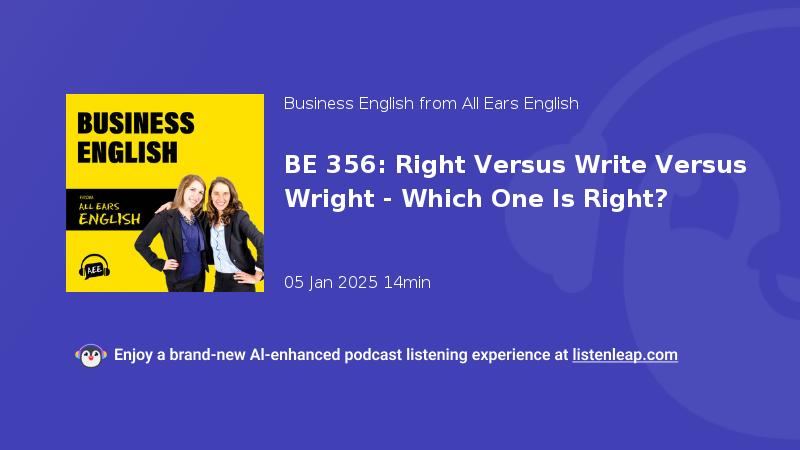
This is the Business English Podcast episode 356, right versus right versus right.
Which one is right?
Welcome to the Business English Podcast from all ears English.
Get the English skills you need to achieve your dreams in global business.
For a presentation, a meeting, or your office party, this is real business English with your favorite American hosts, Lindsay and Michelle, coming to you from New York City and Colorado, USA.
Imagine what's possible when learning doesn't get in the way of life.
At Capella University, our game -changing FlexPath learning format lets you set your own deadline so you can learn at a time and pace that works for you.
It's an education you can tailor to your schedule.
That means you don't have to put your life on hold to pursue your professional goals.
Instead, enjoy learning your way and earning degree without missing a beat.
A different future is closer than you think with Capella University.
Learn more at Capella .edu.
Hey, Michelle, how are you today?
Good, Lindsay. Lindsay, do you always have a desire to be right?
Is that important to you?
I would say not, not really.
Sometimes I'll be around someone that you can sense that with them and that will trigger that in me and then I'll get a bit of a personality clash.
Interesting. But if I'm not around a person like that and I don't tend to encounter people like that that always need, I've only known one person really in my life that was like that, then I don't know.
I like to learn actually.
And sometimes I like to be proven wrong because then you learn something.
Right. Right. Right, right, right.
Yeah. Interesting. Well, today we're going to answer a question about this word that we had from a listener.
Lindsay, would you like to read the question?
Yes. Here we go. Hello, Lindsay.
So good to talk to you.
I've been listening to the episode since 2020.
Oh my gosh. Lorraine from Brazil, Lorianne, sorry, from Brazil.
Amazing, Michelle. A five year listener.
Incredible. Thank you so much.
Thank you. Thank you for being a loyal listener, Lorianne.
We appreciate you and bring your friends.
Okay. The app is wonderful and your work is amazing.
Congrats. I have a doubt meaning I'm going to translate that because that is that's a mistake in that writing.
Right. I have a question about the words right and right.
So R I G H T and W R I G H T.
Do they have the same meaning?
I hope this could be an episode if the words have the same meaning and the sound may be the same.
Thanks for your job and improvement in our lives.
Have a nice day. Michelle, it warms your heart, doesn't it?
Yes. I love it. Thank you so much for listening.
We're really happy to be doing this.
We are such amazing listeners.
A hundred percent. So it is a good question on top of those compliments, right?
What exactly is the listener asking?
What is Lorraine asking?
So it's interesting because Lorraine, um, about two uses of the word right.
So in her message, it says between R I G H T and W R I G H T.
Now, there is another way, Lindsey, that you pointed out, which I was thinking about, which is what?
Yeah, the other way W R I T E.
Right? Mm hmm. Yeah.
So, yeah, we're gonna.
We are. We can talk about all of this.
So I mean, is right.
W R I G H T. Lindsey, is that a word?
Well, I don't know that to be a word by itself.
I know it's a last name.
I know people with that last name and it's part of other words.
But by itself it is not a word in English.
Right. Yeah. Merriam Webster dictionary said a worker skilled in the manufacturer, especially of wooden objects.
Interesting. So I thought that was interesting.
So it's used in combination ship, right.
Wheel, right. But then I've also heard it.
I also did look in another dictionary and it said a maker or builder used in combination with other words.
So that's like playwright.
Right. Yeah. Playwright is a great one.
And that probably makes sense.
Maybe at one point it was used in isolation as its own word.
And it makes sense why we see this as a last name, too.
And also we see last names like Cartwright.
And yeah, it's probably those last names came from the role of a family member historically, right?
Super interesting. Yeah.
Oh my gosh. Now every time I say write in this episode, it makes my ears perk up.
Right. So, right. So did you do that on purpose?
No, I didn't. Okay.
So generally we say write R -I -G -H -T or the other way W -R -I -T -E.
So Lindsay, what is W -R -I -T -E?
Yeah. So it's to physically write something right with a pen or a pencil on a paper.
Right. Not just on a paper, on different things.
You could, yeah, anyways, our listeners know what that is.
So now that - You have to start saying correct, Michelle, in this episode.
Correct. Correct. Now that we said that, we're going to give you some, we're going to focus really on the R -I -G -H -T version because that's, to me, the most versatile one that you're going to think of in a lot of different situations.
As far as W -R -I -T -E, actually writing something down, that's one of those things where you have to pay attention to the context.
If we're talking about write down, then you know W -R -I -T -E.
And I wouldn't even worry about W -R -I -G -H -T.
Don't worry about it.
One less thing to worry about.
We love that. It's done.
Cross it off your worry list.
So let's use it in a few different ways here.
So, okay. What does write mean?
We're going to focus on some great ways.
So write generally means the opposite of left.
Correct. And there are more meanings, even just as a filler.
I think that's how I've been using this episode.
Something something something.
Right. Right. Oh yeah.
There's a lot of uses of this word.
So let's break it down into some examples and really clear some things up here with our listeners, right?
Yes. So, well, actually we're going to focus on some expressions more specifically.
So I think that that is the best way to go for this episode because we can talk about which expressions would be useful for the business.
So let's do this one first.
So in one's own right.
Yes. Yeah, for sure.
I hear this a lot. Here's an example.
She's a good receptionist and a good relationship builder in her own right.
You see this a lot in profiles and bios of people.
When it's saying in her, she is able to do something on her own entirely separate from something else.
That makes sense. Yes.
Right. Right. In her own right.
In her own standing in her own capacity.
She's good. I was going to say it and I stopped.
The next one is have the right idea.
So again, the correct idea.
Same idea. You have the right idea.
Let's expand on that in the meaning.
Yeah. So we wait to encourage someone.
Right. Yeah. Oh my gosh.
I said it again. I have to do is listen to all her English and you'll see how to use this expression.
But these two examples that we've just given are completely different.
Just to be super clear.
In one's own right means in one's own capacity.
Let's let's say let's give a better example.
Let's say we have an apprentice painter.
Someone's apprenticing or over under a famous painter.
And we could say this person apprenticed for this famous painter.
And she's also an amazing her own water color painter in her own right.
It's in her own capacity not in relation to that other person.
So this is really really different than you have the correct idea.
Totally different. Okay.
Yes. Good point. All right, Michelle.
We're back. Now let's tie in a more similar one.
So what is it? Okay, so this one is to go in the right direction.
So again, so the right direction would be the correct direction.
So you could say we are going in the right direction, but we still have some kinks to work out.
So I imagine using that in a meeting where maybe we're brainstorming or maybe it's an evaluation and we're say, oh, we're we're almost there.
But we're we're not quite there yet.
Right. So this is using right to mean correct.
Just like the previous example before the break.
Right. I have the right idea.
We're going in the right direction.
It means correct. So going in the right direction.
And I think I went with mostly that meaning for these expressions because to me these ones were the most useful for our business.
Right. So let's let's do one more.
Yeah. Yeah. Sorry. I was just going to say before we go into this one, we could go.
There are lots of other meanings for the word right, like your rights fight for your rights.
We could go in that direction another day.
Right, Michelle. But today we're mostly just tying in the meaning of correct in these expressions, like you said.
Okay, go ahead. Sorry.
And then this one is to make the right call.
So that's also basically saying the right decision, the correct decision.
So you could say, I think you made the right call with that new hire.
She seems like a real team player.
And that's something that can be challenging for upper level management in a company making the right call at the right time, having good judgment or kind of intuition.
And sometimes it's really hard to see what is the right decision.
Yeah. And you might not know it for years.
You might not know.
It's just in hindsight, you see it was the right call.
But yeah, tough. So this does come up a lot in business for sure.
Exactly. Should we do a role play then tie it in?
Let's let's do it together.
Alright, here we go.
Go for it. What's our what's our context here?
All right. So you are leading a meeting that I am attending.
All right. Here we go.
So we have to think very carefully about this because we really want to make the right call.
Absolutely. And I think we are going in the right direction.
But what are the reports telling you?
Yeah, it seems we have the right idea and with all our new marketing efforts.
But I still think we could use more help.
And you've been great with your sales expertise and you're really a great marketer in your own right.
Oh, thanks. Well, there's always more to learn.
True. Showing humility.
True. Right. OK, so here I said first, so we have to think very carefully about this because we really want to make the right call.
And that means we want to make the correct call.
The right decision.
Right. OK, right. Oh, my gosh.
I'm realizing how much I say.
Right. I know. I never realized that before this episode.
OK. Or then I said, absolutely.
I think we are going in the right direction.
But what are the reports telling you?
So I'm saying, I think I have this intuition that what we're doing is correct.
But I want to see the numbers.
And sometimes in business, I mean, you have a certain intuition, but the numbers don't support that, which is really interesting.
You know, where does that intuition come from if the numbers don't support it?
So we really do need those numbers.
Really important. And then I said, yeah, it seems we have the right idea with all our new marketing efforts, but I still think we could use more help.
And then you gave me a little compliment.
You said, and you've been great with your sales expertise and you're a really great marketer in your own right.
So in your own capacity, in your own way, separate from the sales.
Separate from what you've done with the company.
Right. So that's an important piece to remember.
Your own right is your own, again, your own capacity, your own world kind of.
Yeah. That's an interesting use of it because I think it's quite high level in one's own right.
Yeah, that's the odd man out of this episode.
The other ones are more straightforward, just meaning correct, that we decided to go in that direction.
But this is kind of a fun, interesting one that you can think about a little.
Yeah. And in episode three, thirty four of this podcast, we had an interesting conversation.
Was that you and me or me and Aubrey?
I can't remember which was you and Aubrey.
Okay. We said we talked about the title was rebuild or carry on how to maintain business relationships.
And we know here at Aller's English, we believe that business is all about relationships and connection.
And so dive into that episode, everyone.
Check it out to see what you can learn there.
Yeah, definitely. All right.
So Lindsey, take away for today.
Today we answered a question.
So right, right, right.
Lindsey and I realized how much we say right.
So this is very, very useful as a filler or just to agree.
But today we focused mostly on expressions dealing with the definition of right.
R .I .G .H .T. to mean correct on how you can use that in business when you're going over ideas, talking about progress.
And then we threw in another fun one for for you.
You got it, Michelle.
All right. Good stuff.
And always bring it back to connection.
That's the most important thing.
So think about how you can insert these.
I mean, especially the expression in your own right, you could elevate someone.
You could say something nice about there may be a scenario for our listeners where they're at a business launch and they're asked to stand up and talk about someone, give a dedication or some sort of speech.
This could happen spontaneously.
It's not out of the scenario.
It's not out of the possibilities.
So let's be ready for it with a high level vocabulary like this one to recognize someone.
Yeah. Love it. Thank you to our listeners so much for that question.
We really appreciate you listening and Lindsay.
I will see you next time.
All right. Talk soon, Michelle.
Bye. Thank you for listening to Business English, a podcast just for you, the high achieving global professional.
Want more from All Ears English.
Don't miss our biggest and best podcasts with eight million monthly downloads.
Just search for the All Ears English podcast and hit follow to get four new episodes per week on fluency, American culture, grammar, and so much more.
Or tap the link in the show notes.
Remember, we believe in connection, not perfection when it comes to learning English.
Follow the All Ears English podcast now.