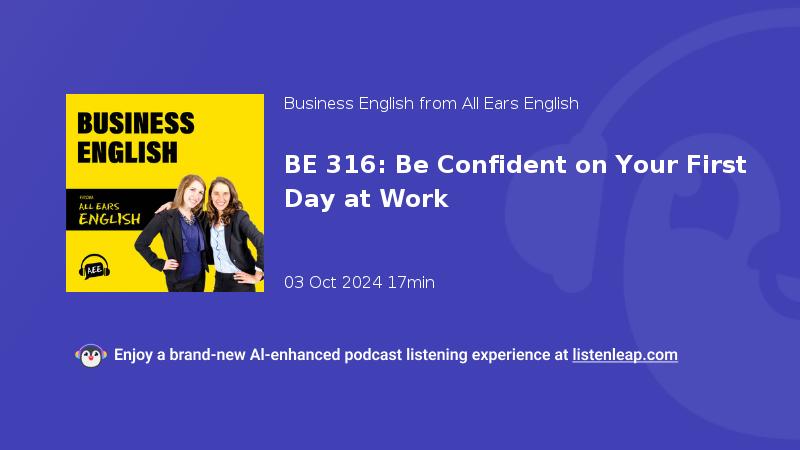
This is the Business English Podcast, episode 316.
Be confident on your first day at work.
Welcome to the Business English Podcast from all ears English.
Get the English skills you need to achieve your dreams in global business.
For a presentation, a meeting, or your office party, this is real business English with your favorite American hosts, Lindsay and Michelle coming to you from New York City and Colorado, USA.
What is the difference between B1, B2 and C1 English and what is your English level?
You'll get all of these answers with our free quiz, from small talk before Zoom meetings to complex negotiations with clients.
You need to know where you are now so you know how to improve.
Take our free English level quiz at allearsenglish .com slash fluency score.
That's allearsenglish .com slash fluency score.
Hi, Michelle. How are you today?
Hi, good, Lindsay. How are you?
Very good. Do you have a question to start off the day today?
Yeah. Do you think most people speaking a new language feel insecure?
Yeah, I think it's a really common feeling.
I mean, I know from personal experience when I started learning French, I felt insecure.
When I traveled to South America, I realized my Spanish was not where it needed to be, which I tell this story in a lot of our videos in our courses.
It just wasn't. I think a lot of our listeners find they've studied English their whole lives and then they end up in the country and they don't have the tools they need.
Yeah, absolutely. Today, we're going to answer a listener question.
This is from Jose Hernandez.
We're going to talk about his question today because I'm sure a lot of you guys are feeling it.
I mean, it's a very common feeling.
So yeah, for sure. We're going to bring it back to the business space and what does that mean to feel insecure in the business world and how to be confident in business?
But first, I want to say a big, genuine thank you to our reviewer, Lucy Lee from the US, who reviewed us on August 17th.
She says, best podcast for English learners.
She says, listening to this podcast has become my daily life.
It's the best podcast if you want to learn business English with American business culture.
Wow, Michelle. We want to say thank you.
And guys, go review the show, whether you're listening in Spotify or Apple podcast or something else, go leave us a rating and review because we do read them and we'll try to read your name out loud on the show.
All right. Absolutely.
Thank you so much, Lucy.
So I can read the question.
This is from Jose Hernandez.
OK. And he says, I'm about to start my medical assistant training here in California.
Wow. Yes. I'm a non -native English speaker, so I feel a little bit insecure.
What can I do to feel more confident?
So great question. I mean, this is I think, you know, we talk about feeling insecure, maybe for regular conversations, things like that.
And specific career goal of being a medical assistant.
And so this is really kind of comes down also to business English.
And how do you feel about it?
Because he's learning and talking about a specific set of words he's going to be learning and all that comes with it and that pressure of feeling you want to do a good job.
Yeah. Yeah. To accomplish your dreams, to get to your goals.
So I'm sure you guys we have so many intelligent listeners here who are working for a promotion to be in school, to get training for something like Jose trying to get a new job.
So how do you how do you feel that?
For sure. How do you feel that confidence?
So, again, I'm not sure if Jose is completely starting a whole school to be a medical assistant or if he's already in this role and just that training already in this role.
But we're just going to talk about in confidence in your career.
So what are some reasons why Jose and many others might not feel comfortable?
I mean, you might not have all the language.
And the truth is, you're not going to have all the language, right?
It's I mean, I don't know all the words in English, right?
But I know it's different for a native speaker, like you're just not going to be 100 % prepared.
And that's okay, right?
Because that's why we changed the focus.
We put the focus on connecting in this case for Jose connecting with co -workers.
Yeah, managers. Yeah.
Yep. Yeah, exactly.
I mean, I have a friend who I think speaks near perfect English.
Yeah. But she still thinks she can articulate all that she would want to get across in her first language.
So sometimes you're your own worst critic or but it's not it's not really that it's just that, you know, I know what I want to say.
I want to be articulate.
I want to show who I really am.
And I'm struggling to to do so.
So that definitely that's tough.
I mean, and this feels leaves you feeling like you might not be able to express your personality or you might worry that you're going to misunderstand something or that you're not going to be given certain opportunities to based on your English level.
Yeah, for sure. I mean, we're always are we we see the gaps in our skillset more than others do.
That's the first thing to notice.
What is that? I think there's a famous quote that people are to what is I have to come back for another episode and get the quote, but it's something like, you know, if it feels like everyone is noticing you, they're actually just paying attention to themselves.
Right? Yeah. Oh, I don't know that exact quote either.
But yeah, this idea of we think people are paying attention more than they are really because they're self consumed involved in their own lives.
Yes, it's so true. And that's just a good lesson in general.
Anytime you think, Oh, you know, what is this person thinking about me?
You're probably not thinking about it.
Yeah, right. Do you do you ever feel like that, Lindsay?
Yes, yes, it really wraps up in my head sometimes I can get really insecure and I think, Oh, my gosh, they I said the wrong thing.
They're they're really upset with me or they're all sitting there laughing and thinking about what they had for breakfast and something they have to do later whatever it is.
So I think the same idea can go with working on your working on your language, right?
You might feel it more than others.
That doesn't mean you don't want to improve.
But here, we're gonna give our listeners ways to feel more confident in the business English world.
And of course, in general, and that's what the whole podcast is about.
Well, this so yeah, and also our other podcasts, right, Michelle, the All Airs English.
So that's our first recommendation.
Make sure you're listening to both All Airs English and this show.
So go over and find All Airs English podcast, we do five days a week over there, right?
Go and hit follow over there.
Yeah. Yes. All right, Michelle.
So what are some recommendations and things that our listeners can do this week right now today to work through this feeling of anxiety, this weird feeling that sometimes our hands get me and our heart races.
We all know, right?
Well, yeah, yeah. Well, practice some of the basics.
So practice, you know, the your introduction.
So I mean, the best thing is to do is to be prepared, right.
Even if you just practice to yourself or to a friend, rehearse things that are going to commonly be used, right?
So introducing yourself, right?
So if you're going to be in a new training program, or you started a new job, and you're doing training, practice over and over again, how are you going to introduce yourself people to people and give some basic information, right?
So you don't necessarily want to write out a script, right?
But just practice getting those words out.
Just don't let it be a surprise when it happens.
There are certain things that we can plan for and prepare for without writing it down.
But we know, okay, what happens on the first day of the training program?
What happens on the first day of a job, you're gonna introduce yourself, right?
So think about those situations that are coming up and practice for them.
Yeah, I like that idea.
It's kind of like we're setting up a template, a model of what the day, the week might look like.
I would say check in with someone who, for example, if you're moving abroad, let's say you're moving from Japan to the US, you worked as a medical assistant in Japan, the day might look different.
I don't know, the number of meetings away, meetings are held, there might be very stark differences.
So talk to someone and say, Hey, what can I expect during my first week?
How often do we have meetings?
Am I expected to speak at the meetings?
Am I expected to listen?
Ask some of those questions.
And then, I like what you're saying though, Michelle, you write out a template of what you predict, it's about prediction.
What do we think the day is going to look like?
We coined the term over on IELTS energy podcast, open your brain box.
That leads into the next one, which truly is opening your brain box around words, right Michelle?
Yes, so this is something that when I work with students, I love to do this.
I think about, okay, well what field are you in and what are some of the most commonly used words in that field, right?
So we're talking in your specific area of business, so your industry.
So go through these words and you're going to go through for pronunciation, meaning practice making sentences with each.
So for medical, it would be medical vocab, finance, financial vocab, but the ones that are going to be the most commonly used.
And if you don't know them yet, you're about to start your training.
That's something that you should be taking.
Like you're learning for general learning, you're in that program, but you're also learning for the English.
So maybe you want to have a separate notebook where you're writing down those words or just an area where you can really hone in on them.
100%. And if you feel like you're strong, some of our students, our listeners, might feel like they're strong already in their field, their industry vocabulary, right?
I mean, you know, depending on how far as Michelle said, you are into your industry, you're going to know a lot of the words already.
But what about the words around interactions then in English, right?
So maybe you know the vocabulary, if you're a heart surgeon, you know all the terminology, of course.
But what about talking with the patient before they go under?
Right? What about talking with your co -surgeons?
Starting to open the brain box around those communication skills would be another option.
If you already feel strong in your industry, which is for some people, that's the case, right?
Right. Yeah. Right.
So really, Lindsay, what Lindsay is talking about is filling those gaps.
Yeah, fill the gaps.
Always think, okay, what are the gaps?
What are the areas in my industry that are making me feel uncomfortable?
Is it the small talk?
Is it the actual jargon?
Is it the meetings?
Right. So there are so many areas of business that we can start to think about, okay, what are these holes and start to fill them in.
And that will start to start to give you a much more empowering feeling once you start to fill those in and become self aware about them.
Yeah, I think a lot of this is about being proactive to create a virtuous cycle of success.
So what we mean by that is first, you're predicting, you're opening your brain box, you're getting ready, and then you're turning that into actual raw experience.
And we hope we get some wins during that raw experience, then that turns into confidence.
Then we do go around the cycle again, we go and we predict for the next time we have some successes, maybe some failures, but that's okay.
Again, we're defining success as connecting, don't forget.
Then that, so I think it is, it is experience that creates confidence.
Yeah, right on the ground in the room experience in life.
Yeah. Recently, I've been saying for some reason, I don't know, you know, you ever hear what people say, knowledge is power.
Yeah, that, to me, it's just so true.
And like, give, let yourself feel that empowerment as you learn on these, learn these new things.
And the other thing is to lean into it.
So you may not feel like you can completely express all your thoughts in English.
Recognize this, don't let it scare you or hold you back, just be kind to yourself from the start as you pick up new information.
So that's just kind of a mindset.
Yeah. And then beyond that, it's just consumption, right?
This is a way that we prepare by getting our ears used to English by listening to podcasts like this show and All There's English, reading books, blogs about your industry, give yourself a lot of opportunities to get input, input information coming in.
Okay. Yes, exactly.
Yeah. Anything else you want to mention, Lindsay?
I mean, define success, you define success on your terms.
If you really want to be hard on yourself, then you'll say a successful day at work is I didn't make a single mistake, but I don't represent, I don't suggest that.
I don't suggest that.
And that's not what we believe here matters.
Did you connect with a colleague and have a positive interaction where you're then going to build a relationship?
That's what actually matters.
That's what gets you the promotions, the advancements in your career, the success, the happy customers, happy clients, happy patients, right?
Yeah. Happy, happy, happy.
Yes. Exactly. I think that that's so important, Lindsay.
And yeah, it's like we always say, connection, not perfection.
But take some deep breaths and realize that over time, you will feel more confident and everyone can feel this way at first.
Even native speakers, like the people, Jose, who are joining you on your medical assistant training.
Maybe a lot of them are native speakers, but even native speakers, everyone feels nervous.
Because we said earlier, the mind finds the gaps, the problems.
That's how our minds are designed from caveman days.
We are looking for the tiger, hiding from the tiger.
It's just evolutionary psychology.
Right. And so guaranteed, you are native speaking colleagues who are entering the same training, the same job, have found what they think is their big problem.
Maybe they feel like they didn't get the best score on their entrance exams.
They just barely squeaked in.
And so that's in their mind, that's the big problem, right?
Everyone's coming in with some kind of insecurity.
So you're not alone in that sense.
Yeah. I think that that is such a good point is that when we talk about the gaps, when we talk about holes, it's not only language, right?
Everybody has something.
And so I think just remembering, okay, so you feel this way, but even if you feel, oh, maybe I'm the only non -native English speaker.
But again, everybody has something, especially at the beginning of a new experience.
Yeah. That's why we focus on how can we connect, how can we add value, how can we help people?
What do people need from me?
Not what's wrong with me, what do people need from me to make their day better?
Yeah. I think we've given Jose and the rest of our listeners some things to think about to chew on today.
And I think we're good to go for today, Michelle.
Awesome. Good luck, Jose.
All right. Talk soon.
Bye. Thank you for listening to Business English, a podcast just for you, the high achieving global professional.
Want more from All Ears English?
Don't miss our biggest and best podcast with 8 million monthly downloads.
Just search for the All Ears English podcast and hit follow to get four new episodes per week on fluency, American culture, grammar, and so much more, or tap the link in the show notes.
Remember, we believe in connection, not perfection when it comes to learning English.
Follow the All Ears English podcast now.