This BBC podcast is supported by ads outside the UK.
I've spent the last three decades trying to better understand money across the boardroom, the newsroom and the trading floor.
That's longer than most podcast hosts have been alive.
But even I've got questions.
Join me, Meryn Subset-Webb, every week for my show Meryn Talks Money from Bloomberg Podcasts, where I have in-depth conversations with fund managers, strategists and experts about how markets really work.
And join me for a separate episode where I answer listener questions on how to make those markets work for you.
Follow Meron Talks Money on Apple Podcasts, Spotify, or wherever you listen.
I'm Alex Ritson and in the early hours of Wednesday, the 11th of February, these are our main stories.
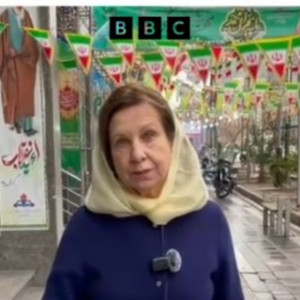
As Iran marks the anniversary of its Islamic revolution, we're on the ground in Tehran for the first time since the regime's brutal crackdown on anti-government protesters.
A rare mass shooting in Western Canada has left several people dead and more than two dozen injured.
Cuba says it can't supply airlines with aviation fuel as a result of de facto American embargoes.
We assess the impact on local tourism.
Also in this podcast.
Scientists believe you can train your brain to reduce the risk of getting dementia.
Looking at a computer screen, seeing two objects in the center that you have to make a decision about.
And then around the outside of the screen, you start to get distractors.
And some of international cinema's biggest stars are in Berlin for the annual film festival.
In Iran, ten days of events marking the anniversary of the 1979 Islamic Revolution come to an end today, with the authorities organising a major rally in the capital, Tehran.
For the first time since massive anti-government protests shook Iran and the brutal crackdown left thousands dead, we have a report from inside the country.
The BBC has gained access at a time when President Trump's renewed his threat of military action against the Islamic regime if nuclear talks fail.
And Israel's leader is expected in the White House later today to discuss his own strategic aims regarding Iran.
Our correspondent, Lise Doucette, sent this report from Tehran on the condition that none of the material is used on the BBC's Persian service.
These restrictions apply to all international media organisations operating in Iran.
The traffic is brisk as you can hear.
Many people going about their day.
We're in Revolution Square in Tehran, an iconic square.
And the place is surrounded by brightly colored murals which have just been put up.
The bunting is out and the flags as Iran marks 47 years of their revolution.
But this is a truly momentous time in Iran, just weeks after the unprecedented protests were met by an unprecedented crackdown.
Iranians are facing crises on every front.
And so we're going to speak to some of them to see what's on their mind.
But she said dangerous.
You said dangerous.
Okay.
We understand.
We understand.
It's a very sensitive time.
We might hear it more than usual.
Hello.
What's your first name?
I'm Dorit.
Dorit.
And how old are you?
I'm 20.
What's the main worry on your mind these days?
Oh.
In the circumstances right now.
I mean, I don't see the situation very well because I think we're going through a really really hard time in our country and just nothing is stable here right now.
And I guess people are having a really tough time during their lives and everything costs so high.
And I just think that there's nothing stable right now in the country.
And can I ask what you do know about this last month?
What?
Last month was really terrible.
We went through the blackout of internet and we could just know nothing about our country and what happened to people.
And after the connections we saw a lot of horrible videos and photos from people who were under attacks.
And the pictures were really so disappointing and they just made you cry out.
And everything was so terrible, actually.
What's your message to your leaders, then, after this terrible moment?
The leaders of our country?
Okay, I cannot say that on the microphone, but... Do you think it will get better?
The way that they're going through, I think that I just hope that everything doesn't just get worse.
Because I think nothing's going to get better, actually.
It is a hard time.
The people and we are all upset about the situation.
There were lots of people that now they aren't here with us and we are upset about that.
Because they were killed?
Yes.
And I have also other concerns too.
They say there are possibilities that America is going to attack us.
I think people are worried about that.
It's 47 years of the Islamic Revolution.
What is your message to your leaders then at this time?
I think we should hear our people's voices.
We shouldn't do what we want.
It's important.
Leaders and people that are responsible for this country.
They must hear what people say and do what people want, not the things they want to do.
For my future, I think so.
But about Iran, I don't know.
I don't have any idea about the future of Iran.
I don't know what will happen to us.
What would you like to happen?
I just want to access the basic...
Basic normal life.
Basic freedoms or?
Basic freedoms, basic economy.
Basic needs met.
Yes, so bad.
I'm sorry, I'm sorry.
Thank you for sharing your thoughts.
Just listen to the voices.
This is a deeply worrying time, a painful time.
And for the leadership of Iran, a defining moment.
Never has the leadership faced a challenge on this scale.
This kind of unrest and dissatisfaction and anger at home and growing threats from abroad.
This Islamic Revolution anniversary is unlike any this country has known.
Lise Doucette in Tehran.
At least ten people have been killed in Canada in the western province of British Columbia.
Some of the bodies were found in a school in the small community of Tumbler Ridge.
Ken Floyd from the Royal Canadian Mounted Police gave more details about the shooting.
As part of the initial response, officers entered the school to locate the source of the threat.
During their search, police located multiple victims.
The individual believed to be the shooter was also found deceased from what appears to be a self-inflicted injury.
Six additional people, not including the suspect, were found deceased inside the school.
Two victims were airlifted to hospital with serious or life-threatening injuries, and a third victim died being transported.
Police found another two bodies at a residence.
25 people have been injured, some of them seriously.
The Canadian Prime Minister, Mark Carney, said that he was devastated by the horrific shooting.
A view shared by Nina Krieger, the Minister for Public Safety in British Columbia.
The people of Tumbler Ridge remain in a state of crisis following one of the worst mass shootings in our provinces and countries' history.
This is a devastating day for a close-knit community, and the loss being felt is profound.
There are truly no words that can adequately describe the pain being carried tonight by parents, families and loved ones of the victims.
British Columbians and people across the country are standing with the Tumbler Ridge community tonight.
I would like to thank the RCMP officers, who were on the scene within two minutes of receiving the call.
That speed and professionalism saved lives today.
Our North America correspondent Peter Bowes told me more about the police investigation.
Two locations.
Initially, the Royal Canadian Mounted Police said it received a report of an active shooter at a school in this very small town, Tumbler Ridge, which lies in the foothills of the Rocky Mountains.
This was shortly after lunchtime.
There was an initial search of the school, and that's when six people were found dead.
A seventh died on Sunday.
The way to hospital and the authorities say another person believed to be the attacker also discovered dead inside that building from what appeared to be a self-inflicted injury.
But then, as you say, a second location as well.
And they say the authorities believe that...
A nearby home was that second location where two bodies were found, and the police say they believe that that incident at that home and what happened at the school was linked, although at this stage they're not going into any details.
The police say that they don't know the attacker's connection.
So details of the suspected shooter fairly few and far between?
Very few and far between.
The only inkling that we have about a possible well, not so much an identity, but an initial alert that went out to the authorities when it was discovered that something had happened at the school.
The Canadian media say the alert described the suspect as a woman, someone in a dress with brown hair.
Now, that isn't confirmation that it was a woman, but perhaps an indication that in the early stages of this they might have believed that a woman was responsible, but certainly no confirmation about an identity from the police.
And this is a tiny community.
Yeah, 2,400 people approximately live in Tumbler Ridge.
As I say, it is a very small community.
It's about 1,000 kilometres north of Vancouver, near the border with Alberta.
As we know, based on past shootings in Canada, shootings are very rare in that country.
If you compare it say, to the United States in terms of the use of firearms and violence, these kinds of incidents.
They have happened in the past, but very few and far between.
Peter Bowes.
Cuba's tourism industry has suffered a major blow after dozens of flights were cancelled because of a lack of aviation fuel.
Air Canada, which flies many tourists to the Caribbean island, suspended flights on Monday because of the shortages.
The shortage of jet fuel is the latest result of efforts by the Trump administration to impose an effective oil blockade on the communist nation.
The White House is threatening tariffs on any country which supplies Havana, and local people are already feeling the pain.
I'm Emilio Hernandez.
Two hours.
I've spent two hours waiting for the fuel tanker to arrive and no sign of it.
We don't know if it's coming.
And this is paying in dollars.
My name is Francisco Perez.
I've been here for five hours.
No tanker yet and no idea if it's coming.
They say it's coming, but who knows?
In Cuban pesos or foreign currency, whatever.
You just have to find a way to pay for it.
We have no other option.
David Lee is the owner of a U.S. company which organizes trips to Cuba.
The situation has in many respects been deteriorating for some time.
So there's an aging power grid.
Life in Cuba is difficult.
It's a third world economy.
How that affects tourists.
Americans are not allowed to travel to Cuba as quote unquote tourists.
There are a set of licensed reasons that Americans can travel there.
Cuba's saying that international airlines won't be able to buy jet fuel and refuel when they're there.
Coming from the U.S., that may not matter because you probably don't need to refuel.
Coming from further away, a different story.
That's exactly right.
Literally in 15 years I have not seen a US jet refuel before flying from landing in Havana and turning around and flying back to the US.
This makes Cuba more dependent on US tourism than it doesn't stop tourism.
It just means that nearly all the tourism would be from America.
Well, depending on how long this continues.
At this point.
The only flights I've heard that have officially been suspended for now are flights from Canada.
And keeping in mind that, you know, it's a very different market.
It's very much a beach destination for most Canadians.
And Cuba has already announced that they're preparing for this.
They know that, in addition to not just because of the jet fuel situation, but lack of fuel and power supply for the entire island, they're consolidating and closing some of the beach hotels and keeping only a couple of them open.
So it may not make all that much difference by the sound of it.
Well, I think it makes a difference.
I am spending hours every day talking to current clients who have trips booked, groups that are coming soon, prospective clients and having to you know answer these same questions that you're asking me right now and let people know it's safe.
The Places that we have you stay have backup generators.
My team have gasoline in their cars.
The buses have gasoline.
You're going to have a great itinerary and a great experience.
But if you're going somewhere and it's a trip and it's a leisure experience, just a little bit of fear can cause some people to make other plans or put things off.
At the end of the day, if this fuel siege continues for too long, it's definitely unsustainable.
David Lee talking to my colleague Andrew Peach.
Still to come in this podcast the return to Nigeria of some of the Benin bronzes artwork by indigenous people looted during colonial times.
They were looted in 1897 so towards the end of Queen Victoria's reign in an infamous so-called punitive expedition and the pillaging of all the treasures within its palace what today we call the Benin bronzes.
I've spent the last three decades trying to better understand money across the boardroom, the newsroom and the trading floor.
That's longer than most podcast hosts have been alive.
But even I've got questions.
Join me Maren's Hubset Web every week for my show Maren Talks Money from Bloomberg Podcasts, where I have in-depth conversations with fund managers, strategists and experts about how markets really work.
And join me for a separate episode where I answer listener questions on how to make those markets work for you.
Follow Meron Talks Money on Apple Podcasts, Spotify or wherever you listen.
This is the Global News Podcast.
Is there a way to train your brain to reduce the risk of getting dementia?
Scientists in the US believe it could be possible.
They spent two decades tracking thousands of older adults and found that exercises designed to sharpen the brain's processing speed had a Professor, Marilyn S Albert from Johns Hopkins School of Medicine in Baltimore, co-authored the study.
The research shows that you can reduce the risk for Alzheimer's disease by engaging in this particular cognitive task.
It doesn't mean you ward it off.
It doesn't mean it will never happen.
It's just reduction of risk on a group level.
So of course it doesn't mean for an individual that they won't get ill, but it's nevertheless exceedingly important as a finding.
There were three kinds of training that were evaluated in comparison to what we call a control group, and only one of the cognitive training tasks reduced risk for the diagnosis of dementia over the course of 20 years.
That task is called a speed of processing task, and it's actually quite demanding.
The task involves looking at a computer screen, seeing two objects in the center that you have to make a decision about which object it is, and then around the outside of the screen, you start to get distractors and you have to identify a particular object that's on the periphery.
As you do that, and you do it well, the presentation of the items gets faster, so it gets harder.
There was two hours of training for six weeks, and then after a year there was another three weeks where there was two hours of training each week, and then after three years, again these what we call booster sessions.
And we believe that it's effective because it's likely making new connections in the brain.
We don't know that from this study, because this study didn't do any kind of imaging of that sort that could give us that information.
What we did in the study was to see whether or not, if you engaged in that training over the course of 20 years, you would have a lower risk of having a diagnosis of Alzheimer's disease.
Professor Marilyn S Albert, head of the Alzheimer's Disease Research Centre at the Johns Hopkins School of Medicine.
Telegram is one of the most popular messaging apps in Russia, but starting on Tuesday, access has been limited.
It's the latest example of a clampdown on Internet freedom in Russia, which has accelerated since the full-scale invasion of Ukraine.
Galina Timchenko is the founder of the independent Russian news organisation Meduza, now based in Riga, which has an estimated Russian audience of between 10 and 12 million, who access it via VPNs and apps like Telegram.
In December, a court in Moscow sentenced her to five years in jail in absentia for operating what was described as an undesirable organisation.
She explained how important Telegram was to Meduza.
Telegram is vital for us because Meduza website is blocked in Russia and we successfully avoiding blocking with our mobile application.
More than 80 of our Telegram subscribers live inside Russia, so our information is crucial for them.
For Medusa, we could lose 20% of our audience.
And for our readers, it means that they have to make a difficult choice.
And unfortunately, I'm a pessimist.
If the choice is freedom or news, definitely you will choose freedom.
Because Kremlin is halfway to criminalize reading.
They've already criminalized searching information, so-called extremist information.
If you search in search engine like Yandex or Google, for example, Alexei Navalny name, he was labeled as an extremist.
So you will be punished, fined, and then imprisoned.
And it seems to me that Medusa could be put in extremist list as well.
Of course, you personally are considered extremist, aren't you?
Yeah, I'm not an extremist.
I'm a criminal.
A criminal.
You're considered a criminal, a five-year prison sentence.
Yeah, five-year prison sentence in absence.
Has that made any difference to you?
You know, I could not travel.
European Union, United Kingdom. and maybe Commonwealth countries and not the United States anymore.
Can I ask about what the authorities in Russia are doing as an alternative to these messaging apps?
They've come up with their own app called Max, haven't they?
Yeah.
Tell us about it.
It's been in place for several months now.
How does it work?
They mandatory ordered to pre-install Messenger Max in every phone purchased inside Russia, for all the stores.
And it's not a messenger.
It's a surveillance tool.
And they recommended to transfer, for example, domestic chats or school chats into Max.
And it's a surveillance tool.
And in every article published in Meduza, we said, guys, please avoid this.
Please do not use it.
It's not safe.
Unfortunately, we see apathy and fear among Russian society.
And for sure, our core audience will find the way.
And now they are desperately searching the way to have some independent information.
But the rest of audience, they are full of apathy.
And they just bend the knee.
The argument that the Kremlin makes as to why it's doing what it's doing.
It says that there is posts on Telegram from terrorists, from people who are trying to undermine the Russian state.
What would you say?
It's just a platform, just a tool.
And many Russian propagandists very successfully use Telegram as well.
Galina Timchenko, founder of the independent Russian news organisation Meduza, speaking to my colleague, James Kumarasamy.
The University of Cambridge here in England has transferred legal ownership of more than 100 bronzes looted from Benin in West Africa in the 19th century.
The head of Nigeria's Commission for Museums and Monuments said he expected the objects to be returned before the end of the year.
A number of other British institutions are also in possession of similar artefacts, and pressure will now be on them to follow suit.
Barnaby Phillips is the author of Loot, Britain and the Benin Bronzes.
They were looted in 1897, so towards the end of Queen Victoria's reign, in an infamous so-called punitive expedition led by the Royal Navy, which resulted in the annexation of the Kingdom of Benin which of course is in southern Nigeria today, a kingdom which had been there for hundreds of years and the pillaging of of all the treasures within its palace what today we call the Benin bronzes brass, bronze and ivory carvings, which were brought back en masse, some 5000 of them, here to London.
I think Western museums in general have felt under a lot of pressure over this over the last, let's say, four or five years probably, since Black Lives Matter really hit its height in 2020.
And the relevant point particularly to the Benin Bronzes, is they've just become so emblematic that the way they were taken was so shocking, so well documented, so photographed.
And German and Dutch museums have moved en masse, as it were.
Some smaller British institutions have moved.
But this is now a big moment because Cambridge has the second largest collection of Benin Bronzes in Britain, behind the British Museum itself.
I don't think this means we're going to see an imminent change of policy from the British Museum.
It has a new director, a man called Nicholas Cullinan.
Despite being younger, and perhaps you might call him more progressive than his predecessors, he's rather conservative on the crucial question of whether the law should change to allow so-called national institutions here in Britain to return or as museum curators call it, deaccession treasures from within their collection.
So I think there's going to be a lot of frustration.
I think the British Museum is going to end up appearing more isolated, but I don't think there's going to be an imminent move on the Benin bronzes or, for that matter, many other contested treasures in the British Museum.
Barnaby Phillips on the Benin bronzes.
Some of international cinema's biggest stars are gearing up for the prestigious Berlin Film Festival, which gets underway on Thursday.
It's one of the biggest European film events of the year, and Tom Brook is already in the German capital.
The winter gloom of February in Berlin may be lifted by the city's annual film festival, one of the three biggest in Europe.
More than 200 feature films from around the world will be shown in Berlin over the next 11 days.
Horror, sci-fi, drama, documentaries and much more.
It will open with no good men.
Based on real events.
It follows the only camerawoman working at Kabul TV in Afghanistan in the days prior to the Taliban's return to power.
Patricia Tuttle is the director of the Berlin Film Festival, now in her second year in the job.
I asked her why she chose to open the festival with no good men.
It's a surprising look at Afghan women, and I think it's very moving.
Politically, I think it is also really important.
It's about fragile democracies, it's about our shared humanity, but I also think cinema fans are going to really respond to it.
Big names are expected to hear this year, including British singer and songwriter Charlie XCX, who appears in The Moment a mockumentary that's partly a satire of the music industry and pop culture.
This festival embraces global cinema.
In competition.
This year there's A New Dawn, an animation from Japan, and films from Africa and Latin America and elsewhere.
Culture journalist Thomas Rogers.
It's a very international program every year and it often offers very personal takes on current events or geopolitics.
Interestingly, there's a cluster of Scottish films in Berlin, among them an emotionally raw documentary portrait of the adventurous Turner Prize-winning artist Douglas Gordon.
In 2006, Gordon used multiple cameras to artfully capture football player Zinedine Zidane in a live match.
Filmmaker Finlay Pretzel says he was partly inspired to make his documentary about Douglas Gordon because he so admired the artist's film on Zidane.
It was a 90-minute film, huge soundtrack by Glasgow-based Mogwai.
It made me sit up and think about making films in a very different way.
The Berlin Film Festival has been one of the key, vibrant elements of the cultural scene in Berlin since its inception in 1951.
But over the decades, the media landscape has shifted dramatically.
Movie fans can now access films in multiple ways, not just through festivals.
So what is it that the Berlin Film Festival gives the movie-going public that it can't get elsewhere?
Tricia Tuttle again.
We are probably the biggest public-facing film festival in the world.
Last year 340000 tickets were sold for the festival, but we're also one of the biggest markets in the world.
So I think these two things coming together delivers a lot of complexity, but also a lot of dynamism.
If nothing else, the Berlin Film Festival can bring participants a sense of belonging to a creative film community where they can find cinema that's escapist and entertaining, but also boundary pushing movies that can perhaps help them understand themselves better and the tumultuous times in which we live.
Tom Brooks.
Don't forget our sister podcast, The Global Story, which goes in-depth and beyond the headlines on one big story, available wherever you get your podcasts.
This edition of the Global News Podcast was produced by Muzaffar Shakir and mixed by Chris Kouzaris.
The editor is Karen Martin.
I'm Alex Ritson.
Until next time, goodbye.
I've spent the last three decades trying to better understand money across the boardroom, the newsroom and the trading floor.
That's longer than most podcast hosts have been alive.
But even I've got questions.
Join me Maren's Hubset Web every week for my show Maren Talks Money from Bloomberg Podcasts, where I have in-depth conversations with fund managers, strategists and experts about how markets really work.
And join me for a separate episode where I answer listener questions on how to make those markets work for you.
Follow Maren Talks Money on Apple Podcasts, Spotify, or wherever you listen.