This is where, like my interest in him and, I think, the sort of kind of general interest in him in a very specific thing nature that is very specific to black folks.
It may be even very specific to black boys or men.
I'm not sure about that one.
But I definitely remember the way He occupied a space similar to Michael Jackson.
I'm going to try to describe this a little bit.
Michael Jackson is the first young black person I knew who was in the public arena, like outside of sports, in the public arena, in the way that he was.
I mean like seven years old Michael Jackson's two, three years older than me, and by Scott, because you know we're two weeks apart.
I'm November 30th, 1960.
He's December's first two weeks of 1960.
So we're roughly almost the same age.
So we saw a lot of the same things, cartoons, television commercials.
Like I'm always struck Like, even in the last show at Verge Burgundian I think it was at Verge Burgundian where he has the paintings with the Ideal logo.
Like, you know, that's so specific.
Ideal was a toy company.
It was the alternate toy.
Like Mattel was the biggest toy company, and the other toy company was Ideal.
And whereas Mattel had Hot Wheels, Ideal had Johnny Lightning.
It's like the NBA versus the ABA, the roller Derby versus the roller game.
Now this probably doesn't mean anything to anybody else.
It's very specific to people who turn teenagers in the early seventies.
Right.
You know, so in 73, I was 12, he was 12.
Right.
Okay.
It's commercials, like toy commercials from Saturday morning cartoons.
So it's a lot of inside stuff that's just, it's very specific to a time period.
So I know Michael Jackson existed in a very similar way, because there was no precedent for Michael Jackson at the time.
You got like when he was on the Ed Sullivan Show in whatever, 66 or 67, You know, he was like seven or eight years old and and ruling the stage, the owning the stage.
Right.
So there was a way in which not just black boys but the black community tracked Michael Jackson's arc, like in the black community.
This is, like you know, I'm sure, Motown and Motown, but the Jackson five they were known in general.
But I don't think society at large track their art the way the black community track their art.
Because when people are vanguard, when they're like in the black community, we send a person out into a field, and it's a field in which black people hadn't been before.
People actually do watch how they progress.
So same thing with the Jackson Five, the Jacksons in general, but specifically Michael Jackson.
I remember in the early 70s when Michael Jackson was about to go through puberty and stuff like that, there was a whole bunch of discussion in the black community about was his voice going to change.
People were like You know, like if there was social media it would have been like a stock market, like tracking it day to day.
Is Michael Jackson's voice going to crack?
Because that was the whole game for the Jacksons.
Michael Jackson was the game for the Jacksons.
I could say a lot more about that, but I want to say it.
But what I'm trying to say is, like John Michelle was very similar to that later, because he's not, you know, he's not preteen.
But like he's 1920 when he first pops on the scene.
So paying attention to his art wasn't just paying attention to Jean-Michel Basquiat, the person.
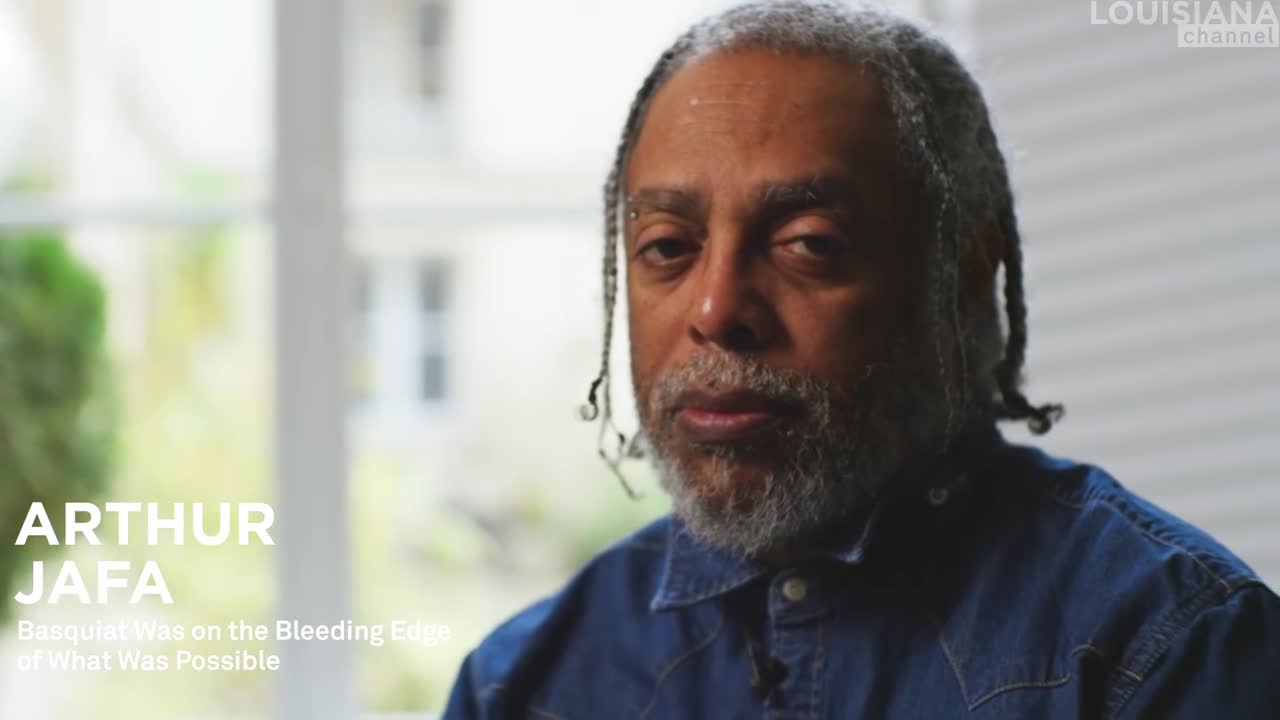
It was paying attention to a person who really was like on the bleeding edge of what might be possible for black people in general.
Like was it just going to be?
He's an exception, like an exception to the general rule that black people aren't allowed to even have careers in the art world.
There were a lot of genius black artists around, but none of them were in the mainstream art world at all.
So there was really no precedent.
I mean, the same way people would track Jackie Robinson in the Major League Baseball.
It was very similar to that, you know.
But Jackie Robinson like say for example At least I mean obviously that happened a little earlier, like I think maybe in the 40s or something like that.
But, you know, Jackie Robinson was a man in a way, and you didn't quite, I didn't, I don't know.
I have to ask my dad, you know, how did they feel about Jackie Robinson.
But this is a person who was exactly your age in an essentially segregated environment apartheid environment who's moving through the space in the way a person who wasn't black could move.
So even early on, there was this weird parallel between the Jackson 5 and the Osmond Brothers.
I don't know.
This might be some geeky shit that nobody knows.
But the Jackson 5, they were a black family making music.
And then they came out with a kind of white equivalent, the Osmonds, the Osmond Brothers, right?
And Donny Osmond was the lead singer.
The same thing.
He was the youngest one.
He was the lead singer.
And they used to kind of compare them.
Even at the time it was like this is a joke, there's no comparison.
I mean, the Osmonds were talented, but nobody would confuse the Osmonds with Michael Jackson, who is the greatest entertainer of all time.
I think at this point I don't know about the greatest artist or anything like that, but the greatest entertainer, unparalleled right.
And so when black people pay attention to his art, it was like because he was like a prototype of what was possible in that space.
So people tracked it because it wasn't just is Michael Jackson going to win or lose?
It was like can black people win or lose?
And it was very similar to John Michelle from the beginning once he broke.
It was like people tracked his progress, because it was like not just was he the individual person gonna win or lose, because it wasn't a question of genius, because there were geniuses all around.
This, like, is indisputable now.
You see people like Jack Whitten having these shows at moments, you know, he's dead, he doesn't have a show until he's in his late 70s, but Jack Whitten was making a lot of the work that was undeniable as early as the mid-70s. i remember seeing visiting my cousins in new york and going to the studio museum and seeing this painting that's still in the studio museum's collection dead reckoning and i was like that's genius i wouldn't use the term at the time but i remember looking and saying who the is this artist who's jack i never heard of him you know and um and the way his career played out has made it you know proven it to be the case but um but so john michelle was very that was a part of people paying attention to him in the black community that was specifically like that.
It was like when you get a person who's on the bleeding edge of something that's happening, like we can see now the entree of black artists into the art world it's like a tidal wave.
It's not.
It's nothing like even when I try to communicate to younger people like well, When I was a teenager, my late teens or twenties, there was no black artists in the art world.
There were black artists, but not in the art world.
And so when Joan Michelle's thing popped the way it did, it was sort of like you couldn't quite understand it.
It was a little like a person who was moving in a different sort of time space, continuum to everything that was around.
And so for John Michelle, who was a brilliant guy, I mean literally one of the most brilliant people I've ever been, even though I was only in his presence a few times.
You know, when you're in the presence of somebody like this is not, it's not typical.
There's nothing typical like Michael Jackson.
If you've ever been in Michael Jackson's presence, It's crazy.
It's like you know, if there was a Geiger counter that could measure you know what I mean the radioactivity of it, it would be like off the roof.
Same thing with Jean Michel.
Everybody will tell you that.
His intellect was, it was startling, like just to be in the presence of how quick his mind was.
Like, I don't mean like book stuff, even though he read, but just sharp.
You can see any of the interviews.
He's so far ahead of the people who are talking to him, to him, and it's exasperating to him to a certain degree.
There are assumptions about what he's thinking.
So in the early interviews you know, it's the classic ones where the guys ask him is it primitivism or something like that.
He's kind of laughing, you know, because he's like this is dumb, I'm doing this interview.
But he's sort of like a cat playing with a ball of yarn.
But by the end he's super depressed in all those interviews because he's gotten worn down by the essentially kind, racist nature of the way he's being interrogated, the presumptions of the interviewers and stuff about what he does or doesn't know.
It's just worn him down, you know?
And that process of being worn down is what I'm talking about, when you have like, a Hendrix or a Basquiat or anybody who's in that space, and nobody who looks like them has never been in that space.
There's a late picture.
I saw it just the other day.
I was in a museum and I was flipping through at the Louis Vuitton Museum.
I was flipping through a book.
It was a Basquiat book, I mean, I've seen them all you know.
I was flipping through it but I was standing in line flipping through it and it has this picture of him holding a newspaper and it says still like, still standing, or something like that, because like towards the end of his life.
And you know people have said this in the documents, you know.
It wasn't a surprise that when he died, it was more like a surprise that he lasted as long as he did.
He was just worn down by the space-time continuum and the social forces that landed on him as a young black man.
In that context,
And like I said, like many other black people who are the first into these arenas.