Did you know your credit card points and miles can lose value to inflation while they collect dust?
Credit card companies often reduce the redemption value of your points and miles.
Imagine a credit card with rewards that can grow in value.
With the Gemini credit card, you can earn Bitcoin or one of over 50 other cryptos instantly with no annual fee.
Every swipe at the store or gas pump earns you instant rewards deposited straight into your account.
Plus, sign up now for a $200 Bitcoin bonus to kickstart your rewards.
Visit Gemini .com slash card today.
Again, if you're looking to invest in Bitcoin but don't know where to start, the Gemini credit card makes it easy.
Issued by WebBank. To qualify for the $200 crypto intro bonus, you must spend $3 ,000 in your first 90 days.
Some exclusions to instant rewards apply.
This is not investment advice, and trading crypto involves risk.
Check Gemini's website for more details on rates and fees.
Ryan Reynolds here from Intmobile.
With the price of just about everything going up, we thought we'd bring our prices down.
So to help us, we brought in a reverse auctioneer, which is apparently a thing.
Mint Mobile, unlimited, premium wireless.
How did they get 30, 30, how did they get 30, how did they get 20, 20, 20, how did they get 20, 20, how did they get 15, 15, 15, 15, just 15 bucks a month?
So, give it a try at mintmobile .com slash switch. Upfront payment of $45 for three -month plan equivalent to $15 per month required.
New customer offer for first three months only.
Speed slow after 35 gigabytes if network's busy.
Taxes and fees extra.
See mintmobile .com.
History This Week is now in its sixth season, which is kind of crazy, but we're continuing to grow and to bring you stories from the past that you've never heard before.
There are more ways than ever to follow our show.
So yes, you can listen on your podcast app.
But now you can also subscribe to History This Week Plus on Apple Podcasts for an ad -free experience on all new episodes.
Also, if you're more of a Spotify person, Spotify now lets you comment directly on individual episodes.
So let us know what you think.
You can also get email reminders each time an episode comes out.
Sign up for that at historythisweekpodcast .com and be sure to follow us on our new Instagram page too.
There's some fun stuff going on over there.
As always, share History This Week with your friends, give us a five -star review if you want, and if you want to reach out, shoot us an email at historythisweekathistory .com.
Five years in, we have a ton of episodes that you can always go back and listen to, and we're also really excited about everything that's coming up.
We hope you are, too.
For now, enjoy the latest episode.
The History Channel Original Podcast. History This Week, July 29, 1992.
I'm Sally Helm. The presidential campaign is in full swing.
Democrats have nominated Arkansas Governor Bill Clinton in a raucous convention at New York's Madison Square Garden, and Republicans are heading to the Houston Astrodome to re -nominate President George H .W.
Bush. But now, between those two conventions, a surprise candidate has entered the race.
Someone with national name recognition, someone with a kind of unconventional resume, experience in business, medicine, and even space exploration.
inspiration, a candidate who drives a sports car and lives in a cool pink house.
That candidate is...
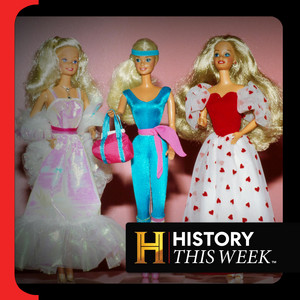
Barbie, or as the toy company Mattel calls her, President Barbie.
The Baltimore Sun runs a picture of the candidate waving from the White House lawn and another glamorous shot of her in a ball gown, patterned red, white and blue.
The paper quotes a real political fundraiser wondering if Barbie is old enough to run for president.
She's been around for 33 years and you have to be 35 to hold the highest office in the land.
But then again, she came on the scene as a teenager.
So maybe she's in her 40s.
The Minneapolis Star Tribune raises other questions.
Why was she sent to flight attendance school twice.
And what's going on with her and Ken?
Are they married? Are they just friends?
Also, what is her plan to pay off the $4 trillion national debt?
Barbie, I hate to tell you, will not win in 1992.
But she will go on to run again, seven times and counting, which does tell us something about her place in our lives.
We in the U .S. are living in a country where a doll is a public figure, one important enough to run repeatedly for president.
Today, maybe it's a doll's world and we're just living in it.
How did toy makers, artists, and inventors create game -changing dolls that revolutionized play and even politics?
And what do these dolls have to tell us about ourselves?
The backdrop for our first piece of Dahl history is the Franco -Prussian War of 1870.
France and the German states are competing to see who will dominate Europe.
Their armies are on the march. Germany and France were constantly in conflict with each other.
That is Dahl expert Florence Theriot.
Alt. She told us that France and Germany were not just fighting on the Belgian frontier.
They were also clashing on the culture front.
That same kind of little tiny war was going on between the doll makers of Germany and the doll makers of France.
At this time, the doll makers of Germany and France are locked in a fierce competition to capture the international doll doll market.
Which is a major market.
Dolls are more than toys.
They've become status symbols and little tiny cultural ambassadors.
Florence Theriault says, in the past, some countries would only let foreign dolls enter with a passport as if they were people.
France's best hope to win the doll war is a man named Pierre Jumeau.
His company has been making dolls since 1841.
Pierre was this very serious Frenchman and very upright and proud.
As are his glazed porcelain dolls.
They were mainly what were known as poupées, which would be a lady doll.
Poupées are elegant.
They wear lace bonnets or fur collars.
Pierre Jumeau employs leather workers and hat trimmers to help dress the dolls.
But the faces that sit above those fur collars or under those lace bonnets, those faces come from Germany, the doll -making capital of Europe.
The heads mostly came from Germany, and he would put them on French bodies.
He costumed them because his whole background was in fabric and textile and fashion.
Everyone loves German doll heads.
They have these lifelike expressions.
But after a while, Pierre says, enough of this.
I'm going to open my own porcelain factory and make my own heads.
French heads. And voila.
In 1873, at the Vienna exhibition, his dolls are a hit.
A reporter writes that the new French heads surpass in beauty the products we used to buy from Saxony, meaning Germany.
So, point for France.
And for Pierre, who feels that his dolls have been perfected.
Which means no more changes.
He didn't ever like to take a wild gamble on something.
He always wanted to make sure that their bills were paid.
And that was the way they did business.
And that is how it stays until 1878, when Pierre retires and his son Emile inherits the business.
Emile only gets the job because his hardworking older brother dies young and suddenly.
Florence Theriault says, Emile is surprised to wake up one day and find himself at the head of a famous company.
He was the party boy of the brothers.
He liked a good time.
He was energetic, he was charming, everybody liked him.
He always wanted to start new projects, get things going.
Unlike Pierre, Emile is ready to take a wild gamble.
He was a little more forceful in trying to push his father into the new wave of what dolls should be.
Emile thinks the new thing is babies.
He wants to make porcelain dolls that look not like fancy French ladies, but like children.
children. He calls it the bébé doll or the baby doll.
His father, Pierre, hates the idea.
He's like, why would Emile mess with success?
Kids love these sophisticated dolls with their custom -trimmed hats.
So they had a lot of friction going on between them.
But Emile is in charge.
He can do what he wants.
And so soon enough, kids all over France are opening up boxes to find the bébé.
You're presented with a doll who was a companion, someone that might be your age in terms of the scale of their body and the type of costumes they would be wearing.
I think today we're familiar with seeing a little kid with a baby doll in their arms. Why was that in particular important or a big deal for the toy world?
Oh, it's a big deal.
It was actually a whole echo of what was is happening in society because particularly in France at this time, there was an awakening of recognizing the child as a child, not just a little person.
The Jumeau bébé is like a caring sibling for that child, someone to accompany them through this new thing called childhood.
She even comes with a note for her new owner, calling herself a friend who knows how to console you.
You can count on me never repeating your words to anyone or gossiping about anything you may have done.
At the Paris World's Fair in 1878, Emile's bébés are a smashing success.
He walked away from that exhibition with a gold medal.
And he makes sure everyone knows about it.
Every one of his dolls would be stamped on the back of their torso, so, jumeau, medal d 'or.
That would be the gold medal.
Even Pierre has to admit that his son's gamble has paid off.
And Emile is not finished.
Pierre's dolls had been made by artisans.
A wig maker sewing the wigs, a glassblower making the small glass eyes.
They've been spread out all over the place, sending their individual pieces to the factory to be assembled.
But Emile sees a better away.
He came up with a concept.
Let's put it all under one roof.
He starts producing the dolls completely in -house, but he is still a stickler for quality, like for their wigs.
One story that someone wrote at one point was the finest of the mohair came from the underbelly of the mountain goats.
So I always kind of have this image of people looking for the mountain goats and trying trying to get that hair that grew on their underbelly, because that was as soft as hair.
Under Emile's watchful eye, the bébé becomes the clear winner in the doll war.
It was immensely popular, not just in France.
The majority of its sales were actually international.
It became like Barbie might be known in our world today.
People knew the name Jumeau.
It was synonymous with doll.
The golden age of the bébé lasts about 15 years.
The French were winning these awards, but guess who saw the French winning these awards?
The German doll makers.
And by the late 1890s, the visionary Emil, his head is just not in the game.
He was losing his concentration in the business, and he lost his drive.
And so, the Germans swoop in and retake the doll market by selling a lookalike child doll at a cheaper price.
Jumeau bands together with other French doll companies to cut production costs, and this consortium chugs along until 1958, when they cease operations.
Today, the name is mostly known to collectors.
Why do people still collect the Jumeau dolls?
We're constantly on the quest, looking for dolls that can trace its personal history back through time.
The name of the little girl who owned it, the name of the family, the ownership of them can be traced.
Florence Theriault has a name for the people who collect these pieces, the keepers of the dolls.
I like to say to collectors, you don't own that doll.
It's a piece of history, and you have an obligation to preserve it like any other part of history because it tells a story about who we were what we were like it tells somebody's story the McDonald's snack wrap is back you brought it back ranch snack wrap spicy snack wrap you broke the internet for a snack snack wrap is back hey there cats and kittens it's Brian from the commercial break the mediocre comedy podcast Podcasts where my best friend Chrissy and I attempt to make sense of the world.
We talk about the absurd, the ridiculous, and the stuff no one asked for, like internet weirdos, pickup artists, and why everyone is obsessed with crystals and colonics.
It's all got to stop.
The show is free, it's frequent, and it's probably not for everyone.
You can go to tcbpodcast .com, subscribe at youtube .com slash thecommercialbreak, or check out the show wherever you listen to podcasts.
We'll see you on the next commercial break.
And best to you. This episode is brought to you by State Farm.
Knowing you could be saving money for the things you really want like that dream house or ride is a great feeling That's why the State Farm Personal Price Plan can help you save when you choose to bundle home and auto Bundling just another way to save with a personal price plan Prices are based on rating plans that vary by state Coverage options are selected by the customer Availability, amount of discounts and savings and eligibility vary by state So far we have seen dolls change from fancy women women into innocent children.
In our next story, those baby dolls get some personality.
We move from the Seine to the banks of the Missouri River in 1885, where a young girl named Rose O 'Neil is growing up.
Writer Pat Waller says you probably don't recognize Rose's name.
Which, to her, is kind of strange.
This is a woman who wants everyone in the whole world new.
And now, if I bring her name up in a group, people don't know who she is.
Rose is the formerly world famous creator of the cupid doll.
In the early 20th century, her creations seemed to be everywhere.
But before any of that, she was a young girl from a poor family in a small town called Walnut Shade.
She started to copy figures from her father's many books, which were all over the house, and taught herself how to draw.
By the time she's 19, it is clear that Rose has real artistic talent and that to develop it, she'll need to leave her small Missouri town.
So she makes a big move.
In 1893, her family helped her scrape together enough funds to send her to New York City, where they felt like she could really make her career.
New York is home to the magazine industry, which is booming.
Photography isn't yet easy and cheap, so all those magazines need illustrators for their advertisements, article art, comics, covers.
It is a good time to be a skilled artist. Rose arrives at the place she is staying in the big, exciting city, a convent in Manhattan.
The lodging was arranged by her father.
By day, she makes the rounds, looking for a job.
She would go and personally visit publisher after publisher and meet with the art editors to show her work.
And she would be accompanied by two nuns in their full -flowing garb.
That alone is probably enough to get people's attention.
But her talent also speaks for itself.
She did begin to sell pieces and her work was starting to be noticed.
She illustrates everything from jello ads to Christmas stories, drawing children gathered at Santa's knee.
She works for major magazines like Harper's and Life.
And after a little while, in the background of some of her more romantic drawings, Rose starts to slip in these distinctive little cupids.
They catch the eye of an editor at the ladies' home journal, who asks Rose to make those cute little cupids the basis of a new comic strip.
Rose agrees on one condition, that she gets to not only draw it, but also write it.
She was very adamant on that point and set to work right away to develop these characters and the stories and the verses that would go along with them.
What did it look like?
It looked a lot like you would picture a Cupid being.
Cupid was Cupid, but kind of the opposite of Cupid because where Cupid got people into trouble, Cupid got them out of trouble.
It was a benevolent little creature.
Exactly. A benevolent, happy creature that was created to do good things and make people smile and make them happy.
Cupid's look like chubby babies with mischievous little grins.
Their faces are almost as big as their bodies, and they have this sassy swirl of hair on their heads.
Their motto is doing good deeds in a funny way.
Pat Waller says that pretty much describes Rose herself, too.
She was very vivacious.
She was someone who was able to draw out the good in other people and generous to a fault.
Rose's comic strip, The Kupies, debuts in 1909.
nine. It was almost an immediate sensation.
People loved it. The Kewpies live in a place called Kewpieville.
They travel around in happy little packs having adventures, like they teach grumpy grown -ups to dance around a maple.
They're adorable. And soon, companies are like, I want to put a cute little Kewpie on my product.
Kewpies were licensed to appear on virtually virtually anything.
Ashtrays, dishes, radiator caps, cameras, anything you can imagine.
I've even seen a roll of toilet paper that the exterior wrapping had a cutie on it.
They're popular not just in the U .S., but also in Europe and Japan.
And eventually, some smart entrepreneur is like, well, why not do a doll?
Rose already knows there's a market for it.
She had been getting letters for years from kids who wanted a Kewpie to call their own.
So when the pitch comes in for a Kewpie doll, Rose is ready.
She was smart enough to copyright those Kewpies and not accept a one -time payment for the dolls.
She wanted to have royalties on on the dolls.
And that's what made her a wealthy woman.
Eventually, Rose has enough money to live pretty much anywhere.
But she gravitates toward the bohemian scene in New York's Greenwich Village.
She hangs out at artistic salons, and she gets involved politically.
She was pretty much at the height of her fame and popularity as she got involved with the suffrage movement.
So she marched in parades, did everything she could to support the cause, including enlisting the Kewpies.
How does a Kewpie become an advocate for women getting the vote?
What does that look like?
She drew them in cartoons.
She drew them in placards and leaflets.
Kewpies show up on floats at suffrage marches and in other unexpected places.
In 1914, the crowd at a Nashville fair looks up at a plane flying overhead and at the curious sight trailing behind it.
Hundreds of QB dolls floating downwards on parachutes.
The dolls have been dropped by a female pilot.
They wear sashes that say votes for women.
It's Rose O 'Neill's contribution to the cause.
she did it in her clever little teasing, funny way.
Was this helpful for women's suffrage?
I personally think so, simply because they had become such an icon, really, of their time.
And if the Kupis were for it, well, maybe we should be for it too.
Pat Waller says the Kupis helped combat the stereotype that suffragettes were humorless and cantankerous.
And the 19th Amendment, which gives women the vote, is finally ratified in 1920, just before the cutie's popularity starts to fade and photography starts to replace magazine and newspaper illustration.
Rose has been generous throughout her life, so much so that by the end, she has given away a large part of her fortune.
She supported her entire family.
She supported many struggling artists because she had a heart for people who were trying to make it in the arts because she knew how difficult it was.
And I think she deserves to be remembered for what she accomplished.
When we return, we will bring you one more piece of doll -sized history, accessories included.
at New Balance we believe if you run you're a runner however you choose to do it because when you're not worried about doing things the right way you're free to discover your way and that's what running is all about run your way at newbalance .com running eczema isn't always obvious but it's real and so is the relief from Epglus after an initial dosing phase about four in ten people taking Epglus achieved itch relief and clear or almost clear skin at 16 weeks and most of those people maintain skin that's Still more clear at one year with monthly dosing.
EBGLAS, Libricizumab, LBKZ.
A 250 milligram per 2 milliliter injection is a prescription medicine used to treat adults and children 12 years of age and older who weigh at least 88 pounds or 40 kilograms with moderate to severe eczema.
Also called atopic dermatitis, that is not well controlled with prescription therapies used on the skin or topicals or who cannot use topical therapies.
EBGLAS can be used with or without topical corticosteroids.
Don't use if you're allergic to EBGLAS.
Allergic reactions can occur that can be severe.
Eye problems can occur.
Tell your doctor if you have new or worsening eye problems. You should not receive a live vaccine when treated with Epglys.
Before starting Epglys, tell your doctor if you have a parasitic infection.
Searching for real relief?
Ask your doctor about Epglys and visit epglys .lily .com or call 1 -800 -LILY -RX or 1 -800 -545 -5979.
This episode is brought to you by LifeLock.
When you visit the doctor, you probably hand over your insurance, your ID and contact details.
It's just one of the many places that has your personal info.
And if any of them accidentally expose it, you could be at risk for identity theft. LifeLock monitors millions of data points a second.
If you become a victim, they'll fix it, guaranteed, or your money back.
Save up to 40 % your first year at LifeLock .com slash podcast. Terms apply.
Los Angeles, California, 1945.
1545. Ruth and Elliot Handler are a married couple selling wooden dollhouse furniture out of a small garage.
Their toy company is called Mattel.
It's just a little company, but Ruth is already thinking big.
Really big. She was very, very focused.
She wanted to be the biggest toy company in the world.
Author Robin Gerber says that Ruth has some skills to back up this dream.
She loves selling. When she made that very first sale, she said she felt like she'd taken drugs.
She was so high on the experience.
Her husband, Elliot, does not share his wife's passion for sales.
He was very shy. They always talk about how he couldn't even order food in a restaurant.
She had to order for him.
She was a complete dynamo, but he was a genius designer and artist. So Elliott handles the creative side while Ruth runs the business.
And she is not afraid to take risks, like when she gambles most of the company's money on a novel ad strategy.
Commercials on televised children's shows.
She is ahead of her time.
Televised ads like this will transform her industry.
It really changed the whole landscape.
Suddenly, children were in the driver's seat on the toys that they wanted.
It's now the 1950s.
Mattel has become a modestly successful company.
Ruth and Elliot are no longer running it out of the garage.
But what they really want is to come up with a new kind of toy.
Something truly game -changing.
One ethic they had for the company, Ruth and Elliot shared, was that they would not go into the market for any toy unless they had an innovation.
So when it came to dolls, they had not made a doll because they would only make a doll that was different from the others.
And then one day, Ruth sees her daughter Barbara playing with paper dolls.
Dolls, which Robin Gerber says are not a perfect toy.
I get frustrated thinking that I played with those.
It was so miserable.
The tabs would tear and they'd fall off the paper doll all the time.
The paper dolls are flimsy, disposable.
But Ruth stops to watch how Barbara and her friends are playing with them.
And she notices that these paper dolls are grown up And they offer something that baby dolls don't.
Little girls want to play at being big girls.
And this was the high -concept idea.
A doll that is not childlike, but rather a fashionable young woman.
It bucks the trend, a trend that began in 1890s Paris with the bébé and continued through to Kewpie dolls and beyond.
But the idea is also a throwback to the first version of Jumeau dolls, which looked like high -society women.
Ruth thinks, what if Mattel could invent a grown -up doll with a sweet, fun -loving persona?
And what if these dolls could be made not out of porcelain, but out of some cheaper, more modern material?
She brings her concept to Elliot and the design team.
She's sure they'll love it.
but the men said don't be ridiculous mothers will never buy their daughters a doll with breasts go back to running the company ruth you're doing a really good job the designers also tell her it's impossible to make the doll she wants with current plastics she accepts their verdict briefly she kept bringing it up she kept getting swatted down she's quite disappointed that elliot didn't see it either.
Finally, Ruth just files her idea away, where it waits until 1956.
She is on vacation in Switzerland with Elliot and the kids when she spots something that stops her in her tracks.
They walk by a toy store and there in the window were dolls dressed very beautifully, each one differently.
Ruth walks over to the window, mesmerized.
These dolls are what she has been picturing in her mind — grown -up figures, 12 inches tall, they're German, they're called Lilli.
And, like the Kewpies, Lilli began life as a cartoon.
A famous cartoon in the Bild Zeitung newspaper in Germany.
But she is not an adorable cherub.
The cartoon was of this woman, Lily, who was very sexy looking, and all of the men who kept her in various ways.
So she was essentially a prostitute.
The raunchy comic is so popular that it gives the German cartoonists an idea.
You know, maybe I could make a gag sex toy for men.
And they could give it out at bachelor parties and hang it from their rearview mirror in their car.
So, lily dolls start appearing for sale in tobacco shops and newsstands, places where adult male patrons are likely to see it.
But surprisingly, it also attracts another demographic.
Little girls saw this toy and said, well, we want to play with that.
And so eventually it worked its way into toy stores where Ruth saw it at a toy store.
Ruth buys three lily dolls to take back to America.
And she tries to buy additional clothing for them, but she's told that Lily's clothes are not sold separately.
To get more outfits, you have to buy more dolls.
So she immediately thought, this is ridiculous.
They are missing the boat here.
We can sell a doll and then make clothes to go along with it.
Ruth introduces the Lily doll to the men of the Mattel design team.
And this time, they get it.
They buckle down to create a similar doll, but not before Ruth makes some stylistic improvements.
The lily doll did look more sexual than she wanted.
She was trying to tone that part down.
Once the doll is made more wholesome, Ruth gives her a name, Barbie, after her daughter.
Then she starts working on what will turn out to be a key part of Barbie's appeal — accessories.
Mattel hires a clothing designer to start putting together a vast wardrobe for Barbie.
Customers will soon be able to buy not just Barbie in her famous striped bathing suit, but also her party clothes and her commuter outfit.
Even her wedding dress.
All sold separately.
Ruth believes she has a winner in the making, but she also knows that the market can be fickle.
So she brings a Barbie prototype to focus groups who tell her something crucial.
The mothers were concerned.
They definitely immediately talked about this doll is too sexual.
But the girls love the doll from the first set.
They were really in love with this doll.
So Ruth and the marketing team start making ads to reassure parents about Barbie's maturity.
Market the doll as a teenage fashion model and emphasize this part that the doll could help their daughters learn how to dress and do their hair and be the kind of women they want them to be.
Finally, in March of 1959, Mattel debuts Barbie at her first toy show.
Ruth and and Elliot lay everything out on a table.
The dolls, the clothes, the accessories.
Then they sit back and wait for the major orders to roll in.
Only they don't. The big buyer from Sears walked out without placing an order.
Ruth is crushed. She rushes back to her hotel room.
Elliot said it was the only time he saw her cry.
And she called and said, stop production.
So it was a very miserable time.
time. Ruth is sure she's made a mistake.
A doll descended from a German prostitute?
What was I thinking?
But a few months later, school lets out.
Kids are spending more time at home in front of their TVs, where they start seeing some catchy new ads.
They're from Mattel, and the lyrics present Barbie as someone who girls can aspire to be.
Someday I'm gonna be exactly like you Till then I know just what I'll do Barbie, beautiful Barbie I'll make believe that I am you You can tell it's Mandel, it's swell Girls all over the country take in this commercial And they are enraptured Robin Gerber still remembers how she felt playing with Barbies instead of playing mother to her baby dolls.
Which personally, I found the most boring thing in the world.
Suddenly I could be anything.
Later, critics will say that Barbies' looks and sculpted body set an impossible standard and that that's harmful to little girls.
But for now, Barbies' fortunes are about to move in only one direction.
Up. By the end of that year, they'd sold 300 ,000 dolls.
By this point, the creators of the Lily doll have gotten wind of Barbie and her suspicious resemblance to her German cousin, so they sue.
The case settles. Mattel agrees to pay a little over $20 ,000 for the patent, a fraction of the millions that Barbie will earn in her first decade.
Robin Gerber says that Barbie, like the Jumeau and Cutie dolls that came before her, turns out to be perfect for her time, thanks to the innovations of Ruth and Elliot Handler.
Their whole emphasis was how many ways and how much of the child's imagination will this toy stimulate.
And in that way, Barbie was completely genius.
Thanks for listening to History This Week.
For moments throughout history that are also worth watching, check your local TV listings to find out what's on the History Channel today.
If you want to get in touch, please shoot us an email at our email address, historythisweekathistory .com, or you can leave us a voicemail, 212 -351 -0410.
We love to hear from you.
Please reach out. special thanks to our guests Florence Theriault, doll expert and founder of Theriault's antique auction firm, Pat Waller author of The Rose of Washington Square, a novel of Rose O 'Neill creator of the Kewpie doll and Robin Gerber, author of Barbie and Ruth, the story of the world's most famous doll and the woman who created her this episode was produced by Corinne Wallace, it was sound designed by Dan Rosato, story edited by Jim O 'Grady and fact -checked by Catherine Newhahn.
Our senior producer is Ben Dickstein.
History This Week is also produced by Julia Press, Chloe Weiner, and me, Sally Helm.
Our associate producers are Hazel May and Jonah Buchanan.
Our supervising producer is McKamey Lynn, and our executive producer is Jessie Katz.
Don't forget to subscribe, rate, and review History This Week wherever you get your podcasts, and we'll see you next week.
Copyright 2023 A &E Television Networks LLC.
All rights reserved.