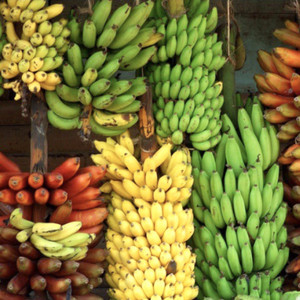
A killer fungus is destroying millions of bananas and threatening the world's supply of the tasty fruit.
The soil -borne fungus, called the Panama disease, has already affected crop supplies in Asia, Africa, and Australia.
Banana -pocalypse, banana -geddon!
In our last episode, Mauricio Diaz -Granados told us that there was a disease threatening to wipe out our beloved bananas, and it's true.
On that cherry note, welcome to part two of the Gastropod Banana Fest. Yes, you're listening to Gastropod, the podcast that looks at food through the lens of science and history.
I'm Nicola Twilley.
And I'm Cynthia Graber.
Last episode, we told you the story of how the banana became the most popular fruit in America and how it transformed the countries where it was grown.
This episode, we look at where the threat of the banana apocalypse came from and what scientists and breeders are doing to save the banana.
We've got parakeets, naked presidents, and a whole bunch of exciting new bananas that we're auditioning for the role of banana of the future.
This episode is supported in part by the Alfred P.
Sloan Foundation for the Public Understanding of Science, Technology and Economics.
Gastropod is part of the Vox Media Podcast Network in partnership with Eater.
Support for this show comes from Pure Leaf Iced Tea.
When you find yourself in the afternoon slump, you need the right thing to make you bounce back.
You need Pure Leaf Iced Tea.
It's real brewed tea made in a variety of bold flavors with just the right amount of naturally occurring caffeine You're left feeling refreshed and revitalized so you can be ready to take on what's next The next time you need to hit the reset button grab a Pure Leaf Iced Tea Time for a tea break?
Time for a Pure Leaf Hey, this is banana candy but it doesn't taste like banana Why?
Why? Bananas and banana flavoring.
Why do they taste so wildly different?
Anything that's banana flavored doesn't taste anything like the bananas that we get at the grocery store.
I actually love the taste of those foam banana gummies, but they are most definitely quite distinct from the taste of an actual banana from the store.
I like them too. I love banana flavored pretty much everything.
I'd always chalked up the difference to the fact that it's candy.
Like strawberry candy tastes pretty different from real strawberries.
But it turns out there might be something else going on here.
One theory favored by internet detectives is that the flavor discrepancy can be traced back to the fact that the banana that was around when banana flavoring was first created is not the same as the banana we eat today.
To see if that's true, we have to take a step back in history to the original banana plantations, the ones we told the story of last episode.
Remember, basically none of these bananas have seeds and they're all the exact same banana.
It's called the Gros Michel.
shell. This is Mauricio Diaz -Granados again.
He's the chief scientific officer of the New York Botanical Garden.
The problem is that because they've been propagated vegetatively, so they are clones of each other, they are genetically identical.
Every single one of the millions and millions of bananas that were being grown on United Fruit and Standard Fruit plantations in the Caribbean and Latin America was a big, yellow -fruited banana called the Gros Michel.
shell. Having the same banana growing was super convenient for the companies, and it was comforting and familiar to consumers.
But that left the banana plantations incredibly vulnerable to disease.
Because they're sort of a genetically similar buffet for a pathogen to really eat its way through.
This is Ben Brisebois.
He's a professor of public health at the University of Montreal.
And because we're just getting the gang back together, here's Dan Koppel, author of Banana, Banana, the fate of the fruit that changed the world.
Scientists were warning the banana companies, don't do this.
Diversify, find other bananas, change your supply chains.
Of course, the banana companies didn't listen to that advice.
Growing just one banana clone was the way for everything to be as cheap as possible.
And so they also ignored the warning signs of a disease noticed in the Pacific in 1914 called sigatoka.
So sigatoka, it detox the leaf surface and then that reduces the yield from the fruit itself.
off. Sigatoka is a fungus that's airborne.
And when it lands on a banana leaf, those leaves develop yellow streaks and then black spots.
And then because there are so few healthy leaves left, the plant doesn't have enough energy to make a lot of bananas.
And the bananas it does produce turn soft right away when they're harvested.
So you can't really sell them.
Sigatoka spread from the Pacific around the world, and it eventually made it to Central America.
By the 1930s, it was definitely in Honduras at least, and a huge storm in Honduras in 1935 blew sigatoka all around the plantations.
United Fruit spent a lot of money looking into ways to stop the spread of sigatoka.
One solution seemed to be to plant bananas under shade trees.
That way the fungus landed on the leaves of those trees and mostly left the bananas alone.
But those shade trees tended to become home to little mammals and insects that might blemish the banana skins.
ends, and US consumers require perfect bananas.
Instead, United Fruit scientists focused on a chemical that had been developed in the late 1800s in the Bordeaux wine region of France to control a fungus on grapes.
It was called Bordeaux mixture.
So Bordeaux mixture was copper sulfate mixed with quicklime in water.
And so it actually would control the fungus to an extent.
Copper is known to stop germs from growing and spreading.
And in this case, it did in fact stop the fungus spores from reproducing.
And so this Bordeaux mixture was sprayed from a central area and sprayed throughout a plantation using very large tubes and very large pumps.
Bordeaux mixture had to be applied at an epic scale, 250 gallons per acre, 20 to 30 times each year.
The banana companies installed miles and miles of pipes and thousands of pumps, and they used so much of the the world's supply of copper sulfate, that they had to send out mining engineers to find new sources.
All this spraying didn't just kill the fungus.
A local governor at the time in Honduras reported that it pretty much killed everything it was applied to, all kinds of insects, animals such as squirrels, everything.
But Sigatoka was more or less halted.
And actually, there was a silver lining for United Fruit and Standard Fruit, the really big banana companies.
Because they were the only ones who could afford this massive investment in pesticide infrastructure, any remaining competition was driven out of business.
Smaller scale growers just gave up.
But small scale growers lost something else, and that's food.
Sigatoka spread to the bananas that local people were eating.
Sweet bananas, starchy plantains.
These were being killed off too.
And hunger wasn't the only problem people who lived on or near the plantations were facing.
Bordeaux mixture causes a condition called vineyard sprayer's lung, lung where lungs are essentially rotted from the inside.
And workers would be turned blue, especially the spray workers, would be turned blue by the copper sulfate.
This blue thing sounds exaggerated, but it's true.
Banana workers in charge of spraying used to wake up with their bedsheets turned blue from their sweat overnight.
The stuff was in them.
And they are known as los pericos, parakeets, because of the color their skin takes on.
And banana workers who become too sick to work are left to die.
And a lot of them did die.
You'd think that something this toxic would eventually be banned.
And while it is illegal in some countries, in other places it's actually still in use today, though in much smaller amounts and in theory in a much more controlled and safer manner.
But sigatoka was not the only fungus to find the idea of infecting a plantation's worth of clones quite attractive.
There was another fungus of concern in the region, Panama disease.
This wasn't airborne, so it was a little slower moving.
You'd travel by contact.
So if I'm a banana worker and I have a machete and I cut down one tree that has, you know, a little bit of this disease, and then I use the machete on the next tree, that tree is going to get sick.
And it was just as deadly to bananas as sigatoka.
Plants that are infected with Panama disease end up with purplish brown stalks that really kind of stink.
Their leaves wilt. And then the plants barely produce any fruit at all.
It's bad. The banana companies first discovered Panama disease on their plantations in Panama, hence the name.
They tried to do a lot of things to get rid of it.
They tried flooding their plantations to wash it out.
They pumped huge amounts of water into the fields.
But all that did was spread the fungus further.
They also set up research facilities to study Panama disease and try to find a chemical that would kill it, but they couldn't.
And we still don't have one.
There's no fungicide today that can get rid of Panama disease.
And the obvious solution, grow a different banana that was resistant to Panama disease, that didn't work either.
Not because there weren't bananas that were resistant.
There were. But when Standard Fruit started shipping one of them in the 1940s, Americans just didn't buy it.
The bunches of this new banana variety were small and the fruits themselves were quite short and it was no Gros Michel.
While all of this was going on, the disease was spreading quickly.
It was wiping out thousands of acres of banana plantations.
At the same time, demand kept on growing in America.
Banana companies aren't saying, oh, you know, we just lost 30 % of Panama or all of Suriname has happened.
So let's calibrate our marketing efforts so we can sell fewer bananas.
No, they say, oh my God, we got to grow more bananas.
We need more land. We got to tear down more rainforests.
We got to make these even cheaper.
And so every time a plantation falls to Panama disease, another one is cut.
And so having land available that was uninfected, that was probably uncleared, became a vital business strategy.
When divisions would be infected with Panama disease, United Fruit would open up new ones.
And that meant leaving behind vast ghost plantations that the companies also held on to, just in case.
All of which meant that United Fruit and Standard fruit ended up owning truly astonishing amounts of land in Latin America, much of which was totally empty at any given moment.
Guatemala is a great example of this.
In Guatemala, more than 70 % of all the arable land available in the entire country was owned by banana companies, but three quarters of it wasn't being used.
It didn't have any bananas on it.
In the 1930s and 40s, the leader of Guatemala was a super wealthy general who was also super super repressive.
He had a great relationship with the banana companies and the US, so he was fine with United Fruit stockpiling vast amounts of land to help them cope with Panama disease.
But then he got toppled in the 1940s, and there was finally a less tyrannical leader.
He was much more sympathetic to the needs of the poor people in his country, not just the elite.
He finished his term in 1950.
And then this newly democratic country made way for its next elected president Jacobo Arbenz.
When Arbenz came to power, he had the ambition to redistribute land to Guatemala's poor majority.
Arbenz asked United Fruit to give him the land that cannot be used for bananas.
It seems an entirely reasonable request. Super reasonable, especially because Arbenz planned to compensate United Fruit.
He was going to give them exactly the amount they They declared it was worth on their tax returns.
And United Fruit actually declared a very small amount of money as the value of the land on their taxes.
And so Arbenz compensated them at that value, at which point they said, oh, no, actually, the land's worth a lot more than that.
They declared it for $600 ,000, but United Fruit said it was worth $16 million.
They'd undervalued it.
Shock. Arbenz went ahead anyway.
I mean, it wasn't his fault United Fruit was lying on their tax returns.
And so, Arbenz nationalizes about 200 ,000 acres of United Fruit land.
Productive land is not taken, but United Fruit appeals to the U .S. government for help.
Now, I'm not saying there was a connection, but one of the members of United Fruit's board, Alan Dulles, is the brother of the U .S. Secretary of State, John Foster Dulles.
Cozy. Whether or not that relationship made the difference, the U .S. government did want to help United Fruit, But they felt like they couldn't take military action on behalf of the company without some kind of excuse, however flimsy.
So they started out with a propaganda attack.
The United States mounted a sophisticated publicity campaign portraying Arbenz as sort of the red menace of international communism.
As part of this campaign, United Fruit took journalists on trips to show them how big a threat Guatemala posed to American security.
Security. They hired a journalist to write a quote -unquote fact -finding report investigating ties between Arbenz and the Soviet Union that they then sent out to congressmen and senators.
They even made a movie that basically made it seem as if bananas and the free world were one and the same thing.
It was called Why the Kremlin Hates Bananas.
Large amounts of private capital from the United States are being invested to build new industrial and agricultural enterprises which help to strengthen the economy of Central America.
And therefore, the agents of international communism have selected the United Fruit Company as a prime target of attack.
No wonder, then, red leaders detest and fear the company that grows ships and markets bananas so successfully.
This was all propaganda.
There's no truth to the allegations that Arbenz was in bed with the Kremlin in an attempt to unfairly attack United Fruit.
But after the successful propaganda campaign, it finally was time for military action to supposedly protect United Fruit from the communists in Guatemala.
This was in the mid -50s.
First there was a naval blockade, and then the American military showed up.
And as a result of a lot of kind of sophisticated intelligence and communications work, a lot of the Guatemalan troops were convinced the U .S. was invading with a giant force.
There actually weren't a lot of Americans compared to the Guatemalan army, but the Guatemalans had been led to believe that they didn't have a chance.
So they pretty much gave up.
This war ends very quickly.
Arbenz falls. He's let out naked onto the tarmac.
He has flown away and he begins this sort of five -year sojourn trying to get back and eventually dies in a bathtub in Mexico around 1960.
What happens in Guatemala?
The democracy is overthrown, and so begins the most oppressive right -wing government in the history of Central America up until that time.
That government extrapolates in this brutal, horrific, genocidal way, the idea that if banana workers need rights, we must strip all rights from banana workers and possibly kill them.
And so the Mayan genocide begins.
The Mayan genocide continues until the 1980s, at least 200 ,000 Guatemalan indigenous people, indigenous Mayans are murdered.
And the country doesn't return to democracy until about 1990 -something.
So literally, and I'm not going to sugarcoat it, this is the fault of the banana companies and the banana business model.
Like we saw last episode in Colombia, the ripple effect of Big Banana in Central America went far, far beyond what anyone could have imagined, ruining lives for generations.
But not all lives. There were some locals who benefited too.
They were the ones who helped the Americans win.
This didn't just make Americans rich. It made the Central American elite rich. And we got to remember the ethnic makeup of much of Central America.
It's white people descended from the Spanish, the ruling class, and indigenous And so the indigenous people were the ones who suffered.
And the elite classes got money.
And so they were accomplices.
The brutality, the acquisitiveness was invented by North Americans, but it was embraced by the Central American elite.
The rich became richer.
The poor became poorer.
The environment was trashed.
And the banana remained an American supermarket staple.
But this moment actually marked a turning point for the banana companies.
This overthrow of the government in Guatemala, it wasn't the only coup the U .S. government was involved in.
The CIA also helped out with the non -banana related coup in Iran, also in the 50s.
And the American public noticed and started to think that maybe overthrowing foreign governments wasn't a great idea.
This becomes less acceptable and possibly less successful.
And so the banana companies begin to change their strategy.
And what they do is they divest. They begin to sell these plantations to trusted local entrepreneurs, local businesses.
This gives them plausible deniability for anything that happens.
Hmm. It sounds like maybe the banana companies didn't learn their lesson and instead just change tactics.
Can this be true? Let's find out after the break.
Real brewed tea made in a variety of bold and refreshing flavors with just the right amount of naturally occurring caffeine.
With a pure leaf iced tea in hand, you'll be left feeling refreshed and revitalized with a new motivation to take on what's next.
The next time you need to hit the reset button, grab a pure leaf iced tea.
Time for a tea break, time for a pure leaf.
So after a successful coup in Guatemala, but a backlash from the American public, as we said, the banana companies changed business tactics.
But then they also had to do something else.
They had to change their bananas.
Panama disease was ripping through the countries that grew bananas and killing off miles and miles of plants.
Despite decades of research at this point, there was still no pesticide that worked.
And their whole technique of just acquiring more more land was increasingly challenging for both political and geographical reasons.
The obvious solution was to just switch to a disease -resistant banana, but they really, really didn't want to.
United Fruit had worked very hard to identify Gros Michel as the banana.
They had a whole system of growing, transporting, and marketing a very specific banana that they were convinced was the only one consumers would really appreciate.
As we mentioned, by this point, there were two companies that dominated the market, at United Fruit and their competitor, Standard Fruit.
Standard was a little ahead of United when it came to switching fruit.
Now, Standard Fruit, which is not yet known as Dole but will be, is a much smaller company with a 10 to 20 % market share.
They can't afford any kind of disruption.
They're going to go out of business for sure.
And so they begin to experiment with Cavendish.
There were options out there, tasty seedless bananas that weren't affected by the fungus that causes Panama disease at all.
whole. Dan mentioned one of them, the Cavendish, but researchers had come up with a handful.
So Standard began trialing them, growing them in small amounts and selling them to U .S. consumers.
But like we said, the fruit of one good candidate was judged to be too short, and yet another variety needed many more nutrients, which would be expensive in terms of fertilizers.
And so they were striking out.
Then there was this variety that had made its way to a British grower on the island of Mauritius and he just called it the China banana.
Eventually this banana was sent to England.
It's grown specifically in a greenhouse in England at an estate called Devonshire.
The family name of the Dukes of Devonshire is Cavendish and the banana was growing at Chatsworth House, their fabulous estate in the Derbyshire Dales.
They have this banana in this glass house and it's brought over to Jamaica to the Institute of Tropical Agriculture And it's one of the many bananas that the banana companies are always experimenting with at their test farms, even as early as the 1920s.
They're growing dozens, but none of them have the characteristics needed because Gros Michel is so ideal, partially for its taste, but mostly because of its shipability.
So remember how we started out with the whole mystery of why banana flavoring doesn't really taste like bananas?
This is maybe a part of the answer.
Sir, if banana flavoring was developed back when the Gros Michel was the reference banana, well, then that makes sense because the Gros Michel tastes a little different from its replacement.
The Gros Michel is known as a better tasting banana than the banana we eat, which is called the Cavendish, and it is better.
Is it a lot better in terms of taste?
Maybe not. It's sort of like different grades of vanilla ice cream and there's sort of the stuff in the big half -gallon tub, and then there's the pints, and then there's the really fancy.
So the Gros Michel is kind of the Haagen -Dazs compared to the Breyers that's the Cavendish.
I know that Dan is the true banana expert here, but I have to say I'm not sure I agree with him about the Gros Michel being the Haagen -Dazs of the banana world.
I mean, I struggle to taste the difference between Haagen -Dazs and Breyers.
I'm actually a big fan of Breyers vanilla.
But anyway, when it comes to the Gros Michel, I've now tried it twice.
I can say that it ripens a a lot more slowly.
So as Dan says, that'd be great for shipping.
But otherwise, the difference between that and the Cavendish, I can barely tell them apart.
Yeah, I tried a Gros Michel a while ago, and it definitely has a thicker skin, which means more protection for shipping.
But flavor -wise, it's a banana.
I'd heard this Gros Michel banana flavor theory before, and my conclusion when I tried the Gros Michel was that the reason banana candy tastes different from bananas, it's because it's candy.
Friend of the show Nadia Berenstein, she's the star of our episode all about artificial flavoring, she says that artificial banana flavoring and banana -flavored candy was actually for sale in the U .S. before real bananas.
So maybe we should just blame real bananas for not tasting more like the single synthetic chemical Americans were told they taste like.
But the bigger point is that, yes, the Cavendish was resistant to Panama disease, And as Dan said, it's the banana that we all eat today.
It is, in fact, the one that won in the end.
But Dan told us it was really the shippability issue that made it a hard fought battle.
It certainly is not shippable in the way banana companies understand it then.
It can't be thrown into a boat.
It ripens too quickly.
It's too fragile. If banana companies just threw bunches of Cavendish into the hold of a cargo ship, they'd be a total mess by the time they got to northern ports in America.
So Standard Fruit, remember, they were going to go out of business if they couldn't find a replacement banana, so they had to move faster than United Fruit did.
They came up with a brilliant solution, nestle bunches of bananas in boxes.
So instead of those big hanging bunches, you see these stacks and stacks of these rectangular 40 -pound boxes.
By the 1950s, Standard Fruit had made the switch and planted all of its plantations with Cavendish.
United Fruit battled onwards with the Gros Michel, but they were hurting.
In just the decade between 1950 and 1960, their profits shrank from roughly $66 million to just $2 million.
So they really had no choice.
They reluctantly switched from the Gros Michel to the Cavendish.
Even though Standard had already made the switch, United Fruit was still nervous that nobody would buy the new banana, But this time, they were wrong.
It certainly helped that the Cavendish pretty much looks like the Gros Michel.
It's long and yellow.
Banana production soared, and sales kept up.
And there's barely a blip in the banana supply.
And so anyone who is born after 1965 probably has never tasted a Gros Michel, has tasted a Cavendish, and it is the banana.
It turned out that one of the Cavendish's supposed flaws, its fragility, this downside also had an upside.
side. Because each bunch had to be hand -wrapped in plastic bags and placed in a cardboard box, the companies had to set up packing plants.
And if they were already doing that, well, why not take the opportunity to put a little sticker on the bananas, too?
Before this, you had no way to know which company's bananas you were buying.
But after the switch to the Cavendish, the companies could label their bananas, and they made sure you knew which one to buy.
Thanks to the Cavendish's thin skin, bananas had gone from a commodity to a brand.
And along with the new banana came a few new growing practices, all of course in the name of saving money.
The companies did away with as many workers as possible by putting in new technologies like cable systems for transporting bunches of bananas, and aerial spraying to get those chemicals they needed onto the ground as easily as possible.
And in terms of chemicals, forget just plain Jane Bordeaux mixture.
Post -World War II, the petroleum industry and chemical weapons producers stepped into the mix with a real smorgasbord of new pesticides and fungicides and herbicides and other things that killed everything.
everything. The Cavendish was so fragile that any pest attack would leave a mark that made them unattractive to American consumers.
So the banana companies responded by spraying early and often.
Unsurprisingly, these chemicals didn't just attack the banana pests.
Just like the Bordeaux mixture, earlier in the banana's history had killed all sorts of insects and mammals in and around the plantations.
These new chemicals were worse.
Dead fish floated in irrigation canals.
mammals like skunks and possums that came into contact with them dropped dead.
It was pretty devastating.
And for workers, well, there wasn't even a mention of wearing protective equipment in the United Fruit Company manuals of the time, so it's safe to conclude that banana workers were frequently exposed to all these chemicals.
Ben told us about a particular chemical that was used to kill nematodes.
These are microscopic worms that can burrow into the roots of banana plants.
Once a plant is infected, it doesn't produce as much fruit, but even more disastrously, it can just topple over.
So starting in the 1950s and 60s, banana companies started using a nematicide named DBCP.
And so DBCP was used for years in Latin America and was later found to be making workers sterile.
What happened was that the workers at the California plant that was manufacturing this nematode -killing chemical, they discovered they were nearly all infertile.
And then it emerged that the companies that had developed DBCP had kind of guessed this might be an issue based on their studies in rats.
This should have been known from the initial toxicology testing of the chemical in the corporate labs where it was produced.
But the corporate scientists who were at these companies, they did not communicate these results to regulators.
And as a result, the chemical was approved for use with vastly exaggerated claims of safety.
Before the California finding, DBCP had been used with abandon in Latin America.
After the California workers were found to be sterile, production in California stopped.
The U .S. government banned it, United Fruit stopped using it, though they did sell off their stockpiles locally instead of destroying them.
And Standard Fruit continued to use it for another couple of years because why not?
The consequences for Latin American banana workers are still being teased out.
Researchers have argued that as many as 10 ,000 people in banana growing areas suffered serious health problems from their exposure to DBCP, including cancers as well as fertility issues.
The banana companies argue it never hurt anyone.
There have been some settlements, especially workers have taken, mounted a number of lawsuits against banana and chemical companies over sterility.
A lot of these have been thrown out of court using a variety of legal arguments.
Dole, for example, maintains that it never sterilized anyone.
However, they still offer compensation.
They still offer programs to workers while maintaining that they don't actually have to do so.
Now, at this point, I would love to think that the banana companies learned a lesson and stopped poisoning not only the fungi but also the animals and, most importantly, their workers.
But I am, of course, going to now be disappointed.
pointed sorry cynthia they just carried on spraying of course they had to switch chemicals and they kept having to anyway just because the pests would become resistant but banana plantations were on what scientists call a pesticide treadmill because they got sprayed so much all the helpful bugs and soil fungi died so it was easier for diseases and pests to take hold so the companies needed to spray more often and the sheer amount of chemicals the companies needed to use and the frequency they needed to use them, it all just kept growing.
In 1990, they would spray 30 times a year.
And a decade later, they had to spray like 50 times a year.
Bananas really can't survive in this type of plantation system without these chemical cocktails applied and regularly.
But maybe did the banana companies learn something from the whole tragedy and at least protect their workers from these chemical exposures?
Maybe not as much Ben visited banana plantations in Ecuador a few years ago for his research, and he said, at least on some farms, the situation was still pretty terrible.
I had workers who told me, you know, we're just not provided with personal protective equipment, or we're not allowed to leave the fields.
Which, after everything, is like, why?
Why would companies skimp on this?
It costs a bit more money to provide personal protective equipment.
It costs more money to adequately train workers.
it costs more money to remove the workers from the field when there's an overhead aerial fumigation.
So people told me that these practices were still going on and reports that I've read continue to sort of document them.
And public health researchers who want to try to figure out how this is affecting workers, they're having a tough time doing so.
First of all, the companies aren't excited about public health research, and so they're making it hard for the researchers to get data.
And as we said, the companies have to change the chemicals they used regularly, so it's hard to keep track of what's going on.
But also, it's just such a wide variety of chemicals all being used at the same time that it's hard to figure out what the effects would be.
When you test chemicals one at a time in laboratories on, for example, rats, that tells you what happens in those controlled circumstances.
However, when you get a chemical sprayed in a worker, there can be a whole cocktail of chemicals that are being used.
And no one really knows exactly what that adds up to in people's bodies.
But there is increasing amounts of data showing that banana workers have elevated levels of DNA damage, which is often a precursor to cancer, as well as neurological issues and other side effects associated with pesticide exposure.
Banana workers do know they have health problems, but they don't necessarily know why.
It wasn't talked about, like, it wasn't really a problem that was talked about in the shop floor.
or like it wasn't like, oh, this chemical is doing this.
Laila Zaglul Ruiz is an anthropologist who studies agricultural commodities, and she just published a new book called Bear Trade Enclaves, Labor and Livelihoods in Costa Rica's Banana Industry.
It was more of like, I have this problem with my skin.
What do I do to deal with it?
It's itching. And so they will like, you know, recommend remedies and stuff.
But there wasn't a focus, and I was surprised by that, on why this was happening.
So it's kind of like Groundhog Day in the banana -verse.
And stop me if you've heard this one before, but now disease is threatening to wipe out the banana again.
The world's most popular banana may be on the verge of extinction.
What's the threat? It's a new version of the old enemy Panama disease.
It is a different variety than the one that killed the Gros Michel.
shell, but it is just as deadly, just as virulent, just as easy to spread.
It's called Panama Disease Tropical Race 4, or TR4 for short, and banana companies are afraid.
Because if TR4 is not stopped, it would wipe out Cavendish.
And it's already happening.
Globally, we're facing the collapse of a $25 billion Cavendish industry.
The Cavendish was and is resistant to the original Panama Disease, but it's not not resistant to this version.
This version, TR4, had been living a quiet life in Malaysia where there weren't a lot of Cavendish bananas to attack.
But then industrial banana production started there.
And so Panama disease, version two, son of Panama disease, begins to spread.
And the banana companies say, oh, no problem, just Malaysia.
But TR4 wasn't satisfied with just Malaysia.
It made its way around the South Pacific.
It hopped over to Australia.
It arrived in India.
It made the jump to Africa.
And sometime around, nobody knows for sure because this is kept a little secret, sometime around 2015 to 2018, it shows up in El Salvador.
And now it has spread to several more Central American countries.
Dangerously close to where most of the world's export bananas are grown.
And just like in the past, scientists haven't been able to find a pesticide that will kill it.
So instead, they've been trying to breed a new resistant banana, but this is really hard. So the word that is most often used and that I use in my book to describe the banana breeding paradox or problem is intractable.
Bananas have no seeds.
They are sterile. It is very difficult to breed from something sterile.
Occasionally, they will have a single seed, but the banana breeders Dan visited with, they'd had to go through a quarter quarter million bananas to get two dozen seeds, which makes banana breeding a very long, slow process.
Now, if you're breeding conventionally, this is almost impossible because bananas only fruit once a year, and then you've got to plant a new one.
So it takes years and years to develop, grow, and test. Obviously, this can be made a lot faster using gene editing techniques, and there is one GM banana approved for sale in Australia already.
But getting genetically genetically modified bananas to market is a whole other can of worms. That's a story we've saved for our newsletter.
Even if and when scientists manage to breed a banana that's resistant to the new Panama disease, they won't have solved all their banana woes.
The new banana has to match the cavendish.
It needs to be the same length and the same thickness, and it has to turn the same shade of yellow, and it has to do it in the same amount of time.
Let's imagine that bananas get to us via a pipe from, let's say, Guatemala to New York City.
That pipe, It's like a tunnel that can only handle Volkswagen Golfs.
It can only fit that one kind of banana, the Cavendish.
Other bananas have different qualities, different sizes.
So the banana companies are not interested in inventing new pipes.
They're interested in breeding bananas that will fit the existing pipe.
But there are so many qualities to that pipe that it's been really difficult.
These bananas taste different.
They do. Some of them ripen differently, like some of them don't really turn yellow.
And so basically, there is no new cavendish yet, and meanwhile, the actual cavendish is being wiped out in not -so -slow motion while being doused in pesticides.
It is, as Mauricio told us, banana -geddon.
So is there a better option out there?
Can you buy a banana that doesn't harm the environment and banana workers?
Maybe even a banana whose banana relatives will still be around after the banana -pocalypse?
That's coming up after the break.
avoiding your unfinished home projects because you're not sure where to start Thumbtack knows homes so you don't have to don't know the difference between matte paint finish and satin or what that clunking sound from your dryer is with Thumbtack you don't have to be a home pro you just have to hire one you can hire top -rated pros see price estimates and read reviews all on on the app.
Download today. At this point in our banana odyssey, you might be thinking, wow, things in banana land are pretty messed up.
Maybe I shouldn't be eating them.
So we asked Dan, does he still eat bananas, knowing everything he knows?
I'm not going to dodge the question.
I will try to stumble through what I have thought.
And there are times in my life when I've thought, absolutely, do not eat bananas.
And I haven't. And there are times in my life, including now, when I eat them.
I also eat the occasional banana.
But when I go to the grocery store, I do have some options.
We talked about how stickers were the original banana brands.
But today those stickers tell me I can buy fair trade bananas, which seems like it should be better.
And in fact, it was a fair trade sticker on a banana that started Lila down her research path.
I think that the first banana that really changed me was when I first moved to the UK.
Lila grew up around bananas.
She's from Costa Rica on the Caribbean side where bananas are grown.
Her parents didn't work in the industry, but her childhood home was less than a mile from a banana plantation.
But then she moved to London to study anthropology.
And I saw the first fur trade banana, which I've never seen before, because you don't really find fur trade bananas in Costa Rica.
So that for me was more significant, because growing up in that environment, that really made me question how can a banana be fairly traded fair trade as a movement started out many decades ago with like homemade goods that were bought directly from workers and developing countries and were meant to ensure a fair wage they were sold to westerners at stores like 10 ,000 villages but when it comes to food products fair trade started with coffee the first certifications were also made in Central America and Mexico, so that that area and that crop are very important to the foundation of Fairtrade.
It makes sense that Fairtrade started in coffee because, unlike with bananas, there were still small -scale farms that grew coffee.
It wasn't all on huge plantations.
And since Fairtrade was set up to promote family -owned or worker -owned farms, it was easy to find coffee farms that would fit the bill.
Export bananas are mostly grown in plantations, so the business model is harder to make work with fair trade principles.
Still, the first fair trade certified bananas hit the market in the 1990s, and today something like 10 to 15 percent of all the bananas purchased in North America and Europe are fair trade certified.
It's up to one in three in the UK.
So that sounds pretty good, but does it actually improve banana workers' lives?
That's what Lila wanted to know, so she moved back to her home region in Costa Rica to do some research. She was able to spend six months working on a conventional banana plantation and six months on a fair trade one.
I just moved to the villages nearby and I worked as a banana worker.
And my everyday tasks were mainly in the packing plant.
Every farm has the plantation and the packing plant inside the farm.
And I worked there because because that's where most of the women work.
One of the main promises of fair trade bananas is that farms will pay the workers more for their labor.
The fair trade premium is supposed to improve the incomes of workers.
So did workers on the fair trade banana plantation in Costa Rica make more money?
The simple answer is no, but it's complicated.
The workers didn't make more money because the farm didn't make more money.
They were paid more per bunch, but they didn't sell as many bunches for two reasons.
One, for whatever reason, the Fairtrade farm was less productive than the conventional one.
But mostly, it's that they weren't selling their not -quite -perfect bananas on the secondary market locally.
Nothing to do with flavor.
It's just aesthetics.
It's 100 % aesthetics.
The Fairtrade market only deals with first -class bananas.
So the surplus in the Fairtrade farm is thrown away.
This is kind of our fault as North American and European consumers.
We don't buy fruit that looks at all imperfect, even if it still tastes great.
And so supermarkets won't buy it either.
And so growers have to find local secondary markets, which is work that not all growers have the capacity to do.
So this fair trade farm just didn't sell those second class bananas.
One thing buyers might hope is that workers on a fair trade farm might overall be happier with their work than on a conventional farm because the working conditions are better.
Well, yeah, it's interesting because even though most of them have been doing that work for most of their lives and their parents did the same thing, the overall environment was not great.
Like, they didn't like what they were doing.
They, hate is a very strong word, but they disliked their everyday work.
And having said that, especially in the fur trade farm, farm, they were like family.
It did exist that this beautiful sense of family, familiarity, and maybe it contributed the fact that they were cooperative.
You know, they have a sense of belonging.
So that's kind of nice.
But ultimately, Lila found that the workers on the Fairtrade banana plantation had pretty much the same labor protections or lack of them as the workers on the regular plantation.
A lot of them were seasonal workers on short -term contracts on both farms. A lot didn't have insurance or health care on both farms. There wasn't a functioning union on either farm.
So to answer your question in a few words, fur trade wasn't able to change those structural factors that cause exploitation.
No, the certification wasn't able to do that.
One of the reasons the situation on both farms was fairly equal is that Costa Rica actually has pretty decent labor laws for a banana -producing country.
That's not as true in Ecuador, and Ecuador produces almost 40 % of all the world's bananas.
Lila told us that fair trade farms in Ecuador do seem to be significantly different from conventional farms. United Fruit slash Chiquita and Standard Fruit, or as we know it today, Dole, Ben says they started moving to Ecuador post the Guatemala coup precisely because Ecuador was even poorer, its workers weren't unionized, and it not only didn't have particularly strong labor laws, it also didn't really enforce the ones it had.
So the government regulations of the country growing the bananas are critical.
This is more important than a fair trade label.
When it comes to the environment, which obviously also affects worker well -being, that's another area where Lila found that the biggest impact came from government regulation.
But in this case, it was the government of the purchasing countries.
The most strict regulations in terms of environment was the EU regulations.
Bananas sold in the EU have to meet higher environmental standards, and so the farms growing bananas for the EU meet those standards.
But if you're in the U .S., don't despair.
Organic certification also severely restricts the use of synthetic pesticides and farm chemicals.
And a lot of banana producers, I have heard conventional ones will say, you know, anyone who tells you that organic production is a thing, they're lying.
Now, the organic producers themselves, I've seen them.
They're not lying. But they also have less productivity.
activity. Organic bananas do cost a few cents more per bunch, but they're grown in a way that does less harm to the environment and to workers, which seems like it's worth the pennies.
Another label you may have seen on your bananas is Rainforest Alliance Certified.
Chiquita partnered with this non -profit in the 1990s, and they have also focused on environmental sustainability, though many observers say it's less stringent than organic certification.
Rainforest Alliance, Lions, I think, have done a great job in reducing the damage to the environment.
They deal with that more than with the social aspect of it.
Is it perfect? Of course not.
It needs improvement, but I think that is something that we need to recognize that what they have done as well.
You might also see an Earth University label.
As it happens, Lila grew up at Earth University.
It's a nonprofit that teaches tropical agriculture and they grow bananas commercially as well.
She said it's great and if you see that sticker, then great, but it's also not scalable.
This isn't a model that the rest of the banana world can copy.
Still, Lila said if she's buying a banana, she would rather it be an Earth University one.
When I'm buying bananas, I always buy organic.
So labels do make a difference.
It's just that they don't make enough of a difference.
And I don't think that even though it comes from great and very good intentions, just a purchasing decision is not going to change the exploitation of workers.
It needs to come from when we put the hat of, you know, of activists or organized in a different way and not as consumers, because unfortunately, at the end of the day, it's about making profit.
So I think it's complicated to put that only in a choice when you're in a supermarket.
It has to transcend that.
Again, and it's important to say this, in the days of cutting entire government departments, protecting workers and the environment is the role of the government, not consumers.
It's great and important to buy organic bananas, and we should.
But in the end, systemic change has to come from both the governments of the purchasing countries and those of the producing countries, and the rules have to be enforced, which takes more government officials.
But also, even with the best and best -enforced regulations in the world, bananas, at least the kind you find in American supermarkets, they have a problem that is kind of inherent.
I'm a little skeptical that bananas can be grown in the quantities we have now without major, major environmental impacts.
As we've seen from the commercial bananas history, growing banana clones in a monoculture at an industrial scale just makes the bananas super vulnerable.
Growing them this way and keeping them cheap requires a massive amount of chemicals and bad working conditions.
So maybe the best thing to do is to try to find a way to buy bananas that aren't all clones grown in a monoculture.
Because both the banana apocalypse that the industry is facing and the problematic environmental and labor conditions that Ben and Lila have researched, they're both really the result of growing bananas at scale in a plantation monoculture to make them cheap and ubiquitous.
If the supermarkets offered more of a variety, if we could pay a little more for all these different types of bananas, it's not that every non -Cavendish banana is resistant to these diseases, but it'd be much less likely that one disease could just wipe out the commercial industry.
There'd just be more resilience in a system like that.
Both Dan and Mauricio agree the banana of the future shouldn't be a Panama disease -resistant Cavendish replacement that just slots into the existing plantation system with all its problems. What I think they should be doing instead is growing many bananas.
My message would be to try to consume different types of bananas, and in that way, you will be supporting the diversity of them by creating the demand.
And there are amazing bananas.
I've tasted maybe 260 to 300 banana varieties, and there are so many amazing, incredible bananas.
If you could get these bananas to market along with other ones, you would be able possibly at least to raise prices on some bananas.
That might help workers.
It might protect them from disease.
You can sometimes find a non -Cavendish banana at the store.
Occasionally at a high -end grocery store, you might find like one other kind of sweet banana.
You can tell because it looks different and is a different size than the Cavendish.
In cities that have big Latin American populations, you can often find more interesting bananas at grocery stores serving those communities.
But this is just the tip of the banana iceberg.
Anthony Rodriguez, he's an ethnobotanist and a photographer, he caught the banana bug and he decided to travel the world tasting and photographing as many species and varieties as he could get his hands on for a book.
He showed us a photo of one of his favorites.
It's a wild swamp banana from Borneo.
The fruit was slender and just a few inches long and astonishingly beautiful.
I guess it's like a light green, bluish green with like these striations of purple in there.
It's spectacular, but it looks like a bean, not a banana.
This particular species, the seeds aren't that hard. They're actually chewy and it forms like a gum when you chew them.
It's a really sweet banana.
He also showed us a photo of a much larger mango -sized and shaped banana from Hawaii.
Anthony told us it's a type of banana that belongs to a rare family of bananas found mostly in the Pacific Islands called fahey.
It has a very deep orange -yellow color to it, and it has like a custardy like flavor and texture.
It's also loaded with beta -carotene.
The interesting thing about fahey is what I noticed is like when you eat large amounts of it, it actually turns your urine the color of antifreeze.
Anthony even tried to photograph his bright yellowy green urine, but the photograph didn't really come out, and who wants to look at that?
The other cool non -urine -related fact about this Fahey banana is that you can use it different ways depending on how ripe it is.
So it starts off as a cooking banana and then turns into a dessert banana.
And that's the other thing about bananas that we tend not to think about at the grocery store.
You can eat all different kinds of bananas, and you can eat them all different ways.
We mentioned last episode that plantains are starchier and snack bananas are sweeter.
In Colombia, Mauricio says they eat them all, all the time.
We have what we call the manzano, which is a tiny one, so kind of apple banana.
It's maybe a couple of inches long and it's very sweet.
The popocho, which is a very thick banana, is like similar to a cavendish banana, but is twice as thick.
And then for savory banana dishes, you need to forget all those revolting sounding United Fruit banana meatloaf and curried banana recipes from last episode.
Savory bananas can be the most delicious of all.
We have the plantains and in the plantains, when they are cooked green and smashed, they are called patacón.
And that's delicious.
and it's usually a flat hard and salty and you add things on top like you can add meat or fish or any veggies etc but also if it's a ripen and it's blackish at the end the end of the life that's when it's sweeter or the sweetest and then you can put it on the oven and it's going to be a delicious sweet plantain that we call the maduro.
So we eat bananas pretty much every day.
If you, like me, are now feeling like you've lived an impoverished existence when it comes to bananas and you want to start ramping up your banana game, Dan has a suggestion.
Yes, buying certified organic or fair trade Cavendish bananas makes a difference, but your grocery store adventures can and should go beyond that.
Your task, should you be willing to accept it, is to manifest your banana dreams. Practically speaking, that just means talking to the folks at your local grocery store.
Tell them there are all sorts of bananas.
Why don't they stock three or four different varieties?
What about even eight?
That personal decision about whether or not you eat bananas should translate into you becoming the weirdo who goes into your Whole Foods and asks for the produce manager, as I often do, and says, did you know there's eight different kinds of bananas?
Why don't you get one?
We actually did get to try a bunch of different kinds of bananas for these episodes.
We had to special order them.
And to find out what we thought of them and how to host your own banana tasting party, it's all in our special supporters newsletter.
This goes out to superfans who support us at the $5 per episode or $10 per month level or above.
Go to gastropod .com slash support.
Thanks this episode to Dan Capel, Mauricio Diaz -Granados, Laila Zaglou -Ruiz, Ben Brizoua, and Anthony Rodriguez.
We have links to all their books and photographs and research on our website.
Thanks as always to our fantastic producer, Claudia Guy.
We'll be back in two weeks with a brand new episode.
Till then. Support for this show comes from Pure Leaf Iced Tea.
When you find yourself in the afternoon slump, you need the right thing to make you bounce back.
You need Pure Leaf Iced Tea.
It's real brewed tea made in a variety of bold flavors with just the right amount of naturally occurring caffeine.
You're left feeling refreshed and revitalized so you can be ready to take on what's next.
The next time you need to hit the reset button, grab a Pure Leaf iced tea.
Time for a tea break, time for a Pure Leaf.