N. P. R. This is the Indicator from Planet Money, I'm Waylon Wong.
And I'm Paddy Hirsch.
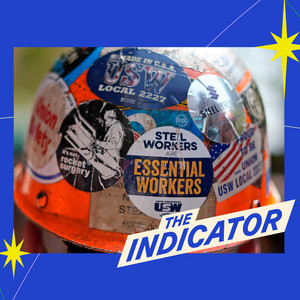
There is a big fight going on in Pennsylvania right now about the future of US steel, which recently agreed to sell itself to a Japanese firm called Nippon Steel for $15 billion.
And the fight has arranged itself in an interesting way, not left against right the way it might have a decade ago, but economists against politicians.
The economists are for it.
They say the deal will save jobs.
Politicians oppose the deal on the grounds that American manufacturers should stay American.
But there are loads of American companies that are owned by foreigners, right?
Like Firestone? Anhosa Bush?
Belgian -Brazilian. And Ben & Jerry's, the iconic ice cream company, is owned by the Brits.
They're going to throw it into the ocean.
Not as long as it's not pistachio.
So why the resistance to foreign ownership now?
Well, here's the thing.
US Steel is based in Pennsylvania and Pennsylvania is a so -called battleground state, one of the very few in the nation that is hotly contested in this upcoming presidential election.
Which raises the question, is the opposition to the US Steel deal really about economics and jobs and national security, or is it about politics and perception, trying to win precious votes at any cost?
On today's episode, we'll look at how politics can often distort economics and find out whether that's what's happening in Pennsylvania and some other battleground states right now.
That's coming up after the break.
Support for this podcast and the following message come from Wise, the app that makes managing your money in different currencies easy.
With Wise, you can send and spend money internationally at the mid -market exchange rate.
No guesswork and no hidden fees.
Learn more about how Wise could work for you at wise .com.
Support for NPR comes from NPR member stations and Eric and Wendy Schmidt through the Schmidt Family Foundation, working together to create a just world where all people have access to renewable energy, clean air and water, and healthy food.
The Schmidt Family Foundation is part of the philanthropic organizations and initiatives created and funded by Eric and Wendy Schmidt to work toward a healthy, resilient, secure world for all on the web at the Schmidt .org.
This message is brought to you by Warby Parker.
Their glasses start at $95, including anti reflective, scratch resistant prescription lenses that block 100 % of UV rays.
Try five pairs of frames at home for free.
Go to warbyparker .com slash covered.
It is the economy, stupid.
This is a phrase used by James Carville, a Clinton political adviser, in the 1992 elections.
It was true then and it seems to be true today.
The economy is the top issue for voters in this election.
But what does the economy actually mean?
Michael Strain is a director of economic policy studies at the American Enterprise Institute.
That's a think tank that you might say leans gently to the right.
Mike says that when it comes to the US steel deal in Pennsylvania and the opposition to it from both presidential candidates, the economy doesn't necessarily mean good economics.
The idea that we should be troubled by foreign investment in the United States is completely backwards.
Foreign investment is a good thing and is a very important source of productivity growth and wage growth for workers.
It helps to make American companies more competitive.
Before you say to yourself, well, he's one of those business friendly conservatives.
Here's Betsy Stevenson, former chief economist in the Department of Labor under the Obama administration.
We should welcome getting savings from Japanese consumers coming in and helping Japanese companies invest in US jobs.
That's the dream, right, having outside investment support a growing US economy.
So while economists of all political leanings pretty much agree that the US steel deal with Nippon steel should go ahead, politicians of all political leanings, or the ones that matter, at least, say it should not.
Yes, former President Trump opposes the deal.
So does President Biden and Vice President Harris.
They're worried about a potential threat to around 14000 North American jobs.
And the steel union agrees it doesn't trust Nippon steel to keep those workers employed.
Mike Strain points out that without a deal, US steel could go under.
He says not only has Nippon steel offered to pay 15 billion dollars for US steel in cash.
My goodness, it has also pledged a further one point four billion to refurbish US steel's aging facilities that will protect those jobs, he says, and potentially even create more.
The deal doesn't close any manufacturing facilities and move them to Japan.
The deal keeps everything in the United States.
Moreover, the deal would strengthen America's steel producing capacity.
The rules of orthodox economics then dictate that the US steel Nippon steel deal should go ahead.
But of course, the two candidates in the presidential race aren't focused on Orthodox economics in Pennsylvania.
They're focused on politics, on winning the votes of Pennsylvanians.
Betsy says that is an entirely different kettle of fish.
Everybody's fighting over a very small number of marginal voters that you have to get them to deeply believe you're on their side and you're trying to make it right for them.
I think that that's the way in which politics is hijacking economics, leading for people to argue for the kind of populist policies that make economists want to claw their eyes out because they seem like they don't make any sense.
It's not just in Pennsylvania that economics have been hijacked.
It's Michigan, Wisconsin, North Carolina, all battleground states that have become crucibles of debate about the future of manufacturing in the US.
And manufacturing, of course, used to be a big employer in the US, one of the biggest even.
But Betsy says that hasn't been the case for a long time.
Today, it's a mere eight percent of US jobs.
And I think that's really hard for people who grew up and were young adults at a time when the middle class really depended on a strong manufacturing sector.
That voter nostalgia has driven both Harris and Trump to focus on the revival of manufacturing in their campaigns.
Mike Strain says that populist impulse is making for some questionable economic calls.
We're seeing a lot of silly and harmful ideas, what seems to be a willingness to continue policies from the Trump and Biden administrations where we have demonstrable evidence of harm to American workers into the US economy.
Mike is talking here about protectionism, tariffs, subsidies.
Protectionism is designed to shield American industry from foreign competition, maybe even to keep America self -sufficient, which may sound like a good idea in principle.
But Mike argues that history has shown that protectionism, taken to an extreme, comes with a sting in its tail.
If you are arguing that the US should be self -sufficient, then you are arguing that American workers should be less productive, that American workers should have lower wages, that American households should have lower income and that America's long -term economic future should be quite dim.
The most recent round of protectionism, mainly aimed at protecting US industry from Chinese competition, was ushered in by the Trump administration.
And it's been maintained by President Biden since.
But protectionism is not a new thing, nor is it the province of any one political party as loyal indicator listeners know.
In this presidential campaign, the distortion of economics by populist politics is a feature of both parties' platforms in the battleground states, but it's not confined to those states.
Betsy Stevenson says the remarkable thing about the stances taken by both the Harris and the Trump campaigns is that they're so consistent in their messaging across the US and so similar to each other in content.
This protectionism is the same on both sides of the aisle.
Yeah, both candidates essentially agree that protectionism is good and in the case of US steel, that foreign ownership is bad, even if that investment comes from an ally, bails a US company out, shores up the American steel industry and saves American jobs.
Betsy says that protectionist message may fly in the face of good economic practice, but it resonates with a significant chunk of the American population, whatever state they live in, because they feel the economy hasn't necessarily been good to them for a while now.
It feels like the system is rigged that somehow you don't have a fair shot.
You know, it's like a deep -seated notion of unfairness that I think a lot of people feel deep in their bones and how they're reacting to that unfairness is different.
But it's causing everybody to feel like I need to keep more for myself.
That's protectionism.
More for me. Betsy says, and Mike Strain agrees, the distortion of economics by populist and protectionist politics hasn't been manufactured by this campaign.
It's been a long time coming, nor is the distortion confined to the battleground states.
They just happen to be where the spotlight is shining right now and where we can see exactly how these policies are playing out.
This episode was produced by Cooper Katz McKim with engineering by Patrick Murray.
It was fact checked by Cierra Juarez, kicking in and edits the show and the indicators of production of NPR.
Summer is over. You're spending more time in traffic and the calendar is more full than ever.
There is also a presidential election to keep track of, but fear not.
NPR's daily news podcast Consider This can keep you up to date on the election and all of the other important things happening in the world.
Listen to you Consider This wherever you get your podcasts.
On the Ted Radio Hour, online chopper Aparna Mehta used to get a lot of packages delivered to her door.
Oh, per week. 12, 15.
Whoa. Sorry, but I didn't think I was doing anything wrong.
Look, the store is making it possible for me to order as many as I want and return back what I don't want.
Shopping and the state of fashion.
That's on the Ted Radio Hour podcast from NPR.