This message comes from Capital One with the Capital One Saver Card. Earn unlimited 3 % cash back on dining and entertainment.
Capital One. What's in your wallet?
Terms apply. Details at CapitalOne .com.
You're listening to Life Kit from NPR.
Hey, it's Marielle.
We talked about ticks on the show recently.
They're not my fave. But guess what?
There's a little flying creature that gives them a run for their money.
Let me give you a hint.
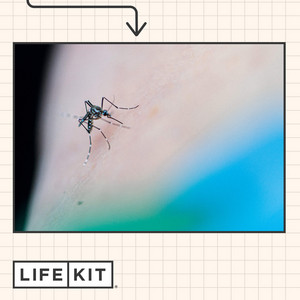
You're lying in bed on a summer night, drifting off to snooze land, when you hear a high -pitched whining sound right next to your ear.
How did this damn mosquito get into my house?
Now I'm up. The lights are on.
I'm on a mosquito hunt, because if I don't kill this thing before I fall asleep, it will feast on my blood all night and leave me with itchy bites all over my body.
Seriously, I've had one bite me on the eyebrow.
brow. Not the face, y 'all.
And those itchy, inflamed bumps can be more than just a nuisance.
In rare but real instances in the U .S., they can lead to serious or even deadly illness.
According to NASA's report on mosquito -borne diseases from May, the U .S. has seen nearly 1 ,500 cases of dengue fever so far this year.
There are about the same number of cases of West Nile virus in 2024.
Out of all of the creatures on the planet, mosquitoes have caused us no end of trouble.
They are likely the most devastating insects that we have ever encountered.
Sammy Ramsey is a professor of entomology at the University of Colorado Boulder.
And the thing you need to know about him is he's a bug evangelist. He thinks insects are so awesome he goes by the nickname Dr. Bugs.
I'm going to say something that I think a lot of people will find very surprising.
I, Dr. Sammy, your friendly neighborhood entomologist, think that we should eradicate mosquitoes.
Hey, I said it. Because mosquitoes are just so perfectly adapted to spread disease, he says.
They can find a human being like a homing beacon, homing in on their breath and their body heat to arrive there and then have this remarkable set of needles all tucked into their face, all stitched together that allow them to pierce the human skin so so effectively that oftentimes people don't even feel that they've been bitten enough to fight back and try to slap the mosquito.
The good news is we humans have found simple, effective ways to protect ourselves from mosquitoes.
So on this episode of Life Kit, reporter Andy Tegel talks all about that with Sammy and with Professor Brian Bird of Western Carolina University.
They get into why some people get bitten by mosquitoes more than others, what ingredients you should look for in bug repellent, and why you've got to stop spritzing that bug spray the same way you do your perfume.
First thing to know up front, takeaway one, mosquitoes aren't just a summertime or a weekend in the woods problem.
Anywhere there's standing water, hot temperatures, and humans, mosquitoes are likely to follow.
Is it just me, or are there a lot more of these disease spreaders?
a lot more often or is it just in my head?
You know, like here where I live in San Diego, this isn't just a problem June through August or September anymore.
Oh, it's not just you.
The mosquitoes are seemingly everywhere all the time.
As the climate changes around us, as we get both more rainfall as a result of climate change in a lot of areas and warmer weather, the mosquito season can persist for longer.
And the rainfall is a really big part of this as well because the only place that they can reproduce is in stagnant pools of water.
And so when that water collects in tree holes after heavy rain or discarded tires, garbage, cracks in the ground that have accumulated enough water and then have decomposing organic material in them that they can feed on, those mosquitoes are then able to lay a lot of eggs.
And every year that they do really, really well, you have a larger number of mosquitoes emerging that spring to then start a new population.
Okay, that doesn't make me feel good.
But we don't have to worry about every mosquito that we come into contact with, right?
Absolutely. You certainly don't have to worry about every mosquito.
I mean, really, you only have to worry about half of them.
The males are out for pollination.
They are flying around, sipping nectar, moving pollen from flower to flower and allowing for those flowers to set fruit and seed.
Great. Good for them.
Love that. that. The lady mosquitoes actually need the nutritive components of blood to really get the process of generating the egg yolk for their eggs going.
And if they don't feed on our blood, it doesn't allow them to actually produce offspring unless they have fed on the blood of another vertebrate organism.
Now, strictly speaking, you don't even have to worry about every female mosquito.
There are over 3 ,500 mosquito species in the world, but only a small percentage of those bite humans and or carry human diseases.
What's important, if you notice you're getting mosquito bites, it's time to do something about it.
Brian Bird is a medical entomologist and professor of environmental health at Western Carolina University.
I spend most of my time studying mosquito -borne diseases.
Brian says there are a fair number of myths and misconceptions about mosquitoes out there.
He's going to help us with a few for takeaway, too.
While the majority of mosquito bites don't pose a serious threat, there's still something you want to avoid as best you can.
Especially if you're like me, someone who came to this story because you feel like you're attacked by mosquitoes ten times more than anyone else you know.
But you're wondering, is that really true?
Like, are some people just more prone to getting bitten?
It absolutely is true.
And there's all kind of sort of factors that play into that.
One big factor is your smell.
So they'll notice how much you're breathing off, they'll detect that CO2 and then find their way closer and closer.
And as they get closer, they might even cue into things like body temperature or other odorants that we give off.
We give off things like lactic acid and some humans give off trace amounts of ammonia that some mosquitoes can kind of detect.
Those are two sort of important what we call human odorants that mosquitoes can really hone into.
to. Next, clothing.
A 2022 study found it's best to avoid wearing red and orange, likely because they most closely resemble skin tones.
On the other side of the spectrum, mosquitoes weren't attracted to white, blue, green, and purple.
Something to consider before your next picnic.
Another thing to keep in mind might be what you put in your picnic basket because there's been in some research to suggest certain aspects of diet can attract mosquitoes.
Specifically, researchers found that your body odor after drinking beer and eating bananas was a lot more attractive to little suckers.
And I also asked about blood type, something I've long heard and blamed for being extra mosquito bite prone.
But Brian didn't bite.
The science on this just isn't settled, he says.
Regardless of your blood type, there's not one blood type that's It's 100 % protective, right?
So it's not that you're going to be at 100 % reduced risk for mosquito -borne disease.
And so I think we have other tools that would be much better ways to protect yourself than to think about your blood type.
Fair enough, Brian.
So let's talk about those best ways to protect yourself.
The 3Ds. 3Ds are some of the basic mosquito protection 101, which involves drain, dress, and defend.
Let's learn those one by one.
Takeaway three, drain.
Prevent mosquito populations before they start.
We really want to focus on standing water.
And so if you're regularly emptying or cleaning out or covering containers that can hold water, these could be tires or buckets, toys, planters, birdbaths, flowerpots, the list sort of goes on.
If you're regularly, maybe once a week, dumping that water or just doing a backyard inspection to make sure you're not creating any of your own problems when it comes to mosquitoes, that drain can actually reduce some of that risk in your backyard. Okay.
And I'm thinking about how much water there needs to be and how, you know, how big of an area we're talking about.
Yeah. It doesn't take much, you know, even a small sort of, you know, coffee cup that's, you know, a third of the way full in your backyard can, you know, produce a lot of mosquitoes.
And it doesn't take long during the summer.
You can go from eggs to adults, certainly within a week to you know 10 days and so it doesn't take long and it doesn't take much next up dress this one's about making sure you're covered by appropriate physical barriers take away four so if you're camping for example making sure that your tent is very well sealed is really helpful but i know people who camp sometimes and all they want to do is sleep in a hammock you can bring a mosquito net to then drape over that hammock and the mosquito net will protect you.
In your home, you really need to pay attention to how well your doors are screened.
If you have screened doors or screens on your windows, they don't last forever.
This also means wearing protective clothing.
Cover your skin as much as possible.
Wear clothing like long sleeve shirts and long pants that can reduce skin exposure.
That's often a tough ask in the middle of the summer when mosquito biting pressure is sort of the highest. But if you have ever really tight fitting, thin clothes, especially the type of clothes we like to use when we're, you know, going for a run or working out.
Some species can bite through that clothing.
So I think, you know, if you're wearing a little looser fitting clothes, that can add some level of protection.
And if you're someone who works outdoors in bug or mosquito prone areas, Brian says it might be a good idea to go one step further.
Permethrin could be a sort of repellent that you can use to treat clothing and gear.
And it's not for the skin, but you can apply it to your clothes and get, in some cases, long -lasting through multiple washes, protection against mosquito bites and ticks.
Something to note about permethrin, the Environmental Protection Agency evaluated it for health and safety and deemed risks below levels of concern.
But you definitely don't want to get it on your skin.
Even brief exposure could cause irritation or burning on the spot.
And accidentally ingesting it could cause dizziness, trouble breathing, or vomiting.
Also of note, permethrin spray is toxic to cats.
So use only if needed and take care to use correctly.
And that brings us to the last and seemingly most controversial D, defend.
end. Takeaway five, for individual defense against mosquito bites, use bug repellent.
Now, after that disclaimer, this is something a lot of people understandably might feel concerned or confused about.
Repellents often involve chemicals, and namely one called DEET.
DEET probably isn't what you're thinking it is, and we'll get into that in a second.
But first, Sammy is going to explain how it works and why you want to use it.
Remember in the beginning of the episode when he told us how mosquitoes can find humans like homing beacons?
If you think for a moment about what it is that DEET is doing for you, it provides hours and hours of consistent relief by confusing the capacity of the mosquitoes to smell you.
And if they can't smell you, they can't locate you as a host. It basically camouflages your chemical scent so that you do not actually smell like a human being or a host for them.
That is, if you spray enough to give yourself full coverage.
I've seen people just kind of spritz it like cologne, like a little bit here, a little bit there, rub it together.
That's not going to help you.
You want to make a sweeping motion each time you spray it so that the chemical is actually landing in very well distributed amounts across your skin instead of piling up in one area.
So when used correctly, bug repellents with DEET basically act like invisibility cloaks against mosquitoes.
Amazing, no? Now let's address why you might have some concerns about DEET.
Now DEET is something that I think I've heard from a lot of people that they're afraid of.
And when I talk to them about it, they say, oh yeah, DEET, it like thins eggshells and it's bad for pregnant women.
And I realized after a while, they weren't talking about DEET.
They were talking about DDT.
Briefly, DDT, short for or dichlorodiphenyl trichloroethane, is an insecticide that was banned in the U .S. back in the 70s.
It was really effective at combating insect -borne diseases, but it was found to do a lot more harm than good.
It doesn't break down easily in the environment, causes liver tumors, and is a likely human carcinogen.
DDT is a completely different thing from DEET.
D -E -E -T. The name DEET is a reference to the product's chemical compound, diethyltolumide.
Unfortunately, DEET just sounds incredibly similar to that famously banned insecticide.
And also protects against pests, but that's where the similarities end.
DEET has been deemed safe by the EPA.
Their last review, which was back in 2014, just FYI, didn't identify any risks to human health, non -target species, or the environment.
If it's used appropriately, DEET does not provide a health risk, right?
So sometimes people think, you know, a little is good, a lot is better.
So they'll buy higher concentrations, for example, of DEET.
And we know that even lower concentrations, like 10 % DEET or 20 % DEET, can last for up to about two hours or even longer.
And then those higher concentrations actually last longer.
It doesn't change their effectiveness.
So before you buy, look at those labels and think about what you really need.
If you're just heading to a neighbor's backyard barbecue for an hour or two, a lower concentration, like 10%, is probably the right call.
But if you're, say, headed to the rainforest of Borneo on a research trip, as Sammy's done before, you'll want something much stronger, maybe as high as 50 or 70 % deep.
The point to underline here, not every bug spray is right for every person or scenario.
The American Academy of Pediatrics, for example, says to remember anyone under two might have skin different than that of an adult or even an older child.
So apply deep sparingly when it comes to super young kids.
But for most of us, when used correctly, it's effective and safe.
Let's be really clear here, though.
There are bug spray best practices.
Don't apply it in closed spaces or under your clothes.
Just the exposed skin and outward facing stuff.
stuff. Don't spray directly on your face.
Instead, spray into your hands and then rub onto your skin.
Wash off your repellent with soap and water when you get back inside and be aware.
There's also certain kinds of material that DEET can interact with strangely.
Things like spandex, nylon, rayon, it can melt them.
There are plastics and eyeglasses and stuff that you also don't want to get this chemical on.
It can kind of gooify them in ways that will make them look less than stellar.
So do keep that in mind.
Yikes. I mean, should, but it's okay for your skin in the smaller concentration?
I mean, it just makes me feel strange that something at a higher concentration would melt a plastic, but it is okay for my skin or like even okay for my kid's skin.
How does that work?
I know how scary it sounds when someone says that this has the capacity to to dissolve things like latex and so on.
But I mean, water has the capacity to dissolve sugars and you can drop it on a sugar cube and be like, oh my God, it just turned that into nothing.
What will happen if I deposit this water on the surface of my skin?
And because of the totally different chemistry of your skin, you're totally fine.
If that analogy still doesn't make you feel totally comfortable with DEET products.
The good news really is there's other products.
There's Bacardin. There's IR3535.
There's oil of lemon eucalyptus and others that have been proven effective.
Brian also shared a great online tool for this from the EPA with a very direct name.
Find the repellent that is right for you.
It's a little dashboard that asks how long you'll be outside, what you need protection from, even if you're interested in a particular active ingredient.
There are likely also a lot of products that aren't on the EPA's list that you might have questions about.
when I told people that I was reporting on this story the questions started flooding in what about essential oils citronella candles those little bracelets or bug spray patches I put on my kids clothes you know there's a lot of alternative options out there and I think the important message is that different pathogens like viruses that can cause disease from a public health perspective we want strong data supporting what we're going to recommend so if they're not evidence based, we do not recommend them.
Before you buy, look for the science.
If a product doesn't mask your body heat or human odor entirely, don't expect it to work, or at least work well enough to protect you better than draining, dressing, or defending.
Finally, I asked Sammy and Brian about what to do after you've been bitten.
The answer? Not much. Takeaway six, less is more.
So what do do we what do we do when one of these little suckers gets us calling them little suckers is the perfect way to to refer to them too that's precisely what they are the first thing i do is you know avoid more bites right so it might be putting on another layers of clothes it might be reaching for the repellent but if i get a mosquito bite i'm really focused mostly on just keeping that bite clean right look for signs of infection that can be any redness or persistent swelling or a pus.
Especially with children, they've scratched it and introduced some bacteria into that wound.
One thing that I do is I slap a band -aid over it to kind of prevent my instincts for scratching.
And then there are topical ointments you can use, of course.
Hydrocortisone is a common one.
Aloe vera is a good natural idea.
But a lot of people have their own go -to favorites for itch relief.
I asked Sammy about a few that I'd heard, like running your arm under or hot water, slapping the area so the pain could substitute the itchiness, or even applying things like oatmeal or honey.
Those last two are both safe remedies, according to the Cleveland Clinic, but it might not be recommended if you want to avoid more bug bites.
There are a lot of things that you can do.
Putting ice on it. If you're someone who is particularly prone to swelling or heavy reactions from mosquito bites, not everyone reacts the same way.
It's not actually the bite of the mosquito that causes your skin to turn red and swell.
it's actually the saliva that they've injected and it's the response of your immune system.
There's not a lot that you can do about your immune system's response other than slowing it down.
And when is it time to see someone about a potentially more serious disease contracted from a mosquito?
There is no one answer to when you should be worried that you have a disease from mosquitoes because they are such effective vectors that there are so so many different diseases that they are able to spread to people.
And all of them have their own sets of ailments and symptoms and so on.
I will say that a lot of them have very generalized symptoms. Body aches, joint aches, confusion, vomiting, any neurological symptoms, seek health care.
You don't want to wait.
You know your body probably better than anybody else.
It's worth going to a doctor and having that examined to determine if there is a problem there.
and really make sure to describe the set of circumstances.
I was in Thailand for a vacation and I'm coming back and I'm just feeling kind of crummy and I was bitten by some insects there.
I'm not entirely sure, but that might be related to this.
That can be really helpful for your physician.
Okay, let's recap. Takeaway one.
You're likely to find mosquitoes just about anywhere you can find hot temperatures, standing water, and humans.
They're not simply a summertime or out -in -the -woods type pest. So, take away two, try to avoid being bitten in the first place.
The best way to do that is, take away three, drain, dress, and defend.
Start by draining standing water once a week to eliminate any potential mosquito breeding grounds nearby.
Take away four, dress to protect yourself.
Create physical barriers between you and mosquitoes by wearing loose -fitting clothes when you go outside.
Use screen doors and mosquito nets when you can.
And fans and AC units can help guard from mosquitoes too.
Takeaway five, defend your exposed skin with bug repellent.
DEET is safe and effective and the preferred choice of our experts.
But there are other options and different concentrations that will work best depending on your personal needs.
Finally, takeaway six, when you get a mosquito bite, less is more.
Keep it clean and dry, do your best not to scratch, and monitor for infection.
If you feel strange or feverish after getting bitten, especially if you traveled outside the country?
Don't wait. Consult your doctor.
That was LifeKit reporter Andy Tegel.
For more LifeKit, check out our other episodes.
We have one on composting and another on protecting yourself from ticks.
You can find those at npr .org slash LifeKit.
And if you love LifeKit and want even more, subscribe to our newsletter at npr .org slash LifeKit newsletter.
This episode of LifeKit was produced by Sylvie Douglas.
Our visuals editor is Beck Harlan, and our digital editor is Malika Gharib.
Megan Cain is our senior supervising editor, and Beth Donovan is our executive producer.
Our production team also includes Claire Marie Schneider and Margaret Serino. Engineering support comes from Simon Laszlo Jansen and Tiffany Vera Castro.
I'm Mariel Cigarra.
Thanks for listening.
This message comes from Ritual.
What makes Ritual Vitamins different?
Ritual Vitamins are made with bioavailable, clinically studied key ingredients and a patented nutrient delivery system that aims to help your body use the nutrients you're getting.
Ritual's essential multivitamins are made with you and your body in mind and backed by scientific research, filled with key ingredients as well as the essence of mint, so you can enjoy taking your vitamins.
Get 25 % off your first purchase when you visit ritual .com slash npr.
The House of Representatives has approved a White House request to claw back two years of previously approved funding for public media.
The rescissions package now moves on to the Senate.
This move poses a serious threat to local stations and public media as we know it.
Please take a stand for public media today at goacpr .org.
Thank you. Thank you.