Hello and welcome back to English with Lucy.
Do not mix up these words.
These are words that sound the same but mean totally different things.
They are called homophones.
And when we mix them up, it can lead to some hilarious misunderstandings.
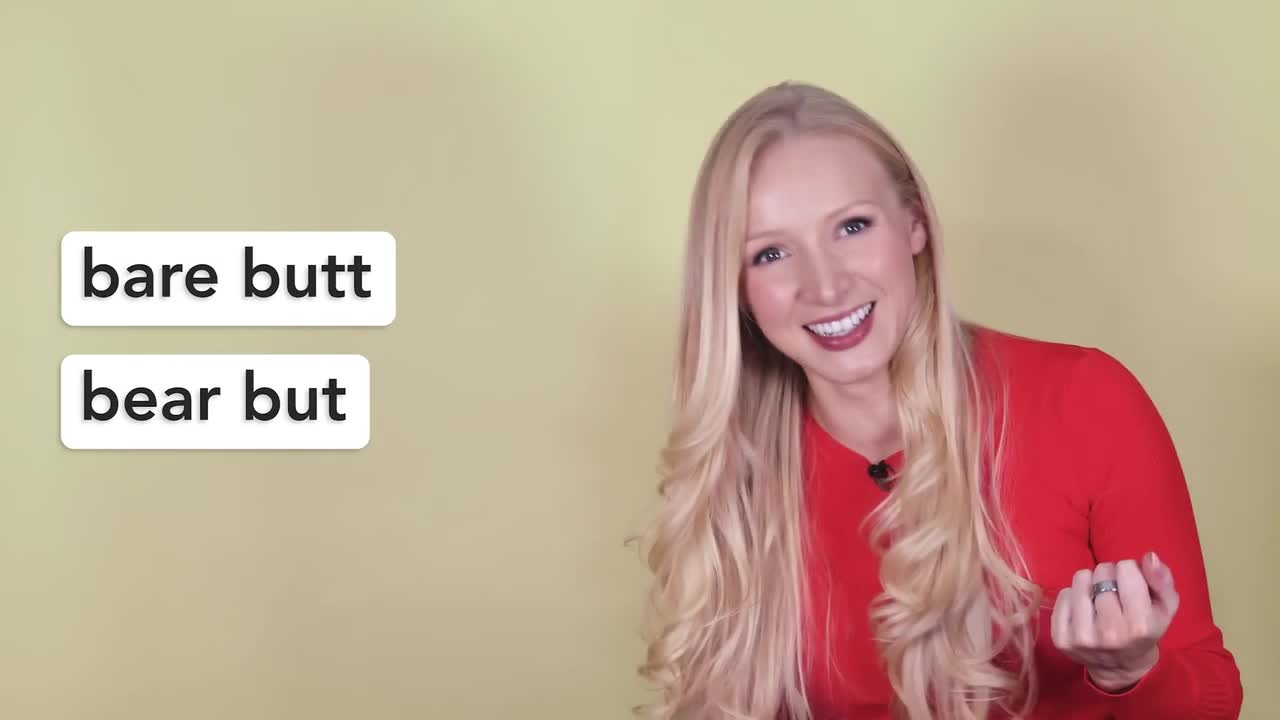
So let's make sure that you never confuse a bear butt with a bear butt again.
And if you really want to sort out your IELTS from your IELTS, you are going to need the PDF that goes with this lesson.
I've made it for you for free.
It contains all of the information in this video, plus five extra pairs of confusing homophones and a link to some secret exercises so you can practice what you've learned and make sure that you understand and remember them all.
To download that for free, just click on the link in the description box or you can scan that QR code there.
You join my mailing list and the PDF will arrive directly in your inbox.
Let's begin.
What comes to mind when you hear this?
She woke up feeling a little hoarse after the concert.
Now, did you picture a person touching a small horse? as in the animal we can ride.
I don't blame you.
But it's more likely that she felt horse with an A.
If you feel horse or you are horse, it means you have a rough or strained voice, often because you've been shouting, or you have a sore throat.
With homophones, we often have to go off context.
Horse as in sore throat is much more likely after a concert.
Next, listen to this sentence and decide how you think I might start my day.
I always start my mornings with the same serial drama.
So I said serial, which is the pronunciation of two different words.
One is spelt C-E-R-E-A-L and that is the food some people eat with milk for breakfast, like cornflakes.
The other is spelt S-E-R-I-A-L and it describes something that's published or broadcast in several parts.
The Crown and Peaky Blinders are serial dramas.
We just call them series now.
So do I begin every day with some sort of excitement over breakfast cereal or by watching an episode of a drama?
Well, that's for me to know and you to just imagine.
So our next two homophones are p, as in a small round, green vegetable, and p, which is slang for urine, liquid waste from the body, usually yellow, hopefully not too yellow.
You might need to hydrate yourself if it is so, which springs to mind when you hear this sentence?
The dog left a little pea by the door.
It could technically be either, right?
In the case of my dog, Diego, it could be the vegetable.
He never goes to the bathroom inside.
When he was a puppy, let's just say that accidents did happen.
Okay, moving on.
If someone tells you there's a leak in the kitchen, should you panic?
Maybe it all depends on whether they're talking about the long green and white vegetable related to the onion.
It is spelt with a double e, l e, e k.
That's a perfectly normal thing to find in the kitchen, but a leak spelt l e a k, that's something to worry about.
This kind of leak is a small hole or crack that lets liquid or gas escape.
Notice that the words are pronounced with the long E sound, leak, leak, not the short I sound, lick.
You could have a lick in the kitchen.
It would hopefully be cake batter.
Next up, let's test you, native speakers included.
I know some of you watch my videos, you're very welcome here.
Which spelling of the word aisle do I probably need here?
Come to the biscuit aisle.
Is it I-S-L-E or A-I-S-L-E?
Well, the second spelling is the most likely.
It's not impossible that it would be I-S-L-E, but the second spelling is most likely.
In this sentence, it most likely refers to the passage between shelves in a shop.
So imagine that I'm calling out to my husband to come over and check out some tasty biscuits.
Isle, I-S-L-E, is another word for island.
Now remember that in island, aisle and aisle, all spellings just mentioned, the S is silent.
An island made of biscuits sounds like heaven, but as far as I know, it doesn't yet exist.
There is a place called the South Sandwich Islands though.
Now, do you know that there's another word that's a homophone for aisle and aisle?
Well, it's aisle obviously spelt I apostrophe LL and that's the contraction of I will.
All right, next homophones, listen and form a picture in your mind of what I'm saying.
That's a barefaced lie.
Did you picture a bear, the animal, telling a lie?
Well, that's what I always thought it meant when I was little.
But barefaced means open and not ashamed.
Your face is bare.
It's open for everyone to see.
A barefaced lie is a deliberate and shameless lie told without any attempt to hide the fact that it's untrue.
It's got nothing to do with bears, the animal.
Spelt B-E-A-R.
So B-A-R-E, bear, can mean not covered by anything, which is probably the meaning this word developed from.
You also might know the phrase, the bear necessities, meaning the basic necessities.
It's a title of a song in the film, The Jungle Book, and was sung by Baloo, who is a bear.
I love a good pun.
Now let's stick with our bears for this next one.
This is tricky.
What do you imagine when you hear this sentence?
I think that's a bear, but I'm not sure.
Okay.
What do you think I mean?
So there's a lot going on in this sentence.
We have two sets of homophones, bear and butt.
Now first there's bear, b-e-a-r, as in the animal, but also bear, b-a-r-e, meaning without clothes.
And then there's but, which introduces a contrast like however.
But with a double T, B-U-T-T, is the part of your body that you sit on.
I'm sitting on mine right now.
But is more common in American English bum or bottom in British English.
So how will you ever know what i saw?
Well, you'll have to listen closely to my stress and intonation.
I think that's a bear, but i'm not sure my voice goes up slightly on bear.
I pause slightly and then i continue.
If i say i think that's a bear butt, i'm not sure i say bear butt, together quickly with no pause, then i pause and i continue.
In this context it could be a bear's bum, or maybe I've spotted someone's naked bum.
This might seem ridiculous, but playing with words like this word play forms a huge part of British comedy.
Okay, let's move on from body parts now.
Listen to this sentence.
What is the problem that I need to address?
We need to address the whole issue.
Okay, so I might have a problem with a hole as in an empty space in a solid surface like this.
In this case, we would often put more emphasis on hole.
We need to address the hole issue or I might want to address the entire or complete issue.
That's spelt with a silent W at the beginning, W-H-O-L-E.
In this case, I might put more emphasis on issue.
We need to address the whole issue.
Okay, our final pair of homophones.
What do you imagine when you hear this sentence?
He pulled a hair out of his hat.
Was it a hair?
H-A-I-R, the thin threads that grow on a person's head.
Or did you imagine a magician pulling an animal like a big rabbit, called a hair, out of a hat?
In that case, the spelling would be H-A-R-E.
Both work.
I guess the second is more likely if you're doing a magic show.
Okay, now it's time for a quiz.
I'm really interested to see how much you've learnt.
So keep score and let me know in the comments.
Number one.
When I go camping, I only pack the bare necessities, coffee and chocolate.
B-A-R-E or B-E-A-R?
It's...
B-A-R-E, the bare necessities meaning the basic essentials.
Two, she read the whole book in one day.
Is it whole with a W or without?
It's more likely to be whole starting with a W as in complete or entire.
Unless it's a book about holes.
I did read a book called Holes once.
It was quite good.
I guess either could be correct there.
Number three, that new cereal you bought is delicious.
Is it cereal starting with C or cereal beginning with S?
It should be C-E-R-E-A-L, as in breakfast cereal.
Four.
I just saw a huge hare running across the field.
Which spelling should we use here?
It should be H-A-R-E, like a large rabbit, not H-A-I-R, like the hare on your head.
And finally, number five.
We spent our honeymoon on a deserted aisle.
How should you spell aisle?
Well, hopefully you said I-S-L-E as in island.
If you said A-I-S-L-E, then they spent their honeymoon in a supermarket or on the passageway going down a church.
A deserted one, that would be depressing.
So what was your score out of five?
Let me know in the comments and tell me which other homophones you find confusing, because I might put them in a future video.
And don't forget to download the PDF that goes with this video.
You can click on the link in the description box or scan the QR code there.
I will see you soon for another lesson.