Just let me brush this bit of dust off this old shelf.
There we go.
Welcome back to the Squiz Kids Vault, where Bryce and I take it in turns rummaging around in the archives, blowing off a few cobwebs and pulling out an episode that absolutely deserves another listen.
And this week well, with the ashes, that age-old cricket battle between Australia and England underway, I couldn't resist choosing something that gives me a nice big serving of Aussie pride.
Because sure, the pomps I mean the English might be handy with a bat and ball, but when it comes to clever ideas that have changed the world, oh boy, do we punch above our weight.
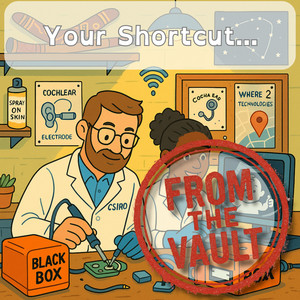
So today, we're rewinding to our brilliant shortcut on Aussie inventions that changed the world.
It's a celebration of Aussie curiosity, creativity and that let's just give it a crack spirit that we're famous for.
So settle in, enjoy this trip into the vault and because I can't resist, Aussie, Aussie, Aussie!
This is a Squiz Kids podcast.
Your fresh take on what's happening in the world around you.
Without them, we'd have no Wi-Fi, no antibiotics and no Google Maps.
This is your Squeeze Kids shortcut to Aussie inventions that changed the world.
The podcast where we dive into the who, what, when, where, why and how of the big news stories.
I'm Amanda Bower.
And I'm Bryce Corbett.
Bryce, National Science Week is coming up.
There are more than 1000 events happening all over the country to celebrate science and technology, and more than 1 million Australians are going to take part.
Now, there are two purposes of Science Week.
The first one is to give a shout out to the Australian scientists who have contributed so much to the world of knowledge.
Yeah.
And the second is to encourage an interest in science.
And Bryce, I am pretty sure that you're going to be extremely interested in what we're going to learn about some of the Australians who've literally changed the world with their scientific inventions.
And I don't doubt that for a second.
Today we'll take you through what are some of the biggest Aussie inventions that changed the world, who are the inventors, who've revolutionised medicine in particular, and why Australians are so good at inventing things.
Listen carefully.
There's a squeeze at the end.
What?
Bryce, do you remember that not so long ago, the only way that you could connect to the internet was to plug a cable into your computer?
Oh, yes.
I wonder what they did back then in classrooms.
Well, to put it simply, they didn't do anything.
What?
There really wasn't any internet access for kids at school.
It's crazy.
It's a lot easier now with Wi-Fi, isn't it?
Sure is.
And you guessed it, Wi-Fi was invented by two Aussie scientists at the Commonwealth Scientific and Industrial Research Organisation, usually known as CSIRO.
Cool.
So what's really cool is that these scientists were originally looking for ways to measure black hole signals from outer space.
Right, scientists always keep their minds open.
It did occur to them that they could use the same technology to build the core of what we now know as Wi-Fi.
And you know what, Bryce?
Every year, CSIRO gets millions of dollars because they hold the patents to key Wi-Fi technology.
And a patent, of course, is what you get if you invent something that is new and useful.
If you're granted a by your country's patent office, then anyone who wants to use your invention has to pay you.
Ka-ching!
And every year more than 2500 Australian inventions are submitted to our patent office, with every inventor hoping that they might have the next Google Maps or Black Box flight recorder on their hands.
Hold on, they're all Australian inventions?!
!
I thought Google was an American company.
Google is an American company that very quickly buys other companies whose technology Google thinks will change the world.
And way back in 2004 they were right on the money when they snapped up a Sydney company called Where2 Technologies.
Right.
The four guys who started it had the idea for a web-based mapping platform.
Now...
That's grown to more than 7,000 people working for Google Maps all over the world.
Amazing.
And what about the black box flight recorder?
That's the thing that records everything that happens on a plane.
So if there's a problem or a crash, investigators can figure out what happened and prevent it from happening again.
Yeah.
So that was invented by an Australian called David Warren.
Now, sadly, David's dad died in a plane crash in 1934 when David was only nine years old.
By the 1950s he had become a research scientist in Melbourne and he was investigating what had gone wrong when the world's first commercial jet airliner called the Comet had crashed.
And he remembers seeing a little mini voice recorder somewhere and thinking, you know, if a businessman had been using one of these in the plane and we could find it in the wreckage and play it back, we'd say oh, we know what caused this.
So he went and invented the black box.
Yeah, although actually it's painted orange.
Is it?
Boxes that contained electronic components used to be called black boxes, but Orange is easier to find at the scene of a plane crash.
Of course.
So Australia was the first country in the world to make it compulsory for all commercial flights to have a black box.
And nowadays it's required everywhere in the world.
Just imagine how many lives David Warren has probably saved by preventing problems with planes from happening again.
Now speaking of saving lives, many of the Aussie inventions that have changed the world have been in healthcare.
Who are some of our most famous medical scientists?
Who?
There are so many, Bryce, it's hard to choose.
And you should definitely look in the episode notes for links to lots of other Aussie inventors.
Oh, cool.
But to start with, I really don't think we can go past Dr Mark Lidwell and his friend, the physicist Edgar Booth.
Okay.
So let's see if you can guess what they invented.
The first case of this invention working in a human was in 1928 when a newborn baby's heart stopped.
Dr Lidwell put a needle into the baby's heart, then sent small pulses of electricity through the needle.
What?
After 10 minutes, the machine was switched off and the heart continued to beat.
That baby made a full recovery.
Wow.
Hey, hang on a minute.
Was that an early version of a pacemaker is exactly right.
So lidwell and booth eventually made them so that they could be implanted into your body, right?
So your heart beats regularly thanks to its own internal natural electrical system.
But if that doesn't work well, then the pacemaker will step in and start your heart again, right?
So more than three million people around the world right now can thank those two aussies that they are alive because they all have pacemakers in their bodies unbelievable.
Now the next one on your list is an Australian scientist whom you say was behind the development of antibiotics.
That's right.
But I thought it was an English scientist who discovered penicillin, which is the key ingredient, of course, of antibiotics.
Well, yes, Alexander Fleming, the Englishman, discovered penicillin.
But it was an Aussie who figured out what to do with it.
So in 1939, while he was working in England, Howard Florey and his team purified penicillin and showed that it could fight bacterial infections.
Right.
That led to antibiotics being mass produced and used to help injured soldiers in world war ii.
Wow, and it is impossible to say how many lives have been saved by howard flory's antibiotics.
Yep, you're absolutely right.
Then, of course, there's the australian company that developed plastic lenses for spectacles, which were much safer, lighter and cheaper than glass yep.
And the Australian company that developed the ultrasound machine, which allows doctors all over the world to look at internal organs, including developing babies, without exposing them to the radioactivity of an X-ray.
And, of course, if your parents have a grainy black and white printout of you when you were still inside your mum's tummy, that's thanks to ultrasounds.
It sure is.
And then there's Professor Graham Clark, who invented the bionic ear.
This one's especially important to me Bryce, because it was Professor Clark's cochlear implant that allowed my gran to hear again, after she'd been deaf for a very long time.
Oh, that's amazing.
Then, of course, there's the Perth-based surgeon who invented get this spray on skin for burns victims.
And there's the Brisbane-based researchers who developed the world's first vaccine against cancer.
Yeah, that's right.
So since 2008, their vaccine has been approved for use in more than 120 countries to protect women against a certain type of cancer.
Amazing.
Again, just think of the lives improved and saved.
Absolutely.
It all makes me very proud to be in Aussie, Amanda.
Now, why are my fellow citizens so good at inventing things?
So Bryce, we all think of Australia as a big country, which it is, if you just look at how much land there is.
But our population is pretty small.
It's only 0.003% of the world's population.
Oh, wow.
Now, according to the most recently available statistics, we file 0.6% of all patents.
Wow.
So that's 200 times more than you'd expect given our population.
Right.
Wow.
So what is our secret sauce?
Well, one theory is that we got good at inventing things and having kind of an experimental culture because we were forced to right early white settlers arrived in australia without much stuff and much of what they did bring from chilly, rainy england was completely useless in the australian climate and conditions.
So they really had to innovate and invent or suffer.
Yeah, i mean there is a reason, if you think about it, that the cool guard is safe, which was invented to keep food coal without the use of ice or electricity, was invented in a boiling hot gold mining town in WA.
Yeah, absolutely right.
But I guess it's highly likely that those early settlers were also learning from Indigenous Australians who invented the world's oldest wind instrument, the didgeridoo, and an ingenious hunting tool that we all know as the boomerang.
Absolutely.
The knowledge and the inventions of people who'd already survived here for 60000 years did nothing but help.
And in the past hundred or so years, we've also learned a lot from people all over the world.
You know, Australians are explorers.
We travel a lot and many of our brightest minds spend time learning and working overseas.
So some of the inventors we've talked about did their most important work while they were living in other countries.
But they took that innovative Aussie spirit with them.
That's right.
Time for the quiz.
This is the part of the podcast where you get to test how well you've been listening.
Question number one.
WiFi was invented by scientists who were originally studying what?
Yeah, that's right.
They were studying black holes.
Question number two.
What is the name of the technology that allows people to see their babies before they're born, because it uses sound waves?
Question number three.
What did Howard Florey develop from penicillin?
Yeah, that's right.
He developed antibiotics.
Hands up if you've ever had to take them.
Thank you, Dr. Florey.
No, my hands up.
Yeah, my hands up too.
Thank you, Dr. Florey.
That's all we have time for today.
Thanks for joining us as we explored the who what how where, when and why of Aussie inventions that changed the world.
Happy National Science Week.
Now get out there and have a most inventive and excellent day.
Over and out.