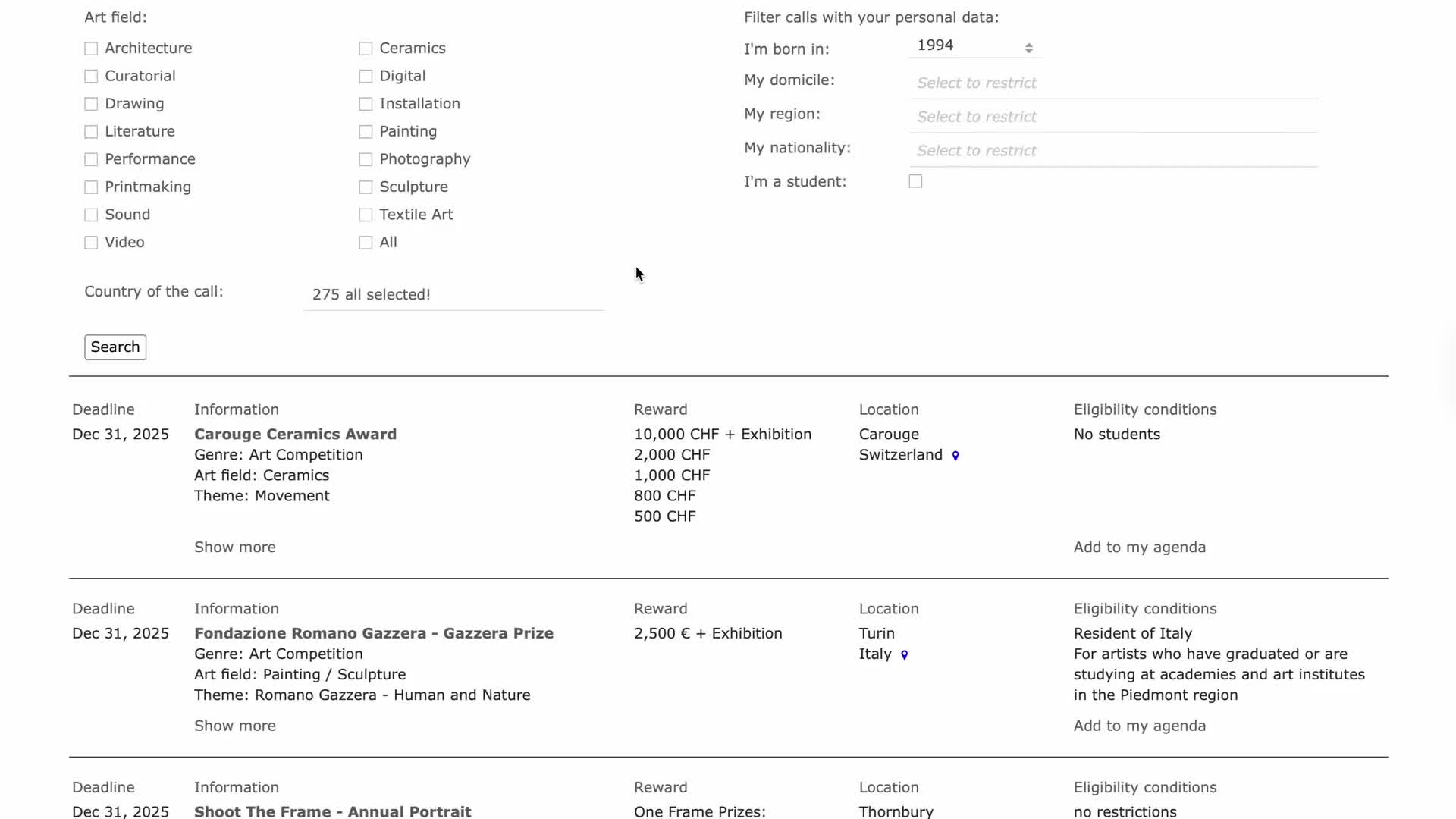
This video is brought to you thanks to the generous support of Artenda, a database presenting a clear and high quality overview of art opportunities and open calls for artists.
Hello dear readers and subscribers.
Artist Residencies are programs designed to support artists, often initiated and funded by government bodies, non-profit organizations, art institutions or sometimes also private patrons of the arts, in which the artist works for a defined period of time at a specific location.
These environments typically provide studio space, but also accommodation and in some cases, also additional support in the form of critical feedback, technical assistance expertise workshops, etc.
In the end, at the core of the artist in residence program is that they aim to create time and space for, for experimentation, for research, for artistic creation.
It is very important to point out, and also to understand, that not all artist residencies work in the same manner, and all too often I see that artists are a bit too focused on the monetary aspect of an artist's residency, as it is an alternative way to earn an income as an artist.
And whereas there are artist residencies that provide grants and stipends, the true value of artist residencies is not necessarily within that monetary gain but in the added value a residency can have for your career and development as an artist.
And this is something we're going to discuss by illustrating the different types of residencies based on what they provide the artists.
Furthermore, we're going to discuss these categories with some specific examples that, once more, as always, have been provided by artendanet, which is our number one recommendation and partner for artist opportunities.
So let's get started.
First and foremost, we have residencies in unique settings, which can vary from historical settings, architectural ones, natural ones, in wild nature.
And this can be tremendously rewarding for an artist to, instead of being in an urban environment or a specific urban environment, to kind of let the environment itself have an impact on the artist and their work.
A strong example can be found in the Fogo Island Arts International Residency.
It offers artists the opportunity to live and work on Fogo Island in the North Atlantic, and its geographic specificity serves, of course, as a natural framework for an engagement with your art, with themes such as sustainability or ecology or belonging.
So therefore, the setting is both visually very striking and also conceptually very immersive and in fact, at this time the program is accepting applications for several residency streams, So definitely have a look at that residency program.
It currently has a deadline of January 23.
Another emblematic example is of course the Villa Medici residency in Rome.
Here there are no production obligations whatsoever.
Residents are not required to produce specific outcomes, but they can truly focus on research, reflection and artistic development.
They also have access, for instance, to shared facilities, including its library, but also sound and video studios, a joinery, a photographic laboratory, etc.
So the residency offers a highly concentrated environment where both historical but also intellectual and material resources coexist.
A second category are production based residencies, and this can be very, very useful for artists who want to kind of expand their practice with new expertise or by having certain access to certain materials.
So this can be very, very useful, for instance, if you are looking to have a deeper understanding of a certain medium that interests you, or that you even already practice, but do not have the access to the resources to practice it and reach its full potential.
A strong example, for instance, is the current Hochschule for Gestalt in Offenbach, which is a porcelain residency program.
So for ceramics,
Artists can work very closely with specialized craftsmen and industrial facilities here, which of course enables them to explore ceramics as a medium in depth.
Another notable example here is the Keyholder Residency, which is dedicated to printmaking.
This program offers emerging artists access to professional printmaking facilities.
They are also open for applications at this very moment.
There is no application fee and the deadline is February 15.
It's a three-month residency that takes place in New York, but also a shared studio space and a 500 euro grant.
Applicants must not be students and they must reside in New York or the surrounding area.
Next, we have the long-term development residencies.
And instead of offering a unique setting or access to certain technical resources here, these residencies truly invest in the overall artistic development of an artist.
So it's a bit like arts education, but actually that goes beyond the arts education.
So it's perfect for, for instance, postgraduates who still want to have that critical framework that actually cannot be found outside of an academic context.
So this includes for instance critical feedback, mentoring, lectures, studio visits, etc.
A key example is the ateliers in Amsterdam.
Applications are actually currently open until January 15 and the program offers a two-year residency.
The applicants can no longer be students and, while there is no formal age limit, most participants are between 20 and 30 years old.
Datelies provides a studio-based and tutoring program, including weekly individual studio conversations with visiting artists and tutors, which form the core of the program and offer continuity and depth.
Artists receive a yearly grant of €17916, a €2100 working budget and rent-free studio space and accommodation.
There is also a more artist-led model which is offered by Tracy Emmen Foundation in Margate in the United Kingdom.
The Tracey Emin Artist Residency is a free and also a very rigorous program that functions kind of as an alternative to formal art education, often compared to a master's program without a degree.
It offers studio space, mentorship and, very excitingly, a direct engagement with Tracey Emin herself, alongside visiting experts.
Think of live drawing sessions and also exhibition opportunities.
So the residency emphasizes experience-based learning and the raw artistic development of its artists, with a strong focus on painting and material practice.
To conclude, there is also a form or a type of residences that are more institutional recognition than they are a program for the artistic development of artists.
Residencies that are dedicated for more established artists.
A key example, for instance, is the British School at Rome, which is in partnership with the Bridget Riley Art Foundation.
This six-month residency invites exceptional early to mid-career artists working in painting, drawing or sculpture to develop their practice within an international community in Rome.
Applications are open to UK or Commonwealth nationals or residents with a deadline of January 9.
And finally Villa Massimo, which kind of represents the pinnacle of institutional recognition for artists based in Germany.
Each year, up to nine scholarships are awarded, providing a monthly grant of 2500 euros and rent-free living and studio accommodation.
There's no application fee and the deadline is January 15.
A selection for Villa Massimo is widely regarded as a defining career milestone rather than a developmental step.
So you can see how every artist's residency can actually bring a certain value towards an artist and therefore, when doing your research for applying to artist residencies, do not focus too much on the monetary aspect of it, on the numbers.
First make sure that they align with what your practice or your development needs.
Financial support is important but it's only part of the equation.
Furthermore, Artenda has been very kind by selecting a high quality selection of residencies specifically for this video, specifically for our audience.
So I will leave a link to those residencies below.
And I will also link to Artenda, of course, where you can explore more residencies for you, for your career.
Thank you so much for tuning in today.
Feel free to watch last week's video where we discuss the most important goals for a successful 2026 next.
Support us on Patreon and please consider subscribing to stay posted for more contemporary art.
Bye!