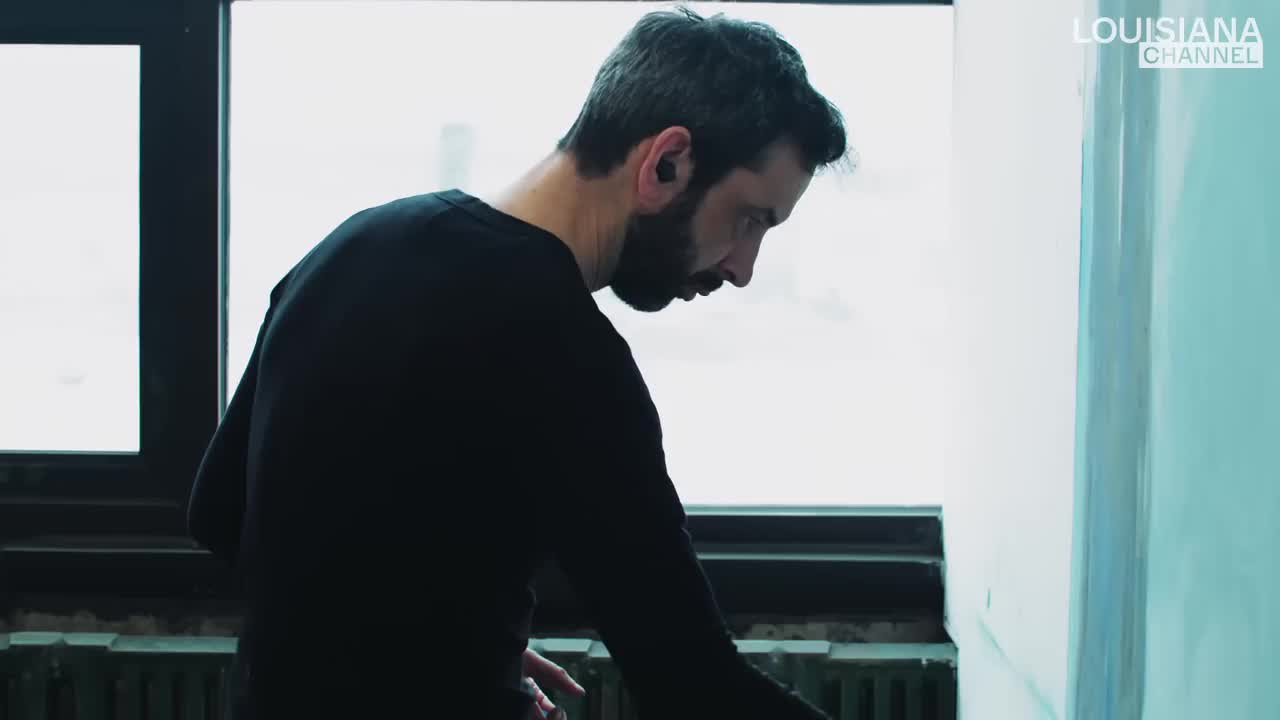
The state of mind that I'm trying to be when I paint is to be as loose, as free as possible and to have no kind of limitation with this specific kind of act, that is, you know, this act of kind of creating an image.
What you really want as a painter probably as an artist is to create a painting that is much more complex and interesting than yourself.
When I paint in the studio I usually try to be really in my kind of mindset and being fully connected to the practice and the process of painting.
So music and books actually like I listen mostly books when I, when I paint, because they somehow use a very different space in my brain.
So it's like drivers do that too.
And I mean the state of mind.
I think it's to try to be as like, as free as possible.
Free is a big word, but like trying to not think about what you're doing as much as possible.
So that's why I play like books or music.
So you trying to be not self-conscious, not like having like, I mean, that's what I'm trying to do anyway.
Like the best is really to get to follow some sort of intuitions and feelings and get like as much as connected with you know, like the act of painting, which probably is just being lost in a much bigger layers of energies and like ideas than just like oh, i'm gonna paint a tree and so, like you want, you're trying to escape that as much as possible.
So it's true, the music is and the books for me it's, it works very well.
I'm sorry.
I mean, what you want with your hands is the... You don't want to think about techniques.
You don't want to be reduced with, oh I don't know how to do that effect, or I don't know how to do an eye, and then I just have to.
Then you get tense, and I think that's where it's very hard to paint.
I think you want to accept your skills, whatever they are.
They can be, you know, in terms of academic knowledge, they can be high or low.
It doesn't really matter.
There's great painters with little skills. and they can produce the best paintings in it.
And the other way.
There's also painters with great academic skills that can really produce great paintings.
So it's the act of creating a painting that is interesting, that resonates with the world in a dynamic way.
I think It's really, I think, probably a lot about the connection that you have when you paint.
It's true.
And, I guess, in general in your life, what you can have, since you emulated with the world that you live in.
Yeah, your hands is definitely the... that it goes through that.
But I always think that the eye is a much more important tool than the hands.
The hands again, like if you accept your limitation in terms of skills because I'm, for example, I consider myself not very skilled.
I'm not like someone that is like a great craftsperson.
If you ask me to draw a horse running, chasing by tigers and there's a dragon, there's no way I'm going to be able to do it without the heavy source images and uh, so i had to like learn to be like.
It doesn't matter, like you can do whatever you want.
It's like children, you know like, especially until a certain age, but until probably like eight nine, they're like, they're completely free.
They never think about like oh, I don't know how to do that.
They just do whatever they want.
And it's usually the best kids drawings around like six, seven, eight.
And as soon as they become more like teenager, they start to be like oh, I don't know how to do the eyes.
And usually a lot of people stop doing it.
So I think for me what is important is more like the back and forth when you paint.
You always step back, you paint, you step back and you look at it.
That moment is definitely, in my opinion, a crucial moment, because it's when you take a decision like as simple as like oh, I need to do that, shape bigger.
I need to do that shade of gray, more red.
I need to add like a bit of white here.
And I think That is the moment where I think things really happening.
It's really this kind of you look at what you're doing and you transform it.
Those moments are very important.
Again, you can't really think about it, you just have to.
I always talk about the idea of practice because I think especially with painters, probably because musicians have that or dancers have that to be the loosest and the freest person.
You really have to practice practice, practice every day.
So you don't even think about it.
I come here every day and I paint for like six, seven hours a day.
So it's not like when I'm here, I'm really like, what do I do?
I'm doing it every day for 30 years now.
So I'm like, I'm just pretty comfortable with it.
So my relation to landscape is yeah, it's true, it's very probably like close to where I grew up.
Switzerland is a very landscapey place.
And especially culturally.
Landscape is a big part of the Swiss identity, like the mountain and the Alps.
Switzerland has a bit of a lack of classic history, meaning you know like big battles, big kingdoms, you know like that uh, that has been.
You know like which is the classic history kind of way of building a um, you know like a nationalistic identity.
Uh, switzerland really don't have that much and i think landscape has been a big kind of identity building in kind of the myth of what is this kind of nation?
So I think, like growing up there, landscape is very present, not only around you with the Alps and the lakes, but also all around, like culture, like it's a very kind of presence.
So probably like this is a part of it.
And I think, everybody that grew up in a place that value landscapes not only as something that you look at, but also culturally, like in paintings, in design, in movies, in books.
That definitely has an impact on someone.
And I think the other way that I feel like connected to landscape.
Again, I don't think I can really explain except that as a subject, when I paint trees and mountains and sky and, like you know, see that I feel like a connection with whatever I'm trying to explore and the feeling that I'm trying to express.
I think there's a sense of peace and a sense of connection to a bigger me that is clearly into this idea of the landscape that I think I like to explore, like in the idea of the, the mountain, this kind of much bigger landscape that you feel a little bit smaller and you maybe you feel like more connected to a bigger kind of you know picture than your neighborhood or like that, something like that is probably like something that marked me as a maybe as a child when I grew up and a lot of the art that I look at has that's kind of A little bit of I will say a little bit like the most well-known artist romantic, you know, the Frederick idea of, like me and facing the nature, that you have this kind of more kind of kind of existentialist, almost kind of perception of yourself facing that kind of nature idea.
So that's definitely a part of it.
I love working with color and color is a very important part of my practice and I think it's also because of my medium, like pastel and, as you can you know.
So in my studio, like I have all those different colors and it's I have definitely this constant conversation and back and forth with seeing all those different colors and applying them, you know, in different ways.
I mean working with colors when you paint it's it's this is like even the most extreme way of being completely intuitive because there's you know it's like really notes or flavors there's not like oh you put this next to this with you know that amount of there it's it's there's absolutely no formula for it.
It's really your pure sensitivity to it, and it is maybe one of the most fun parts of making a painting is putting colors next to each other and to see how sensitive and how subtle, like a tiny shade of a color or this it's all about the the, the shade of the color that you use and the type of color and the, the size of that.
You know, like a surface that you paint with red and then the blue and the green or whatever, and it's like Color only exists obviously, in relationship with each other.
They don't exist by themselves.
So it's all about that mix of those different characters.
For a painter.
That's really fun because it's very easy to change and you just do a tiny dots of one color and change everything and you remove it.
So that's one of the most fun process for me to do.
So it's probably why I use a lot of colors maybe stronger colors because it's even make the process even more fun and kind of entertaining for me because if you use bright colors that process is even like stronger and you feel it's stronger like if you use only like i mean there's a lot of great work in the studio right now but like uh it's it's maybe you have slightly less of this kind of strong impact If you use bright colors, it's very easy to create those strong, dynamic... And that's something that I definitely really love and it's very, very entertaining for me to do that in the studio.
I love that part.
It's probably my favorite part, actually.
Yeah, I mean beauty is definitely, But it's a word that is.
The word beautiful or beauty is a very big word that is very hard to.
It's almost like the word God.
It's like a little bit like, well, you know, what are you going to do with it?
What I like in the idea of beauty is the bit of being attracted, attracted to something.
And then when you're attracted to that, you know space.
Inside that space you can, you can explore different, different kind of ideas and feelings.
So I think for me, beauty is a way to attract someone inside and I think nature has a lot of that relationship with humans for a very long time.
Like this idea of like, oh, this is beautiful.
The flowers are beautiful.
Those animals are beautiful.
This tree is like, and I think that that moment of attraction, then you get lost in it.
You can, I think, connect to a very specific aspect of humanity, and I think that is kind of something that I'm interested with.
My landscape in general are not realistic in the sense that they represent basically an idealistic portrait of nature and I see them as like either pre-humans or post kind of humans and kind of this idealistic way that human have been seeing kind of nature and landscape very much in kind of in opposition of the idea of the landscape that represents where we live, which is a strong history, especially with the kind of the realistic type of landscape of the Barbizon school.
But even like the impressionist landscape where basically, like the representation of landscape changed by humans, is very presence and the human presence in the landscape is a very important aspect of that process.
In my representation of landscape.
It's more this kind of almost this conception of this idealistic nature that we've been having for a very long time.
As far as we know, the paradise is basically nature.
And it's human, before we were human, we were all in this perfect nature.
And then we had the sin of becoming humans.
And then we basically created this chaos.
And then after that, like we're supposed to go back to this idealist nature.
So it's a little bit of that part of that Western kind of canon and this storytelling of that nature is perfect without us.
And we have this kind of strange relationship with the idea of nature.
I will say that maybe you don't have to believe that your work has to basically be important.
That's because that's too, it's too much of a weight and it's probably gonna block you, you know, when you go to the studio.
But anybody will probably be almost everybody in the world will agree that an autistic kind of object is one of the most important thing they have in their life after like, the basic of health um, and you know very material kind of thing like a roof, those kind of things, uh.
But you know, like i think music is probably the and it must have been really the first art form.
Uh like rhythm, it's like it.
You can ask anybody pulling across all the cultures like oh like, Can you see yourself without any music for the rest of your life?
It will be extremely hard.
People that even don't listen to music much.
They don't realize how much music there is around constantly.
Of course, TV is full of music.
But now, I mean now, music is everywhere obviously, but it's even in the past like rhythm and songs were like, and I think, I think it's just a way of connect to our feelings, and the feelings can be very complex.
It can be like how we perceive our own place in this universe, or just like love or sadness, which I think, at the end of the day, feelings is what drive humans to be humans, basically.
And I think, of course, if you say oh painting, if you extract oh, is painting important as one object?
You're like, of course not.
But if you think about any creative object that are surrounded by us, this is obviously a hugely important part of human culture, because it's the only way we express feelings.
Like without music, without storytelling, without like exactly legends and books and dancing, we can't express those feelings.
And it will be probably unbearable to live without expressing those feelings.
As again, as deep as like the fear of death or the joy of new life, or as common as love, those things need to be put out.
And art is there for that, basically.
Thank you.