Hello and welcome to Roundtable, where we serve up piping hot debates on the issues that sizzle in China and beyond.
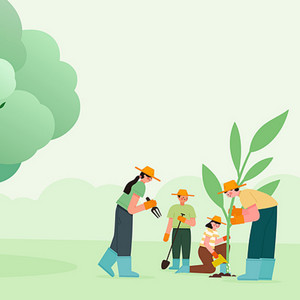
I'm Yeohang Lin. If planting trees could be a competitive sport, China would be taking home some gold medals.
With over 25 % forest coverage and the world's largest artificial forest, China isn't just going green, it's going super green these days.
But how did this happen?
Let's stick deep to find out the roots of this incredible transformation.
For today's show, I'm joined by Lai Ming and Steve Hatherly.
Now grab your virtual compass and follow us to the heart of the discussion.
Once home to some of the world's most severe desertification, China was losing land at an alarming rate.
Fast -forward to today, and it leads the world in reforestation.
What changed? Is China's green success just about planting trees?
What's the bigger picture?
What are some lessons that we can learn from the previous approach?
March 12 marks China's National Tree Planting Day.
On this special day, Roundtable invites you to discover how to make us greener.
And before answering all these serious and hard to answer questions, I wanna ask you a simple one.
Have you ever planted a tree before?
Well, I'm Canadian, so what do you think is the answer?
Canadians plant trees?
No. I've never even seen someone plant a tree before.
Oh, really? No, it's a thing in Canada.
But it absolutely is for sure and it's a thing that people do sometimes as a job after university or even a summertime job and it pays quite well.
That's why it was such a popular thing to do.
When I was in university, I never did it myself, but I know plenty of people who did do it.
They talked about how much money they could save doing it as a part -time job in the summertime and they also talked about how hard it is.
It's very labor intensive or at least it was at the time, but yeah planting trees is something that's always Always on the tip of our tongues when we talk about nature in Canada for interesting I'm sure tree planting is organized differently in Canada, but I'm sure is just as important as it is in China cuz As I understand the geography of Canada There's a large part of Tundra, so not every part of the country is covered in forests But I'm sure forest is needed where you are.
So maybe that's just the way work is organized.
Sure, yeah. Getting well -rewarding jobs.
Yeah. I'll touch on Canada's forestry situation in a little while.
And the reason I'm asking this question is because I have and...
Oh, you have? Yeah, I have tried, managed, helped, planted a tree.
And that was because of the tree planting day.
Of course, here in China, planting trees is a very professional thing.
You have workers doing that or farmers doing that.
Yet, for each and every individual, if you're interested in this great cause, if you think having the experience of planting a tree could be a fun little story that you can share in your later life like I'm doing right now, there are plenty of activities allowing individual citizens, those who have never used a shovel, have the experience of get your hand dirty a little bit.
You plan this huge sampling.
It's not a tiny little branch that you would imagine a little, even a little scene, no, no, no, no, no, no.
It's just huge sampling and you need to use this real shovel and it's really much harder than you...
Yes, it's really much harder than you think as someone who is not that tall and strong and women, I find it a bit hard than I thought.
Yet, while I was doing it, I think it's two or three years ago, I also was joined by a lot of families, a lot of kids in their primary school and middle school.
And also you have the parents bringing their kids.
The kids would help bring the water to water the tree and they would even clean up the whole you dig into the ground pick away the little rock and flint and little branches and just clean the area but it's a really fun family activity for them and it's a really good early time education for the kids to understand the importance of planting trees as well as the responsibility of we being an individual is also pretty much involved in this.
Yeah and in Canada we have tree planting day as well here in China.
It's in March, but I think it's in September in Canada and it's part of National Forest Week.
And I think we're about to learn.
It's very similar to what happens here in China where you have government campaigns, but then you have grassroots level involvement.
For example, school campaigns as well where the kids can get involved.
And there's a lot of volunteer work during that time where thousands of people will gather, companies will get involved.
Yeah, that too, communities.
Yeah, and send their employees out to get involved as well.
So it really is kind of a moment to reconnect with nature, and it's a moment to remember as well how important trees and forests are to our climate and to our planet.
I think the tree planting day nature in China is quite similar to that.
Tree planting day nature, of course, is designed to encourage people to plant trees According to China Odyssey Tours dot com China's tree planting day could date back to a proposal made by Dr. Sun Yat -sen which is a great, who was a great China Revolution leader.
He made the proposal in 1915 oh wow the regulation was formally publicized that Tomb Sweeping Festival April the 5th was adopted as tree planting day however April 5th was a late time for tree planting in southern China, well, we are a big country.
So it was changed to March 12th by the Nanjing National Government in 1927 in order to commemorate Dr. Sun Yacen, who passed away on March 12th 1925.
And then the day was reaffirmed in 1979 by the People's Republic of China, with Deng Xiaoping playing a significant role in promoting this initiative.
Hmm, so what happened?
I love that history.
I didn't realize it went back that far here in the country.
So, on this day, I mentioned a couple of things that happened in Canada or happened in Canada during this time.
Similar things here.
I guess a lot of people get involved, yeah?
So, on this day, we would definitely promote tree planting in a way like Roundtable is doing that on a special day.
And, of course, we have different communities, schools, companies organizing these tree planting activities.
city, but that is from a larger scale and basically telling people that making our planet, making our country greener is a very important thing and it matters to each and every one of us.
But besides that, a lot of other, I would say, relatively even more concrete work has been done.
Sure. According to a recent China Daily report, Liu Jie's spokesman for the third session the 14th national committee of the chinese people's political consultative conference, china's top political advisory body and he mentioned that china's forest coverage rate has exceeded 25 percent and this is an increase from 12 percent in 1981.
like i said like i keep stressing china is a big country so that percentage rising from 12 percent to 25 you can only imagine and the amount of efforts and the amount of trees having to be planted.
100%. China also leads globally in artificial forest area.
It's emerged as the world's top contributor to increasing greenery and the numbers have continued to grow and when the numbers grow in this context, it means a huge improvement.
There was a report from the People's Daily in December of 2024 that talked about the fact that China's forest coverage rate was at 12 % in 1981 and we heard that updated number, and you make a great point, Laiming, in the vacuum, going from that percent up to 25%, might know, okay, that doesn't seem like - Not that impressive.
That impressive, but when we consider that China is one of the biggest countries in the world, then, yeah, it is a massive improvement, isn't it?
I was looking at a website this morning that I found called South China Botanical Garden in the Chinese Academy of Sciences, and they were talking about the year 2022.
And by that time, China's total forest area had reached approximately 220 million hectares, with over 80 million hectares of artificial forest accounting for about 23 percent of the country's land area.
And over the past couple of decades, large -scale afforestation efforts, they've put China in the position as the world's leader in artificial forest expansion, contributing around 25 percent of the global increase in green cover.
And since 1995, China's classified forests, and this is a really smart move too, classified forests into ecological public welfare forests and commercial forests according to the purpose and management objectives.
So they know what the forest is for, and therefore they know how to manage and take care of that forest.
Planting trees sounds like a simple idea.
You've got the sampling, you put it in a hole on the ground, and you wait for the nature to do the magic.
but it's much harder than that.
Like Lai Ming has said repeatedly, China is a vast country which means the geographical situation, the climate situation in different provinces, maybe in different cities and townships can be different.
So you need to carefully select the kind of tree you want to plant.
You want to make sure it does not mess up with the local relatively small ecosystem of that area and some in some local government they need to also make sure that for example the tree that you're planting and the forests you're creating would not in springtime trigger massive allergic situation in the city with your people so it's actually quite scientific so are we doing well and each and every province in different places?
Well there is the consideration of whether the trees you're planting are fit to grow in the region.
I think older residents in the city of Beijing could recall their plague if not the plight of catkins in early spring.
Steve, you're new here.
You're soon going to experience the overflow of catkins floating in the air and and costing people just sneeze.
So that was the result of massive tree planting efforts back in the days.
And now, the city is thinking about replacing many of the what we call them yang xu.
I don't really have the vocabulary for the word here, but is a particularly tall tree, type of tall tree that grows very fast in northern China.
And so that could be an issue, but the city's in the process of replacing them with still the same type, but they're not prone to produce the kind of catkins.
So as to - I look forward to finding out what this is, it's going to happen soon I guess.
Maybe Alamo, the tree.
Yes and the thing is with the city of Beijing, there are more, I try to find a bit more information about Beijing because remember Steve in some of our previous shows you keep on talking about coming to Beijing and realize how green it is.
You find it super green and I was trying to see whether or not it is your own impression or it is really something that can be supported by data and this is what I found.
In 2024, a Beijing officially unlocked its status as a city of 1 ,000 parks, reaching a total of 1 ,100 parks across the city.
And two thirds of these parks have adopted an open and interconnected design, allowing for seamless public access.
Meaning that whenever you go out, you would see something green.
So it's not you. It's really the city.
Yeah right. I figured as much.
And it's very interesting, because on January 22nd, 2025, is this year, Beijing Municipal Bureau of Landscaping and Greening released the 2025 Urban Greening Work Plan and the aims to create 200 hectares of new parkland and green spaces, including 15 leisure parks and urban forest, as well as 50 pocket parks and micro green spaces, and it will enhance 10 old age -friendly parks and 10 tweed -lined roads.
And there are a lot of different types of initiatives, actually, I find some very interesting, including they're even hosting a National golden corners and silver edges, urban micro garden competition.
What's that? That means that when you are walking in different blocks, the corner area should be decorated with different types of flowers and decorations.
And the line, which means the wall besides different trees and avenues, would have different plantations.
And that is the kind of example I find very interesting because we're living in city area, in urban area.
you feel like we would feel like forestation is something a bit far away from us.
We're thinking about those huge forests with maybe deer and tiger in it.
I don't know, I'm not really good at this.
Yet, actually it's related to us in a very, in everyday life kind of way.
100 % and it's not just the cities, it's the country as a whole.
The term carbon sink if you're familiar with that, carbon sink refers to the reduction rate at which carbon accumulates in the atmosphere, and thus reduces the rate of climate change, or the rate at which climate change occurs, and that's what forests are sometimes called, right, carbon -carbon sink?
When we cut down those trees, when we get rid of those trees, well that carbon's released back into the atmosphere and it accelerates climate change, and at the end of 2023 China's annual carbon sink reached more than 1 .2 billion metric tons.
And that's doing a really great job, not just for the cities, the bigger cities here in the country, but also the country as a whole.
We talked about Beijing a little bit, but it's not just Beijing, right?
It's other parts of the country too?
Sure. In Taklamakan, a recent CCTV report says on November 28th, 2024 in Yutian County on the southern edge of the Taklamakan desert in Xinjiang.
the final section of tree planting was completed.
The 3000 kilometer green, sand blocking shelter belt surrounding the Taklamakan Desert was fully connected and therefore forming a continuous protective barrier.
In northern China's arid regions, the tree coverage rate increased from approximately 5 % to about 14 % and I have to say China has done a lot to study and experiments with the techniques and the types of trees that we can grow in different environment.
We know that in Northern China is much drier.
There aren't as much rainfall, and therefore it's not wise to plant trees that can only grow in more humid weather because they will take more water to irrigate.
And if they take up too much water for irrigation, then we are taking valuable resources from animals and humans in our daily lives.
Yeah, it's a delicate balance, isn't it?
Right. So as such, in Northern China they commonly used plants, trees are like black locust, cypress, elms, bruise, sea berry, so and, and so I don't know, I don't have the vocabulary again for that, but I know this from - You're forgiven.
I don't even know what those are in English.
I kind of feel like I know where - These are bushes.
Yeah, and we plant them in deserts.
I know this from planting virtual...
I wouldn't say virtual trees, but virtually planting trees on Alibaba payment tool Allepay.
That's a recent thing too, right?
Well, not recent in terms of last year, but recent in last few years where people can plant a virtual tree, it's a donation, right?
It's a donation. And then somebody goes out and does it on your behalf.
Yeah. There are other measures as well.
This is from China Daily last year.
They were talking about China's national forestry and grassland administration and how they in recent years have implemented this forest chief responsibility system.
system. It was by June of 2022 that the system had been fully implemented nationwide.
And it resulted in a decrease in forestry and grassland administrative cases and it boosted ecological environment restoration.
What that group does is they assign specific responsibilities for designated areas, ensuring that local authorities are answerable for the safeguarding in the development of forests and grassland resources, then this system has been pivotal in advancing the restoration of forests and grasslands and enhancing ecological conservation, because, again, going back to that point of how big China is, and we're not talking about one region here, we're not talking about one specific location, when we plant the trees there, when they plant the trees there and they're trying to develop the area, then they
need to monitor and they need to safeguard that and that's exactly what this group is responsible for and they've been very successful in doing so.
and on top of having someone responsible for a forest actually there are some other smart moves we are using smart landscaping and digital technology to help manage trees and forests implement real -time monitoring for vegetation health and pest risks and also there are renewable energy integration in this grade costs promote solar trees in hybrid solar wind street lights in urban landscape is also another approach.
And I have also looked into a little bit of the exact kind of tools you would be using when you're planting trees, because I'm just I remember that very heavy shovel quite vividly.
So I was kind of curious about whether or not you doing things differently.
And look at what I found.
Multifunctional planting shovel, traditional shovels have limited functions, but the innovative multifunctional planting shovel brings significant improvements.
This shovel not only easily digs holes suitable for sampling growth, but also integrates features to measure depth and angle, ensuring standardized planting.
It's a smart shovel, essentially.
It is. Is it Bluetooth enabled?
Well, the shovel might not be, but there's also intelligent tree planting robot that is newly developed, and this robot is capable of precisely locating planting spots and efficiently performing tasks like digging, planting, backfilling at the predetermined depths, and you can...
It is equipped with advanced sensors and intelligent control system.
They are Bluetooth.
And these robots can adapt to complex terrains even for those areas that are hard for human beings to go to.
These robots can go there and plant trees.
Yeah, recently on Roundtable we were talking about AI in the agriculture sector and how useful it is and how much of a… how much of a true game changer it is.
So fun! And it was.
and now we can easily see how that could be implemented into the tree planting sector as well Using robots or autonomous vehicles to do the planting to make sure that each plant is done Absolutely.
Perfectly right at the right depth and the right conditions You know we can be prone to human error when we do it ourselves Especially after you get tired a little bit your method of planting the trees.
It's really quite difficult, isn't it?
If you're doing it all day, right?
So this is just another great development here in China.
We have a phrase Mian Chaw Huan, Tu Bei Chaw Tian, a phrase that we use to describe the hard work that farmers putting to do what they have to do, planting, growing, and growing and vegetables.
The direct translation is to face the yellow dirt and then have your back against the sky the whole time.
And we know the years of physical labor can do to somebody's physics and sometimes Sometimes people get host bags and stuff.
And then, what is the word?
Arthritis? Yes. That's the word that you describe the symptoms of your anchors and joints.
So with AI or robots replacing humans, then I can only see good things happening too.
In fact, perhaps I could imagine young people wanting to go back to agriculture and to tree planting.
Yeah, absolutely. because not only is it something that could connect communities, but it's important, it's really important for our environment.
I mentioned a little while ago, I wanted to just briefly touch on Canada, because it's such an important issue in Canada as well, because forests and trees, they're nature based solutions, aren't they?
And they've been supplying people with food and heat and controlling soil erosion and improving water quality and providing habitat for many species.
That's important. It's supporting biodiversity.
They can help stop floodwaters from reaching homes, depending on which forest in the world you're talking about.
Snow in Canada is a big issue.
They can act as a shield from that.
And forests provide clean drinking water to just under 50 % of Canadians and support clean air for all.
Canada is known for its good air quality.
But we also have our challenges there as well, our own environmental challenges.
as recent data has indicated a concerning trend in tree cover loss over the past couple of decades.
The country has seen a net decrease in tree cover by approximately 2 .76%.
And that's just a figure that underscores the challenges that we face.
That doesn't sound like a big number.
But if that number continues in that direction, then it's going to be a bigger problem.
We're also facing things like wildfires, forest fires these days.
So we also are facing our own challenges forest -wise, And we have to figure out our solutions, too.
Yes, and even though tree planting is the keyword here, actually we're talking about a broader issue that is to make the environment better, make the planet greener, which is why on top of planting trees, China is also working on wetland restoration.
We're working on promote great grass, use as a way to do sand control in northwest China, integrating ecological restoration with renewable energy, and also there's the coastal protection.
We are trying to make sure that in the sea, the plants in the sea are also grown properly, and in that sense, again, it is related to each and every one of us and by doing so, we can enjoy a better environment.
And we can enjoy the urban parks with cultural heritage zones linked to the green tourism projects.
That's some really good way of using these green lands and by developing wetland research hubs and forest wellness resources and resource we can go enjoy ourselves in our free times in those places as well so yeah tree planting day striving for a greener future is always a good idea just remember you're not doing this for the planet you are doing this for ourselves because the planet would be just fine without human beings and we are doing this to improve our environment in fact.
Great point.