We'd like to thank Audible for supporting PBS.
I recently visited an art museum and learned very little about the art on display, but quite a bit about myself.
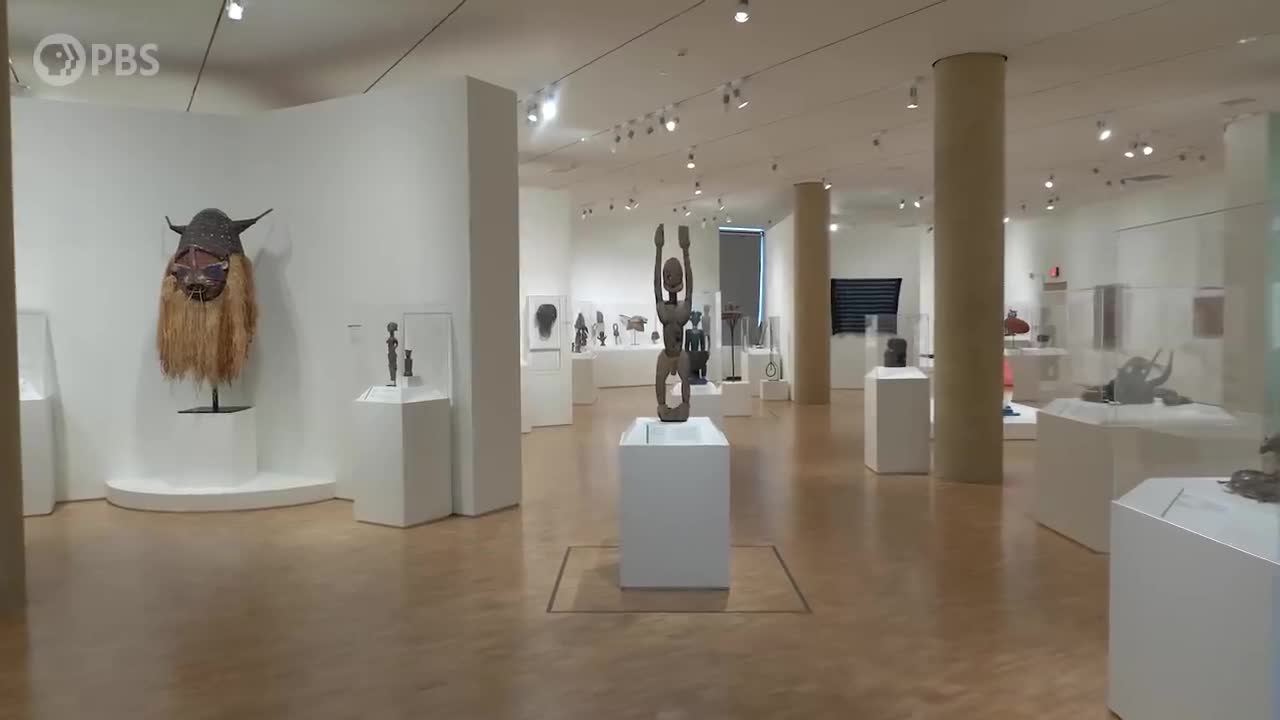
That's because I was meeting up with not a curator or docent or artist, but an art therapist at the Sidney and Lois Eskenazi Museum of Art at Indiana University, Bloomington.
The building was designed by architect I.M.
Pei of Louvre Pyramid fame and recently underwent a $30 million renovation.
I wanted to go check out their collection of over 45000 objects, visit the new galleries and also experience an art museum in a completely new way.
Not to read all the labels or think about history, nor to contemplate the many ways artists have understood the world and manipulated materials.
Those are all things that can and do happen at this place, but not this day.
This day was for free association and introspection, letting the art be the art and me be me, and working with a credentialed art therapist, see what kind of connections we might draw between what we see and what we feel.
Are you with me?
Let's start with this artwork.
We're going to break from tradition and not tell you at first who made it or when or why.
But we are going to look at it and ask ourselves objectively, what do we see?
I see lots of shiny little metal objects held together by wire, joined into a kind of quilt-like structure which must be affixed to the wall but appears to be floating there as if frozen in mid-motion.
To me, it looks delicate and flexible, but also strong, simultaneously intricate and stable.
If you're at the Eskenazi Museum and working with their credentialed art therapist, Lauren Daugherty.
She might then ask me to take it a step further and consider whether I might find any metaphors in what I've described or find a way of connecting this object to my life.
Perhaps my life, like this artwork, is delicate and intricate, but stronger and more stable than it looks.
Someone else might look at this artwork and say it's held together and on the wall, but it looks like it could fall off at any second.
Maybe that resonates with them in their life, and they're held together, but barely.
Lauren might first ask, What holds this object together?
And then transition to asking, What holds you together?
Then she might show you to the art-making studio where you could create art that relates to this question in some way.
She might ask you to picture what your life would look like if the thing that was holding you together wasn't there.
Alternatively, she might ask them to envision what their life would look like if what is missing was actually there.
If their soul was whole, what would it look like?
Lauren's approaches are variable and depend heavily on who she's working with, both in the gallery and in the art studio.
With adults.
She might lead with more open-ended questions and tends to give them a wide range of art supplies to work with.
With kids, she'll usually ask more pointed questions and give them specific materials and a more structured activity in the studio.
After talking about the last work.
For example, she might ask a group of young people to weave together found objects that mean something to them and figure out a way to make them physically hold together.
But the work she does she describes as emergent, meaning she has a plan to get the discussion started, but lets it take its own course.
She responds to what arises and makes connections between the things group members are saying, the goal being to reassure participants who are making the often scary leap between stating what they see and expressing how it relates to something from their interior lives.
By the way, I am a terrible candidate for art therapy.
Anyone who's studied art can have a really hard time doing this, because it can be difficult and or impossible to separate what you know either about the artists or the tradition, or about materials and processes, from your reaction to the art.
Like when I look at this work.
I've got all these alarm bells going off about tidbits of information that I know.
This is El Anatsui.
He's from Ghana and works between there and Nigeria.
Those pieces of metal are recycled liquor bottle caps and he works with teams of people to bend and shape and connect them, transforming them into usually wall-based sculptures that can be monumentally large.
They also change, with each installation, endlessly variable and able to be adjusted and draped in new ways.
His early works were variations of Ghanaian kente cloth, but he has since expanded in many new directions.
But in the context of art therapy, my aim is to connect not with the information about the work, but rather with the artwork itself.
This is also what makes art therapy really great for people new to art, who might have an easier time getting over themselves and what they're so proud of knowing, and be able to better connect with what they're actually seeing and consider how it might relate to aspects of their lives.
Art therapy challenges you to consider what it is that you're actually responding to.
Are you just recalling trivia or actually letting the art do its work?
But we can still use those tidbits of information we know to connect back to our task at hand.
Like.
If I'm already thinking about the communal nature of this work, perhaps I might associate it with a sense of belonging or community.
From there we might consider what other works in the gallery might connect with the idea of belonging.
Like.
I also know that this giant fish sculpture in the middle of the gallery is a coffin, a communal object, if ever there were one, an object made for a community to send someone into the afterlife.
If the discussion went in that direction, Lauren might then ask us to make something in the studio that responds to the question what do you envision the afterlife to look like?
The glory of this approach is that you don't need to be an expert about anything and you can have a productive experience, even if the assumptions you make are wrong.
The art can be whatever you think it is and you can go on a journey based on what it looks like to you.
If you thought the El Anatsui work looked flexible but strong.
What else in the galleries might represent that?
Maybe we think this little alligator dude looks strong, or these figures exhibit strength, or maybe we see a mask in the room that we think looks strong.
Perhaps someone else sees a different emotion in the mask, which might lead to a discussion about the things you do and do not show the world.
What masks do you wear?
Lauren also works with groups of young people who have been through traumatic experiences.
And she finds landscapes to be particularly useful in sparking discussions among them.
Let's take this painting, for example.
You know how in Mary Poppins she takes the kids into the painting?
Well, Lauren might ask her group to do the same.
Where do you belong in this painting?
Sometimes darkness can be traumatic for people.
Maybe for those who've been victims of sexual abuse that only happened in the dark.
Considering where they would be standing in the lighter areas or in the darker ones can be a way to begin a discussion about extremely difficult topics.
What kind of things might happen if you weren't in a safe place?
Often in their responses, they're building from past experiences.
This painting is titled Flight Into Egypt, by the way, which may impact your reading of it.
See?
I can't help myself.
I am terrible at this.
But let's consider where our safe places might be in another landscape.
Perhaps we want to be in this house over here. or hidden up in a tree.
A kid might joke and say, I want to be hanging from that limb right there.
And Lauren might ask, does that actually look safe to you?
What would happen if you fell?
One might say their mom will give them a hug and a Band-Aid.
And another might say their dad's going to be mad when they fall and break something and have to go to the hospital where it's going to cost money.
Another might say they'd want to be away from the shady-looking guy with the stick.
Another might think he doesn't look shady at all.
Maybe he's stranded.
Me?
I'd be with the group of people right there in the light.
They're on the path.
They know where they're going.
But someone else might not find safety in other people.
Maybe they say, I don't want people bugging me all the time.
That all tells Lauren something and gives her a direction to take her follow-up questions.
Back in the art-making studio, Lauren will ask the group to make what she calls safe place boxes, taking old jewelry boxes and transforming them by adding drawings, collage elements, small objects and anything else.
She'll ask, Who belongs in your safe place?
Who's allowed in and who isn't?
When they're done, they take their boxes with them and they can serve as a kind of transitional object, like a security blanket that goes with them through lives that can be highly volatile and changing.
Now you may not have such a program at your local museum and you'll never know until you look into it.
But even if you don't have access to an art therapist, there are some ways to incorporate approaches from art therapy into your next art experience.
When you find yourself in a gallery or museum, look at portraits and make up stories about what the people might be saying.
Like this lady right here in pink.
Maybe you look at her and think she looks mildly annoyed and disapproving.
She might be saying, really, you bore me with your incompetence.
You might then ask yourself, who does this remind you of?
If you say your grandmother, maybe you think about what your grandma means to you.
Is she or was she a supportive presence or a critical one?
If she were with you, would that make you feel safe?
You might look at another portrait nearby and imagine a conversation between the two of them.
What would they say if they could talk to each other?
Or if you just want to focus on this one, imagine if this person were giving you advice.
What would it be?
More often than not, that advice will be something you need to hear.
Alternatively, you could consider what advice you'd offer the individual in the painting.
Walking into any museum.
You could guide your visit with a larger quest like to find a symbol of strength.
Perhaps you find that in a portrait, but you might just as well find it in a landscape or an abstract work, or even a conceptual one.
You might try to find yourself in the galleries.
Perhaps it's just someone who looks sort of like you, or you might think about a quality you have that you see exhibited in someone or something else.
Find something you associate yourself with or would like to associate yourself with.
There are a lot of difficult topics that art can help you confront or address, but those are probably not the best ideas to explore without the guidance of a licensed therapist.
Like you probably wouldn't want to guide your museum visit with the question what are you missing, unless you had a therapist with you who could help you explore the dark places but then lead you back to a more positive, constructive place?
If you're doing this on your own, you could try to find a work of art that reminds you of home or reminds you of your most beloved family member.
You could look for an image or object that brings you comfort.
Like one painting might remind you of a vacation with your family, or another might remind you of the tea parties you had when you were a little girl.
You might then ask yourself, how did you feel back then?
And how does that differ from how you feel now?
If you're looking at abstract works, you might try to attach emotion words to them, like joy or anger, elation or confusion.
You might find an expression of happiness in the galleries, or sadness or something harder to give words to, but that an image might capture even better.
But whatever you do, try to end on a positive note.
It's important to remember that real art therapy is facilitated by a professional therapist who weighs a lot of concerns and tailors their approaches very specifically to who they're working with and the environment they're working in.
Whether it's in a museum or within a hospital or shelter or nursing home or veterans organization or school, art therapy can deeply enrich the lives of a wide range of individuals and support therapeutic treatment goals.
It can be part of treatment plans for those with severe medical and mental health problems, but it can also be something that just improves your life in a smaller way, helping you give voice to your emotions and experiences.
Best of all, it's a way of being with art that doesn't ever make you feel stupid or self-conscious about what you did or didn't learn in school.
My art therapy experience has made me question the ways I usually look at art in a really challenging and exciting way.
Most of the time, I'm still going to read the labels and give in to my desire to engage with art intellectually.
But other times maybe I'll just engage with what's in front of my eyes and dare myself to see how it makes me feel.
We'd like to thank Audible for supporting PBS.
Audible's selection of audiobooks includes Audible Originals, audio titles created by storytellers from around the literary world.
For example, Bedtime Stories for Cynics a hilarious collection of short stories presented by Nick Offerman.
Members own their books and can access them at any time.
To learn more, visit audible.com slash art assignment or text art assignment to 500-500.
Thanks to all of our patrons for supporting the art assignment, especially our grandmasters of the arts Tyler Calvert-Thompson, Divide by Zero Collection, David Golden, Tim Seery and Ernest Wolf.