Empathy is a word we hear pretty often these days, used to describe our ability to understand the experience of someone else and in some way share in their feelings or plight.
And art can be really good at stimulating empathy.
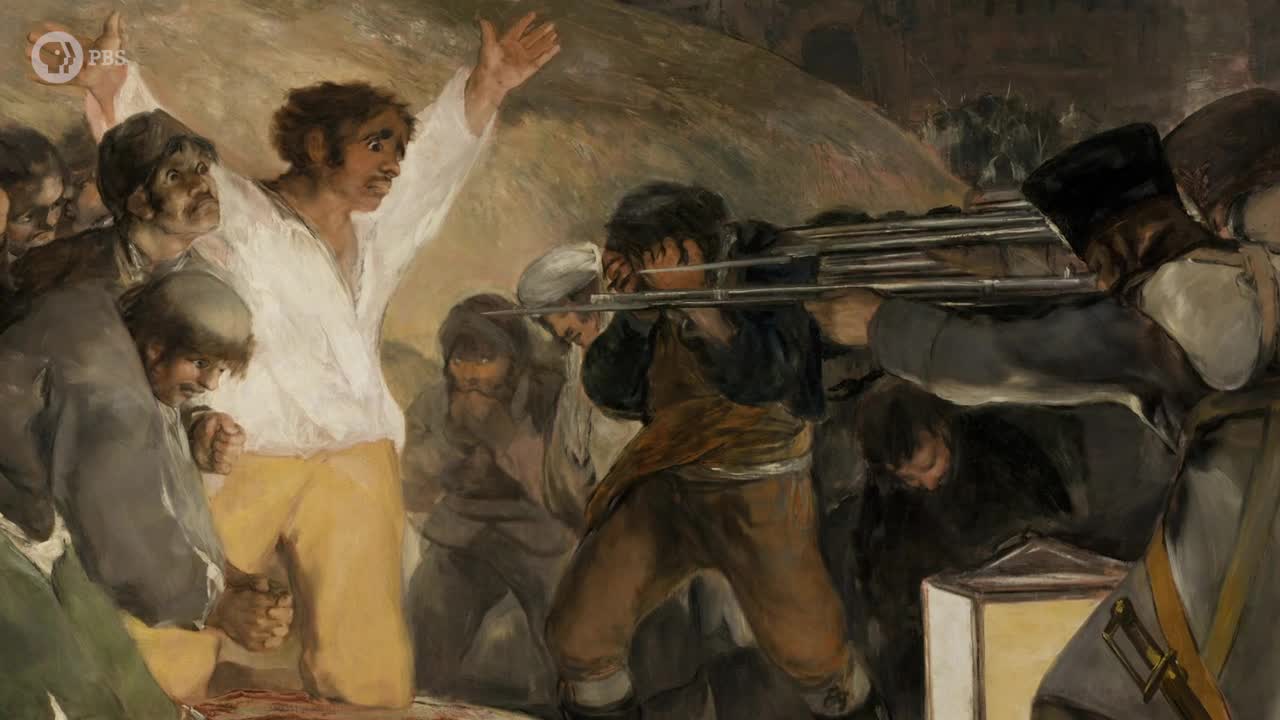
For example, if you look at Francisco Goya's The Third of May 1808, it's nearly impossible not to feel for its main subject.
A man is pictured at a moment of utter desperation, his last moments.
We feel for him.
We ache for him.
Maybe our pulse quickens.
Maybe we even find ourselves mimicking his wild-eyed, pleading stare at his executioners.
We brace for impact.
This ability of art to link us to others and arouse feelings within us is one of the primary reasons people like art.
If we let it, art can penetrate the jaded armor of modern existence.
Many of us wear inviting us to feel what someone else once felt, someone who might live far away or in centuries past.
Empathy's relationship to art gets more complex when you consider the origin of the word, which came into being only about a hundred years ago.
English-speaking psychologists in the early 1900s were trying to translate the German term Einverlang.
They were describing the capacity to project one's own feelings into an object, thereby enlivening it or transforming, let's say, a big hunk of metal into an object of contemplation.
Empathy was coined using the Greek m for in and pathos for feeling.
But this putting the feeling into something is quite different from today's conception of empathy as a kind of bringing the feelings in from someone else.
This is the fifth and final video of our series focusing on a much-discussed idea or aspect of life today and looking back to see how people from the past have made artworks and objects that speak to it in some way.
Today we address art and empathy.
Empathy both in its original and current understandings thinking through where and when and how the feelings are coming in and radiating out.
And we'll explore a few of the many ways art has assisted in the process of not just envisioning but actually feeling the worlds and experiences of others.
Religious art has long taken on the task of stirring up emotion and empathy in those who look upon it.
The Rotgen Pieta is a painted wood sculpture just 34 inches high, created in Germany in the early 14th century.
It depicts the biblical story of the Lamentation of Christ, when Mary holds the dead body of Jesus, her son.
There had been many Pietas before, but what was new here in the late Gothic period was an emphasis on the humanity of the subjects.
Mary is very visibly distraught confused, even angry, which sets her apart from past depictions showing Mary at peace, following the Catholic belief that she had the foreknowledge that Jesus would rise from the dead.
But this Mary does not seem to know, or at least feels no comfort in the knowledge.
Similarly, Jesus is shown to be deeply, gruesomely human.
We see the gory, gaping wounds from his crucifixion. with dimensional blood pouring forth.
Oversized thorns extend from his crown and presumably also into his head, with dripping blood painted down his forehead.
The paint has deteriorated and used to be much more vivid, likely amplifying the intensity of the scene.
Catholic writers during the later Middle Ages had begun to describe a Christ who was less of a divine figure and more human.
Francis of Assisi, for instance, wrote about a Christ who was poor and who understood and related to the pain of being human.
A new spirituality had emerged, a kind of mysticism that described moments such as the Lamentation with great detail and emotion.
The Rotgen Pieta and others like it were intended to bring this story alive and into the present, to summon its spectators, to connect with these figures on a deeply personal level.
It was meant to deepen your faith by generating empathy for the suffering of Jesus and Mary, but also demonstrate that these divine figures could understand your suffering.
Emerging from the Buddhist tradition is another divine being embodying compassion.
Jizo is a bodhisattva entrusted with the salvation of all thinking beings between the death of the historical Buddha and the advent of the Buddha of the future.
The representation of Jizo we're looking at now stands at nearly life size and was created in Japan between the late 12th and mid 13th century.
It was carved from wood and bears traces of the colorful lacquer and gold leaf that originally decorated it.
Jizo is portrayed in a state of meditation and as a traveling monk, wearing humble garments and carrying a pilgrim's staff in one hand and a wish-granting jewel in the other, a symbol of his limitless powers to answer prayers.
The Japanese name translates literally to Earth Repository, and that is indeed Jizo's role as the Buddha Amitabha's attendant and intercessor in the world, postponing his own Buddhahood to help others achieve enlightenment.
The deity is both a symbol and embodiment of empathy and also a model for similar behavior among its worshippers, demonstrating how compassion and empathy can be a foil for suffering and a gateway to enlightenment.
In the early 17th century, Guaman Poma gave us a window into the suffering of his fellow indigenous Peruvians under Spanish colonization.
It took Poma nearly three decades to create his nearly 1200-page illustrated manuscript the first new chronicle and good government, completed around 1615.
It records the extensive history of Andean civilization before the Spanish invasion, as well as their ultimate conquest and the new colonial regime.
What sets apart Poma's account from others is that it details the abuses of the Spanish against the Incas, which you can not only read about but also see in a number of the nearly 400 pen and ink drawings it contains.
Poma's manuscript also importantly acknowledges that a history of indigenous Andean culture had indeed existed before the conquest.
It's just that it was recorded in a different way.
Through khipus, colorful knotted cords, Incas used to register names, events and numerical and statistical information.
Poma used khipus, along with oral accounts, as his sources and wrote the chronicle in four languages Spanish, Latin and the Andean languages, Quechua and Aymara.
It was addressed directly to the Spanish king, first Philip II and then Philip III, intended to communicate not only the deep history of Inca culture and the brutalities that had occurred, but also the corruption then taking place and Poma's suggestions for better government.
The chronicle was designed to be published and distributed, but Poma also traveled hundreds of miles in an attempt to pass it on to authorities, who would then give it to the king.
We don't know whether the king ever actually received it, but there is something remarkable in Poma's act of direct appeal, which assumes a level of decency on the part of the king and a faith on the part of Poma that his work could encourage powerful people in the colonial regime to empathize with the Inca.
The Chronicle was never published during Poma's life, but it was rediscovered by an anthropologist in a Copenhagen archive in 1908 and eventually reprinted.
Today, you can explore the entire manuscript yourself on the Royal Library of Copenhagen website, where you can peruse scans of the document and read translations, and also exercise your own capability to empathize with the Inca, who suffered mightily under Spanish rule.
Photography can be an extremely powerful tool for stimulating empathy.
In the 1930s and 40s, the US government's Farm Security Administration hired a number of talented photographers to document the devastating effects of the Great Depression and the Dust Bowl.
Dorothea Lange's iconic 1936 photo we refer to as Migrant Mother emerged from this effort and succeeded in capturing the attention and compassion of many and even inspired financial assistance to the camp of migrant pea pickers near where the photo was taken.
That same year, Fortune magazine sent James Agee and Walker Evans on assignment to document the lives of sharecropper families in Hale County, Alabama.
Fortune rejected the article, but Agee and Walker published a book instead, titled.
Let Us Now Praise Famous Men, combining Evans' indelible images with Agee's distinctive and sensitive writing.
They changed the names of the towns and the families they captured and openly grappled with the challenge of presenting their subjects with dignity and respect, while also painting an accurate and extremely moving depiction of their harsh lives of poverty.
The question of how to document the hardship of others and how to inspire not just an empathetic response but also action was addressed differently in 1943 by artists Chittaprasad and Zainal Abedin.
That year, one of the worst famines in history struck the Bengal province of an India still under British rule, and the Communist Party of India sent the two artists to create a record of the suffering.
The famine would kill as many as 3 million people, due in considerable part to British policies that redirected the food supply of Bengal to the World War II effort.
Chittaprasad's pen and ink drawings are a stark and haunting record of that devastation, as are Abedin's drawings painted with brush and ink.
Both artists' works reflect the desperation and also humanity of those pictured and served, then and now, as a powerful indictment of the abuses of power that caused it.
More recently, the artist Alfredo Jarre has explored the limits of photography and its capacity to inspire empathy with such works as real pictures.
It's part of Jaar's Rwanda project, which he began in 1994 after witnessing the horrific aftermath of the Rwandan Civil War and genocide of as many as one million Rwandan Tutsis by Rwandan Hutus.
Jaar took many photographs during his trip, but for this installation decided to share exactly none of them.
Instead presenting a configuration of stacked black linen portfolio boxes.
Each contains a photograph, but is closed with a label providing a factual description of the image inside.
In a world of increasing image saturation, sometimes the most effective means to provoke empathy and action is to consciously hold back images, allowing captions and quotations and the refusal of images to speak instead.
The human impulse to memorialize the dead also concerns itself with empathy and the ways we build spaces for others to mourn.
There are many extremely affecting memorials that are figurative, including German artist Käthe Kollwitz's 1920 woodcut In Memoriam Karl Liebknecht made in response to the assassination of the communist leader during a 1919 uprising, or her chilling memorial to her youngest son Peter, who died in battle at age 18 during the First World War.
But there are other non-figurative ways to memorialize the dead and make spaces for mourning.
The Vietnam Veterans Memorial in Washington DC, designed by Maya Lin and completed in 1982, demonstrates how powerful and empathetic a work of abstraction can be.
Lynn's proposal was selected from a pool of over 1400 submissions and constituted a decisive break from the traditions of monument design.
She described her concept like this.
The memorial appears as a rift in the earth, a long polished black stone wall emerging from and receding into the earth.
The wall, as it's come to be called, points in one direction to the Washington Monument and in another to the Lincoln Memorial.
And it is inscribed with the names of the over 58000 American servicemen and women who died in active duty during the war.
The black granite surface is highly reflective so that in visiting you see not only the names but everything around and behind you, making a kind of alternate mirror world, seemingly behind the stone.
The surface also allows you to see yourself making those who visit an integral part of the memorial.
In 1991, Lynn explained that the purpose of the wall is to help the veterans coming back, to help their families, to talk to people 100 years from now who will know nothing about that war and nobody on that wall.
To me, it's a very simple notion.
You cannot ever forget that war is not just a victory or loss.
It's really about individual lives.
A monument can't be everything to everybody.
This one does not address the much higher number of Vietnamese lives that were lost in the same conflict.
And at the time it was unveiled, some protested Linh's abstraction, interpreting it as a politically charged response to an unpopular war.
But it is deeply meaningful for many, visited by millions every year, and a site of pilgrimage for veterans, the families of those who died and everyone else trying to fathom and process this tragedy.
You feel the loss here, even if you didn't personally lose anyone in the war.
Lynn's design is remarkable for its break with tradition, but mostly for the extreme empathy it shows for those in need of a space for mourning.
Now, empathy doesn't have to involve feeling the loss or pain of others, although that has been our focus so far today.
We can, of course, empathize with those experiencing other emotions, like passion or joy or contentment.
And we can also empathize with people in other parts of the world who deal with the same kind of non-life-threatening but still important issues.
We all do.
Ghana Think Tank is an artist collective working today that engenders empathy between groups of people often separated by borders, continents or ideological divides.
The mission of the group is, to quote develop the first world, inverting the usual power dynamics through which people in the so-called developed world intervene in the lives of those in the third or developing world.
To do this, Ghana Think Tank collects problems and challenges in areas of the US and Europe and sends them to think tanks they've assembled in other areas of the world.
In Wales a complaint was registered that the elderly were treated like a burden to society, and the collective sent it to a think tank in Iran.
That concluded that the problem was that the young people of Wales didn't think they had anything in common with their elders.
And their solution was to recommend recording the funny, dirty stories of older people and make them available for younger people to hear.
And that's exactly what Ghana Think Tank helped make happen, enabling cross-cultural exchange and a cross-generational gateway to empathy.
Now, there is still no consensus on what exactly empathy is or means, and our understanding of it will no doubt continue to shift.
The artworks we've seen today show us how empathy can live in many areas of art.
It can live within the mind of the artist as they consider their subject matter or imagine their audience.
It can also live within the artist's intention for the work, in their hopes to stimulate the empathetic abilities of those who see it.
The artist James Turrell once described his intention like this.
Art is a completed pass.
You don't just throw it out into the world.
Someone has to catch it.
For me, all artwork has the potential to stimulate empathy.
Whatever it is, it offers me a brief glimpse into the mind and motivation and emotions of another person, whether it's someone alive today and living in my own city, or someone from a dramatically different time and place.
When we're actively engaging with art, we almost have to be empathetic to derive something from our experience.
We imagine who might have made it, where they made it, and most importantly, why.
What compelled them to represent their ideas in this particular way?
It's this process of questioning that leads us to more nuanced understandings of other people.
It compels us to imagine other people complexly, to experience their lives as real and important.
And if that's not a good reason to study art, I don't know what is.
What is empathy to you?
And what are the artworks and objects that have helped you experience it?
Let's talk about it in the comments.
This episode was made in partnership with Smart History, an outstanding resource for anyone curious about art and cultural objects from around the world.
Subscribe to their YouTube channel and visit smarthistoryorg to learn about some of the artworks and histories discussed in this video.
Thanks to all of our patrons for supporting the art assignment, especially our grandmasters of the arts, Vincent Apa and Ernest Wolff.