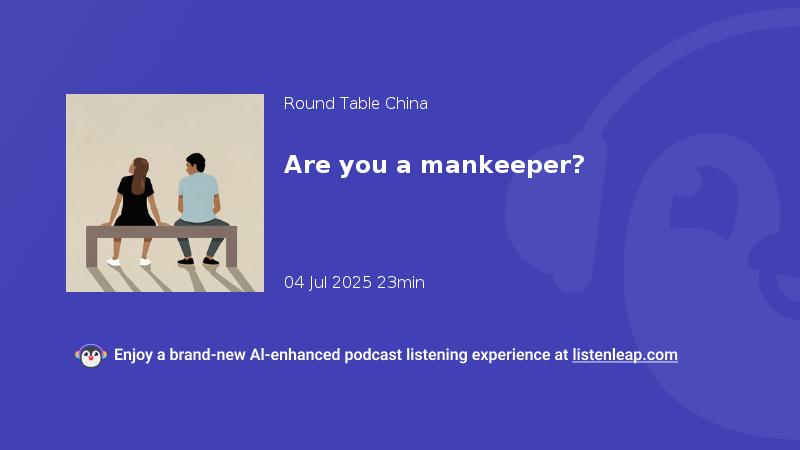
Discussion keeps the world turning.
This is Roundtable.
You're listening to Roundtable with myself, He Yang.
I'm joined by Steve Hatherly and Yu Shun in the studio.
Coming up, to the ladies out there, do you ever feel like you're dating with a job description you didn't sign up for?
Think of it as being in a relationship and quietly managing someone else's emotional health, friendships, and life logistics, all while your own needs are neglected.
And that's apparently called mankeeping in English reporting.
We take a look at this unacknowledged role women often take on, and it's leading to serious burnout and dating fatigue.
And life's best moments from the soundtrack of your heart to little things that make you smile.
join us at roundtable's happy place our podcast listeners can find us at roundtable podcast on your favorite podcast platform actually go look up roundtable china on the podcast platform of your favor and have you got a question worth exploring we are game send it over to roundtable podcast at qq .com emails are fine but bonus points for voice memos they are our listener's favorite.
Now on Roundtable, let's switch gears.
Ever feel like your relationships come with an unspoken extra job, that persistent feeling you're managing someone else's emotional landscape, their social life, or even their daily needs, often without it being asked for or reciprocated.
This growing dynamic, increasingly known in English as man -keeping, is causing a significant shift in modern dating, leading many to question the balance of emotional labor.
As a woman, and reading many random articles on social media, as well as feminist literature, I know emotional labor has traditionally been something that women Men sort of automatically take up more.
But I'm surprised that this term has been given this very stark gender specific categorization here.
What exactly is mankeeping?
Yusheng, do you feel like you're sitting in the principal's office right now?
I feel I'm feeling a lot of our listeners.
This is how our studio is set up.
So Clee Young's sitting on one side of the table and then on the other side, Yushin and I are here alone, it feels like.
And yeah, I remember being called to the principal's office in middle school and it felt a lot like this.
Tell me why. I hope you had a nicer principal, at least in speech. But Steve, you gave it away.
This is not necessarily a round table, physically.
Anyway, Yushin, yeah, go on.
Tell us what we're doing wrong.
Yes, and this has been a hot topic in Western media recently.
Many outlets have published articles on it.
Huffington Post, Forbes, Vice Media, others.
There's man -keeping, refers to a situation in romantic relationships where women take on a disproportionate amount of emotional, social, and logical labor for men, even though I believe this doesn't happen in all romantic relationships.
This kind of labor is often one sided with women giving far more emotional care than they receive in return.
And the phenomenon is often described with the metaphor as tending to someone else's garden while letting your own wither.
Oh, that's a good metaphor.
Yeah, it is good. Yeah, that's a good one.
But is it really that bad?
Oh, my. My first reaction, okay, so let's talk a little bit more about it before I'll give you my reaction to it.
When I first was introduced to the topic, because, yeah, I haven't heard of this term.
I hadn't heard of this term before either.
So it's the excessive part of things, right?
It's taking care of your boyfriend or your husband's emotional needs needs and their social calendar.
You'll be booking events to hang out with friends together, but that falls on the girlfriend or the wife's responsibility list. So there's logistical labor there and it's an imbalance, right?
So it's where the wife or the girlfriend is really taking care of the husband or boyfriend's emotions.
How was your day? Oh, you're upset.
Okay. Tell me about it.
Oh, that's too bad.
Oh, he said what to you?
That's terrible. I can't believe that, but it's not reciprocated.
So it's a one -sided thing, and that's why they say that it feels like a heavy, unspoken job for a lot of these girlfriends and wives, and that's where the term man -keeping came from.
As opposed to maybe housekeeping?
Yeah, yeah, yeah. Yeah, right?
So you're maintaining the guys, everything.
That is why it's called man -keeping.
I think that's why, yeah.
So everything's clear.
So when I first was introduced to this subject, my immediate defensive, man defensive reaction was, well, hold on.
I've heard complaints for decades in the media that women always want their boyfriends and their husbands to be more verbal in their emotions and saying how they feel and, you know, crying from time to time and things like that really show what's on the inside.
side so why are you complaining now that men are doing this but then when i learned oh it's one sided and that's the issue here with man keeping is that it's not reciprocated so it's not like the boyfriend or the husband is unloading their emotions and then saying okay your turn now you tell me all of your things what's going on with you it's like they're treating their girlfriend friend or wife like a therapist slash social planner and it's unpaid and it yeah yeah well if you pay your significant other that is well there's a bit strange there's a word for that but we're not going we're not going
there yeah yeah yeah see this is interesting as um a younger millennial lady um i've been raised here in china as well as uh with my you know international international experience.
I think one thing actually, I'm a little embarrassed to admit that I think I've been raised and feel free to jump in fellow girlfriends out there of this generation and younger possibly.
I think we've been raised in a slightly gender neutral way.
And I grew up always thinking, well, I'm going to earn my own living.
I'm going to be an independent woman.
and I'm going to support my man if I get to find him and it should be a two -way street and we should march on this journey of life together.
But one thing I did not really pick up when I was younger was that if I could emotionally support my boyfriend a bit more it would make me, first of all, so much more attractive.
Second of all, because I think we were kind of raised in the same way as the guy in many ways.
And then I just didn't really think, okay, so for a woman, there's this very nurturing supposedly instinct that is very good for you in dating and having long -term relationship but I just didn't pick up on that social cue and I was just like being on round table in my relationship and obviously that's not very attractive because you're not playing into the female qualities and here in this western term or this discussion of mankeeping so yes of course you know like you two need to like take care of of each other.
It can't be a one -way thing.
Yeah. Yeah. And, um, and also what's expected from both genders is kind of interesting here.
So the lack of reciprocation is one big issue, but another aspect to mankeeping is where the girlfriend or wife will have to coach their, their man.
See, like not all young women know how to do this.
Wait, wait, wait. They shouldn't have have to right that's the point you shouldn't have to so here's the complaint they're having to teach their boyfriend or their husband basic social and emotional skills so they feel like and we've seen this in movies and tv shows a lot like i'm not your mom right we've heard that in tv shows and movies right so there's that aspect of it too i'm not gonna teach you how to have um emotional emotional intellect.
Okay. I'm not, I'm not going to be your coach here.
And that's the complaint.
Part of the complaint is like, Hey, we're supposed to be in a 50, 50 healthy relationship here.
I'm the one who's taking care of your emotional needs.
I'm planning social events.
You can't even do that.
And when you do try to share, I have to teach you how to do that in an effective manner So that we're having an adult conversation.
It's emotionally draining.
It's physically draining.
And as a result, only 38 % of single women in America are currently looking for a relationship, while men that number is 61%.
That's from Vice from June 2025.
That's a hot off the press statistic.
but i was thinking of course um females are more good at um of at meeting people's or their partner's psychological need i was saying this case where we're listing i agree with that point i mean because they are taking more responsibilities according to the stats we're listing right but doesn't the same apply to men as well if the men is supportive enough or they they are like taking the same responsibility in this relationship, should they like on the flip side, if we don't provide enough emotional support, we're also seeing not being supportive enough, right?
And girls can talk.
And girls don't want to date you anymore.
Yeah, yeah. That was an interesting path in logic that you just took.
And I'm kind of still in there trying I'm trying to find my point there.
But I think now a lot of women, including myself, I don't think I'm apt to coach anyone.
And I'm not even so in tune with my potential partner's emotional state of mind either.
So no wonder this isn't working.
Because like both parties, I think we're kind of both lost in a way.
Yeah. So if it is positive enough and you are taking mutual responsibilities, this should be the thing that you do to try to sustain your relationship.
It should not be a one -sided job for one part.
Yeah. Well, if it is a healthy balance, then it's not mankeeping, but that's not what we're talking.
We're not talking about healthy balance here today.
We're talking about the unhealthy imbalance.
And it seems like this imbalance is more common than maybe we think it is.
Yeah. They say that the shrinking male social network plays into this mankeeping phenomenon because men are increasingly relying on female partners for their emotional and their social needs.
There's a researcher from Stanford, her name is Angelica Ferreira, and then another researcher called Dylan Varguera, and they talked about the declining close male friendships and the narrowing of emotional outlets.
You can find that from media outlets, their study.
The declining friendships that men have in their lives means they don't have any emotional outlet other than their wife or their girlfriend.
The loneliness statistics will support this.
Men with six or fewer close friends dropped from 55 % in 1990 to 27 % in 2021.
And get this. Men with no close friends rose fivefold from 3 % in 1990 to 15 % in 2021.
That's from Psychology Today.
So those statistics will tell you that men don't have as many friends as they used to.
If they don't have as many friends as they used to, That means there's not enough emotional or not enough opportunity for emotional outlet.
And men, when they hang out with their friends, typically, stereotypically, I'll say, don't want to share their deep emotions, their relationship stuff with their with their dude friends anyway.
So where does that fall?
It falls on the wife and the girlfriend.
And these days, the term mankeeping has popped up because women have said, hey, I'm not I'm not I'm not going to be the only person in your life who's responsible for that.
And one help can't help but wonder what what happened to these men?
I mean, why the loneliness?
It's like we've talked about on the show many times, actually, every year we get listeners questions about, you know, feeling very lonely in a big city, especially once you move to a new place.
And it comes from men and women in China.
But Steve, you cited figures that seems to be a male loneliness epidemic.
I mean, I'm just curious what contributed to this.
There's two reasons.
I'm sure there's more than two, but two reasons that they stated was, number one, a lack of third spaces, places for men to go and have kind of a natural social environment that's outside of their home or outside of their work where they can establish male connections and build friendships and foster sharing there.
And another reason they say is because of the influence from technology, because social media, it builds this superficial interaction type of thing where deeper bonds are not seen as important anymore, so that even if interactions do take place, they're more at a surface level as opposed to anything deeper.
Another factor I saw is the societal norms. norms traditional masculine norms discourage male emotional vulnerability yeah that's like that's like a western culture long -standing thing though I'm sure it's true in other parts of the world but that that wouldn't be specific to 2025 I don't think and actually I think that linked to your factor of the loss of or the lack of third space I don't think there aren't any or on a lot lot of third space for male to socialize.
Bars, places you can hang out on, like football fields.
Everything can be a social environment, right?
But the thing is that the connection and the communication, or the way that we define loneliness, it's more about will you just express yourself, Express your vulnerability or your feelings to others.
And that is how we define whether you are forming a true bond or relationship with others.
I think there's something, too.
We talked about this on Roundtable a long, long time ago, and this is just my opinion about masculinity in Western culture.
And this is what I said at that time, too.
I think it's been redefined, where a long time ago, decades ago, a real man would never cry.
A real man doesn't complain.
A real man doesn't share his emotions when he's feeling hurt or depressed.
depressed i've never heard my dad say the word depressed or i've never even heard him say he was feeling down but now i think that's been redefined where the the sexy modern man is in touch with his emotions right and is is comfortable sharing but if we don't have as we've we've just learned a decline in natural social environments outside of work and home for male connections if those Those are disappearing.
Combined with men now feeling more in touch with their emotions and more comfortable about sharing them.
Well, then where is the outlet?
It's going to be your your romantic partner.
That's all I can say.
Interesting. I try to fathom what this is about and I look at the men in China trying to see if there is any comparison.
And I think some of this stereotypical masculinity ideal still holds to a certain extent in China, but also I think with the younger generation of male Gen Zers, for example, I think it aligns with the Western new ideal as well.
It's, you know, guys who are in touch with their emotions and are caring and are comfortable in sharing that.
I think that's similar.
But also, I'm not sure about this.
There are no like studies supporting my observation, but isn't it always easier for most people to find friends of your own gender?
I know for women it is.
Most of us can socialize quite easily with another girl, another woman, and then we chat, we offer each other compliments.
And this is something that Yushun and I chatted before the show one day.
I'm always kind of baffled with how close male friends trash talk each other and the language they use the insults it's a love language though don't get i just don't get like such insults can be a love language and with women we exchange pleasantry and it's like from the heart uh compliments those kind of things but anyhow so yeah i just feel really sad if this were true that guys can't even find like their male friends Because for a woman, I know that so much strength and comfort comes from your close girlfriends.
And even if you can't find a man, don't have one now, but it's okay.
I have my close band of girlfriends and they're my rock.
I wonder, too, if there's an overcompensation happening for decades and decades of keeping emotions bottled up inside that now men are saying, we're finally emotionally free.
And I'm going to tell you everything I'm feeling at every moment of every hour.
I wonder if there's a bit of overcompensation happening.
I have no idea. And also, nobody can take up that much emotional pressure.
So no wonder the relationship can't last. But what's really, I think, potentially devastating from a society point of view is if heterosexual people, they want to find a partner, but if they have lost faith or feel just very burned out of the other gender.
Yeah. And I wonder, too, you know, if you are if you're listening to this chat and you feel like, yeah, maybe I'm mankeeping right now, then what do you do about it?
I don't know the answer to that, because how do you tell somebody, hey, stop sharing so much with me?
You're going to crush their soul and you're going to number that's number one.
And number two, you're basically telling them this is not a safe space.
Don't share with me anymore.
They'll just stop communicating altogether, I would think.
That is why, you know, at the beginning of the discussion, I was thinking and He Yang was saying, you didn't think that is quite a burden when you are doing these kind of things.
And I think, yeah, if you are in the relationship that you really like him, I don't think it will be that much of a burden for you.
And that would be just a thing that you would like to be supported.
But it has to go back and forth.
It has to go both ways.
Yes. And also, it's not necessarily like I've been nice to you cleaning up the dishes today and then you must cook tomorrow.
It's not like that.
There are so many aspects in a relationship.
relationship maybe I cleaned the dishes um today but if you I'm sorry for using this slightly gender stereotypical uh example but if the guy can fix the sink tomorrow or a week later I mean that that's great you're contributing in some way it doesn't have to be in the exact same way but you know like that's how a relationship works oh my god it was like five months ago my wife texted me and she said this there's something wrong with the sink now in my brain because i'm not like a guy that knows how to fix stuff right but in my brain i said uh -oh we have to call somebody but no put on your husband hat i
went home and i opened up the area under the sink and i i don't know i didn't know i haven't any idea what i was doing and i thought oh my god i'm gonna destroy this i took off one pipe i found the i magically found the thing that was blocking it i put the pipe back on it's done i fixed the sink oh my god for like a week i was walking around with my chest puffed like babe anything else needs fixing in the house i got this and i think she saw me as a just a maybe five percent sexier too for about a week or so that's great that a lot of things can be easier than you think to be honest when you're
fixing things i was so scared well good job steve thank Thank you.
Yeah. Well, relationships are complicated and everybody's situation is different.
And I think it's interesting to introduce this man keeping vocabulary to some of our listeners, I suppose.
Yeah, but reciprocation, reciprocity or two way street.
That's really essential in any successful relationship.
But again, I think just as a final point, you know, if you're listening to this and you're thinking, oh, I didn't even know I was in this situation right now.
We can't exactly tell you how to address it, but at least maybe you can be aware of it.
And if you're a dude and you think, oh, my gosh, maybe I'm doing this, then maybe back off.
Yes. And also, if you're a dude and you're feeling I'm a woman keeping, feel free to write in Roundtable Podcast at QQ .com.
and I hope everybody's relationship can't work out.
And we will reserve our happy place for another Friday and do, you know, look forward to that.
And thank you so much, Steve and Yushun for joining the discussion.
You can always find us on Apple Podcasts at Roundtable China.
I'm Hei Young, we'll see you next time.