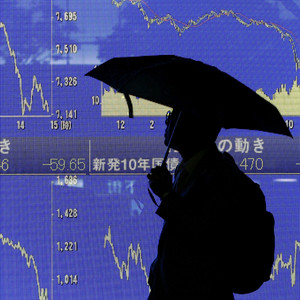
When you look at the global economy today, it's easy to get the impression that things are bad.
After all, when you turn on the news and it seems like all you hear about is countries dealing with financial panics, trade wars, soaring inflation, collapsing industries.
Yeah, is that our fault?
Well, remember we did our sentiment analysis.
We're slightly cheerier than the average financial news source.
Okay, so, you know, maybe like half guilty as charged.
Ishwar Prasad is a little different, though.
He's an optimist by nature and he's also a professor of economics and trade policy at Cornell University.
When he sat down to write his most recent book about the global economy, he wanted to focus on the positive.
Sure, he thought, the world seems like it's in turmoil right now.
But when you zoom out, there's a more optimistic story to tell.
One could argue and I was going to argue that we're just in a transitional period where there is a lot of volatility, but everything is going to settle down.
But the more research he did, the more convinced he was that the future for our global economy actually is quite bleak, and actually a lot bleaker than he originally thought.
You know, my heart was pulling me in one direction, which was the optimistic thesis, and my head was pulling me in the completely different direction.
So Ishwar wrote a very different book than he planned.
Out this month, it is called The Doom Loop.
Why the world economic order is spiraling into disorder.
Okay, so maybe our like slightly chipper delivery might want to have some more somber tones.
This is the Indicator from Planet Money.
I'm Darian Woods.
And I'm Adrian Ma.
Today on the show, Ishwar argues how forces meant to make the global economy more stable and prosperous have actually been doing the opposite.
And he'll talk about what it will take to get out of a doom loop.
This message comes from BetterHelp.
February is full of flowers, candy and lots of relationship talk.
It can feel like everyone has it all together in their love lives, but the truth is they're still figuring it out.
And whether you're married, dating or prioritizing being single, just remember you're right on time.
Therapy can take the pressure off and help you feel lighter.
Just a little outside perspective from a professional can lead to new understanding and a lot of progress.
Visit betterhelp.com slash NPR for 10% off.
You can target your buyers by job title, company, role, seniority, and skills.
All the professionals you need to reach in one place.
Get a $250 credit on your next campaign so you can try it yourself.
Just go to LinkedIn.com slash NPR pod.
That's LinkedIn.com slash NPR pod.
Terms and conditions apply only on LinkedIn ads.
So what is a doom loop?
According to Ishwar Prasad, it's a cycle where economic conditions, domestic politics and international geopolitics feed off each other in a negative way.
And in his book, Ishwar provides a number of examples of the doom loop at work.
Today, we're going to focus on just three of them, globalization, institutions, and technology.
All of these things were supposed to make the global economy more harmonious and stable, but Ishwar argues they're actually doing the opposite.
Let's start with globalization, this trend that's been playing out in the last few decades towards more interconnected economies.
It's led to cheaper goods and decreased poverty in a lot of developing countries.
And there are, in fact, huge benefits.
But the problem is that these benefits were not very evenly distributed.
So this created a class of disaffected people within countries.
And there was a sense that the economic and political elite were walking away with many of the benefits of globalization and they were able to capture the political system.
Ishwar says this economic discontent created by globalization has created an opening for what he calls the politics of resentment.
He says you can see it in politicians like Jair Bolsonaro of Brazil, Viktor Orban in Hungary or Donald Trump in the US.
You know, politicians who claim to be populist, who claim to have the interests of the common man or woman at heart, essentially are able to say that the problems that people are facing are because of the other.
And that other could be elites or immigrants or entire other countries like Mexico, China or Venezuela.
And this politics of resentment in the hands of skillful politicians can be a very powerful force.
It doesn't necessarily end up making common people better off, but it gives people the sense that they have to blow up the system in order for any change.
And that gives leaders political room to demonize minorities or start beefs with other countries, which you've probably seen in the news lately.
A second example of doom loop dynamics involves institutions.
International organizations like the United Nations, the World Bank, the International Monetary Fund.
These were originally created to foster economic cooperation between countries.
They did underpin global stability and prosperity for a long time.
But what has happened right now is that the United States, because of the doom loop dynamics, is beginning to walk away from some of these institutions, especially the United Nations, because it feels that these institutions don't serve US interests narrowly defined, that much anymore.
At the same time, the emerging market countries like China and India feel that institutions like the International Monetary Fund and the World Bank are really only protecting the interests of the richer countries rather than their interests.
So what has happened is that many of these emerging market countries, led by China, have started setting up their own institutions.
Examples are the Asian Infrastructure Investment Bank or the New Development Bank, which has been set up by the major emerging market economies.
So basically China was like we don't like your little club's rules, so we're going to start our own club.
And it's not just emerging economies.
President Trump has created his own global institution, the so-called Board of Peace.
So now, rather than having a common set of rules that everybody can agree upon, we have fragmentation, and that is the recipe for instability rather than stability.
Is the implication here that instability economically makes conflict between countries more likely?
That's correct.
You know, trade used to be seen not just as a bridge between countries, but essentially as one that would keep cooperation between countries on an even keel.
Persistent instability is going to mean much more strife within countries, but also between countries.
So we've covered how the forces of globalization and institutions play into the doom loop.
Let's do one more example, technology.
So in the cheerful version of the book, technology was going to be the answer to everything.
I'm a technology optimist.
I think many of the technologies around us creating wonderful elements of economic progress, creating ways to improve our lives in many ways.
And in the book, I focus in particular on AI, on digital currencies, and on social media.
All of these can bring us together, but technology has a dark side.
So he says, take digital currencies, for example.
There are these cryptocurrencies called stable coins, which have stable value because they are backed up by the US dollar.
They're going to be much more trusted than the currencies of some small countries that don't have credible central banks or credible currencies.
So those currencies could basically vanish because of this direct competition.
Or he says, look at the rise of AI.
We are seeing that AI is leading to, you know, some very wealthy people getting much wealthier.
And it's not clear how broadly these benefits are going to be shared.
So I worry again that, for all its promise and for all the technology is giving us in terms of overall progress under the surface, it is going to create even more tensions that intensify the doom loop.
So this is a pretty dire prognosis.
Is there a way out of the doom loop?
There is a way out.
And I do point to this in the last chapter of my book because, after all, I did want to give my readers some light at the end of it all.
What it's going to take is a combination of all of us as citizens, you know, seeing ourselves not just as citizens of our country's, but of our communities and the world at large, and recognizing that a better future requires one of shared prosperity among all of us.
Second, it's going to take leaders at all levels community business, national leaders who can help us see beyond our short-term interests and prejudices.
And we need better institutions.
It does sound like a very tall order.
Like, do you really believe that all that can happen?
That is my fervent hope for us and also the future generations to come.
We really need to work to change this reality.
But man, it's going to be a hard slog to get back to a better world.
8, Darian Woods here.
Very excited to possibly see you in person in New York, April 6th.
Come see me and Mary Childs and Amanda Aronchick from Planet Money.
We're going to perform a live, never heard before, Planet Money show.
We'll also hear from Emily Oster, who is an economist most famous for letting mothers-to-be know that they can drink coffee.
This is all part of Planet Money's book tour.
You'll get a tour tote bag with your tickets while supplies last.
And we're also going to a dozen cities.
Each stop is a little different with different hosts.
I'll also be in Toronto.
Find out more with links to get tickets at planetmoneybook.com.
This episode was produced by Corey Bridges and engineered by Robert Rodriguez.
It was fact-checked by Sierra Juarez.
Cake and Cannon is our editor and the indicators of production of NPR.