NPR. This is The Indicator from Planet Money.
I'm Waylon Wong. Aura Damon spent 16 years at CNN.
She was a senior international correspondent reporting from conflict zones like Iraq and Syria.
And when Aura was out in the field, she would often bring suitcases of clothing to hand out to the people she met.
This was never in exchange for an interview or story, but rather after she was done reporting.
Still, it didn't seem like enough. It's this feeling that grabs you in the throat because you do want to be able to do more.
So in 2015, Arwa did do more. She started a nonprofit called the International Network for Aid, Relief and Assistance.
It helps children get medical care if they've been hurt by war or in natural disasters.
Inara, as the group is called for short, works in countries like Turkey, Ukraine and Afghanistan.
It also operates in Gaza. None of us have ever encountered a situation like Gaza.
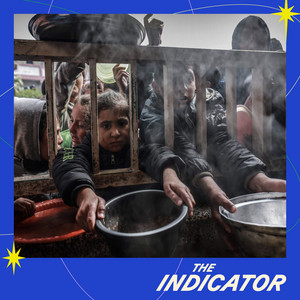
Not on any level of it. Today on the show, Arwa talks about the economics of running a humanitarian aid organization and the difficulties of getting help to Gazan residents.
This message comes from ServiceNow. People should do the creative work they actually want to do, not boring busy work.
Now with AI agents built into the ServiceNow platform, you can automate millions of repetitive tasks in every corner of your business, IT, HR, and more.
So your people can focus on the work that they want to do.
That's putting AI agents to work for people.
It's your turn. Get started at servicenow.com slash AI dash agents.
This message comes from NPR sponsor Holiday Inn by IHG.
It's a new day for a new stay at Holiday Inn for business travelers.
With modern spaces for meeting and working plus delicious dining from breakfast to happy hour and dinner, you have everything you need to get work done.
Give your everyday business travel an upgrade.
Book your next business trip at Holiday Inn by IHG.
Visit HolidayInn.com to book your stay. Arwa Damon founded Inada in 2015 while she was still a correspondent at CNN.
She says her humanitarian work came out of her experiences as a reporter.
Yes, we're there to report and observe. But once we have done that, there's nothing stopping us from then being a human being who wants to just give something to another human being.
A lot of us who are out there, especially in these war zones, we're constantly coming across children who have been injured.
And sometimes you can do a report on them.
And sometimes that'll lead to another organization picking up their case.
But more often than not, actually, it doesn't work out.
And after constantly seeing this for years and years and years, and especially feeling like world's apathy, and at the time it was towards Iraq and then towards what was happening in Syria, I just had this overwhelming need of having to do more.
It was visceral. It was almost paralyzing.
And I was actually in quite a dark headspace.
And out of that emerged this idea of, well, why not build an organization that specifically targets children that are falling through the are able to provide for them or children that need these super complex, lengthy, and expensive surgeries.
And then it just, it grew from there. But at the beginning, Arwa actually funded her charity herself.
When you were setting up your nonprofit, based on your experience as a reporter, as someone who would observe what other groups were doing, how did you want your organization to operate differently?
There's still this very large gap that exists, especially at the larger scale. institutions where the outsiders think they know best.
And we don't know best. And so for us at Inara, we only hire local.
And another thing that we also focus on is not playing the numbers game.
And so we are the organization that will invest the time and resources and finances to To, for example, like we did during the Turkey-Syria earthquake, drive four hours to ensure that a cluster of 60 people has access to clean water and we will deliver a portable water purification system to them. even though that's a lot of time, money, and resources to spend on that number of people.
And that's not necessarily a calculation that other organizations are willing to make.
Interesting. So by numbers game, you mean like another organization might say, okay, we want to reach tens of thousands or hundreds of thousands, and you're able to go in a little bit more surgically and say, we'll help 60 people.
Exactly. And the thing is, is that makes it very tricky to raise money because a big donor, for example, is, again, just as an example, willing to give a million dollars.
They want to be able to say my million dollars reached half a million children.
And they did that through a big vaccination campaign or whatever it is.
Whereas for us, especially because when it comes to the medical work that we do and these very complex surgeries that children end up needing because of the sheer catastrophic injuries that, you know, bombs can wreck on a child's body, our math ends up being, well, actually that $1 million is going to, you know, treat at $10,000 a child, a significantly lesser number.
But then we try to argue, if you treat that child now, you can ensure that that child then is able to go to school. is able to reintegrate with the community, and then is able to, in the future, grow into an adult who is not going to be reliant on others and on humanitarian handouts.
So we've kind of managed to sort of keep going.
But I have to say straight up, there were a couple of times when we almost ran out of money, where we had to almost completely shut down.
It's an emotional roller coaster to try to keep your head above water.
In Gaza, Arwa's organization has team members providing medical care.
It also tries to distribute food, diapers, and other essentials.
This is a really difficult task, involving many stages of approval from the Israeli government.
Arwa says it begins with getting permission for individual items.
From the very beginning, we have had this whole back and forth of items constantly being rejected.
And you can take that from pediatric insulin needles to crutches to sleeping bags to Nutella being rejected as an item inside one of the food parcels.
But once you're able to get your list through, then your truck gets cleared by the Israeli side.
It then crosses just over the border into Gaza, where then the organizations are notified that they can pick up.
To be able to access these collection points, we have to move through what's known as the red zone.
So that's an area that is under either Israeli occupation at the moment, or it's a combat zone, or it's under some sort of evacuation order.
That leg of the journey that takes us through the red zone is where, historically speaking— the armed gang looting activity has taken place.
So once you've gone through with your truck and you've picked everything up, you then have to run the gauntlet of these armed gangs and try to get your truck safely to a warehouse.
I mean, I don't even know how to describe it now because now it's not just the armed gangs.
Now it's also these crowds, these surges of starving Gazans who are swarming the trucks.
I mean, as long as there is scarcity, there is going to be chaos.
And right now, you know, the situation is that the vast majority of trucks aren't actually making it to the warehouse.
That's just the reality. Are there things that you want our listeners to know about Gaza that you think haven't been getting enough attention?
Yeah, I do. It's the kindness that I've seen there and the grace and compassion under these circumstances that none of us could ever imagine.
You know, when I remember Gaza, do you know what I remember mostly?
The older woman who invited me in for a cup of coffee, even though it was her last cup of coffee, people there especially have held on to their grace to such a degree and really held on to their humanity.
Arwa last visited Gaza in December of 2024.
She doesn't know when she can return. I actually tried to go back in February, March, was rejected, rejected, rejected, and then fully denied by Israel.
No reason was given. And it's important to point out that it's not just me.
We reached out to the Israeli agency that handles those authorizations.
It did not get back to us with a comment.
You know, obviously the team is still in Gaza.
They're from Gaza and they're still doing everything that they can.
But it does make it very, very difficult.
I really appreciate you taking the time and coming on the show to talk to us about your work.
No, thank you so much for having me. I really appreciate it.
This episode was produced by Julia Ritchie with engineering by Jimmy Keeley.
It was fact-checked by Sierra Juarez. Kiki Cannon is our show's editor and The Indicator is a production of NPR.