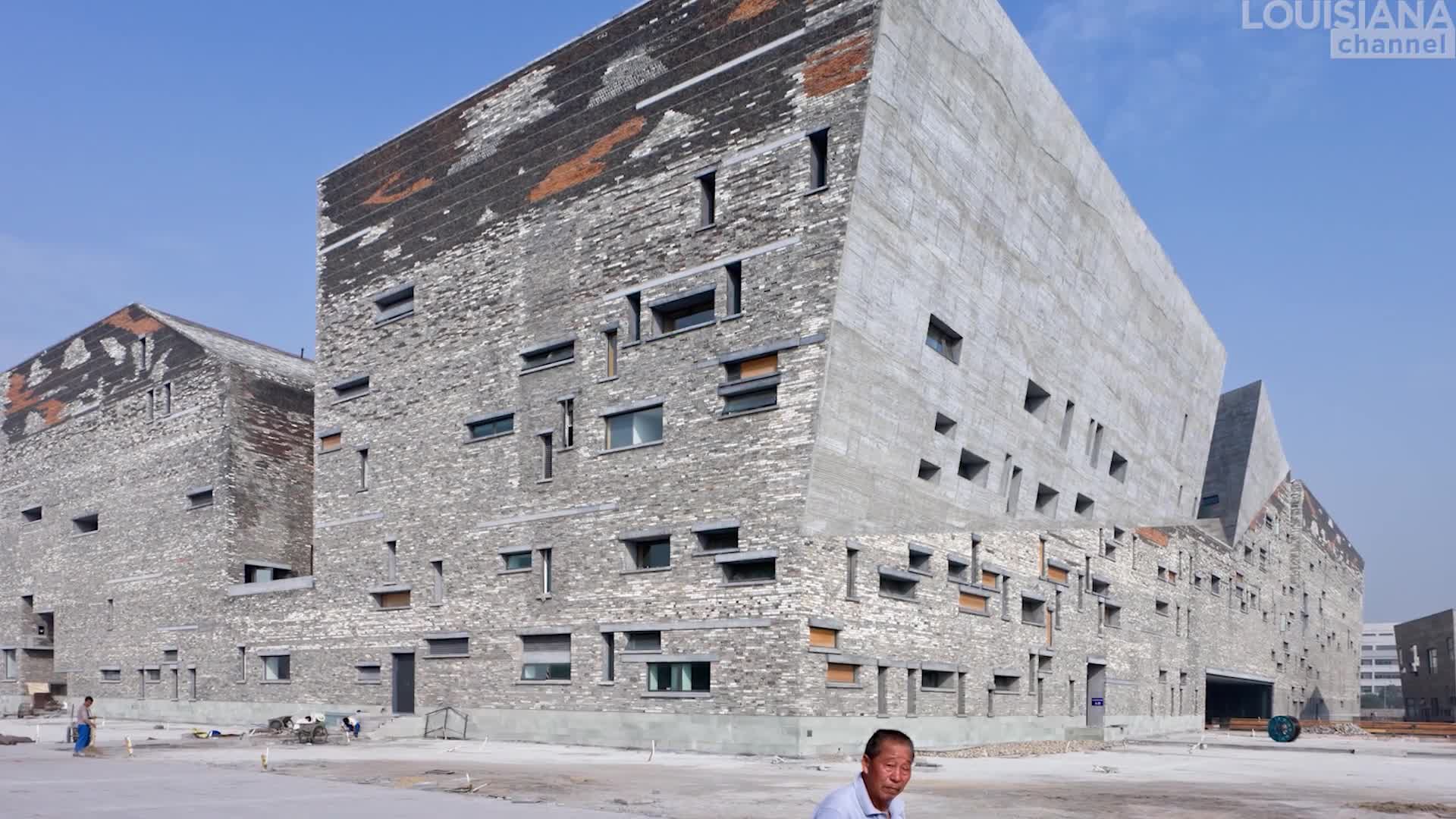
In fact, many people do not know that in that era of China, that is when I was in college, it was the early 80s.
In fact, at that time, the Chinese people had no concept of architecture and architects.
Basically, no one has heard of the word architecture.
No one has heard of the word architect.
That's just in a very small professional circle.
No one knows.
So when I
When I was in college, I didn't know.
I wanted to be an artist.
I wanted to be a writer.
My family didn't agree.
In those days, life in China was difficult.
Everyone wanted their child to become an engineer.
An engineer would have a stable income.
So my family wanted me to be an engineer.
I refused.
But I couldn't help it.
I later mentioned a condition, that is, if you can find an engineer who is also learning, for example, painting.
I can read
Then they went to find.
One day they came back and told me that they found one.
It is said that it is called architecture.
It is an engineer, but it is still painting.
So I learned architecture.
I've been asked this question many times and I still have no idea, because I went out of school at 17.
What can you possibly know about what you want in life at 17?
I had no idea.
So it came out of the most you don't pay attention, in the sense that i went to a person at the at school.
They were saying, look at your grades and said okay mathematics physics, fine drawing okay, so maybe architecture um, that kind of of.
I had no clue.
Uh, actually in in chile, to when you make the national exam to be able to apply to universities uh, you're required to provide the list of um of careers, uh with which, with your points, then you apply.
So i wrote architecture in the Catholic University.
Number two dance.
Number three flute.
I didn't dance, I didn't play the flute, just to.
I had no other alternative.
So either, I didn't go into architecture.
I had no plan B, but I didn't know what it was.
Nobody in my family was an architect.
I think I saw for from somebody plans and I thought well, this is cool.
Do blueprints.
It looks nice.
It was as shallow and stupid as that.
Sixty years of my practice.
When I began my career, after I came back from Corbusier, the task was to find with minimum, with no technique, no technologies, scarcity of materials, economic paucity, everything was happening.
And in that you have to begin architecture or just something to build for people to live and act.
So it's not only talking about housing only, it's also talking about towns, cities, villages.
You are talking about creating institutions.
You are talking about creating some kind of understanding in people about what is the nature of what we had, what we are happy about, proud about, and what are we going to give back in return.
So it's like a revolution.
It's a revolution which begins with nothing, and now we are facing the challenges of the new world, the technological world.
And I think this is where the whole juxtapositions have happened.
And I think this is where I was trying to play my role as an architect.
What is architecture for me?
What is architecture for somebody that is coming from a place where infrastructure is not existing, but it's needed?
What is architecture for somebody like this?
It's simply, it's more than building buildings.
It's just more than creating a piece of work that can be seen as art.
It's more than that something happening.
That is a process on how, together with people, you think about the project.
At the end, to come out with something that people really feel it is our own.
We are part of it.
It is something that we have a strong identification with it.
We see ourselves in that.
So that is how I see architecture.
It's very difficult to define exactly how we are, how we are doing architecture, but we got very early the idea that doing architecture was a way of providing space for uses.
So it means that the uses is everything, everywhere.
It can be small, it can be a little thing.
And we got an interesting experience after the School of Architecture in Africa, where at the beginning we didn't have the feeling that we were in presence of architecture just after making the school, but every day.
It was interesting to see that people themselves were doing architecture because they were creating space with sometimes nothing, no materials,
And that was very interesting for us to learn from this.
It was something intuitive.
But we learned a lot from this.
And this became some principles afterwards in our practice.
I can summarize in a few words, like generosity of space, care to the uses, care to the climate and how we can use all the resources of the climate in order to create a natural quality of environment, of space.
The economy, because the economy is extremely important nowadays to make this architecture affordable in any case.
So all these principles are with us since many, many years.
And of course, every year, every project allows to improve it.
There is a house in a village.
There is only one house in the world.
There is always a village and a house.
Whether the village is big or small, there is always a house in the village.
I realized that again.
Everyone is a member of the family.
Any kind of family always belongs to the community.
That's why there are families protected by the community.
Especially in the world since the 20th century, the community has become invisible.
In the modernized cities of the 20th century, not only in Europe and the US, but in most Asian cities, people lived in condominiums and apartment houses.
They lived together, but they had nothing to do with the person next to them.
But I suppose what's also important is to think about change as being positive, that it wasn't exactly utopia to start with, where we are now.
I mean before the urgency of climate change was really put on the agenda.
You know, the rich are getting richer, the poor are getting poorer, people can't access housing, the thing of democracies being challenged, all kinds of things that are happening in the world.
But somehow, day to day.
As architects, We're probably, some people would say naive, But we're great believers in human invention.
We're great believers in the capacity of architecture to change, to change things.
The invention of architects.
We teach and we see young people doing research on how to make buildings in different ways, how to think in different ways about landscape, about the resources, about water, about solar energy.
I mean there are all kinds of amazing things happening.
And in a way you can't be an architect without being optimistic.
Do you think technology in the end is an ally or a threat to our society?
Technology can never be a threat.
Technology is a means.
So the history of architecture, the history of humanity coming out of the cave into a dwelling, is a story of technology, of innovation.
The high tech buildings of the past, the cathedrals, they're miracles of technology.
Well, of course, any technology you can turn from violent aggressive, you can turn into something which is violent and aggressive.
But that's probably true of anything.
You can use medicine to cure, you can use medicine to poison.
You can, as Bucky put it, you can convert the killing machine into the living machine.
And that was some of the endeavors after the war, to harness.
But that's also true of space travel and space exploration.
So it's really, it's how you use the technology.
But you can't move forward.
You can't answer the needs.
We can't be protected in here when it's raining or snowing or cool in here when we open the windows and it's baking hot outside.
That's a technological response.
And the technology is changing all the time.
So the challenge is to turn it to our advantage.
Often, the architect seems to have a great power.
For example, you remove a big piece of the city, and then you rebuild another piece.
This work is almost done by God.
Because you have changed a lot of people's lives in a blink of an eye.
And then you give them a new life.
This is not a job that ordinary people can do.
It should be done by God.
But now it's all done by the architect.
So this work will tell the architect the actual responsibility of your society.
It's very heavy.