As NPR's daily economics podcast, The Indicator has been asking businesses how tariffs are affecting their bottom line.
I paid $800 ,000 today.
You paid $800 ,000 in tariffs today?
And what that means for your bottom line.
Listen to The Indicator from Planet Money.
Find us wherever you get your podcasts.
You're listening to Short Wave. From NPR.
The first time I ever saw an anglerfish was on the big screen.
It appeared first as a warm, glowing light.
I see a light. A light?
Yeah. Over there. I see it too.
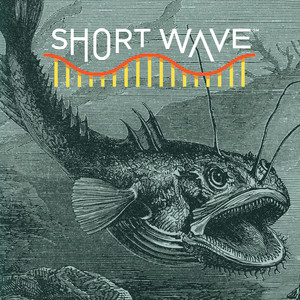
Rising out of the dark with bulbous eyes and pointy teeth, this fish gets a villain moment in the 2003 Pixar movie Finding Nemo.
It's so pretty. Good feelings gone.
And so ensues probably the best underwater chase scene in cinematic history.
I remember seeing this movie in the theaters.
I was three in 2003.
This is Rose Fauchet from Rice University.
And apparently when the anglerfish scene came on, I was so freaked out by it, I started crying, and my mom had to take me out of the theater.
But Rose has had a change of heart about anglerfish, because this past year, she did research about them, alongside evolutionary biologist and ichthyologist Elizabeth Miller at UC Irvine.
Now Elizabeth says this moment in Finding Nemo, where Dory and Marlin are enthralled by the anglerfish's bioluminescent light, is pretty accurate to how it happens in the deep sea.
The idea is that the prey are drawn to the lure and they don't see the anglerfish attached to it, and they get eaten.
There are over 200 species of deep -sea anglerfish.
The one in Finding Nemo is modeled after what's known as the football fish.
But Elizabeth and Rose told me others look very different.
Some are long and thin, like eels.
Some are squat. Some have huge prehistoric -looking teeth.
while others have big eyes set far back into their heads.
And the majority of them live in the bathy pelagic zone, the deep, deep sea.
It's a huge, expansive space in total darkness, high pressure, cold temperatures, food limitation.
But in this zone that is so cold, so homogenous, and so devoid of sunlight, somehow the angler fish still ended up looking very diverse.
And researchers wanted to know, why?
It is a mystery. It's not clear why one Anglerfish species would be shaped one way, while a different Anglerfish species would be shaped a different way.
So today on the show, the big Angularfish mystery.
Why do these science fiction -y fish look so different from one another?
What spurred this divergence in anglerfish body shape and size?
And what can that tell us about the deep sea as a whole?
I'm Emily Kwong, and you're listening to Short Wave, the science podcast from NPR.
This message comes from the Nature Conservancy.
People from all walks of life depend on nature for the food they eat, the water they drink, and the air they breathe, for strengthening their communities, powering their livelihoods and safeguarding their health.
Nature is common ground for everyone.
and uniting to protect nature can help solve today's challenges and create a thriving tomorrow for future generations.
Discover why at nature .org slash npr.
I'm Tanya Moseley, co -host of Fresh Air.
At a time of soundbites and short attention spans, our show is all about the deep dive.
We do long -form interviews with people behind the best in film, books, TV, music, and journalism.
Hear our guests open up about their process and their lives in ways you've never heard before.
Listen to the Fresh Air podcast from NPR and WHYY.
All right, Rose and Elizabeth, the deep sea pelagic anglerfish, what are the big question marks for you?
And what did you want to figure out?
So we can look at images of anglerfish and it seems obvious to our eyes that they're different shapes.
But we needed to quantify that variation so that we can analyze it in an evolutionary framework.
And what I mean by an evolutionary framework is understanding how all of that diversity evolved.
Did it evolve very quickly?
Did it evolve gradually?
Those are the big questions.
And Rose at the time, you were an undergrad student at Rice University in Elizabeth's colleagues' lab.
Can you explain what you did on this project?
What was your role?
So my part of the project was looking at the morphology of anglerfish skulls.
I had to out the skeletons of the anglerfish and then determine which bones are which, and like the edges of all the bones and and things like that.
So I took the CT scans that we had of these anglerfish and first I had to make them into like a 3D model.
And then we have this very fun software that basically lets me put a little dot on certain points of that skull model.
We settled on, I believe it's 111 landmarks that I put on to each of these skulls.
Yeah, I will say 111 points is a lot.
It's even more difficult when you've got these fish that have such bizarre skulls.
The work that Rose did is really tremendous, and it was all done by hand.
So you all set about building a family tree for anglerfish.
That's so cool. How do you go about building something like that.
So, so to back up a little bit, the big family tree is what links all of these species together.
Yeah. And the methods to do this are the same for pretty much any organism.
You extract DNA from the tissues of these specimens.
What makes it difficult in the case of the anglerfish is getting those tissues.
Right. This isn't a 23andMe situation.
You can't just ask anglerfish to spit into a tube for you so you can collect their DNA.
That's correct, and finding the fish is no small feat as you can imagine.
It relies on careful planning of people who regularly go out to sea to do surveys of fishes in general, not necessarily targeting anglerfishes and making sure when an anglerfish is found that it's preserved in the proper way, it needs to be kept on ice and kept cold pretty much as soon as it's brought up, it needs to be preserved in an alcohol and put on a shelf in a museum.
And that's the basis of the CT scans or the three dimensional X -rays that we used.
And then the tissues were the basis of the family tree.
Okay, so while Rose was mapping all these three dimensional X -rays plotting points onto the skulls to see where the anglerfish were visually similar, it sounds like Elizabeth, you were extracting the DNA and seeing where they were genetically similar.
That's right, that's exactly right.
And so from there, I use fancy statistical models and basically it tells me what the differences are from species to species and the significance of those differences as far as how closely or distantly related the different species are.
Wow, okay. Rose, can you talk a little bit about how you and Elizabeth got access to all these specimens and CT scans?
I heard all this was done with museum collections kind of like an interlibrary loan but for museums. So all these different museums across the world have fantastic collections of fish that are basically just preserved in ethanol and there is an online database where you can search for whatever species of fish you're looking for and it will show you.
And the world is actually it's pretty small it feels kind of like everybody knows everybody.
Yeah and so if you ask nicely enough they'll FedEx you fish that have been sitting in a jar since like 1965 and if you're a very lucky undergrad you get to open up a package in lab one day and you're holding like one of the rarest fish on earth.
Were you one of these lucky undergrads who got to do this?
I did get to be an undergrad who Opened up a box from FedEx one day and there's a football fish You know wrapped in cheese cloth soaked in ethanol and I picked up the fish and I was so excited.
I ran down the halls of this building to like go and show all of my friends that I had a football fish Um, also, I'm sure it's you know shocking to hear But but sixty -year -old fish sitting in ethanol do have a particular smell about them Delicious.
So you are going deep into anglerfish history in a way in looking at these samples.
I want to go all the way back to the original anglerfish ancestor.
What did that ancestor look like, the one that started it all?
I'll give some context that anglerfish, the deep -sea anglerfish we've been talking about are all part of this group with the scientific name lofiaformis.
Lofiaformis. Yes. Okay.
So the deep -sea anglerfish, their closest relative within this broader group is a fish called the sea toad.
The sea toad. Yes, that's another fun one to Google if you have access to Google, the sea toad.
Oh, I am, I am. Coffin fishes, is that another word for sea toads?
Yeah, they look very grumpy.
They're literally frowning.
Exactly. and hanging out on the bottom of the ocean floor.
Yep, coffin fish is another word for them so that's the closest relative, the closest living relative to the the deep sea anglerfishes we've been talking about.
And so what did the direct ancestor of the anglerfishes look like?
It most likely looked something like that sea toad, although perhaps something intermediate we we can't know for sure but what it implies is that the broader group, Lophiiformes, has always been in the deep sea in some capacity.
but the more significant transition was off the sea floor and into the water column.
Yeah this seems like one of the biggest takeaways of your study and it's amazing that anglerfish started from an ancestor that lived on the ocean floor and then made it into the water column to be the anglerfish that we know and love today.
That's correct, the bathypelagic anglerfishes seemed to have arisen from a deep sea benthic ancestor.
And it was this transition off the seafloor that spurred the evolution of all of these new shapes.
And what does that tell us about the conditions of this part of the ocean that made that so?
Like, is it just that they had to adapt super quickly in order to survive?
I think the way to think about it is opportunity.
They came off the seafloor into the water column, the bathypelagic zone, and presumably there are new ways of living, new ecological opportunities, even if we don't know necessarily what they are.
And so, they potentially evolved these new shapes to take advantage of those new opportunities.
Yeah, I wanna ask you both one last question.
Why do you think this is so important to study?
How does it change your, how you think about this field of evolutionary biology?
I think this is critical for understanding of the conditions that diversity evolves in and we're used to thinking about diversity in terms of like tropical rainforests and coral reefs places that have a lot going on and we look at a place like the deep sea and we see the opposite of that and what we're learning from the evolutionary history of the anglerfishes is that that also might be a place where you can evolve a lot of biodiversity and and That's a totally new way of looking at that environment.
Rose? Well, so I think especially natural history and marine biology at this point in time can be a pretty devastating field to work in.
You know, so much of what we do and what we think about is how much we are constantly losing that's already gone.
Um, but there's something about the scope of this project that felt positive and, and kind of like a nice reprieve from that.
I think a lot of this project was celebrating the biodiversity that we do have and yeah, it's kinda nice to, to for once not be like, well, here's a We've got 1 ,000 genuses about to go extinct.
No, here's 1 ,000 genuses being opportunistic hunters in the ocean.
Yeah. I love that. Well, thank you both so much for spending time with me and helping short wavers everywhere learn more about these incredible fish.
It was my pleasure.
Thank you. Thanks. This episode was produced by Hannah Chin.
It was edited by Burley McCoy and fact -checked by Tyler Jones.
The audio engineer was Kwesi Lee.
Beth Donovan is our senior director and Colin Campbell is our senior vice president of podcasting strategy.
I'm Emily Kwong. Thank you for listening to Shortwave from NPR.
A lot of short daily news podcasts focus on just one story, but right now you probably need more.
On Up First from NPR, we bring you three of the world's top headlines every day in under 15 minutes, because no one story can capture all that's happening in this big crazy world of ours on any given morning.
Listen now to the Up First podcast from NPR.
It all starts with listening to the person in front of you and the person you'll never meet, to the person living a story and the journalist who helps you see it in a new light.
The NPR network is built on listening, with microphones in every region, so where there any time a voice or sound demands to be heard. Hear stories in the first person.
Hear the bigger picture on NPR.