Hey, everyone, it's Anna.
I mentioned this in our last episode, but I just want to remind you that in the next couple of weeks, on Apple Podcasts and Spotify, you'll need to be an eligible New York Times subscriber to have full access to the Modern Love Podcast and other New York Times shows.
Full transparency, you'll still be able to hear us and all those other shows, even if you don't subscribe.
The most recent episodes will always be out there for everyone.
But if you want to hear the back catalog, you'll need to be a subscriber.
And we genuinely hope you'll consider subscribing as a way of supporting our work.
As a subscriber, you won't only be supporting the journalism that powers The Times newsroom, including Modern Love, but you'll also get early access to the other shows and podcasts we make, including the new season of Serial, which is coming this fall.
To learn more, go to nytimes .com slash podcasts.
All right, let's start the show.
Love now and all. Did you fall in love last night?
Love was stronger than anything else.
I feel the love. Can I love you more than anything?
If you're still alive.
Love. From the New York Times, I'm Anna Martin.
This is Modern Love.
Every week we bring you stories and conversations inspired by the Modern Love column.
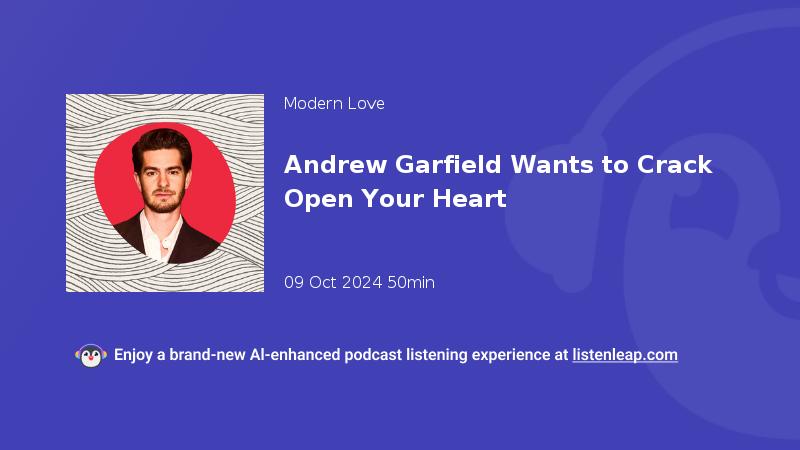
This week, I'm talking to the actor Andrew Garfield about his new movie, We Live in Time.
This movie, I got to tell you, it wrecked me.
Andrew plays a man named Tobias who falls in love with a woman named Almet, who's played by Florence Pugh.
Their story feels epic and expansive, but still somehow very intimate.
It zooms in on these small, everyday moments that just feel so real to me.
But that's not to say it's all sunshine and roses.
Tobias and Almet go through the types of challenges most young couples can't even imagine.
And as you watch them navigate this messy stuff, the movie encourages us to turn inward and look a little closer at our own relationships.
Also, I just want to say something before we start.
Going into this interview with Andrew Garfield, I thought it would be pretty straightforward.
I figured we'd talk about We Live in Time, chat about how it relates to the Modern Love essay he chose to read, and then listen to him perform it.
But during his reading, something happened.
Something that's never happened on the show before.
I don't want to spoil it for you, so here we go.
Here's my conversation with Andrew Garfield.
Andrew Garfield, welcome to Modern Love.
I'm so happy to be here.
Thank you for having me.
I'm so happy you're here with us in the studio.
I have seen your new movie.
It's called We Live in Time.
Everyone should see it, but very briefly, it's about a woman named Almet, played by Florence Pugh, and your character, a man named Tobias.
They meet because, this isn't a spoiler, this is in the trailer, she runs Tobias over with her car.
Correct. Which is a classic meet cute, isn't it?
Yeah, a trope. If you're tender.
If you're a hinch. If you're running over with a car.
Despite that violent start, they end up in a truly transformative relationship that spans all sorts of themes that we talk about here on Modern Love.
Also, I cried so much.
Oh, good. I cried a lot.
And a good, nice, cathartic.
I mean, as my producers, I was sitting next to them, it was one of those kind of like hiccupy sobs with a lot of snot.
Oh, that's wonderful.
And that's what you want?
That's what we aim for, yeah.
Really? Which one would crack the old heart open?
You really crack my old heart open.
There was seriously some stuff I needed to work through, clearly.
So thank you. You're so welcome.
Before we get too far into it, I want to ask, what drew you to this film at this point in your career in life?
What did you want to explore through playing Tobias?
It definitely wasn't a career move.
It was a life move.
Because I was on a kind of unofficial sabbatical because I was tired and entering midlife, you know, looking around, looking forward, looking back, looking presently where I stood.
And wondering what we were doing being alive at this point.
What questions you ask, you know.
In the culture and in our civilization.
And I didn't have a good answer.
And then in the middle of my sabbatical, a year in, I read this very, very beautiful script.
And I could compare it to like, oh, this is a big, massive clay that's already begun to be carved by this amazing writer, Nick Payne.
And the raw material of this piece is kind of the raw material that I'm longing to express and explore and deal with.
So it felt like I was able to go into the next room with some friends and collaborators, including Florence and John Crowley, and go, okay, I'm going to make something with you guys.
But I'm, just so you know, I'm bringing, this is all, it feels like I could have written this.
Very deeply relevant to the place you are in life.
Yeah, very, very prescient and very kind of, yeah, present, yeah.
Did you go in looking for answers to these big, big questions that you were asking yourself during this midlife, can I call it a crisis?
I don't know if you called it a crisis.
I didn't, but I see what you're reading into my demeanor and body language for those of you who aren't watching.
It does look like I might be in a crisis.
No, you can pull jacket on.
Yeah. No, I wouldn't call it a crisis, actually.
I would call it a midlife exploration.
Reckoning. Reckoning, falling apart to put oneself back together.
Like, natural. It feels very, very natural.
And I think the mislabeling, I think it becomes a crisis when you don't consciously deal with the shit that's going on.
Gotcha, but you were kind of dealing with it, it sounds like through.
Yeah, consciously for sure.
And inhabiting this role of Tobias in this film.
This felt like a sculptor or a potter.
It's like, I was full of all the primal matter of what I was transforming through and this script and this film just allowed me to put some form on it.
It was like I could get in and like shape something.
And it was like, oh, it felt healing, it felt exercising, it felt, yeah, it felt very, very beautiful.
Yeah, I mean, the best way that I could describe this film is just to say that it feels extremely real.
Like the movie's full of these moments that you can imagine yourself in.
You see Tobias and Almet washing dishes and talking after a dinner party or they're eating a biscuit in the tub together or they're cracking eggs for breakfast and through all these intimate, small, everyday moments, you can just tell that these characters love each other deeply.
It feels like you're watching a real life couple live their life and try to figure so much out.
I want to know what do you hope people feel when they witness these moments?
I think what's amazing about the film and about, as you say, these small more ordinary, extraordinary moments is it's all of us.
If they feel representative of these liminal spaces between the larger, more explosive, dramatic moments of a partnership or of a life.
And I think people will watch and feel connected to their own lives in a way that maybe they haven't been, if they've been running around in this kind of late stage capitalist nightmare.
Say that again. I mean, I told you I was sobbing.
I clearly, it brought up a lot.
But it was the right movie for me to see at the right time.
Say more. No. Oh, fuck you, man.
I asked the question.
This is some bullshit.
People aren't going to get what they need unless we meet in the middle, man.
I'm just kidding. My editors are like, no, no, no.
I was going to do a big breakup.
I'll just say that.
And we'll get to this.
But the first, the big fight that Almet and Tobias had was so, I'm 30 years old.
We should cut all of this.
But it was like very - The good news is you have the right to.
I know. And I don't.
It just, that conversation in that fight felt like what I could.
I did have. I have had.
Oh, wow. Wow, wow, wow.
It hit. Yeah, yeah, yeah, yeah, yeah.
Good, good. Okay. So there are these beautiful, small moments.
And they're also balanced out by these very painful scenes, these tough points in the story, where Tobias and Almet are grappling with the fact that she's been diagnosed with cancer, and the very real prospect that there might not be many more mornings with eggs for breakfast or biscuits in the bath.
What do you think this movie says about how to hold on?
Oh, no, you don't like this question.
No, I love it. It's just impossible.
Go on, go on. That sigh was heavy.
Yeah, man. What do you think this movie says about how to hold on to the beauty of those moments when you're really scared to lose them?
And sorry, it is a very big question I'm posing to you, but...
But the problem is, you can't hold on to anything.
It's all a letting go.
This is all a letting go.
Sorry, it's like emotional.
Yeah, this life is all a letting go.
And the idea of holding on...
I like the idea of savoring things.
I think that the Jesuits are pretty good at that.
I learned that from the Jesuits.
I thought that was going a segue.
They had this wonderful prayer called the examine that they do every night.
And it's pretty much the same as, I don't know if you've seen the film About Time, the Richard Curtis film, the Donal Gleeson character.
Basically, he starts by saying, so what I did is I started living each day twice and choose to see deeper and be more present in every small banal, seemingly moment.
And it doesn't, you know, you've got to be a Jesuit or a Catholic or even religious to do this.
But it's a beautiful practice at the end of the day, every night, just to lay down, close your eyes, go back over the day.
Think of the three or four moments where, as the Jesuits would say, where you felt God's presence very near you, but fill in the blank.
Where you felt alive, where you felt close to yourself, where you felt connected to the mystery, the unseen forces.
And you reenter those moments and you savor the feeling that it could be something to do with nature, a conversation with a friend, time spent with a God chat, whatever it is.
And then you go through the whole day and you notice where you were aware of that mystery.
And then you notice, again, where you missed the mark.
And you ask for forgiveness and you ask to do better tomorrow.
It takes 15 minutes and usually you fall asleep during and you have a better sleep because you're kind of, you're connecting and you're savoring the things that matter.
But my God, it's all so transient and it's all leaving constantly.
And the people that I'm inspired by most and that I respect and love the most are the people that, I'm thinking now about Mike Nichols who I got to do Death of a Salesman with.
And he became a friend and a mentor before he passed away in the last 10 years.
I remember him as someone who seemed to be giving himself away like seed, just planting himself like seed as he exited this earth.
And he was able to move with such lightness and he knew, I think he got to the place of wisdom to know that he can't take any of it with him.
He just wants to leave it all here for other people to feast upon.
Do you do that prayer every night?
When I'm a good boy.
So no, unfortunately.
Well, it's interesting.
I was going to ask you where the emotion lay for you because when you said you can't hold on to anything, it clearly struck a chord, but I'm listening to you speak.
I realized like the emotion was perhaps I mean, break it down for me, it doesn't feel completely like sadness.
There's a real liberation in the fact that we can't hold on.
It's sorrow. There's no, there's no joy without sorrow.
There's no sorrow without joy.
I mean that wonderful Pixar film Inside Out towards that.
But I really love those films.
I think they ask a great manual for us.
I agree. I'm sure you can be in one.
I don't know. This is my pitch.
I guess I know. I really feel like the only gateway to true vitality is through a broken heart, is acknowledging that our hearts are meant to break.
And break and break and live by breaking.
That's definitely a quote.
It's not mine. It might be the Jesuits.
No, I think it's the beginning of Angels in America.
I think that's a quote that Tony Kushner has.
Basically, like the idea is that our hearts, the only way our hearts can expand is by cracking open and cracking open further and further and further.
Like the finite nature of us being here is the only thing that makes it meaningful.
The concept a friend taught me once called Onism.
O -N -I -S -M. And I believe, if someone could be Googling this just to make sure I'm not incorrect, I believe it is...
Is that you? No, no, I want to say first.
It's like a test. I like a game and a test.
Right. It's both. So I'm going to say it's the sense and knowing and the sorrow of knowing that you will only be able to live your own life.
You won't be able to have all of the experiences you want.
I won't be able to read all the books in the library, see all the films in the cinema, to know all the people on Earth, visit all the countries, know all of history all the time.
Like is a kind of an imprisonment in the life that you have, realizing that you're trapped to a certain amount of experience as you're alive?
That is it, yes. The AI overview, when I Google it, is telling me that you're very correct.
I mean, you are this concept of the sort of prison of one experience, one body, one life that is super on the nose to the modern love essay you've selected to read for us today.
This essay is called Learning to Measure Time in Love and Loss by Chris Huntington.
Before we get into it, can you just tell me, why did you choose this essay?
It chose me. You guys sent me a few.
And this was the first one I read, and it felt like it was a combination of being dragged inside of it and diving inside of it simultaneously.
And I felt like I knew the ending at the beginning, and it does the magic trick that it's talking about.
And then I read the other few, and I thought they were wonderful, but I kept on thinking about this one while I was reading the other few.
So I was like, oh, I have to do that.
When we come back, Andrew reads Chris Huntington's essay, Learning to Measure Time in Love and Loss.
You will not want to miss it.
Hey, I'm Tracy Mumford.
You can join me every weekday morning for the headlines from The New York Times.
We're about to see a spectacle that we've never seen before.
To show that catches you up on the biggest news stories of the day.
I'm sharing with square.
We'll put you on the ground where news is unfolding.
I just got back from a trip out to the front line and every soldier.
And bring you the analysis and expertise you can only get from The Times newsroom.
I just can't emphasize enough how extraordinary this moment is.
Look for the headlines wherever you get your podcasts.
Learning to Measure Time in Love and Loss by Chris Huntington.
For about 10 years, I worked full time in prisons as a teacher.
I logged more than 40 hours a week behind those fences, including a long winter at one facility that had been a serial factory and stood near the highway in downtown Indianapolis.
It was a rock of a building with finger -thick grills on the windows.
During my first week there, an inmate laughed when I asked him to reset the wall clock.
A few minutes off, he said.
We need one that goes by months and years.
What do we care about five minutes?
I mention this only because his words summed up the love story that had defined my life.
When my wife left me, I was living in Paris, which was not as romantic as it may sound because I was incredibly lonely.
My bones ached, especially at the sound of accordions in train stations.
All my plans had come to nothing.
I had failed at marriage, failed at work, and had no money to speak of.
Sometimes I would see my ex -wife on the street, and she would turn away with an eagerness that could not be ignored.
One night, I came upon two boys robbing an old Vietnamese man, and when I tried to intervene and make them stop, they turned on me.
I began to wonder if maybe a part of me wanted to die.
I moved back to the United States and took the job in the prison.
I met the inmate who helped me with the clock.
I also met an inmate who had salt -and -pepper hair, huge biceps, and a pair of ridiculous glasses no one in the free world would ever wear.
This inmate's name was Mike.
Mike showed me a folder of clippings and photocopied certificates from all the educational programs he had completed in prison.
He had earned a GED and a bachelor's degree, as well as certifications in the usual programs like small engine repair and barbering.
He had kept letters from his counsellors, chaplains, and teachers.
In these letters, supervisor after supervisor claimed to love him.
But it all struck me as kind of sad and awkward.
I couldn't read the whole thing.
I had my own problems.
I had taken a tiny apartment and spent my evenings trying to write a book, and corresponding with women, I had met on the internet.
I took all my lost chances personally.
When I first met Mike, he said, these young guys, they just get locked up and they've got five years to do, and they hate it.
When you're 20, five years is a long time, so they act out.
I used to be like that, but now I'm two -thirds done, so every day is taking me closer to the door.
When I think like that, I can get up in the morning and smile.
A month later, my supervisor told me Mike had been locked up for more than 16 years and had at least eight more to go.
Arrested when he was a teenager, he wasn't going to be released until he was in his mid -40s.
He had raped the sheriff's daughter in his hometown.
It didn't matter how fat his folder of supportive letters got.
I used to be angry, Mike told me.
I'd pick fights over nothing.
I was mad to be in prison, and I wanted everyone else to be mad, too.
But then I realized, man, this is my life.
Do I want to be that guy, always mad?
I'm not going to get married, or have a family, not today, maybe never.
I'm going to be here.
I'm a prisoner. There are some things I'm never going to do, and I can spend my life being mad about that, or I can try something else.
I asked him what he had decided.
I decided to be the best prisoner I could be, he said.
This all relates to the clock on the wall because I fell in love again.
And this became my new life.
She was from New Hampshire and had never been to France.
She left me for two years to write a memoir about her mother, but then she came back.
She wrote me letters, and I felt I knew her entire apartment, because I studied the tiny photos she sent me of her sitting at her desk, or standing by her curtains.
We were married, but not before I went to New Hampshire and met her mother.
That afternoon, her mother could barely look at me.
She was 48 and very sick, just a few months away from being dead.
My wife drove me through her hometown, and I saw the lake where she had spent her summers when she was a teenager, not quite five feet tall and voluptuous and swimsuits long gone.
We ate ice cream and talked quietly in the afternoon.
She held my hand. She gave me an expensive watch that I kept wearing even after the crystal was scratched.
Our son is from Ethiopia, where I once saw a dead horse on the side of the road that resembled an abandoned sofa.
I asked a friend if we needed to do something about that, and he said the wild dogs would take care of it.
We took our son far away from all of that five years ago, which may seem like a kindness, except it also hurts.
I wish our son could know those dirt roads and the way they looked like chocolate milk in the rain, the way the hillsides were a delicate green, the way our driver would not go into the zoo because he was disgusted by the concrete ugliness of the lion cages.
I wish my son's birth parents could see him swimming.
He is such a good swimmer.
I wish they could hear him reading books aloud.
I wish he could know them.
I wish our son could speak Oromo.
The language of his birth.
Our story, so full of love, is also full of loss.
When I was younger, I used to get up early in the morning to write.
Now I get up early to make my son breakfast.
I rarely stay up late.
I like my job. But I have to work after dinner most nights.
I can reach my laptop only if I lean over the pile of markers and a tiny buzz light here on my desk.
My wife hasn't worn a bikini for six years and probably never will again.
She says she's too old, which makes me sad.
She's a beautiful woman with gray in her hair.
My parents no longer drive at night, sorry.
Fuck it out, I'm sorry.
No, it's beautiful.
Do you want to take a break?
No, it's okay. Are you sure?
Yeah. Oh, dear. Can I ask you if you just...
This might take you out of it, so tell me to stop.
But what's hitting you so much in this section?
I don't know. It's mysterious.
This is what my art is so important.
It can get us to places that we can't get to any other way.
I think what's hitting me, I don't know, I don't know.
It's the preciousness.
It's the preciousness, as we've been talking about.
And it's the longing for more.
It's like we all pass with so much more.
To know with so much more longing.
Mike passed away. Like Nichols?
Yeah, and he was in the middle of prepping his next movie.
And in the middle of his favorite pasta with his favorite person in the world.
It's hard to understand why that has to be the set up.
I don't know why it's affecting me so deeply.
But I just feel this man's writing.
And it feels like, for all of us, it feels like he's tapping into something so universal.
A longing to be here.
And there are moments in our film, when I watched it in Toronto with an audience where all I saw was...
It was in the quiet moments, particularly after a diagnosis or something, something heavy.
All I saw was two people that want to live.
They're not asking for much.
They just want their fair shot at creating a life.
And I think that's all of us.
I think we all just want a fair shot at creating a life.
I don't know. I'm sad.
I'm sad. I'm sad at losing anyone.
I'm sad at losing anything.
I'm sad at the transience of certain relationships in my life.
I'm sad at losing my mother, of course.
I'm sad at the idea of losing my father, of not being there when my nephews are my age or older.
I'm sad at the concept of not having children of my own.
I'm sad at... But the sadness is longing.
It's true longing. And there's no shame in it.
And I think we feel, I can feel myself right now, putting the kind of the modern conditioning taboo on this very, very pure feeling I'm having and expressing with you.
And I find that sad.
What do you mean? Like you're trying to push it.
There's a part of me that's like, OK, now come on now, dude.
Put yourself together.
I wish you wouldn't until you're ready.
Well, I appreciate that.
But I think that is the killer and that impulse that is not mine, that is inherited, that is conditioned from our culture to not feel, to calcify the heart, to not reveal the heart, to not trust another person with our hearts, is what gets us into trouble.
And I think it's so easy now to feel hopeless in this current state of the world being alive right now.
I can feel quite hopeless and we can feel quite numb.
We can feel quite disconnected and isolated.
But I don't know. I feel like the feeling, the longing lives in all of us, the longing to connect, the longing to love, the longing to risk.
I really appreciate you being so open with us.
I mean, it brings a new depth, I think, to this piece.
Maybe there's also a cracking open happening with this essay, similar to what you mentioned reading the script for the first time.
For sure. Of We Live in Time, and I'm grateful to be able to witness it or be in the same room as it.
Hold space. You're holding lovely space for it.
Thank you. Well, can I meta with you for a second?
Get into it. No one has ever stopped in this way when we've done these essay reads.
And I find it very, it's very interesting for me to experience because I'm listening to you read this and inhabit the voice and the experience of the author.
And then you break out in this way that feels at once very you from what I know of you, but also very much still in this world as well.
And it's very interesting.
I feel like you're bridging many different worlds.
I also feel like you're kind of inhabiting the role of Tobias again and speaking from that perspective that I saw in the film.
So I feel like you're world jumping a bit.
And it's very interesting.
It's really neat. And that's the wrong word.
This is not totally neat.
But I want this to be a more normal type of interaction for wonderful whenever you're ready.
I'm ready. You stopped at.
Yeah, I remember. OK, wonderful.
Thank you. My parents no longer drive at night and have fewer and fewer hobbies.
This summer, my mother made a box of cookies just for my son.
And I was happy to see them talking quietly in the kitchen.
I'm constantly aware of lost opportunities.
I used to think such lost opportunities were beautiful towns flashing by my train windows.
But now I imagine they are lanterns from the past casting light on what's ahead.
My life is constrained in hundreds of ways and will be for years as my son grows up and my wife and I grow older.
I don't know when I will return to Paris if ever.
I don't know when or if I will finish my book.
I do know I love eating breakfast with my son.
My wife wants us to open only one box of cereal at a time to keep the flakes from going stale.
But my son and I get up first.
So we eat what we want.
We like to change. He gives me a thumbs up whenever I open a new box.
In our family, we talk about our days and recount our best part and worst part at dinner time.
Last week I was reading a bedtime story with my son and was distracted by the laptop and work waiting on my desk.
But I turned to him and I said, we forgot best part worst part.
What was the best part of your day?
He pushed his chin into my shoulder and said, this is daddy.
This is. I felt a complete fool.
I had to close my eyes for a moment.
And then we agreed that his worst part was when he had cried about eating chickpeas.
When I was a boy, I hated beats.
I hope I can protect my son from beats until he's old enough to hold in the tears.
They're not worth it.
When the battery in my watch died, I still wore it.
There was something about the watch that said, it doesn't matter what time it is.
Think in months, years.
Someone loves you. Where are you going?
There are some things you will never do.
It doesn't matter. There is no rush.
Be the best prisoner you can be.
Big breath. There's a poem that it makes me think of, please.
Can I? Yeah, of course.
It's, um, are you on the wifi?
No, I think I have it actually.
I have a photo of it handy because I was, I was thinking about it.
It's called The Man Watching and it's by Rilke.
I'm happy to read it.
Do you want to read it?
Do I want to read it?
No, I'm happy to read it.
I'm happy to read it.
Because it's a little bit of a tricky one because the structure is a little weird, but I'll read it.
Okay. I think you should certainly read it and not me.
Okay, so this is The Man Watching by Raina Maria Rilke, translated by Robert Bly, one of my favorite translators of Rilke's poetry and a great poet unto himself.
Okay. I can tell by the way the trees beat after so many dull days on my worried window panes that a storm is coming.
And I hear the far -off field say things that I can't bear without a friend.
I can't love without a sister.
The storm, the shifter of shapes, drives on across the woods and across time and the world looks as if it had no age.
The landscape, like a line in the psalm book in seriousness and weight and eternity.
What we choose to fight is so tiny.
What fights with us is so great.
If only we would let ourselves be dominated as things do by some immense storm, we would become strong too and not need names.
When we win, it's with small things and the triumph itself makes us small.
What is extraordinary and eternal does not want to be bent by us.
I mean the angel who appeared to the wrestlers of the Old Testament.
When the wrestler's sinews grew long like metal strings, he, the angel, felt them under his fingers like chords of deep music.
Whoever was beaten by this angel, who often simply declined the fight, they went away proud and strengthened and great from that harsh hand that needed him as if to change his shape.
Winning does not tempt that man.
This is how he grows, by being defeated decisively by constantly greater beings.
Oh, why did that...
we get two readings for the price of one, eh?
I'm not getting paid shit for this actually.
Yeah, that's journalism.
Can you tell me... Why?
Yeah. It's a poem about humility in the face of the greater opponents, the things that don't want to be bent by us.
It's about the prison.
I want to ask you about the prison.
That last line is also of course echoed in the beginning of the piece and I want to really close read that final sentence, be the best prisoner you can be.
What is the prison?
This body... Onism.
Onism, this body, the gravity, the time of my birth to the time of my death, my white skin, my brown hair, my brown eyes, the shoe size that I have.
I'm never going to know what it's like to have smaller feet.
It's awesome. I knew it!
Fuck! It rocks. But the prison...
And I think the best prisoner is the best version of this, the best Andrew.
You know, I like the idea that at the end of our lives, if there is some celestial being that we meet, I like the idea of them asking, hey, were you Andrew?
Did you do it? Wow.
Did you live into all of what you were meant to live into or as much as you could?
I don't know. And the prison being the fated thing, the thing that we have no control over.
And it's just, you know, how do we surrender to our fate so that we can live into our destiny?
Did you just come up with that right now?
I wish I could... I wish I could lie and say yes.
No. There's a really wonderful mythologist thinker called Michael Mead, who I really love.
And he's full of wisdom and he's someone that I look to a lot and I read around a lot and listen to his talks.
He was a collaborator of Robert Bly, who translated that poem.
We're going to take a quick break.
We'll be right back.
Can I ask you a bit more about the prison, and then I promise we'll move on?
No, it's good. Do you think we're alone in there?
Oh, man. Isn't that interesting?
Hmm. Because the thing that comes to mind as you ask that is I think the loneliness we feel here and the longing that we feel here is a kind of unconscious remembrance of a fact.
And that fact is that we are all actually one thing.
Like I do. That does sound like I could be a burning man and I am aware of that, but I do think we are...
I'm going to say something that illustrates this hopefully in a way that...
I don't know. When my mum passed, something made sense to me and it could just be my imagination.
It could be magical thinking, and I'm actually okay with that.
I got the sense that she was back running with her angel tribe.
For real though. For real.
Because in life, she was an angel on this earth.
She was a helper. She was a carer.
She was a giver. She was a healer in the small, little, subtle ways that are mostly invisible.
And she would get frustrated with herself because she couldn't be in a thousand places at once.
She was frustrated with the kind of prison of her own carnal form.
And then the sense I got when she passed, and one of the things that I saw in her dream, or I felt as a waking dream, I'm not sure, was, oh, she's back with her tribe and she can be in the thousand places at once now because she's pure spirit.
She's back with the everything.
She's back with the source of the mystery of where we all will go back to and where we all originated from.
I don't know. That's just a theory.
I can't know. It could be absolute bullshit.
I like that. I like it too.
I really like that.
It's a lovely image.
I am. You're bringing up your mom, which I'm grateful for.
I wanted to ask you about your experience filming We Live in Time, given your mom's passing from cancer a few years ago.
Did playing Tobias teach you anything new or surprising about your grief and how to go on living after loss?
Gosh, I think what the film does beautifully is it honors grief.
It honors the experience of grief.
It honors what the essay does that we read today as well.
It acknowledges that we don't get to be in charge of what we lose, how we lose it, and when.
And I think I fight loss all the time.
I try to resist loss all the time, foolishly and pigheadedly and egotistically.
And I think, in terms of the transient nature of letting go of everything, I had a friend that passed recently.
Sorry. Thank you. And he was like a zen master in some regard.
Not intentionally. He just was.
And by the end of his life, he was allowing himself the sorrow and the joy of transitioning, as he said it, going over to the other side.
And there was something so exquisite about his courage, his courage not only to be like, this is the way it has to be, but he's also his courage to be like, I want to stay.
I wish I could stay.
I have more I want to do.
I'm so sad. I'm not going to be able to be your friend anymore.
In fact, I felt like you were another son to me.
Oh, my gosh. I wish I could, but bye -bye.
And I love you. Like, it's like, if I can follow in my friend's footsteps in any way, that would be, and then in Mike, Mike Nichols, as I said, giving himself away, holding it lightly, not wanting to be the richest man in the graveyard or caring about legacy, particularly, but just kind of just like.
Being able to be present while also giving grace to the future and embracing both in equal turn.
I feel like to bring it back just once more to the movie, to bias and Elmer do a really admirable job of doing that, of balancing the present and also looking forward.
How do you calibrate that balance in your own relationships?
Sorry, heavy hitters.
We could go with easier questions.
No, listen. I love this, you know.
I love it. This is what I want my life to be.
It's a tough question actually.
Well, time, right? Right, right.
What is time? We live in it.
What is it, though, you know?
Like, the future has already happened.
There's no...it's all connected.
What I love again, I think, what was said in this essay about the missed opportunities becoming lanterns to guide the way into a future, it was so beautiful.
I really got it in a deeper way in the second reading.
It's like, I don't know, it's so hard to listen and trust one's longing.
I think we all have so much longing in us to live.
We have an image of what our life wants to look like, feel like, taste, sense.
And I think it's so hard to have the courage to follow those longings, to own those longings, to want what we want, because then what if we don't fucking get it?
And then the heartbreak comes, and the deepest longings are the ones that we are really afraid to mention, the ones that really could cost us.
Only as much as you feel comfortable sharing.
I think one of my final questions to you, you're speaking about the things you long for, and I wonder, whatever you feel comfortable sharing, what are some things that you're...
My own personal longings.
Yeah, in your own life.
They're pretty basic, they're pretty garden variety.
I find that surprising.
No, but I long for...I long for love.
To connect with life, to connect.
It's not like this is very broad in general, but it's like I want to live courageously.
I want to live true to myself and whatever that means.
I want to make things that are beautiful and that connect with people, that give people some solace, some comfort, that help them connect with the world and themselves.
I want great friendships.
I want great time with my family.
I want healthy, boundaried relationships with friends and partners and family members.
Right now I'm working on co -dependency in my life.
Can you go into that?
Yeah, for sure. Basically, I want to know where you end and I begin.
I don't want to feel like I have to take on and hold all of...
Me? All of me? All of you particularly.
Are you single? That is none of your business.
No, it's fine. It's a fine thing to ask.
And, yeah, weirdly, for whatever reason, I don't give that part of my life anywhere publicly.
I just don't. Yeah, I respect it.
It's just not... I had to ask.
It's a World Love Show.
No, no, it's totally fine.
And I understand the question.
And I think it's such a sacred thing.
And I think becoming a public person is very challenging, I think, for anybody, let alone a sensitive little fuck like me.
And I just know that you and I might have a really lovely conversation about, you know, coming off of that question, but people, certain people listening from certain other publications will take that and turn it into something that is exploitative.
I understand. And I'm just not interested in that.
Okay, I could talk forever, but we do.
I want to respect your time.
You have a heart out, so I'm going to close us.
Okay. I'm trying to debate.
You can tell me which one you'd rather do.
Because I was planning on ending this by playing the game that Chris Huntington, the author of the essay, plays with his kid, which is best part, worst part of our days.
Nice. Or... Yes. What?
We could do the thing that you were talking about with the Jesuit prayers.
Oh. And you could say four things that made you feel very...
Well, you don't have to say four.
You could say a couple of things that made you feel present today.
You know what? I think they're both the same thing.
I think best part, worst part, and the Jesuit prayer are kind of very similar things.
Okay. So let's do best part, worst part.
We're both doing it?
Yeah. Okay. The least you could do.
Let's start with worst.
Okay, go ahead. I have to think.
Me too. I got it. Wow, okay.
My worst part... Is that we had lunch an hour and a half after lunchtime today.
And I got very cranky for an hour and a half.
Because just the schedule, the nature of the schedule while we're promoting this film.
Right. And I, you know, I get cranky.
I get hangry if I don't.
I'm like, you're nodding so much and everything.
I mean, I get it. My worst part was this morning, there was a dead cockroach in my kitchen when I woke up and I was all alone.
Why is that funny? Because it was really scary.
I get it. It was totally...
Have you had a cockroach?
I'm laughing because it's like an acknowledgement.
Have you seen the New York ones?
I know about New York cockroaches, girl.
Have you encountered them, boy?
Yes, of course I have, human person.
Okay, that's true. Well, I just, okay, here's what I did.
I raided it. Yeah. A lot, even though it was already dead.
And then I flushed it down the toilet.
Good for you. Thank you.
You're brave. And you could do it on your own.
Thank you. But it would have been nicer if you had some kind of assistance.
100%. I understand.
That was my worst part.
Now we do the best part.
Was it the first thing in the morning as well?
It was like I was walking in to get my coffee.
Oof. Right there in the middle.
I'm sure you might have welled up a little bit in frustration and upset.
I feel like my worst is worse than yours.
It absolutely is. My worst was not bad at all.
I think you're being coy.
All right, let's do...
Best part? Yeah. I'm going to go first because we should end with you.
We should end with you.
My best part was this conversation.
Very nice. Thank you.
I was going to say my best part was...
Not this conversation.
It was the end of this conversation.
No, I would say my best part was absolutely generally this conversation, but also particularly in a moment of cracked open vulnerability to have to feel safe that I could allow that to be there and to feel that not only did I have my own, I could hold myself in that vulnerability, but that I felt safe
to do it in this room with you people.
It felt like quite a privilege and I'm just very, very grateful for that.
Wow. Well, we're grateful for you.
Andrew Garfield, thank you so much for this conversation.
Thank you. I feel like it was kind of a dream state we were in for a while.
I feel like I have to breathe.
Yeah, it was a little odd.
I want to shake it off.
I know. I know. It was a little kind of like portal.
If you want to read the Modern Love essay featured in today's episode, you can find the link in our show notes.
And before we go, this year is the 20th anniversary of the Modern Love column.
And if you're a reader or a listener, we want to know how the column has affected you.
Has it made a difference in how you think about love in your own life?
If it has, please leave us a message on our Modern Love hotline at 212 -589 -8962.
That's 212 -589 -8962.
Include your name and a number where we can call you back, and you just might hear yourself on a future episode of the show.
Modern Love is produced by Riva Goldberg, Davis Land, Emily Lang, and Amy Pearl.
It's edited by Lynn Levy and our executive producer, Jen Poitat.
Production management by Christina Joseph.
Special thanks to Paula Schumann.
The Modern Love theme music is by Dan Powell.
Original music by Amman Sahota, Diane Wong, and Dan Powell.
This episode was mixed by Daniel Ramirez.
Studio support from Maddie Maciello and Nick Pittman.
Digital production by Mahima Chablani and Nell Gol Oakley.
The Modern Love column is edited by Daniel Jones.
Nia Li is the editor of Modern Love Projects.
If you want to submit an essay or a tiny love story to the New York Times, we've got instructions to do that in our show notes.
I'm Anna Martin. Thanks for listening.