Attention kids of Australia, here's your chance to run the country.
Announcing PM for a Day, a brand new Squiz Kids competition where we ask you, our fabulous audience if you were Prime Minister for a day, what would you do to make Australia a better place to live?
The winner will win a trip to Canberra for a private tour of Parliament House, a chance to visit Question Time and receive a personal tour of Government House by the Governor-General herself.
You might even cross paths with the actual PM while you're there.
All you need to do is send a video to squizkids at thesquizcomau telling us the one thing you would do to make our country better if you were PM for a day.
But hurry, you've only got until March 13 to get your entry in.
Check out our website squizkids.com.au for terms and conditions and details on how to enter.
Hey people, it is Sunday already, and that means it's time for a trip to the Squiz Kids vault, where we keep some of our favourite episodes from the past ready to dust off and bring back whenever the moment is right.
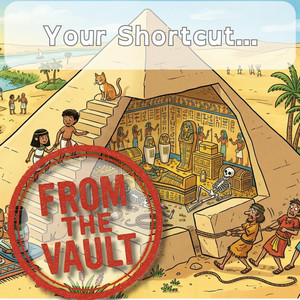
And this week the moment is definitely right because we're heading back to Ancient Egypt.
Now some of you might actually be learning about Ancient Egypt at school this year.
Pyramids, pharaohs, mummies, hieroglyphics, all the good stuff.
So think of this as just getting a little ahead of the pack.
A bit of bonus knowledge you can casually drop.
Okay, let me just find it.
Shelves, boxes, old spritz.
I wouldn't be surprised if I came across a mummified ex-employee wrapped in sticky tape back here.
Here we go.
Still perfectly preserved.
Very on theme.
Let's dig in.
This is a Squeeze Kids podcast. your fresh take on what's happening in the world around you.
It was a place where men wore makeup and women could be kings, where the rich were mummified in tombs and the poor in the desert.
This is your Squeeze Kids shortcut to ancient Egypt.
The podcast where we dive into the who what when where, why and how of the big news stories.
I'm Amanda Bauer.
And I'm Bryce Corbett.
A while back on Squiz Kids.
Today we heard about a 3500-year-old royal mummy that was digitally unwrapped in Egypt without a single bandage being removed.
Whoa!
Experts learned a lot and the world was fascinated.
Centuries after the decline of ancient Egypt, we are still intrigued by mummies, pyramids and hieroglyphics.
But there are a lot of myths around that we need to bust.
Oh, I look forward to that.
Today we'll take you through what are some of those myths about ancient Egypt, why Egyptian men and women wore makeup, and how to make a mummy at home.
Listen carefully.
There's a squeeze at the end.
What?
Okay, Bryce, let's start with the pyramids.
Most people will tell you that the pyramids were built by slaves and that every king had one, right?
Yeah, of course.
Wrong.
Oh.
Egyptologists, those people with the cool job of studying ancient Egypt... say that this myth about the slaves was started by the Greek historian Herodotus, who was born 2,000 years after the Great Pyramid of Giza was built.
He said that 100000 slaves had built the 146-metre tall structure up in egypt shows that it was in fact built by a workforce of 5 000 paid employees and another 20 000 temporary workers, who put in a three or four month volunteer shift on the building site before going home.
Ah well, that sounds much better than slaves being whipped as they worked.
So did every king or pharaoh have a pyramid built to house their body when they died?
Nope, that's a myth too.
Ancient Egyptian history starts around 3000 BC, but by 1550 BC pyramids were kind of out of fashion.
Okay.
From that point onward, kings arranged to have their mummies buried in hidden tombs on the west bank of the River Nile.
That's that massive river that's running through Egypt.
Ah, good.
I'm glad you mentioned mummies.
And, of course, we're not talking about mummies in the mum and dad sense of the word.
We're talking about the process of preserving a dead body by wrapping it in cloth bandages.
Now, why did all the Egyptians mummify themselves?
Or, hang on, don't tell me, is that another myth?
I'm afraid so.
The process of mummifying a human body was really expensive.
Oh.
And it took 70 days.
Wow.
So it was only for kings and the very rich.
70 days?
Why does it take so long to mummify a body?
Well first, special priests would carefully remove all the internal organs from was getting the brain out without damaging the face.
So they did that by sticking a special instrument up through the nostrils and then pulling the brains out.
Ew!
Gross!
Yikes!
Lucky the person was dead and couldn't feel anything.
Yeah, I'll say.
So all the organs were removed and put in jars and buried with the person, but the priests left the heart behind, because the ancient Egyptians believed that was where a person's intelligence and soul were.
Now, that wasn't the time-consuming part.
Once all the guts were removed, the priests had to remove all the moisture from the body.
Oh, why is that?
Well...
Think about how quickly an apricot would go off sitting on the kitchen bench versus a dried apricot.
Oh, yeah.
Drying things out preserves them.
So they covered the body with natron, which is a type of salt, and they put extra salt inside the body.
And the salt drew the moisture out.
Once the mummy was completely dried out, the wrapping began.
And each mummy needed hundreds of metres of linen.
Wow.
And they also put special charms, called amulets, between the layers of the linen and wrote prayers on some of the linen strips.
So that's what happened to the rich who died.
What about regular, ordinary, everyday ancient Egyptians?
You know, people like us.
What would have happened to you or I if we died back in ancient Egypt?
Well, we would have been buried, Bryce, in pits in the desert.
But the funny thing is, we would basically have been mummified too, because the sand was so hot and sterile that it would dry us out.
And in fact the very first mummies in the world were created that way in hot desert sand in northern Chile.
We talked about them in Squiz Kids before.
They're up to 9,000 years old.
Amazing.
So there's another myth busted.
Ancient Egypt wasn't the first place to mummify the dead.
Now, Amanda, when we see movies set in ancient Egypt, everyone is wearing dark black eye makeup.
Is that another myth that men and women painted their faces?
No, that one is true.
Ah, OK.
So, why?
All men and women in ancient Egypt painted their eyes with black and green powders because they thought it had magical healing powers.
Oh.
Now, I don't know about magic, but it turns out it did protect their skin from the sun kind of like, you know, coloured zinc does.
Yeah.
And incredibly, in 2010...
French researchers analysed makeup that was preserved from the ancient past, and they found that it contained lead salts, which are antibacterial.
So that makeup really did help to prevent or treat common eye infections.
Wait a second.
Lead salts isn't lead toxic?
Yeah, that's sort of the point.
So lead is toxic to the bacteria that's trying to infect your eye, but it is also toxic to the person infected.
So those French scientists were very quick to say that no one in the 21st century should be wearing lead makeup to treat an eye infection.
There are medicines available for that.
Now Bryce, while we're on the subject of men and women both wearing makeup, you may be interested to hear that in ancient Egypt, men and women were considered equal in the eyes of the law.
Women could own property, earn money, buy and sell and inherit their property.
Ha!
Something that only started here in Australia in the late 1800s and still isn't allowed in some countries today.
Yeah.
And here's something cool.
In ancient Egyptian, the word for king wasn't attached to any gender.
So women could also be king.
Wow.
How often were there female kings?
Well, historians know that women took the throne at least three times.
The most successful of them was Hatshepsut, and she ruled Egypt for more than 20 very prosperous years.
Cool.
I do want to be clear.
I'm not saying that ancient Egyptian men and women were completely equal in all ways.
For one thing, women were expected to stay home and raise the kids while men went out to work.
So the girls couldn't get paid to build pyramids or work as mummification specialists.
I see.
Now, speaking of mummies, you promised to teach us how to make our own mummies at home.
Well, the good news for those of you playing along at home is that you do not need a dead human body.
That's good.
Yes, a bit of a relief, isn't it?
We're going to make this mummy from a chicken.
OK.
So the full details are in your episode notes, but essentially you're going to need a raw chicken salt, baking soda and a container that you can seal tightly.
Oh, and you're going to need 40 or 50 days.
Oh, wow.
Wow.
I guess it takes time to dry out a chicken too.
Unless, of course, you forget it in the oven.
We are not going to cheat by cooking this chicken.
OK.
So every 10 days you're going to wipe off the old salt and baking soda mixture and then recover the chook.
OK.
And in case it's not obvious, you'll want to wear rubber gloves while handling a raw chicken.
And then can you wrap up your mummy?
You should.
Sure can.
You can wrap it up.
You can attach amulets or jewels.
You could write some hieroglyphics on the linen.
And then, when it's all finished, you can finally hold the funeral, just like they did for the pharaohs.
Time for the quiz.
This is the part of the podcast where you get to test how well you've been listening.
Question number one.
Who did the Greek historian Herodotus say built the great pyramids?
That's right, he said they were built by slaves.
Question number two.
What did ancient Egyptian priests pull out of dead kings' nostrils?
Yeah, it was their brains.
Ew.
Question number three.
What did black and green makeup help prevent?
And remember, don't try lead makeup at home.
That's right.
It helped to prevent sunburn and eye infections.
That's all we have time for today.
Thanks for joining us as we explored the who, what, how, where, when and why of ancient Egypt.
Now get out there and have a most excellent day.
Over and out.