We are living in interesting times, a turning point in history.
Are we entering a dark authoritarian era?
Or are we on the brink of a technological golden age or the apocalypse?
No one really knows, but I'm trying to find out.
From New York Times Opinion, I'm Ross Douthat.
And on my show, Interesting Times, I'm exploring this strange new world order with the thinkers and leaders giving it shape.
Follow it wherever you get your podcasts.
Hi, it's Natalie. Yesterday, the Supreme Court issued a landmark ruling that upheld a Tennessee ban on transgender medical care, effectively shielding similar laws in nearly half the country.
We'd like to hear from you about it.
Are you affected by yesterday's decision?
If so, please send us a voice memo and tell us where you live, how you're processing the court's decision, and how it could affect you.
You can send it to The Daily at nytimes .com with the subject line, Supreme Court decision.
Thank you. Now here's today's show.
From The New York Times, I'm Natalie Kitrow.
This is The Daily. Over the past several weeks, federal agents have mounted increasingly aggressive immigration And we're in an area close to downtown Los Angeles, Sky Fox, over the Home Depot out here off of Wilshire Boulevard. Just moments ago, officers from ICE were out here and they did take some folks into custody.
Across the country, in courthouses, neighborhoods, and workplaces.
Where a seven -year -old witnessed the arrest of his father.
Mommy! Mommy! Mommy!
And they've been met with intense pushback from protesters.
You're here to say end the ICE raids!
End the ICE raids! From politicians.
Why are you arresting the city's controller, and where are you taking him?
I'm Senator Alex Padilla.
I have questions for the secretary.
And even businesses.
I know one landscaper that lost the whole crew he had, and he's just totally out of business all of a sudden.
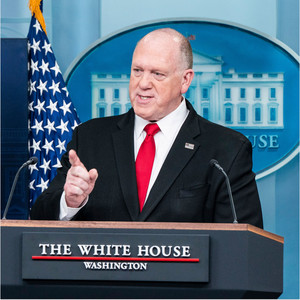
Today, we talked to the president's border czar, Tom Homan, about his deportation strategy and why the Trump administration is only just getting started.
It's Thursday, June 19th.
All right, I'm ready when you're ready.
Thank you so much for joining us.
Oh, no problem. Should I call you Mr. Homan, Border Czar Homan, Czar?
It doesn't matter. Okay, I think I'll call you Mr. Homan then.
There I go. Mr. Homan, we're speaking to you at a really interesting and important moment in the work that you've overseen for the president, which is securing the border.
You've done that very successfully.
You've brought border crossings down to historic lows.
So what we want to do today is talk to you about the second half of that work, which is detaining and deporting illegal immigrants living and working inside of the country.
Because that's where you've bumped into some real challenges, some wider pushback and protests, most notably in Los Angeles, but also elsewhere.
Can you just start by talking us through your goals here?
Are you trying to deport every single person who's here illegally?
And if so, why? Well, look, we're named from laws, right?
We got to enforce the laws.
Entering this country legally is a crime.
and we need to enforce those laws because if we don't, if we send a message to the whole world, you can go ahead and enter this country illegally, it's a crime, but don't worry about it, keep coming, which means more people are going to die making this journey.
The Border Patrol are going to continue to get overwhelmed.
So President Trump's been clear, and I've been clear from day one, we're prioritizing public safety threats and national security threats.
That is our priority.
But I also said from day one, if you're in the country illegally, you're not off the table.
I just want to be clear, Mr. Holman, When the Trump administration says we're deporting criminal aliens, that means everyone who's here illegally.
Staying here without authorization is the crime, in your mind?
No, I'm not saying that.
I'm saying we're prioritizing public safety threats.
People who have committed crimes in this country or committed crimes in their home country and came here to hide.
But we're looking for public safety threats and national security threats.
They remain the priority.
But everyone's on the table.
though. If you're in the country illegally, it's not okay.
That's why I'm saying.
Prioritization about who comes first. And that's what we're trying to concentrate on.
However, sanctuary cities are making that difficult.
When sanctuary cities does not allow us to get the illegal alien criminal in the safety and security of a jail, now we got to send a whole team of five or six agents for officer safety reasons to find that public safety threat.
And when we find them, many times they're with others.
Others who are in the country illegally may not be a public safety safety threat, we're in the country illegally, they're going to be arrested, too, because we're not going to turn a blind eye to illegal immigration.
I want to get to sanctuary cities a little bit more in a minute.
I do want to ask you about your goals here.
The number that you and White House advisors Stephen Miller have put out there as a target is 3 ,000 arrests a day, which would be about a million arrests a year.
That is an extraordinary number, a really ambitious goal.
Are you satisfied with your numbers thus far?
Well, I don't think 3 ,000 is overly ambitious.
vicious. We've added more operational teams in the streets.
We got like 1 ,000 teams operating every day across this country.
We've added other agencies, FBI, DEA, U .S. Marshals.
Other agencies are augmenting these operations.
So, we think with the additional teams, additional resources we provided, 3 ,000 days is a reasonable number.
Let's talk about the raids that we've seen so far, Mr. Homan.
Immigration and Customs Enforcement, ICE, invited our colleagues to one of these raids.
We featured it on the show.
These are raids that have increasingly expanded into workplaces, into neighborhoods.
We've seen ICE agents at construction sites, home depots, car washes.
Can you just explain why you're focusing on work sites?
Well, look, no one hires an illegal alien out of the goodness of their heart.
They hire them because they can work them harder, pay them less, and undercut their competition as U .S. citizen employees.
I've experienced this myself.
Let me tell you a real quick story.
I put a new roof to my home several years ago.
I had to call six companies before I got a company to guarantee me a legal workforce.
And the father and son showed up.
And the father told me this story.
He says, I had 20 U .S. citizen employees, and I paid them $20 an hour to get on the roof.
I couldn't win a contract because all these other companies had illegal aliens.
They were paying them $7 an hour to get on the roof.
I couldn't win a contract.
So I laid off all my U .S. citizen employees, and now me and my son just do repairs.
That happens across this country every day by the thousands.
So work site enforcement is important.
Portland. Portland State Enforcement is the number one place we find victims of sex trafficking and forced labor trafficking.
And second of all, we got to hold these companies responsible because they're undercutting U .S. citizen employment.
They're driving down wages.
And it's against the law to hire an illegal alien.
So, we got to enforce the law.
So, again, if they let us in the jail, we'd have less agents in the neighborhoods.
I've said for months now, if sanctuary cities want to keep playing this game, we're going to flood the zone.
We're going going to flood the zone with agents in the neighborhood.
We're going to flood the zone with agents on work sites because we're going to find that person.
You want to put roadblocks up, that's fine.
We're going to find them.
So we have to have more resources and do more.
That's what we're going to do.
You had said that your priority was public safety, right?
And that you're prioritizing criminals.
At the workplace raids, are you rounding up just the people who are there who have criminal records or is it anyone you think is undocumented?
Is that distinction important to you?
We are not going to turn our back to somebody that we found is illegally in the United States.
They're here in violation of federal law.
These are immigration officers whose job is to enforce that law, and so we're going to arrest that illegal animal.
Absolutely. The instructions are clear to ICE officers.
You find someone that's in the country illegally, you will take proper action.
The officers have discretion on the arrest, and what do we do with them after?
But there are going to be put in proceedings.
That's what the law requires, so we will put them in proceedings at a minimum.
You mentioned this issue that you're having with these sanctuary cities.
You said part of the reason that you have to do these raids is that these cities are not letting you into the jails to arrest the criminals that are there.
If those cities let you into the jails, would you stop doing the workplace raids?
What I'm saying is more agents in the jail means less agents on the street.
It's simple math. Back when we were in Rikers Island, we've had 10 or 12 agents on Rikers Island in New York City.
We arrest hundreds of people a week with a handful of agents.
So, of course, if I had a choice, I'd much rather be in a jail because it's safer for the neighborhood, safer for the officer, and safer for the public.
Well, let me be clear.
Even if they let us in the jail, every jail across the country, doesn't mean we stop our worksite enforcement operations.
We prioritize those, too.
We just don't say, well, let's go to this worksite just for something to do.
No, it's based on a lot of evidence gathered, a lot of information on who we hit.
So it's never going to go away.
It will certainly decrease because we have more agents assigned to the jails.
Got it. So you would be operating on both of those fronts either way.
Yeah. So Trump won the election on the promise to do mass deportations.
But I want to talk about the polls here because while polls show a majority of Americans support deporting violent criminals, they don't support deporting people who have been here for a a while, who are deeply ingrained in their communities.
What do you say to people who say, look, we voted for deporting all the violent criminals, but not for this more sweeping campaign to deport everyone here illegally?
President Obama's clear on his campaign promise to secure the border, which is the most secure border in a lifetime, and running a massive deportation operation, and that's what we're doing.
If people don't like what ICE is doing, then call your senator, call your congressman.
ICE isn't making this up.
We're enforcing the the law is enacted by Congress and signed by president.
You know, everybody attacking ICE right now, and here's what I find interesting.
If you don't like what ICE officers are doing right now, why aren't you on Capitol Hill asking for immigration changes?
Why aren't you protesting Immigration Corps?
Because ICE is doing two things.
They're enforcing laws enacted by Congress, and they get funded to do.
And number two, they're working on immigration, a federal judge who ordered this person be removed, so they're executing the order of removals.
ICE is just doing the job.
And look, the innocent illegal immigration, the non -criminals, they just enter the country illegally for a better life.
When that happens, they're overwhelmed with border patrol, the national security is gone because fentanyl comes across, killed hundreds of thousands of Americans.
Sex trafficking increased tenfold.
All those bad things happen because innocent illegal immigration, people want to call it.
While everybody's fighting for and defense of illegal aliens, there are millions of people standing in line, taking their tests, doing their background investigation, paying their fees, doing things the right way.
And let me add this.
In addition, there are thousands and thousands of people in this world who really are escaping fear and persecution from their home government.
They're sitting in the backseat because all the cheaters have overrun the system and pushed the system back for several years.
So we have to be a nation of laws.
We've got to send a message to the whole world.
There's a right way and wrong way to come here.
You can still make an asylum claim, same.
But you've got to do it the right way.
You don't do it by entering the country illegally.
And what I hear you saying is that basically the people who are not violent criminals whose crime is to cross illegally, that that is related to public safety because of the need to kind of be this nation of laws.
I'm just not sure a lot of people see it that way because we are seeing people talk to their representatives.
We're seeing these really big protests, Mr. Homan, which I know you've seen.
We've seen, you know, people go on the streets to voice their concerns about this.
And I think what they are trying to communicate is that they don't want this.
And I wonder what you say to that, to those protesters.
I would ask them, what laws do you not want DEA to enforce?
What laws do you want FBI not to enforce?
What law do you ask your local police department to enforce?
We don't pick and choose what we enforce.
We're here to enforce the law.
Illegal immigration is not the answer because, again, people don't understand there's a whole ugly underbelly of illegal immigration.
I've done this since 1984.
I've sent them back a tractor -trailer with 19 dead aliens who baked to death, including a five -year -old little boy.
I've talked to little girls as young as nine that were raped multiple times by members of the cartel.
I have seen babies getting CPR in the river.
I've seen enough dead children, enough dead aliens in my career that it's created the person you're talking to today.
I wish people could wear my shoes for the last 40 years and see what I've seen, and they would agree with me.
Illegal immigration is not a victimless crime.
A secure border saves lives.
No, I hear you. And I mean, look, I spent a lot of time reporting from Mexico and reporting at the border, and I can completely understand how having a secure border affects this trafficking that you are concerned about and that you've seen over the course of your career.
I think the question that people people who are on the streets are asking is how does breaking up a family or uprooting a person who has been here for a long time, who is not seen as causing a lot of problems. How does that affect the problems that you're talking about?
We got to look at the results, right?
Look at the data from ICE right now, just under 130 ,000 arrests, close to 75 % of them have a criminal record of pending criminal charges.
We are prioritizing the right way, but we aren't I don't want to send a message that it's okay to be hurt illegally.
Because that just brings more.
Before we start bailing a water out, we had to plug the hole.
We plugged the hole.
But we got to send a message, there's a right way and a wrong way to come to this country.
Because if we say, starting today, we're only going to arrest illegal aliens convicted of a crime.
Everybody else, don't worry about it.
We're not looking for it.
You're saying that would send the wrong message.
To the entire world who wants to become the greatest nation on earth?
Absolutely. We'll be right back.
I'm Brian Rosenthal.
I'm an investigative reporter at The New York Times.
My dad is a scientist. My career has been devoted to scientific teaching and research. I remember growing up, I didn't fully understand what he was doing every day.
But now that I work as an investigative journalist, I do understand.
So you have to start with facts.
From those facts, a hypothesis appears.
And then you work on trying to test that hypothesis.
I do the same thing, obtaining documents, crunching the data, and I've talked to as many people as possible to get to the bottom of the story.
The New York Times does not publish until we can prove that something is true.
The best scientists are able to do that deep work because they receive funding from their university or from the government.
We as journalists depend on funding from subscribers.
You can support that type of work by subscribing to The New York Times.
Sir, I just want to talk about just tactics.
We've seen some Democratic officials who are showing up to protest, and they're at times getting detained.
Most recently, we saw a mayoral candidate in New York get arrested by ICE at an immigration courthouse.
Can you just explain that to me?
What's the message there?
It does feel more aggressive than what we've seen.
We've been clear from day one.
You can protest all you want.
You cannot like ICE.
You can hate on Trump.
You can hate on whatever.
whatever, but you can't cross that line in interfering in a law enforcement operation.
It's unfortunate. These candidates are making a public appearance because they're all looking to get out there and say, look at me, I'm taking on ICE, which is really disgusting, in my opinion.
Where were they when half a million kids got smuggled into this country and separated from their families?
Where were they when millions of people were being released in the United States without proper vetting?
Where were they then?
If any of these candidates met with an angel mom and dad whose children were murdered by Illegal animal?
I guarantee they haven't.
What I find disgusting is that any elected official or any politician, why are those who enforce the law the bad guys and those who break the law the victims?
The whole world's upside down on this.
The men and women of ICE, who I commanded them, I was the first ICE director, actually came up to the ranks, they're mothers and fathers too.
They have children too.
They have parents too.
They don't hang their heart on the hook at their home when they go to work.
They go home with terrible, terrible things every day.
These men and women are putting their lives on the line to enforce the law Congress had told them to enforce.
And they're executing orders issued by a federal judge saying that person needs to be arrested and deported.
That is what they're doing.
This attempt at, you know, attacking ICE and getting on TV.
Boy, look at me. I'm taking on ICE.
It's just disgusting.
The senator in California, he could have had a meeting with the secretary.
All you guys do is do it the right way.
This guy running for political office, why didn't he ask for a meeting with ICE?
they say, meet me after a six.
Where are you going?
Where are you taking them?
I'll meet you there.
I got questions. But they're being really aggressive because they're looking for the limelight.
I can't think of any other reason people would do that.
It's unprofessional and it's unsafe.
Can I just ask, do you think there's anything valid about the criticism that ICE is maybe coming in a little more aggressively than is necessary?
That it's also about potentially intimidation?
It's not about intimidation.
These men and women are under pressure to not only do their job, but to keep themselves and the people around them safe.
When they arrest an illegal alien, they got to worry about his safety.
They got to worry about their safety, their partner's safety, and everybody in the surrounding area's safety.
And I'm reading a story this morning.
California wants to ban ICE officers wearing masks.
ICE officers wear masks because they've been doxxed by the thousands.
Their families have been doxxed.
ICE officers' pictures have showed up on trees and telephone poles.
Death threats are sky high.
I know because I've been doxxed a thousand times myself.
I accept it. I'm the border czar.
I don't really care what people think about me.
But bottom line is, these men and women not only have a dangerous job already, it's made much more dangerous by the false rhetoric being pushed out there by a lot of the media and a lot of the open borders advocates.
They're doing the best job they can in difficult circumstances, and I stand by that.
It's not being aggressive.
It's about being safe and enforcing the law in a difficult situation.
And you said this isn't about intimidation, that this is about safety for your ICE officers.
I'm curious, though, just in a perfect world for you, does everyone here illegally see what you're doing, see these raids and say, look, that's not how I want to leave the U .S.?
I would rather self -deport.
I would rather do this on my own accord. Is that the ideal scenario in your mind?
Absolutely. We spent a lot of money advertising that in several different languages.
Work with us. Get your fares in order, wherever that is, work with ICE, we'll get you a free airline ticket home, and we'll give you $1 ,000 when you land.
We want to do it that way.
And if they do it that way, they're leaving themselves open to opportunity to come back with a visitor's visa, tourist's visa, maybe they have a U .S. citizen child that when they turn of age, they can petition for the parent.
There's other legal avenues they can take advantage of, but if we have to go seek you, we have to go through the formal deportation process, there's a statutory bar in federal law in ways from five to 20 years where you can't come back under any legal program.
So make it easier for yourself and work with us and leave and make other opportunities available to you.
I think my question was really about the kind of images that are coming out of these raids and whether there is a message being sent by the aggressiveness of the approach, which is, look, if you don't want to be swept up in one of these raids, go on your own accord. And do you see the kind of aggressive tactics as sending a message, sending that message specifically?
I don't agree with the term aggressive tactics.
They're doing the same taxes that I'd done starting in 1984.
ICE is trying to do the job.
So enforcing law is aggressive.
I disagree with the term aggressive.
I think they're doing it in a real professional manner.
Despite all the hate they're taking, all the threats they're taking, they're taking extra measures now.
I'll give you that.
They're sending more officers in the zone for officer safety reasons, but that's because of the threats that's being leveled against them.
I am just aware that in some ways the fear that is generated by these actions can be helpful to achieving that aim of getting people to self -deport.
I mean, we know one effect of these raids is that people in these communities, they are afraid, right, based on our reporting.
There is fear that is generated and that could lead to the result that you're saying you want.
What I'm saying is I don't think that's the intent.
I certainly believe what you're saying.
I believe there are people that are afraid of being arrested by ICE because they're here illegally.
I follow that. I believe it.
But that's certainly not the intent.
But if it leads to more people self -deporting in a more structured, controlled manner, then, you know, I hope they do.
I hope they take advantage of it.
So recently we've seen some pushback surface from a very different constituency on this, which is big business.
And quite unexpectedly, also the president, your boss.
who gave voice to some of these anxieties.
Trump posted on social media this week that he's been hearing that the raids are having an impact on hotels and farmers.
I'm just going to quote from his post. Our very aggressive immigration policy is taking very good longtime workers away from them with those jobs being almost impossible to replace.
What did you think of that post?
Because from where I sit, it did look like the president saying, look, this approach that you've been taking, that ICE has been taking, is becoming a problem.
Is that how you read it?
I think what the president is getting to is that, again, I haven't discussed this with the president.
I just, you know, we haven't had a discussion, but I saw the post. And I've said for a long time, and I think we started this interview with this, Congress needs to make some changes, right?
If we need a workforce to do that type of work, then create a legal pathway where they don't have to pay a smuggler, then come with a visa and come here, work, do their job and go home, Pay their taxes, whatever.
I think the president understands that there's a broken system here.
But it doesn't mean we just ignore the law.
Just so we're clear, because I think there was a lot of confusion after this, what is the policy?
Are you still doing the workplace raids?
Because there was a lot of back and forth.
We are still doing workplace raids.
But again, it's based on prioritization.
If there's a victim of trafficking, it's some of the financing going to other illegal ventures like cartel activity or drug smuggling.
And so if there's a violation of law, we certainly prioritize those first because it's about the health and safety of the alien who's being abused the worst first. Okay.
I want to talk about what's happening to people once they have been swept up in these raids.
They're taken into ICE custody where we've seen reports that they have no ability to contact their lawyers.
We have heard about people who are being sent abroad to countries, you know, with which they have no connection, Sudan, et cetera.
Why are people being sent to countries where they have no connection?
It's not their home.
It's a case -by -case of cases.
If it's a significant public safety threat and their country won't take them back, well, they're not staying here.
If we have a third -safe country willing to take them, we'll send them.
The vast majority of illegal aliens who are arrested, the vast majority, are removed to the country where they're a citizen national.
But there are countries out there.
We see Benz and Will turn on and off many times.
When we take them, no, we won't take them.
him well if you don't take him they're not staying here their public safety we'll send him someplace else so we have other countries that are stepping up say look we'll take them we'll give them a place to settle down are there in your mind any limits to what ice would do to of course there's limits we're not going to violate anybody's human rights we're not going to violate the civil rights if someone's not allowed to call the attorney give me an example give me a case give me where When?
And we'll look into it because certainly they have a right to contact their attorney.
We try to treat everybody with dignity and we try to do things the right way.
Mr. Holman, last question here.
You clearly think that these deportations benefit the United States, right?
That it makes it a safer place, that it makes it a place where American workers come first, where the rule of law is respected.
What some of these business leaders, these farmers, these hotel owners and some politicians, including Republicans, are saying, wait a minute, this actually might be bad for the U .S. And to a degree, the protesters are saying the same thing on different grounds, but it's the same idea.
How do you know that you're right and that they're wrong?
Look, you know, the senior leaders of this effort meet every day at 10 a .m. We look at the effects of what we're doing.
We take all these things into consideration.
I've worked for six different presidents, starting with Ronald Reagan.
I've seen hundreds and hundreds of policies come and go.
I see what works. I see what hasn't worked.
We're working with a plan right now, we're using every two in the two shed to keep President Trump's promise to the American people.
That's exactly what we're doing Can plans be fluctuated?
Certainly. I was up on the hill several times last week meeting with congressmen and senators We're talking about fluctuations and messaging and different things we can do, so it's a work in progress and I certainly listen to all these people and will take all all those ideas in consideration.
And in fact, we do.
It's a work in progress.
We'll keep working toward it.
Mr. Homan, thank you so much for coming on the show.
You got it. Thanks for having me.
We'll be right back.
Here's what else you need to know today.
On Wednesday, President Trump said he hadn't made a final call about whether to order American forces to join Israel in its ongoing attacks on Iran's nuclear sites.
Iran's leader has warned the U .S. would face irreparable harm if it did.
At an Oval Office event, Trump said he had, quote, quote, ideas as to what to do, adding, quote, I like to make a final decision one second before it's due.
And while the Supreme Leader of Iran rejected Trump's call for an unconditional surrender, a senior official told The Times Iran would accept an offer to sit down for talks to seek a negotiated way out of the conflict.
And the Supreme Court upheld the Tennessee ban on medical treatment for transgender minors, shielding similar laws in more than 20 other states.
The decision was a setback for proponents of transgender rights, who just five years ago celebrated a different decision by the court to protect trans people from workplace discrimination.
The vote was 6 -3, with the court's three liberal justices in dissent.
Writing for the majority, Chief Justice John Roberts acknowledged the, quote, fierce scientific and policy debates about the safety, efficacy, and propriety of medical treatments in an evolving field.
But he said those questions should be resolved by, quote, the people, their elected representatives and the democratic process.
Today's episode was produced by Caitlin O 'Keefe, Aastha Chaturvedi and Jessica Chung.
It was edited by Michael Benoit, Patricia Willans and Paige Cowan.
Research Help by Susan Lee.
Contains original music by Alisha Ba 'itu and was engineered by Chris Wood.
Our theme music is by Jim Brunberg and Ben Landsberg of Wonderly.
Special thanks to Hamid Aliaziz, Zolin Kano -Youngs, Alison McCann, and Albert Sun. That's it for The Daily.
I'm Natalie Kitchileff.
See you tomorrow.