Hello Easy English listeners and welcome back to another episode.
I'm your host Oliver, and today we are diving into a topic that I get asked about a lot, and it has confused, frustrated and amused many English learners for decades.
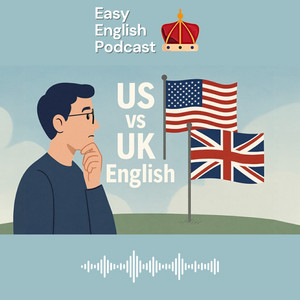
And that is the divide or the difference between American and British English.
It is often said that the UK and the US are two nations divided by a common language.
But why?
Why does a biscuit become a cookie in New York?
Today, we're not going to just look at lists of words.
We are going to look at the history, the rebel spirit and the cultural reasons and shifts that created these two very different versions of English.
But, as always in every episode, we're going to learn some key vocabulary before we look at our main topic today.
And these are words that you're going to hear throughout the episode at different times.
So I want you to listen for them and see if you can hear them in context.
The first word is nuance.
Nuance.
This appeared a couple of weeks ago on an episode.
And I wanted to put it back in because I think it's a great word.
And it's very relevant for this topic.
So that's the nuance, the nuance.
And it means a subtle difference or shade in meaning.
That can be meaning, it can be expression, it can be sound.
So little differences between something.
So we're going to be talking about the nuances between the US and the UK versions of English.
Our second word for today is etymology.
Etymology.
And etymology is a noun, and this means the study of the origin of words, where words come from, how they started, how they became what they are today.
And really, this study looks at those beginnings, but also how they have changed through history.
Great word, etymology.
Our third word today is standardization.
Standardization.
And this means the process of making something conform to a standard.
So you're making something adhere or conform, basically be at a standard.
We want to make them all standard size, all of the same size, for example, you could say.
Our fourth word today is colloquialism.
Colloquialism.
Colloquialism.
That's a hard word to say.
And colloquialism, a colloquialism, is a word or a phrase that is not formal or literary.
So colloquialism is really an informal word or phrase.
So one that is used in very ordinary or familiar situations or conversations.
And our final word today is divergence.
Divergence.
And divergence is the process of separating and going in a different direction.
So when something is divergent, it is divergent, you know, moving away and going in a different direction.
These are all great words and I want you to challenge yourself to try and listen for them in today's episode.
And, as always, if you want the full vocabulary list, including the flip cards for this episode where you get those bonus words, you can access those through.
Patreon membership.
So for your Easy English subscription, you get access to bonus episodes, as well as flip cards and transcripts in PDF form for every Easy English episode that comes out.
You can check that out in the link in the description below.
Okay, let's keep going.
Many people think that British English is like the original English and American English is maybe a mistake or a newer, less correct version.
But the truth is more complex.
It's more complicated than that.
The reality is with language, languages constantly change.
And both versions of English have evolved and changed so much since the 17th century.
When the two really split apart.
In the late 1700s, now we're looking at a little bit of history.
So in the late 1700s, an American named Noah Webster wanted to show that America was independent from Britain. not just politically, but culturally as well.
So he purposefully changed the spelling in his American dictionary to make it more logical and more American.
American.
And these are some spelling differences that you've definitely heard of before.
So, for example, the removal of the letter U in lots of words.
For example, the words colour or honour.
So the American version of colour is without a U. And the British version, of course, we use the U.
And there's so many words in American English that have taken the U out of the words.
There's also the ER flip.
So what this means is the letters ER in words such as theatre and centre were changed around.
So the E before the R instead of the R and the E afterwards, like in British English.
And, of course, he preferred as well to use the letter Z or Z as I guess Americans say a lot too.
The letter Z instead of S in words like realize or analyze.
In British English, we tend to use S. We don't use Z.
So really a lot of those word spelling changes came simply because they wanted to make the language different.
They wanted it to be separate from the British and seem more American.
You know, like, why are we going to spell words like this?
We can do it our way because we are on our own now.
So it really does come from a large element of that rebel nature.
So wanting to go against what they had before.
And, of course, the reason why those languages became more different at the time, why they separated more over time.
Besides those initial spelling differences and a few intentional choices, it simply happened because at that time we didn't have the internet.
We didn't have a lot of travel between the two countries for the average person.
And there wasn't even the telegraph at that time.
You couldn't send messages back and forth easily.
You had to do it by letter for a very long delivery process.
So two populations, both Britain and the US, which were very big populations at the time, were separated by a massive ocean, a big C between the two of them, speaking their different versions of English slowly changing over time.
Language is natural, it grows and it changes and, of course, it can change because of our environment, the things around us.
For example, in the UK it rains a lot.
So people have many, many different ways to talk about rain and the weather.
We have so many phrases and verbs to describe the rain.
In the US they probably use a lot less.
And without that constant contact between these two populations of English speakers, the two versions of English naturally underwent, it went through a process of divergence, moving apart from one another.
This process can be seen and it reflects today in the UK, even in different parts of the UK.
We have very different types of English, different accents, different words that we use and different ways of saying things.
It's the reason why I sometimes get comments on my videos or on the podcast basically saying that I'm asking if I'm speaking American English.
Because sometimes my pronunciation and the words that I use are a little bit different from the standard British English in the south of England.
But where I grew up, back in the past, of course, was a very far away place for that time.
But anyway, enough about the history.
Let's take a look at some of the, I guess the vocabulary in the wild.
We're going to talk about some of the nuance of daily life.
The differences which are practical.
And we can really categorize these differences into three different zones.
We can look at the home, the road and the kitchen for the sake of this podcast, to look at a few differences.
So if we were out on the road?
If your car breaks down in London, you're going to look under the bonnet.
So you look under the bonnet of your car.
But if it happened in New York, you would be looking under the hood of your car.
If you had some extra bags that you couldn't fit in the main part of the car in the UK, you would put it in your boot, in the boot of the car.
In the US, you would put it in the trunk of your car.
Now let's look at the kitchen.
And this is where some of the most dangerous misunderstandings between the language might actually happen.
One you've probably heard about is that in the UK, chips are what Americans call French fries.
So we call chips basically are thick cut fried potatoes.
But in America, chips are what we call crisps in the UK.
So it's very thin, crunchy snacks, potato snacks in a bag.
And we call them crisps.
Crisps.
Chips in America, crisps in the UK.
I like the word crisps more.
I don't know why.
Maybe I'm biased.
Of course, I'm biased.
But I do think it sounds like a lighter, more fluffier word, crisps, than chips.
But yeah, it's just my preference.
We also have the word biscuit in the UK.
Biscuit is just any kind of sweet biscuit.
Like it could be a cookie.
It could be a certain specific type of biscuit.
Whereas in the US, a biscuit is more like what we call a scone in the UK.
It's like a bread thing, which is often eaten with a type of gravy in the US.
And then there's the word cookie.
In the UK, we consider a cookie simply a cookie.
So literally a cookie that has chocolate chips inside.
So it has to be that biscuit with chocolate chips, like a classic cookie.
And for us, it is only one type of biscuit, which is the larger group.
In the US, they call them all biscuits.
Sorry, not all biscuits.
I'm too tired.
They call them all cookies.
So what we would consider different types would be considered cookies.
In the US, whereas in the UK when we hear the word cookie we think it has to be.
You know that biscuit with chocolate chips a cookie.
But hey, the most difficult part with this divergence, with the changes between the two languages over time, is probably not necessarily the words that are different, because you'll just tend to use one or the other.
And now with the internet and American media as well as British media which, to be honest, in the English speaking world both American movies and British movies, including actors and actresses probably the most popular English speaking content being produced
We're all quite used to hearing both.
So most Americans and most Brits will understand each other, even if the phrases are different.
But the hardest bit is the colloquialisms.
It's not those words.
It's the colloquialisms, the informal language and the tone as well.
Here's an example.
So there's the word quite.
Quite.
Quite.
So I don't mean just the word quite as how it is.
I mean this in an informal way.
So the informal phrase of quite in American English usually means very.
So that was quite good.
It was great.
In British English, quite means somewhat or average.
Basically just means average.
It's okay.
It's not great, but it's okay.
So if I say, it was quite good, it means it was okay.
It wasn't amazing.
So that quite before good means not quite, essentially.
That's one way to look at it.
So you can see how that can mean very different things in the US and the UK.
One means it's great, it's good, very good.
And one means, no, not so good.
We've got a phrase as well, which we use in the UK sometimes, which means to table emotion.
So when we table something in the UK, it means to bring it to the table for discussion now.
It means we should talk about something now.
This is a business phrase.
When we table something, we're talking about it now.
In the US, to table something means to postpone it.
So to put it for later.
So literally the opposite meaning from the same phrase.
So I hope that gives you an example of sometimes how those can be a trap.
Even for us native speakers, if we hear the other one, it can be a little bit confusing.
But hey, which one should you learn?
You're listening to this podcast, so you're primarily hearing and learning British English, but you're also hearing a lot of American English too.
In 2026, the lines between the two are blurring.
They're becoming less clear.
With YouTube, TikTok and global streaming, British people are using a lot more American slang and phrases.
And Americans are also starting to use some British phrases as well that make it into the mainstream.
But to be honest, if anything, I would say that British English is probably becoming more Americanized over time, but it still keeps its unique characteristics.
After all, British English is spoken in Britain.
It's spoken in the United Kingdom primarily.
And you can't necessarily take the language out of the place.
So it's always going to be different.
It will always be affected by the area around it.
And as such, will always have its identity.
For me, I think you shouldn't really care about what one you're using, and you shouldn't even care about mixing them, because it's becoming more common to even do so.
Unless you're learning it for you know academia or a specific purpose, like a job where you're expected maybe, to use one or the other.
Picking a side isn't really important.
It's more about your consistency.
If you write color with an American spelling, then try to use without the letter U for other words that are similar.
So keep the American spelling of your words.
Mixing them isn't wrong.
It's not incorrect.
People aren't going to laugh at you for using some American words.
I do it too. but it does show a level of higher consistency.
But I think naturally, with time you will find a balance of which words you like, which ones you don't, and what becomes your natural way of language use.
Whether you say pavement or sidewalk or even footpath, we say in many areas of the UK the heart of the language and the meaning remains the same.
But understanding this etymology of the words and the cultural reasons behind these differences can help you to sort of navigate and get your head around why.
So thank you very much for joining me today with the main topic.
But first, before we finish our episode, I want to take a look at our listener spotlight, because we've had so many amazing comments written in head to the Easy English podcast over the last couple of weeks.
And this is answering questions about your New Year's resolutions.
I almost forgot about these to read, but I've read each and every one of them.
I've read every comment.
And I want to highlight a few of these.
And I'm going to highlight even more of them in next week's episode because we had so many comments.
I had a great comment from Douglas and Douglas said, Hi Oliver or hello Oliver, how is it going?
I'm Douglas and I'm from Brazil.
I already planned some goals for this year, but I'm not sure how good they are.
One of them is to become more fluent in English.
And to achieve that, I planned to be immersed in grammar, read texts, watch movies and series and listen.
Besides this one, I want to be in shape.
I realized I got weight this last month.
I started to go to the gym at least three times per week.
Thank you for your podcast.
It's really helping me.
Great comment, Douglas.
And those are some excellent goals.
Very well spread.
And I like how you've broken down your goals into different parts.
So another, more people answered this New Year's resolutions and goals question.
And I had another great one.
It was from, let's see.
It was from Mo from Myanmar.
And they said it's their first time commenting on Spotify, which is excellent. great job.
And in 2026, Mo wants to become more fluent in English and to become a nurse.
Excellent goals, Mo.
I really hope that you achieve them and good luck with your studies as well to become a nurse.
I had another comment from Manuela and she said she's from Brazil and her podcast is helping her a lot on her English studies.
Congratulations for this wonderful job.
My major goal for 2026 is to finish college and to start studying Spanish, which is very useful in Latin America.
I just realized I read the start of that comment wrong.
I'm recording this very late at night so I've made a few mistakes along the way tonight, but hopefully it was not too noticeable.
So...
Thank you very much for your lovely comment, Manuela.
And I hope to see each and all of these commenters in future episodes.
I read every comment and I love responding and seeing what you think on these questions.
I'm going to read a few more answers in next week's episode as well, because there were so many great comments and goals for this next year.
But today's question I'm going to ask, if you would like to answer it, you can in the comments.
Today's question is, what English do you tend to use?
More British English or... or American English.
Let me know if you have a mix.
Tell me which things you like to say in British English, which things you'd like to say in American.
Have a little think about it and let me know in the comments.
Remember, if you've been listening for a while or you're brand new, make sure you're following or subscribed to the show.
It really, really helps.
And rate the podcast five stars on Spotify or Apple Podcasts.
Thank you so much for listening and I will see you in the next episode.
Have a lovely rest of your day.
Goodbye.