Hi there Gabriel Boruffato from GB Voice Academy, your voice coach to help you master the American accent.
Now, in this video, we're going to be practicing our American rhythm and pronunciation with this dialogue.
If you haven't yet, subscribe to my YouTube channel so you can get access to more of these practice videos to help you master the American accent.
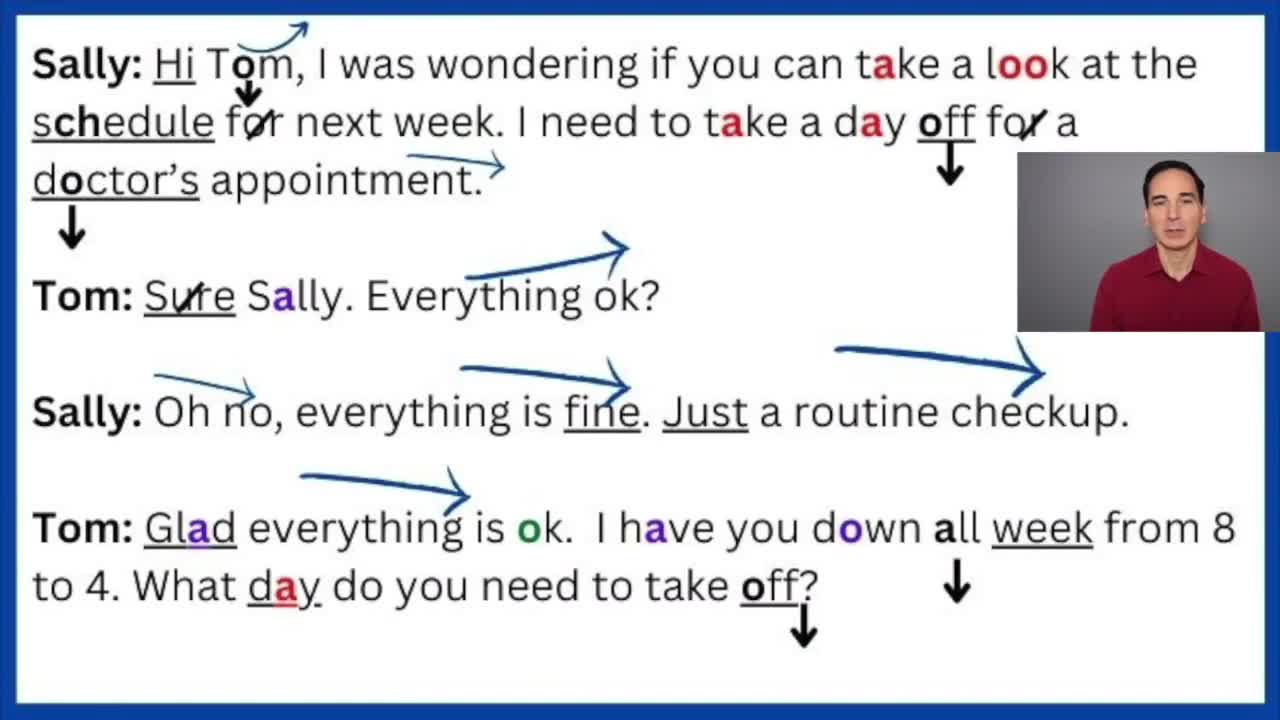
Sally says, Hi Tom, I was wondering if you can take a look at the schedule for next week.
I need to take a day off for a doctor's appointment.
So now, let's focus on the pronunciation first before we get into the actual rhythm.
Hi Tom.
Ah.
This is a particular American sound that a lot of people miss.
Ah.
Tom.
It's very open.
It's very deep.
It goes down.
Tom.
Versus Tom.
Hi Tom.
Hi Tom tom, i want you to imagine you're yawning tom.
There you go, try it.
Hi tom, you see how deep that is now.
Remember that sound, because there's going to be more of those sounds throughout this conversation.
Hi tom, i was wondering if we could take Listen to that sound.
Take.
You see how bright that sound is?
And there's two elements to this sound.
A-E.
Take.
A lot of people tend to miss it.
They go dick, dick.
Can you dick a look?
Dick.
Versus giving me that full A-E sound.
Try it, take very good.
Can you take a look now?
This is another particular pronunciation that we forget.
Oh look, a lot of people tend to go luke.
Can you take a look?
Take a look versus take a look.
It's sort of an open puckered sound.
Try it.
Take a look.
Try it.
Excellent, all right, cool.
Let's start from the beginning up to there with everything we've learned so far.
Hi tom, i was wondering if we can take a look at the schedule for next week now.
It's spelled with a ch.
It's not schedule, it's with a c.
Sound schedule for next week.
Do you notice that I went for versus for next week?
Because we often reduce this word in the American accent to make it flow better.
Schedule for next week. versus schedule for next week.
Sure, you could do that, but it's a giveaway that you're trying too hard.
And the key to mastering the American accent is to making sure we sound as native as possible.
So let's reduce that.
Schedule for next week.
For, for, for.
Kill that O, for next week.
Excellent.
Let's try it from the top till there with everything we've learned so far.
Hi, Tom.
I was wondering if you can take a look at the schedule for next week.
Excellent, i need to take.
Remember that sound.
A versus dick.
I need to take a day.
There's another one of those a sounds that we were referring to earlier a versus a.
Take a day, take a day, Right.
Take a day off.
Hey, there's that other off target that we were talking about with Tom, remember?
Take a day off versus take a day off.
Take a day off, take a day off and then we're coming to another fur.
Take a day off for a doctor's.
Here we have another one of those deep sounds doctor's appointment.
Try from take a day.
Take a day off for a doctor's appointment.
So do you notice that we're jumping up and down?
We're up here, we're down here.
We're tightening up those errs.
There's a lot going on.
So when we read these, let's really take our time and enunciate go over the top.
Let's try it from the top, nice and slow, with everything we've learned so far.
Hi tom, I was wondering if you can take a look at the schedule for next week.
I need to take a day off for a doctor's appointment.
Now, I'm doing a lot of faces, okay?
I don't want you going out there making these faces, but I'm doing it so you can see how physically different these sounds are.
It's not just how it sounds, it's how it feels.
A has a certain feeling to it.
A, it sounds nasally.
Oh sounds very open and dark.
Oh, oh yeah, we're overdoing it here.
So when you're on the real world it'll sound about right now let's look at the intonation to this.
Do you notice?
I went hi tom, i went up on that.
It's an optimistic, welcoming sound.
Hi tom.
We don't want to start off with hi Tom.
That kind of sounds like there's bad news coming up.
Hi, Tom.
I got some bad news.
We don't want that when starting a conversation, unless it is bad news and you need to present it that way.
But, generally speaking, when we're speaking American, there's optimism, there's wittiness, there's fun.
Hi, Tom.
So that when the listener listens to that, OK, great.
We're going to engage in a pleasant conversation.
Hi, Tom.
I was wondering if we can take a look at the schedule for next week.
I need to take a day off for a doctor's appointment.
So going down at the end for a doctor's appointment subliminally tells the listener oh okay, he's finished.
Now it's time for me to take over the conversation.
Okay, moving on.
Tom says, sure Sally, everything okay?
So now, sure, sure.
We're doing the same thing that we did earlier with that fur.
We're killing that U. So it sounds like an SHR sound, sure.
And if you're having problems with that R sound, try clenching your teeth.
Sure, sure.
That's gonna avoid you wanting to open up that bow, sure.
Sure.
Right?
Sure, Sally.
Ah, Sally.
There's another very bright forward sound that we're just not used to making.
Sally versus silly.
Silly.
Ah, it's got a nasally quality to it.
Kind of similar to take A. It's up here.
Sure, Sally.
Everything okay?
Yeah?
And in terms of rhythms, you see how I went up on that?
Everything okay?
It's a tonation of optimism.
Of I hope things are good versus everything okay.
That's negative.
Everything okay?
Yeah?
Moving on.
Sally says, oh no, everything is fine.
Just a routine checkup.
Oh no, everything is fine.
That sounds reassuring.
Like, no, no, no, don't worry about it, I'm okay.
Versus, oh no, everything is fine?
That doesn't sound fine to me.
It sounds like it might not be fine and there's more you need to tell me.
Oh no, everything's fine.
Just a routine checkup.
Again, it sounds more reassuring.
And you notice throughout this, I underline certain words that need to be emphasized, right?
It's very similar to the Shakespearean way of speaking. to be or not to be.
Romeo, Romeo, where art thou, Romeo?
We emphasize certain words to really make what we want to say stand out.
Oh no, everything is fine.
Versus, no everything is fine.
Doesn't really make sense.
Our objective in this conversation is to assure Tom that no, no, everything is fine.
It's just a routine checkup.
Versus, it's just a routine checkup.
Doesn't make sense.
When you're questioning what words to emphasize, well, what is the sentence about?
That's going to be the key for you to know what words to emphasize.
Moving on.
Tom says, glad everything is okay.
I have you down all week from eight to four.
What day do you need to take off?
So now, focusing on pronunciation, glad everything's okay.
There's that ah sound we're talking about when we did Sally.
It's that forward nasally sound.
Glad, everything's okay versus glad glad, everything's okay glad, glad.
We need to get comfortable making uncomfortable sounds.
That's the only way we're going to master this forward rude sounding american sound.
It sounds rude to us, doesn't it?
Because we're not used to going ah, so really hit it.
Glad everything's okay.
Here's another sound that a lot of people tend to miss okay, okay.
This particular target is oh oh, repeat after me oh, it's not okay.
Okay, think of it like an ice cream cone.
Oh, try it together.
Glad, everything's okay.
Good, i have you down.
There's another one of those ah, forward sounds that we were talking about earlier with glad and sally I have you down.
There's another one down all week.
Remember that target?
All, all week from eight to four.
What day, there's that A sound we were talking about earlier, do you need to take off?
Ah, there's that open ah from Tom, remember?
Let's try it all without pronunciation.
Glad everything's okay.
I have you down all week from 8 to 4.
What day do you need to take off?
Good.
Let's look at the rhythm.
Glad everything is okay.
Again, it sounds reassuring.
It sounds like you've heard what Sally has to say and you acknowledge it.
Glad everything is okay.
Versus, glad everything is okay?
Again, sounds like we're not sure of ourselves.
When we wanna make a point, we go down.
I'll have you down all week from eight to four.
What day do you need to take off?
Now let's focus on words to emphasize.
Glad, right?
We're glad.
This whole line is about how glad you are that everything is okay.
Let's get down to business.
Glad everything is okay.
I have you down all week.
This is about the week.
I'll have you down all week from eight to four.
What day do you need to take off?
What day?
We're talking about the day you need to take off.
So, glad, week, day, off.
Again, what is it we're trying to say?
That's gonna help you determine what words to emphasize.
So let's try that whole line again with everything we've been working on.
Glad everything is okay.
I have you down all week from eight to four.
What day do you need to take off?
Excellent.
Why don't we try all of these lines together, putting everything we've been working on into play.
I'll take my time.
Remember to focus on the rhythm, the emphasis, and pronunciation.
Here we go from the top.
Sally says, hi, Tom.
I was wondering if you can take a look at the schedule for next week.
I need to take a day off for a doctor's appointment.
Tom says, sure Sally, everything okay?
Sally says, oh no, everything's fine.
Just a routine checkup.
Tom says, glad everything's okay.
I have you down all week from 8 to 4.
What day do you need to take off?
Excellent.
All right, moving on to the last part of the conversation.
You're doing great.
Remember, it's these practices that's going to get you closer to mastering the American accent.
There's no other way.
It's like going to the gym and saying, I want to look like that big bodybuilder over there.
Well, that takes training.
You got to work out. every day to retrain those muscles to create these sounds.
There's no shortcut.
This is how to do it.
So stick with me here and on other videos to help you get closer to mastering the American accent.
Moving on.
Sally says, I'll need to take Thursday off.
Is that okay?
Now let's look at the pronunciation.
I'll need to take, there's that A from earlier, remember?
Not dick, take.
I'll need to take, good, Thursday.
Now that vowel is killed.
It wouldn't be Thursday.
Thursday.
You could automatically hear an accent when I do that.
When we kill that U, it's Thursday.
And again, if you're having a problem pronouncing that, clench your teeth.
Thursday.
Excellent.
I'll need to take Thursday off.
Remember that aw sound?
If that's okay.
If that.
Remember that?
If that's oh okay.
Remember that?
Versus that's okay.
That's okay.
See what I'm doing?
I'm taking shortcuts there.
That's okay.
Reach for it.
That's okay.
We've got to really reach for those sounds.
Remember, all an accent is, is missed American targets.
Excellent.
Now let's look on what words are we emphasizing?
I'll need to take Thursday off.
You need Thursday off.
I'll need to take Thursday off if that's okay.
Excellent.
And you see how I'm taking my time with the speed.
I'm not rushing.
I'll need to take Thursday off if that's okay.
I'll need to take Thursday off, if that's okay.
You gotta remember to take your time when we speak.
The greatest speakers in the world, what do they have in common?
They all take their time.
They don't rush.
If you translate the rhythm of your native language to an American accent, They usually don't match.
A lot of particular languages tend to speak very fast.
You can't translate that to American patterns because the American patterns are different.
Tom responds Let's look at the pronunciation.
Actually short staffed.
There's that and that day.
Remember that is there any way?
There's that a sound you can reschedule.
Remember that from earlier schedule your we're killing those vowels going into your, your appointment for another day.
You notice we kill the vowel on your and another versus another.
What words are we emphasizing?
I'm actually short staffed that day.
Is there any way you can reschedule your appointment for another day?
And again, we're going up.
Optimism.
I really hope we can come to a conclusion.
Right?
Moving on.
Sally says, I guess I can move it to Friday.
What's the word to emphasize here?
Friday, she's talking about Friday.
Versus, I guess I could move it to Friday.
Tom responds, that would be perfect, Sally.
Thank you for being so flexible.
Pronunciation wise, that, there's that ah, would be purr.
We've got to kill that E, don't we?
Purr.
Perfect.
Versus perfect.
You can instantly hear that accent when I go perfect, when I don't kill that E. Sally.
There's another ah.
That would be perfect, Sally.
Thank you for being so flexible.
What words to emphasize?
Perfect.
Thank you.
Flexible.
You could literally sum up what this whole line is about by emphasizing those words.
Let's try it together with everything we've learned.
That would be perfect, Sally.
Thank you for being so flexible.
You're starting to notice a pattern, a rhythm to this American pronunciation, right?
And then Sally responds, no worries, Tom.
Now that word worries, again, we're killing that vowel.
Versus, no worries.
Kill the vowel.
Worries, no worries, Tom.
There's that aww from earlier.
And what word are we gonna emphasize?
Worries again.
No worries, tom optimism.
Let's try this whole page with everything we've talked about so far, starting with sally.
Here we go.
Sally says i'll need to take thursday off, if that's okay.
Tom responds i'm actually short staffed that day.
Is there any way you can reschedule your appointment for another day?
Sally says, I guess I can move it to Friday.
Tom responds, that would be perfect, Sally.
Thank you for being so flexible.
And Sally says, no worries, Tom.
Excellent work.
A lot going on here.
But when you combine that dance of pronunciation and rhythm, and what words to emphasize, your brain is going to start noticing a pattern and implementing it to what you say, moving forward.
I've also left links to my five-star best-selling action reduction course, as well as other communication courses.
These courses have proven to be a major game changer in bettering your overall communication.