i'm aisha roscoe and this is a sunday story where we go beyond the news to bring you one big story last year we took a deep dive on electric vehicles to answer some of your big questions why are more automakers offering smaller cheaper electric vehicles is it better from an environmental standpoint to buy an electric vehicle now or is it better to keep driving the car that you have. What is the environmental impact of making all of these batteries for electric vehicles?
Those questions came in last March from Up First listeners Arvin Srinivasan, Allie McCurl, and Anna Simon. Over a year later, we here at the Sunday Story have one big question ourselves.
What's next for electric vehicles?
Camila Domenoski is joining us us again to try to shed a little light on that.
Stay with us. Camila, there's a new administration here in Washington, D .C., and we've already seen really dramatic shifts on electric vehicles.
The Biden administration was all in on EVs, and the Trump administration has really basically set out to reverse all of those policies.
So how is that shifting things for this industry?
It is a very different vibe right now.
I mean, a few years ago, you had a president who was setting a target of 50 % of new car sales being electric by 2030.
And you had some companies falling over themselves to set targets for going entirely 100 % electric.
Here's a very specific example.
In 2022, Hyundai announced that they were opening this new giant plant in Georgia that was only going to make electric vehicles.
Here's Jose Munoz, an executive at Hyundai, speaking at the groundbreaking for this factory less than three years ago.
We heard the clarion call of this administration to hasten the adoption of new electric vehicles and reduce carbon emissions.
This administration being, of course, the Biden White House, which had all of these incentives and requirements, the proverbial carrots and sticks, right, to boost EV sales.
So, Aisha, that was the groundbreaking for this plant west of Savannah.
It is now open. It is making electric vehicles right now.
And I was there for the grand opening this spring, walking around, talking to myself, as radio reporters do.
It smells strongly of, I don't know, something I can only describe as a new car factory smell.
And Jose Munoz, that same executive we heard at the groundbreaking, he is now Hyundai's global CEO. He gave speeches, other executives gave speeches, Republican politicians gave speeches.
And do you know what they did not say?
What didn't they say?
The word electric or batteries or EVs or clean or green or carbon or climate, not once.
Wow. I mean, that's a huge shift. And why?
Is it just because they don't want to say these things that have become buzzwords that could upset President Trump?
Trump, is it because electric vehicles are not politically popular right now?
I mean, that's clearly a factor, right?
As you mentioned at the top, there is a policy U -turn that is underway.
Biden had all of these carrots like incentives, tax credits, manufacturing credits and the less pleasant for the industry sticks, federal emission standards, rules out of California that required automakers to sell EVs and eventually to sell only EVs. Republicans are trying to roll back all of those In May, Congress did roll back those key California rules And the EV tax credits are one of the things that Congress could cut in the mega bill The tax and spending bill that they're considering right now And this is a huge priority for the oil industry Which has lambasted these rules Especially anything requiring
companies to do something As being hostile to consumer choice They've also filed some court cases is arguing that these rules would harm the oil industry by reducing demand for oil.
Now, the auto industry likes the incentives.
They like the carrots.
But they've joined in pushing against some of the rules or the sticks, saying they're not feasible.
So yes, this policy shift is happening.
And there is also the element of Trump personally doesn't seem to like electric vehicles.
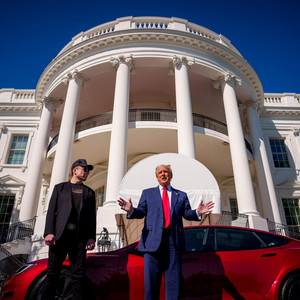
Well, for a minute there, it seemed like he liked electric vehicles if they were made by Elon Musk, you know, I'm not sure how he feels about those Teslas anymore.
Yeah, put a pin in that, Aisha.
We're going to come back.
We'll talk about that some more.
But this big, this vibe shift, this change in tone on EVs, it is not all about politics.
It is also about sales and consumer demand, which has not been where automakers wanted.
After that grand opening, after all the speeches were over, Munoz, that executive, he spoke to reporters.
When we started this project, originally everybody thought, okay, the wall is going to be fully electric.
We were also thinking that way.
But soon we realized that the pace of electrification was not going to be as fast as everybody thought.
Over the past few years, EV sales have grown, but they are nowhere near what companies had planned on.
And some of this is some of the concerns that we mentioned in our previous episode.
The lack of charging infrastructure is a huge one, right?
There's the issue of cost, especially upfront cost of cars.
And there's also been the fact that it's just difficult for an industry to make the shift from selling to early adopters who like to have the shiny new tech to mainstream consumers who just want a good deal.
And the industry is struggling, frankly, with making that switch. Meanwhile, hybrid vehicles have taken off.
And that includes cars like the classic Prius, as well as plug -in hybrids that can run just on electricity for short distances and use gas for road trips.
This whole category of vehicles is growing much more rapidly.
So then very quickly, we decided we're going to produce also hybrid vehicles here.
So what Munoz is saying here is that it's not just a matter of Hyundai de -emphasizing what they're doing at this plant.
It's also simply that it's not going to be a 100 % electric vehicle plant anymore.
more. There are also going to be some combustion engines built there.
So is this something that's unique to Hyundai?
No, not at all. A ton of automakers are getting more interested in hybrid vehicles right now.
And we've seen a lot of big announcements about slowing down EV investments, stepping back from pledges to make a certain percentage of EVs from Ford, GM, Volvo, Mercedes, Mercedes, Honda.
And I want to be clear, it's not that all the automakers are exactly the same, right?
There are differences.
Toyota has always been skeptical of EVs. The all -electric automakers like Tesla and Rivian, they're obviously still all in on batteries.
There is a range, right?
But everyone who sells cars in the U .S. is feeling this political shift and these market dynamics.
And most of them are way behind on their climate goals, where selling more EVs was a crucial part of their plan to cut emissions.
And that is according to a group called Asset Impact, which has been crunching numbers on that.
So you said almost all of them, but who's doing all right?
Who's, you know, sitting here on easy street?
Yeah, well, I wouldn't say easy street.
it's a very hard path.
But right now, BMW and Honda do look like they're on track to build enough EVs to cut their emissions quite sharply, according to Asset Impact.
This is all forecasting.
So we are going to have to see what companies actually do.
And that is a huge part of this, right?
We do have to wait and see what happens.
And I want to be totally clear here that no one is expecting the company to completely reverse course on EVs. Companies still plan to expand banned their electric vehicle sales, they're still putting billions of dollars and lots of effort into this, and they absolutely still plan on selling enough EVs to justify that.
It's just not going to happen nearly as fast. So why are companies then still putting billions of dollars into this if it seems like maybe the demand isn't there?
Yeah, well, first of all, and this is no small thing, these aren't plans that you can just change on a dime, right?
It takes years to build a new factory or redesign a new kind of vehicle.
These are plans made well in advance.
Another factor is that the auto industry is a global industry.
And right now everyone's eyes are on China.
China is pushing into EVs in a big way.
The government has poured money into it.
Companies have been competing like crazy.
Half of new vehicles in that country have a plug now.
It's It's more like 10 % here, 25 % in California, which is the leader nationally on this.
And those Chinese EVs are also very affordable.
They are often cheaper than the cheapest gas car you can get here in the U .S. And by all accounts, they are also very good, very impressive vehicles, in some respects blowing out of the water what we can get here in the U .S., things like a five -minute charge time.
In the States, 20 minutes to charge your EV is considered very fast. And a ton of really high -tech features.
Yeah, I think I've seen some of them, like, on TikTok and stuff.
But the thing is, we can't get those Chinese vehicles here in the U .S., right?
Yeah, that's right.
And that's on purpose.
Long before the current tariff palooza, there were big tariffs on Chinese EVs and bans on Chinese vehicle technology.
And that's partly good old -fashioned trade protectionism, trying to keep Chinese vehicles out because companies have argued that it's unfair that Chinese companies got all these state subsidies.
It's also because of concerns about surveillance technology in Chinese -made vehicles, which I've talked to people in the car industry and in cybersecurity who say those are legitimate concerns.
Cars are essentially rolling surveillance devices these days, packed with cameras and microphones and location data.
In fact, U .S. companies have been busted sharing data with insurers without drivers noticing.
Anyway, for now, yes, folks in the U .S. cannot buy these Chinese EVs like a BYD or a Zeekr or a Xiaomi.
me. But automakers operate globally and US trade barriers or not, they have to be ready to go toe to toe with these Chinese EVs, which are spreading around the world in other countries and selling really well, right?
And then one more reason why they're still getting investment is the idea that EVs are just good cars.
I went to the car show in DC earlier this year and I swung by the General Motors booth to chat with Jeff Morrison, senior vice president for global purchasing and supply chain.
We were surrounded by these big gas -powered trucks and SUVs, but also the electric Silverado pickup, the Equinox EV, the Blazer EV. And when I asked Morrison about federal EV policy, he pivoted.
He wanted to talk about all the GM EVs that he's driven personally.
What I'll tell you is they're just great vehicles.
And the customer experience of being able to charge at home.
The range anxiety that maybe I thought I was going to have when I first started goes away with time because you realize that almost all the charging you do is really at home.
They're stable, they just feel good, the performance is there.
He's saying they're comfortable, they're convenient, they're sporty.
And look, Ayesha, EVs do have environmental benefits, right?
I mean, bikes and transit are much better for the planet.
But if you're going to have a car, an electric version will generally emit a lot less carbon over its lifetime, even with the environmental impacts of batteries and electricity to charge them, like we dug into in that previous episode.
So okay, yes, green benefits.
For some car shoppers and for some lawmakers, that is a top priority, but not for everyone, right?
Whereas something that is fun and comfortable to drive and low maintenance, and especially if they become come cheaper someday maybe than gas cars, well, those kinds of things appeal to everyone, right?
Yeah. So car executives think fundamentally people will want these vehicles at some point.
So they need to be ready to sell them.
And that's a huge part of why even the politics of EVs going through this big upheaval doesn't mean that companies are backing off from EVs entirely.
entirely. This message comes from the Nature Conservancy.
Nature is common ground for everyone, and uniting to protect nature can help solve today's challenges and create a thriving tomorrow for future generations.
Discover why at nature .org slash NPR.
This message comes from DataIQ.
AI is raw power. It's alive in every agent, every decision, every workflow.
So, So do you let it take over or do you become the force behind it?
Take control with DataIQ, the universal AI platform for business teams and AI experts designed for trust and engineered to scale.
Make AI flow through your enterprise.
Don't just keep up with AI.
Control it with DataIQ, the universal AI platform.
Find out more at DataIQ .com slash NPR.
This message comes from Dell Technologies.
The new Dell AI PC with Intel Core Ultra helps fast forward through busy work, leaving more time for you time.
Get a new Dell AI PC starting at $749 .99 at dell .com slash AI dash PC.
Okay, so when we're talking about policy shifts, it seems like there's a big, I don't know if it's an elephant in the room or what you would call it.
But can we talk about Tesla?
You have people feeling very upset at Elon Musk and like putting stickers on their Tesla saying, I bought this before Elon went crazy.
Like, it's very polarizing now.
Absolutely. There has been a truly remarkable turnaround in the Tesla brand.
Driving one used to signal that you were rich or techie or eco -conscious or all three, right?
Right. And now to many people, it signals support for Doge and Elon Musk and Donald Trump, because obviously of everything that Elon Musk was until very recently doing in the government.
So in the near term, this has pretty clearly been bad for Tesla sales.
Musk denies that there's been an impact.
And Tesla is still far and away the top selling EV in the US.
But certainly it was a very very rough quarter, right?
The first quarter profits were down 71%, 71 % from the same time last year.
And that is in part because the people most interested in buying an EV right now do tend to be Democrats.
But still, President Trump, he did urge his supporters to buy Teslas.
Elon Musk himself pointed out in a Bloomberg interview that some people are buying Teslas because he's quote unquote crazy, like the bumper stickers say.
And they agree with what he was doing with Doge.
Absolutely. There is this pressure in the other direction, right?
And I have talked to Republicans who said that Musk is part of why they bought a Tesla.
People like Kamali Wright.
He works in marketing in Florida and spoke to me from inside his Model 3, which he's owned for several years.
Man, I've been a fan of Elon forever.
You know, this man has created thousands of jobs in America for Americans.
You know, this man has created revolutionary things.
So to me, he's always going to be good in my book.
Wright says the massive backlash against Musk makes him more inclined to buy a Tesla.
He wants a Cybertruck next.
You know, if everybody's going to hate on this guy, that's going to make me buy even more, I guess.
And even for people who aren't trying to buy a car to help Elon Musk, this shift does appeal to some shoppers.
I have spoken to some conservatives who said they felt like before driving an EV would signal that they were liberal, which they didn't want, and now, at least for a Tesla, that barrier is gone.
Now here's the problem for Tesla.
Right now, there are simply not enough Kamali rights and other conservative shoppers who now want to buy a Tesla to make up for all the people who are not buying Teslas because of Musk.
There are going to to be no explosion of sales that recover the losses that Tesla has been enduring because of this political shift. Alexander Edwards runs Strategic Vision, a company that surveys new car buyers.
His data last year showed that for the first time, a new Tesla buyer was more likely to be a Republican than a Democrat.
But that's not because Republican sales surged.
It's because many Democrats were fleeing.
All they've done is alienate their primary consumer and those that would love to buy them are not in a position to buy them.
And to be clear, that's not just because of ideological opposition to EVs. Republicans are more likely to live in areas with less charging infrastructure.
Cities and areas with more progressive governments typically have more plugs available.
Tesla and Musk did not respond to requests for comment, but Musk has said that It's the quality of the product that matters, not a CEO's views.
Okay. So, I mean, this is a lot going on.
What does this all mean for the person who's like, I'm just a driver and I'm considering buying an EV?
Yeah. Well, I would emphasize a few things.
First of all is that prices are really uncertain, right?
For a long time, EVs were getting cheaper year after year.
Now, between tariffs which keep changing and the possibility that tax credits get eliminated, possibility, high probability, prices might go up instead.
And that means the best shot at an affordable EV might be in the used market, where a bunch of vehicles might be coming off lease in the next few years.
And used Teslas from people who no longer want to be associated with them, those prices have come down significantly.
So there's real bargains there.
The second thing to flag is that the timeline for new EVs coming out, they've been pushed back.
They're not coming out as fast as expected.
Now, improvements are still coming.
GM just announced a new battery type.
They're going to put new electric trucks starting in 2028.
There are dozens of new EVs coming in the next few years, but not as many different models as previously expected.
And companies might not make as many of them as they thought, especially if the requirements that companies sell a certain number of EVs are eliminated.
Is there anything on the horizon that might fill the void that Tesla's left in the market?
You know, something that's like cool and hip and kind of gets into the zeitgeist or whatever and people are talking about it, right?
Yeah, it'll be interesting to see.
So I'd watch Honda.
The Prologue has done well, and the Honda Zero series, which is a brand new line, is starting next year.
And it looks like it might be pretty cool, pretty distinctive looking.
GM's Equinox is a contender.
It's pretty well priced.
Or on the higher end, those electric Cadillacs people feel pretty strongly about.
And, you know, don't sleep on the Koreans.
Hyundai and Kia, the EV9, the IONIQ lines, those are pretty compelling vehicles.
vehicles. Now, what about charging?
Because I've heard that the federal government is freezing all the money that was going to build more chargers.
And, you know, you've mentioned that charging infrastructure is an issue.
Does that mean that I shouldn't get an EV because they're not going to be building out this infrastructure?
I would put a caveat on that.
So, first of all, yes, this government push was to add chargers along highways and in underserved communities.
It was was moving frustratingly slow and now it is on pause.
There's a legal fight that's currently underway about this.
For now, the money is frozen and the federal office that's meant to support this effort no longer has any full -time staff, according to former staff who spoke to me.
At the same time, the Tesla supercharger network is opening up to other companies, which has been a huge deal.
And Tesla and other private companies are still building new chargers.
You know, I watched the data on this and I also have personal experience.
I did a thousand mile EV road trip last fall.
The charging options out there for road trips have gotten a lot better.
And like that GM executive told us, it is true that most drivers do most of their charging at home, which means you're not using these fast chargers much at all.
If you're considering an EV, I always say step one is to figure out if you can charge at home.
The EPA has a home charger calculator to help you figure out if you'll want to install a special charger or if you can get by on just a standard outlet, which is what I do, for the record. And if you can charge at home, it's a lot simpler, and you will do that almost all of the time.
All right. Well, you know, thank you for those practical tips.
That's the news you can use.
Let's zoom out a little bit, though, and look at the big picture.
Like, four years from now, what do you think will be the state of the American electric vehicle industry?
Well, you know, like they say, it's dangerous to make predictions, especially about the future.
But I think there are going to be more EVs sold in the U .S. than there are today, and I think they'll be significantly better.
How many more, and if they're going to be better enough to compete with the offerings out of China, I mean, that's hard to say.
And a lot of that is going to depend on consumers.
Especially if regulations get rolled back, it'll depend enormously on how the relatively small percentage of Americans who buy new vehicles, how those people vote with their wallet.
I mean, it is fair to say that EV sales will not be nearly close to the 50 % mark that Biden had set, or generally speaking, to the targets that environmental groups have set to stop the worst effects of climate change.
At least not in the U .S., right?
I think the rest of the world will continue moving on this path to electrification much faster than the United States.
And what that means for the economy and for the auto industry in general, we're just going to have to find out.
Well, thank you so much, Camila, for all of this.
I really appreciate it.
Yeah, thanks for having me.
That was Camila Domanoski, a correspondent with NPR's Business Desk.
This episode was produced by Andrew Mambo.
it was edited by Liana Simstrom and Cara Platoni it was fact checked by Will Chase and engineered by Robert Rodriguez the rest of the Sunday Story team includes Justine Yan and Jenny Schmidt our fellow is Andrew Cerulnik, Irene Noguchi is our executive producer I'm Aisha Roscoe Up First is back tomorrow with all the news you need to start your week until then have a great rest of your weekend This message comes from Jackson.
Let's face it, retirement planning can be confusing.
At Jackson, we're working to make retirement clear for everyone, starting with you.
Our easy -to -understand resources and user -friendly digital tools help simplify your entire experience.
You can have confidence in your retirement with clarity from Jackson.
Seek the clarity you deserve at Jackson .com.
Jackson is short for Jackson Financial Incorporated, Jackson National Life Insurance Company, Lansing, Michigan, and Jackson National Life Insurance Company of New York, purchased New York.
This message comes from NPR sponsor Rosetta Stone, an expert in language learning for 30 years.
Right now, NPR listeners can get Rosetta Stone's lifetime membership to 25 different languages for 50 % off.
Learn more at rosettastone .com slash NPR.
This message comes from Mint Mobile.
Mint Mobile took what's wrong with wireless and made it right.
They offer premium wireless plans for less, and all plans include high -speed data, unlimited talk and text, and nationwide coverage.
See for yourself at mintmobile .com slash switch.