All right.
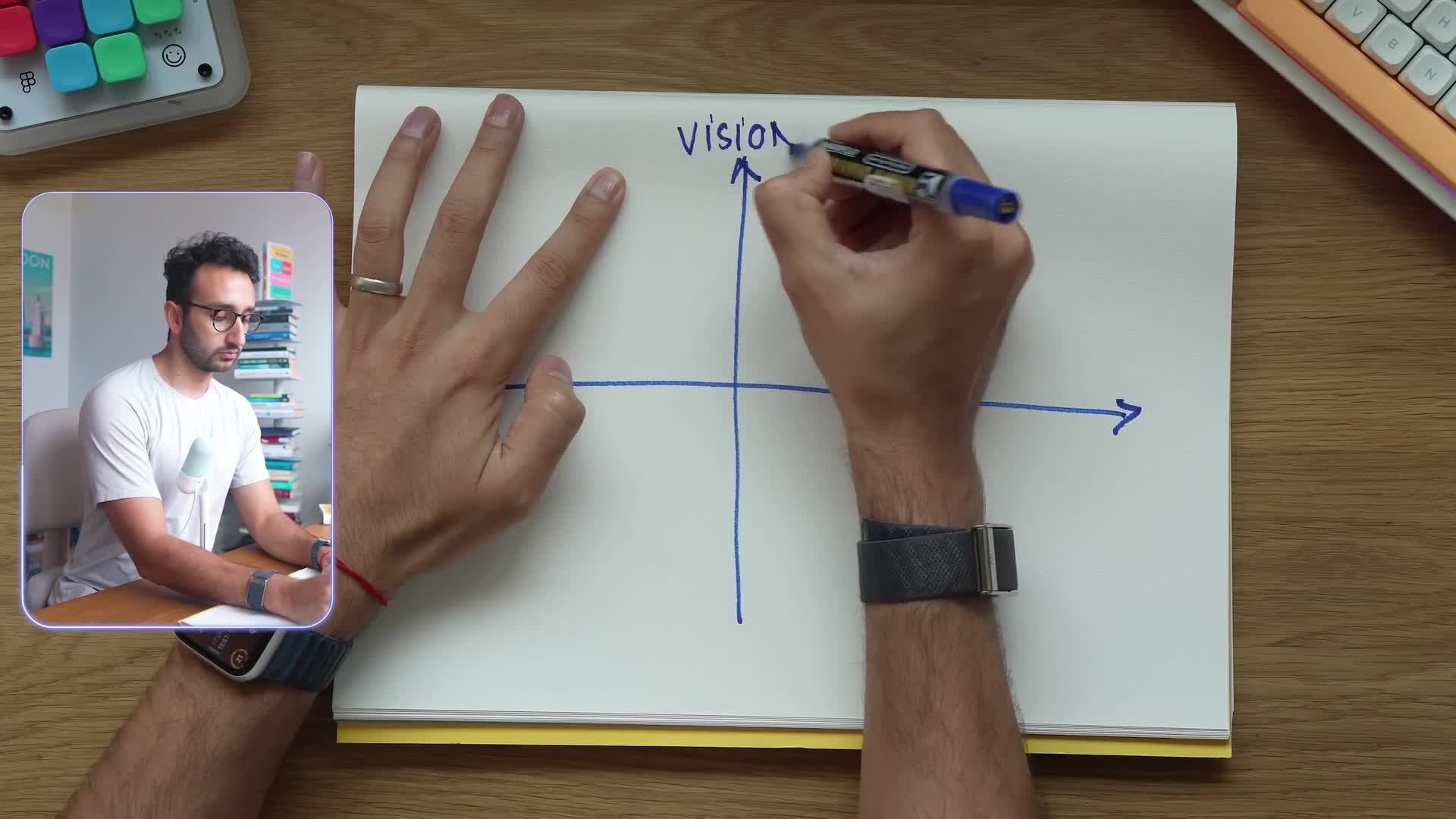
So this is what I like to call the productivity matrix, where you've got essentially two axes.
You've got vision and you have action.
Like vision is kind of like your ambition.
Like, how much do you know about what you actually want in terms of like, goal setting and like having big dreams and all that kind of stuff?
And then action is unsurprisingly, how much are you actually doing the work, right?
So if you have someone who is low on vision and low on action, I call those the drifters.
Not the grifters, the drifters.
They're just drifting through life.
They don't really have much of a goal or much ambition.
They're also not taking much action.
They're just sort of drifting, drifting in the water.
That is obviously not where anyone really wants to be.
Next up, you have the people who are high on vision.
So they're quite ambitious.
They have goals, but they're not taking action.
And I call those the dreamers.
They spend a lot of time dreaming and not a lot of time doing.
Then you have a cohort of people that's very good on taking action.
They're good at grinding, but they don't really have much ambition.
They don't really have a sense of where they want to go.
I call those the hamsters because they are on the hamster wheel of the grind, but without really going anywhere.
And then the place where we all wanna get to, of course, is the people over here, who are the masters.
They are the masters of productivity and getting things done.
They do have a compelling vision that they're working towards.
They've got ambition and they are also crucially taking action to get there.
Now, this is a video that I would like to target at the dreamers.
For those of you out there who you feel like you are ambitious, you have dreams, you have goals, but you might feel like you are lazy or undisciplined.
Like you're not actually taking the action to turn your dream into a reality.
This is my hot take, my honest advice for someone who is in that situation.
So there is a three step process that I would follow if I were in that situation where I am ambitious but lazy.
I've got goals, but I'm not really taking action.
The first one is to clarify what you actually want.
Now there are a lot of people who seem to have ambition, but it's a very vague and undirected sense of ambition.
It's like I wanna be successful, or even I wanna be rich, but they have not actually taken the time to sit down and define.
What does that actually mean?
What does it mean to you to be successful?
What does it mean for you to be rich?
And crucially, why do you want those things?
Because essentially, what this comes down to is creating a compelling enough goal that pulls you towards it, rather than that you have to feel as if you're pushing yourself up the mountain to get to it.
You've got like pull motivation and you've got push motivation.
Pull motivation is like, man, I really, really want that thing.
And so naturally, I feel of course, you know, motivation ebbs and flows, but I feel some sense of drive, some sense of pull towards that thing.
Push motivation is sort of like ah, I should want the thing, or I should want to want the thing, or I really want to want the thing but, like deep down, I don't really care about the thing.
And so everything feels like a struggle.
Everything feels like a grind.
Now, in terms of goal definition, you've got the what, which is like what is the thing that you actually want?
And can we be specific about it?
Because if you know what you want, it's a lot easier to get there.
Whereas if you don't know what you want, it's a lot harder to get there.
When you say you wanna be successful, can we put some numbers on it?
Can we put some parameters on it?
What does success mean to you?
Are you talking becoming managing partner at a local law firm?
Is that your definition of success?
Are you talking about having a lifestyle business that makes you a millionaire and profit?
Is that your definition of success?
What is the thing you actually want?
Because changing the what drastically changes the actions that you're gonna take to get there.
And then also and this is really important and underrated We really wanna be able to answer the question of why.
Why do you care, right?
What are your reasons for wanting to care about this thing?
Generally, when I speak to people who are in this situation, they actually don't know why they want the thing.
They have this vague sense that they wanna be successful or that they wanna be rich, but they've not sat down to really identify and write down.
Ideally, why does it matter to you?
The more reasons you have for doing something, the more likely you are to actually do it.
And again, here, there is a thing that gets in our way, which is the idea of should.
Shoulds very rarely get you to where you wanna go.
The people who should themselves a lot are often the people that have dreams and goals but never actually take action, or rarely take action to get there.
Because when you have should motivation, you know I speak to people sometimes that are like yeah, I really want to get a first class in my degree.
I'm like, okay, why?
Well, you know, my parents have worked so hard to get me into this university because I'm studying abroad.
And you know, I feel like I owe it to them to like, get a good grade okay like, but that's kind of a should.
You don't actually want to do that thing.
You don't actually care about it personally.
You are shooting yourself into wanting to care about it because you want to make your parents proud.
And for some people, that motivation that, like man, i really want to make my parents proud that motivation is not actually a should, it's like man i.
I have this deep, intrinsic desire to make my parents proud.
Therefore, of course, i'm going to do the thing.
Those people are not the ones who are ambitious, but lazy.
They're the ones who are ambitious and actually doing the thing, because the compelling nature of the motivation to make the parents proud, or to make society proud, or to tick the boxes or whatever the thing might be is so strong that it's pulling them towards the result.
But in your case, if you're watching this video, I suspect should motivation is not that helpful.
For me, should motivation has never been that helpful in my life.
Whenever something is a should, I really should work out.
I really should go to the gym.
I really should care more about this exam result.
I really should dot, dot, dot.
That is when we get into that territory of, like having a goal but not having the motivation or the drive to actually follow through on it.
So what we're really trying to get at is why.
What the hell is the actual core want behind the thing that you think that you want?
Why?
Why does it matter to you?
And the other thing about this is that there's sort of two types of reasons.
There's logical reasons and then there are emotional reasons.
And emotional reasons beat logical reasons every day of the week.
A lot of us can come up with logical reasons.
I really should get a first class degree because that will increase my chances of getting a job and that will increase my chances of being secure and being happy, or whatever.
And that's like a train of logic.
It's a train of logic that also doesn't actually work because you know the social contract of society is sort of broken these days, where you can get a totally good degree and get totally good grades at your good degree and still not have a job.
So like what's that phrase when it goes to sort of like dissonance, where sort of one part of you is telling yourself that this is logically coherent and another part's like no, but it's kind of bullshit, because AI and stuff.
But even if it were true, convincing yourself to want something through logic is unlikely to succeed.
Whereas if you can convince yourself on an emotional level that you actually care about the thing, if there's a compelling enough emotional drive behind the thing, that is where motivation becomes a lot more sticky compared to just a chain of logic.
Now obviously, when it comes to things like starting your own business, you're going to want to know how to use AI tools, because AI, as you know, is like changing the world.
And we as entrepreneurs, we really don't want to get left behind.
Now there's all sorts of stuff in the world of AI and every single week there's like new models being released and new news coming out.
And that's where it's actually really helpful to have a foundational grounding in how AI actually works, which is where the sponsor of this video Brilliant, comes in.
Brilliant is a fantastic online education platform that has interactive courses around maths and computer science.
I've been using them since like 2019.
It's absolutely amazing.
I've learned about crypto from Brilliant.
I've learned about AI from Brilliant.
I've learned about the fundamentals of programming in Python and algorithms from Brilliant.
And what's absolutely brilliant about Brilliant is that they really focus on problem solving rather than just like didactic learning.
Yes, they're going to give you content and like watch or read to help you understand the concept.
But then they make you solve a problem that involves using that concept.
And that just makes the learning environment way more fun, way more interactive.
And there's also a bunch of evidence in the world of like education theory to support the idea that, instead of just learning stuff, when you are learning stuff and also doing stuff, that makes you far more likely to retain the information and to actually understand what's going on.
You can try Brilliant completely for free for 30 days by heading over to brilliantorg forward slash Ali Abdaal, or clicking the link in the video description or scanning the QR code that is hopefully currently on screen.
And if you like it, then that link will also give you 20% off the annual premium subscription.
So thank you so much Brilliant for sponsoring this video and let's get back to it.
For example, for me, a major motivation back when I was a medical student and then working as a doctor, a major motivation for wanting my own lifestyle business and wanting financial freedom was because I saw, every single day.
I saw doctors who were absolutely miserable in their career, who were like 10 years older than me and I could see it with my eyes and I could feel like they're their like sense of just almost like not wanting to be there and they're having to drag themselves out of bed and like doing another night shift when they're in their forties or fifties and they really just wanna be home with their kids, but they're doing a night shift at work.
There were some doctors that fricking loved it, but I saw quite a lot of doctors that like seem to have that like, like they've got this enormous weight on their shoulders.
And it's almost like I can't even put it into words because it was just a feeling, right?
It was a feeling that was just really fucking obvious when I was in that environment every single day.
And so seeing that feeling and feeling, that feeling of these other people that I respected and looked up to kind of hating their jobs, made me realize, wait a minute, I really want to become financially free so that if I do medicine, if I continue doing medicine, it's because I want to rather than because I have to.
A lot of these guys wished that they could leave medicine or at least go part-time, but they just did not have the money and so i was like great, i need to make the money.
That was a strong, emotionally compelling reason for me to actually do the thing, whereas if i didn't have that reason then and i thought i probably should start a business someday, i probably should become financially free because, like i don't know, in the future maybe it'll help or like then it's just.
It's just a lot harder to get yourself to do something unless there is a strong, emotionally compelling reason or reasons behind why you actually want the thing in the first place.
So let's assume you have done step one and you have actually clarified the thing that you want.
The next thing we wanna do is we wanna identify the blockers to the thing.
Now this is where it's like, okay, you know that you really want the thing.
Like, you know, a lot of people I speak to really want to become financially free.
And so it's like, okay, cool.
I really wanna have a lifestyle business that makes me 500,000 a year in profit.
Okay, great, that's fine.
Those are the sorts of people we have in our Lifestyle Business Academy, which is like my online business school.
More details down below if you wanna check it out, whatevs.
You've clarified the goal and you've got a clear sense of like the reasons why you want the thing.
The next thing we need to do is identify the blockers.
Like, why aren't you already there?
What is stopping you from having already achieved the thing?
Now this is where people often miss this step and they think OK, I really want to start my own business.
Therefore, I'm going to discipline myself.
I just need more discipline and discipline is fine.
In small doses discipline is fine for like, once you have a goal and you have a plan then yeah, sometimes you're not gonna feel like doing the thing.
So you push yourself a little bit.
You'd use discipline to get yourself to get started.
But generally, if you're enjoying the process, as I talk about in my book, Feel Good Productivity, if you're enjoying the process and working towards a goal you actually care about, then you stop needing to rely on discipline all the time.
But before we get there, we need to identify why are we not already there?
What are actually the blockers that are stopping you?
Now there are broadly three categories of blockers.
There are blockers that are not in your control, there are blockers that are in your control and there are blockers that are somewhat in your control.
This is the sort of the trichotomy of control.
So why do I not yet have that million dollar lifestyle business that I've been dreaming of?
Well, I don't have the right business idea.
So that's a blocker that's under my control, right?
It's under my control to come up with the right business idea.
Of course, there's gonna be stuff I have to do.
I might not know how to come up with the right business idea, but the how is very solvable, right?
These days you just ask Chad, GPT or Claude.
Hey, I'm working towards the goal of a million dollar lifestyle business, but I don't have any ideas.
Can you help me come up with the idea, right?
Easy enough, right?
This is under your control.
Something that's not under your control is government policy.
So if you're like man, the reason I don't have my 500000 lifestyle business is because the government sucks and they're not doing the things that they're supposed to be doing.
Okay, that may be true.
And it's also probably not under your control, unless you happen to work in the government or your dad happens to be the prime minister.
And even then, it's still probably not in your control.
Then you have things that are somewhat under your control.
So for example, I don't know how I would find customers.
Finding a customer for a business is actually, it's a two-way street, right?
In order for you to make money, someone else has to give it to you.
And so it's not fully under your control that there will be people out there who want your thing.
It's somewhat under your control.
You can create content, you can do outreach, you can run ads.
There's a lot of things you can do, but ultimately someone else has to give you money.
And so that's sort of under their control.
And so this would be finding customers.
And this is just a very simple example, but you essentially identify like, okay, cool.
I really do care about this goal.
What are all the reasons I'm not there yet?
And you'll identify reasons that are not under your control.
And then you'll identify the reasons in these three different buckets.
And my whole take on this is we wanna start by looking at the reasons that are not under your control.
So government policy is not under your control.
The amount of money you earn in benefits is not under your control.
The weather is not under your control.
Whether or not you have a physical disability is not under your control.
There are lots and lots of things that might stop you from achieving the goal, that are not under your control.
You can't do anything about them.
Now, in that world, the question I would be asking is Given all of these factors that I can't do anything about, should I still have that goal?
Is the goal reasonable?
For example, I would say I might have the goal to play in the NBA, in the National Basketball Association of America, but I'm five foot six, five foot three or four foot nine.
My height at that moment is not under my control.
I cannot do anything about my height.
So then i'm like all right, cool.
What does that do to my chances of playing in the nba?
Well, if i'm four foot nine, i basically have zero chance of getting into the nba.
It's probably not going to happen, right?
And so i'm signing up for a very difficult life.
If i'm trying to achieve a goal where there is a systemic factor that's not under my control, that i cannot do anything about, that will stop me from achieving that goal.
Now, in that context, it's probably sensible to abandon the goal, right?
Because generally So if you imagine you have a goal, right?
And then you have certain actions.
Now, when the actions you take are increasing the probability that you're gonna achieve your goal.
This is all in alignment and everything feels good.
When you're playing a video game or something and you know that, like every time you hit the boss, you're like making progression, like you're chipping at the boss's health.
Each time you're getting better at learning the moves in the Elden Ring fight or whatever the thing might be, you can feel the progress, that the actions you're taking are actually helping you get closer to the goal, then that feels very good and life is good.
And actually ultimately, whether or not you achieve the goal is somewhat irrelevant, because you'll have enjoyed the journey, because we, as humans, enjoy making progress towards stuff.
But if there is a systemic blocker in place like, for example, your height, and now you're taking actions right.
But you're like coming up against the brick wall of the fact that you're just too damn short to play in the NBA.
This will feel very, very, very demotivating.
And generally people don't like that.
In that context, i would say, you know, some people would say hey man, just follow your dreams, just manifest it hard enough.
You know, steph curry's kind of short and like that proves that it's possible.
I'm like okay, but steph curry is also one out of a zillion and you're probably not steph curry right, and he's also not that short.
So, like you know, i would say in that context, it's worth just like deleting the goal and doing something else instead, because otherwise we're signing up for a lifetime of misery.
So that's, if There is truly a systemic obstacle that is not under your control, that is truly stopping you from getting there, in which case we change the goal.
But for the most part, for the people that I speak to, actually a lot of the factors that are blocking them from doing the thing are actually under their control.
And so the trick here is you just ignore the ones that are not under your control.
There is a phrase from Jocko's book, amazing book discipline equals freedom, which is ignore and outperform.
A blocker is.
I'm really worried about what people will think of me if I start posting content on LinkedIn.
Is that under your control?
Is what other people think of you under your control?
Not really, maybe somewhat, but not really.
So in that context, you ignore and outperform.
You just ignore the fact that that obstacle is there and you work through it and you outperform it.
Unless it's literally like a thing that's going to stop you from being four foot nine and playing in the NBA, which is probably not that for your particular goal.
You just ignore and outperform.
You ignore the category of blockers that are not under your control.
This is difficult for people to do.
It's so easy for people to just blame stuff that is outside of their control, right?
It's so easy for you to think that like oh man, the reason I haven't started my first business is because dot dot dot the economy or the environment, or the weather, or the government, or insert whatever other thing you wanna blame, that's outside of your control.
It's too easy to do that.
It's also not very helpful.
When you do that, those are the people that end up having lots of goals and then never actually taking action, because they are focusing on systemic blockers that are outside of their control.
So we basically just ignore those things.
Great, now we have blockers that are within our control.
And then once we have identified those blockers, we just make a plan to get rid of the blockers.
It's really not that hard.
I'm like, okay, I don't have any business ideas.
Okay, have I tried asking ChatGPT?
Probably not.
I don't know how to find customers.
Okay, have I watched YouTube videos about it?
Have I read Alex Ramosi's book 100 Million Dollar Leads, which is literally a book about how to find customers?
Have I done the sensible things that would help remove this particular thing as a blocker?
And this is one of the key things that you learn as an entrepreneur when you're building a business, that there are always blockers, right.
Like I, wanna grow a business to 10 million a year in revenue, there are certain blockers that are getting in our way as to why we're not already there.
One of those blockers is that we didn't have an expensive enough product to sell.
Another blocker is that we didn't have enough customers.
But like all of these are solvable problems, right?
They're not completely outside of my control.
They're either fully in my control or somewhat within my control.
And as long as someone else has figured out the solution to that problem, that means a solution exists.
And now it's just a job of me to be an investigator.
This is like a magnifying glass.
I'm gonna be an investigator and I'm gonna find the answer to that particular problem.
And generally, I find the people that are the people that end up becoming the productivity masters are the ones who are able to take action to basically identify and remove blockers.
The best CEOs the people in businesses who get paid insane amounts of money are very good at simply identifying and removing blockers.
The people that become productivity masters, who are ambitious and also take action to achieve their goals.
The people I know who are financially free, who are living dream lives where they've got financial freedom, time freedom, creative freedom.
A lot of their core skillset is in identifying and removing blockers.
And what I find from the people that have lots of goals and don't take any action towards getting them, the people who are dreamers, the people who are ambitious but undisciplined, the people who are ambitious but lazy is that it's very easy to have a goal.
It's very easy to have a vision.
But the hard part is in identifying and removing blockers.
And if you think of it as, okay, what are the blockers?
And then how do I identify and remove them?
I find that for me, that is a really, really helpful way of like, tangibly improving my chances of achieving a particular goal.
And then finally, step number three is, once you have identified the blocker and you have identified how to remove it, it will usually require something called work to sit down and do.
It takes work to sit down and come up with a business idea for your lifestyle business.
It takes work to figure out how to find customers for your thing.
It takes work to complete your PhD dissertation or whatever.
Everything worth doing requires some work.
And then we get into the thing of like okay, but like, what are all the blockers that are stopping you from doing the work?
And there's lots of them, but the single biggest one for most people that I speak to and coach through this process is time.
I'm just busy, man.
I've got other things going on.
I've got a job, I've got kids, got family, got mortgage to pay, et cetera, et cetera.
By the time I get home from work, I don't have any energy, et cetera, et cetera.
There's all sorts of problems that come up, all sorts of blockers.
Again, it's a case of identifying and removing blockers.
But the key one that I found for most people is that and the simplest hack is literally just you pick your goal right.
Let's say in this context, it's like my side hustle business or my side hustle lifestyle business.
That's sort of like your goal, right?
And then the next thing that you do is you basically just block time in calendar every week.
Not that hard.
It's not that hard to stick a few time blocks in your calendar every single week for you to work on that particular goal.
This is literally what we do for students in our Lifestyle Business Academy.
Every single week.
We have a form that they have to fill in, and that form asks them how many hours do you intend to work on your business this week?
And they put a number.
And then the next question is great, please block those hours in your calendar and send us a screenshot.
And then everyone's like, ouch.
And we force them force.
Like you know, we strongly encourage them to block the time out in their calendar and they send a screenshot to us because it's kind of like an accountability system as an accountability mechanism.
And, by Jove, like the amount of students we have that are like man, Just sticking the thing in my calendar has been absolutely game changing.
We've had people who in the first month have made thousands of dollars in sales.
They stuck the thing in their calendar.
And it's simple ass stuff that they could have done if even if they weren't in our program.
But there's something about paying money to be part of an online business school and having a coach.
Having accountability is literally just asking you to stick the fucking time block in your calendar every single week.
That makes people do the work.
There are all sorts of other factors, right?
Energy levels and distraction levels and focus levels and like whether the kids knock on the door at a given time.
But the most basic ass version of this is just making the time in the first place.
One of my coaches Eric, when back when I was working on my book Feel Good Productivity, I had a goal of write the book.
And the action I needed to take was spend like 15 hours a week on writing the book.
And in my CEO coaching sessions with Eric, he would literally ask me to bring up my calendar and show him where I was blocking the time out to work on my book.
And when you do that, there's just no excuses, right?
Because you create the container of time for the thing to happen.
And then, when the container of time comes around, whether or not I sit down to focus or get distracted or like block apps and stuff, All of that, then again, identifying and removing blockers.
If I realize man, I get distracted from my phone every time I sit down to write.
I just stick my phone in a different room.
Stick it on.
Do not disturb or block the apps.
Those are solvable problems.
But the first thing we have to do is make the time in the calendar to actually do the thing.
What I find with people who are ambitious but lazy, people who are ambitious but undisciplined.
If you look at their calendar, you do not see the time blocks that have been blocked out for the thing that they supposedly care about.
One of my former team members and friends, Tintin, he cared about growing his YouTube channel.
And so every Monday and Tuesday evening from six to 9 PM after work, he blocked out to work on his YouTube channel.
It didn't really matter what he was doing, whether he was filming or writing or editing, whatever the thing was But there were six hours in his week that were blocked out every single week to work on the YouTube channel.
And Tintin was able to work on his YouTube channel and now has a business where he's making a quarter of a million a year teaching people how to do YouTube.
It was great.
But if he hadn't had that time blocked, the Monday and Tuesday evening, where it's like the calendar block reflected his priority.
If he hadn't had that blocked, nothing would have happened.
And he would have still been, I don't know, working in his management consulting job or like, maybe still even working for me but not having his own business.
So Ali, why did you want to hire me?
I didn't want to hire you.
The time block method, shoving a block of time in your calendar every single week.
Honestly, this is the thing that separates people who do the stuff from people that don't do the stuff.
So right now, if you're at this point in the video, have a look at your calendar.
To what extent do you have blocks of time that are dedicated to pursuing the goal that you say you want?
If not, it's easy enough.
Start blocking time in the calendar for it every week.
And you will find that you will make an insane amount of progress compared to when you're just trying to squeeze the time in whenever there's time.
Because there's never any time.
We're all busy.
None of us have time in our lives.
The people that actually achieve the goals that they set their mind to are the ones who carve out time, who protect the time in their calendar to work on those things and to make them happen.
And if you're interested in a video that goes deeper into how to find the time if you're very busy and if you have a lot going on, If you wanna find the time for whatever you're doing, there's a video over here where I introduce you to my one six, eight hours spreadsheet, and that spreadsheet will totally help you figure out where your time is going and also be able to carve out time for the stuff that matters to you.
So thank you for watching and I'll see you in that video right over there.