From The New York Times, I'm Natalie Kittroweth.
This is The Daily.
As the labor market cools and artificial intelligence booms, many workers are worrying about what their place will be in a changing economy.
My colleague, Karen Wise, got her hands on internal strategy documents from Amazon that offer a glimpse into that future.
In them, she found that the nation's second largest employer plans to replace hundreds of thousands of jobs with robots.
Today, Karen walks me through Amazon's ambitious plans and what they could mean for the American workforce.
It's Monday, November 3rd.
Karen, you know as well as anyone that we have been hearing for a very long time that robots are going to be coming for our jobs, especially at companies like Amazon.
But you've been reporting on how that moment that we've all been anticipating is finally here.
So tell us what you found.
Yeah, so I've been looking into this because, covering the company for as long as I've had, I saw this huge growth in their headcount and the number of employees they had.
And then in the past few years, it started essentially plateauing.
So you could tell something was starting to happen behind the scenes.
But I didn't realize how much progress they had made until I got my hands on some internal documents.
And these are the internal strategy documents for the robotics automation team.
It documents sign-offs at the most senior level of the company.
And it really showed the breadth of the ambition that they have, the progress that they see.
And what I found in these documents is that they have plans to avoid hiring more than half a million workers because of using robots.
And big picture, their long-term goal is to automate 75% of their operations.
That is just remarkable.
Amazon is planning for a world where only a quarter of its operations, you're saying, are done by humans.
And it's a really big deal because Amazon's the second biggest private employer in the country.
And they're also just seen as kind of a leader, a flagship employer in the country.
That really shapes where jobs are heading.
And so I knew that if they were making this progress, other companies would follow.
You're saying this matters far beyond Amazon.
Exactly, yeah.
They are kind of a signature employer of this kind of hourly workforce.
So it's a really big deal much beyond them.
How fast will this happen?
That's a vision for 2033, but that is only with the advancements they currently have at NOAA.
So there's an expectation that it could even kind of improve over time.
Okay, so we're talking about massive change here.
But Karen, we know, right, that Amazon has been automating for a while now.
So what's different about this moment?
You're right.
They have been automating and using robotics for more than a decade.
But what happened is they became this enormous employer In 2018.
They had fewer than 400000 US employees to more than a million in just a couple years.
So they became so big it became expensive and hard to keep that many people cycling through their buildings.
And so you see a focus now on not augmenting workers but actually avoiding hiring people, so that you are actually ultimately trying to bring down the total number of people that you have.
And the other thing that changed is These investments in technology they've been making over the years began clicking.
You know, it takes several years to develop strong robotic systems that actually work.
And they've reached a point where they feel like these different systems are working.
They're working together and they can begin rolling them out at scale.
And how much does this advancement with the robots have to do with AI?
Like, is AI driving that?
Yeah, it does have to do with the robots, because they are getting more sophisticated and more capable because of AI.
But it also has to do with the desire to cut costs, because Amazon is spending so much money building AI, building data centers, you know hundreds of billions of dollars.
And so they need cash.
Got it.
So you're saying basically, what's different now is that Amazon has the capacity actually to replace people en masse because this technology has evolved so much, partly thanks to AI, and it has the need to do so in a much more urgent way than it ever has before, also partly because of its investment in AI.
That's exactly right.
So essentially it now makes more business sense for the company to invest in robots than in hiring more people.
It's become cost effective.
That does seem like a moment to mark.
It also seems important just to understand how Amazon got here, how its workforce became so large that it finds itself in this position.
Tell me about that.
Yeah.
So if you go back even to 2012, at the time they had a handful of warehouses around the country.
They started with books, obviously, and moved into CDs.
And so they had a growing variety of products.
And Amazon.
They have this idea that drives everything that consumers always want things faster, they want them cheaper and they want bigger selection.
And so they start focusing on these three things and all of those end up coming back to the warehouses because they need space to be able to sell things and hold the inventory, particularly when they started letting merchants sell products on their website.
Delivering things quickly.
That's all about how fast they can fulfill the orders and get them to customers.
And then also on price, that the more efficient they become, the lower their costs.
And so they start... building more and more warehouses around the country.
And it starts creating this.
They call it a flywheel, their kind of tech term that the faster things come, the cheaper the prices are.
The bigger the variety they have, the more people buy.
And that keeps kind of spinning up and up and people become more and more loyal to Amazon.
And all of a sudden you have a company that has become a major force, a transformative force in the whole warehousing industry and delivery industry.
And they basically... create it in many ways.
It's not that there aren't other e-commerce companies, but the operations become the heart of what Amazon does behind the scenes.
And they know that when you see, we can get this to you in two days, you are more likely to buy it.
They start opening warehouses closer to pretty much every major city.
And all of that creates more jobs and more work because people are buying more from Amazon.
And how exactly at this point, are robots fitting into this what sounds like a very successful push toward more and more efficiency, faster and faster delivery times?
The biggest investment was in 2012.
They bought a company called Kiva.
And what Kiva did is these little robots that are like a large hockey puck and they pick up towers of inventory and they move them to a worker.
And it cut out a lot of the walking in a warehouse.
You used to walk back and forth across all the aisles to pick the products.
And that's annoying work for a lot of people.
It's exhausting.
And also it's very slow and time consuming.
And so by bringing the products to the people, to the pickers, they could start getting a much higher efficiency out of the labor force.
So at this point, early on, the effect of automation is to make this delivery process as fast as possible.
Again, to just increase the volume of sales, to help with what you call that flywheel.
That's exactly right.
And ultimately it works.
And all of a sudden you have a company that is become a major force, a transformative force in the whole warehousing industry and delivery industry.
And they basically create it in many ways.
It transforms consumer expectations and it transforms retailing and e-commerce broadly.
It's the default way people come to shop is they know that Amazon can get it quickly and that Amazon will get it to them when they say they can.
It becomes very dependable and it becomes this consumer behavior that is entwined with how so many people shop.
And at the same time, you have Amazon adding and adding to its workforce to make that change possible.
That's exactly right.
And even then they were starting to get nervous about this rapid growth and also just to be able to hire enough workers.
I mean they were worried about having enough people in America to employ because their turnover was really high.
And in some parts of the country, they were already kind of working through the available workforce.
And They were starting to face more and more pressure over the working conditions.
You know, the work is very repetitive.
You do the same thing over and over again.
You might be reaching up very high or very low.
So there was risk of strain and repetitive injuries.
And they just started getting a lot of tough questions about the conditions in their warehouses.
And then the pandemic arrives and that just scrambles everything.
Doors start shutting down.
We're all home.
We're scared.
Our kids aren't at school and you're buying coloring books and pop a shot basketball hoops.
These are all not hypotheticals from friends that I know.
You know, you're doing things to not go crazy.
Adults are getting coloring books, you know, and everyone starts shopping online.
But they couldn't staff their warehouses fully.
And so things started getting really delayed.
Like you would have two weeks to get an order.
And people did start shopping elsewhere.
Like other competitors were gaining market share because Amazon didn't have enough workers.
And so even as some workers are staying home, Amazon goes on this essentially historic hiring spree.
They were hiring at a level that had not happened outside of like wartime mobilizations.
I remember talking to labor economists at the time.
So it was just this massive growth.
And by 2021, they had more than 1.1 million workers in the United States.
And some of those are absolutely corporate employees and technology employees.
But the heart of that is the warehouse labor force.
And the cost of labor got very high.
And they started reaching a point where they were basically not profiting because of all of this labor expense and inefficiencies in their operations.
Basically, this is the point where Amazon hits the wall, right?
Where, very quickly, they find themselves with a much bigger workforce that not only was very costly, but actually was starting to affect their bottom line.
How do they respond?
So in this period, Amazon gets a new CEO.
Jeff Bezos becomes executive chairman, and Andy Jassy, who had run the very profitable cloud computing unit, now runs all of Amazon.
And he starts focusing very intently on cutting costs.
And part of that was really trying to look at how can they advance automation further.
And the automation and robotics team sets this ambitious goal to not just augment the work that workers are doing, but to replace them.
And that plan is not hypothetical.
I mean, it is happening now and it is being rolled out around the country.
We'll be right back.
Karen, you said before the break that basically, this plan for robots to start replacing jobs in a massive way is now being rolled out across the country.
So what does that actually look like?
So that looks like a warehouse in Shreveport, Louisiana, that I went to a couple weeks ago.
And this is the most advanced warehouse Amazon has and they see it as a template for future warehouses.
Now we are going to the east side of the building and that is where we are going to see how we bring in freight.
So when I got there, the head of the warehouse, the manager took me on a tour of the building.
So we have a first floor, and then you have four floors on top.
And it's brand new, it's bright, it's very tall, it's five stories and you walk inside and it's super clean.
We have about 1,000 robots in the building.
1,000, okay.
Yeah.
And there's this loud, constant humming of the conveyor belts.
Turns out there's more than 13 miles of conveyor belts in that building.
But it was also kind of calm because it wasn't chaotic.
When you have a lot of workers around, there's usually like an energy and a vibrancy about it.
And there are big parts of the building that have almost no workers.
And the robots themselves are not particularly loud.
It's really just the conveyor belts that make noise. a place where we do consolidation.
So the warehouse manager took me upstairs and led me to an area with a fleet of robots.
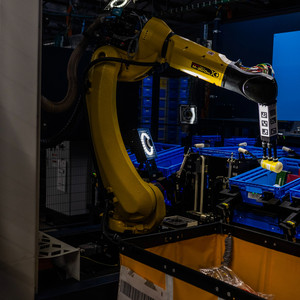
They're called Sparrow.
And each one is quite tall, you know, taller than me.
It has a large yellow robotic arm that kind of bends over and reaches into bins.
The arm has suction cups on the end and it uses different parts of the suction cup fingers.
They're sort of like fingers to pick up items and to put them in another bin.
And that helps them consolidate inventory.
And it's pretty funny to watch because sometimes it's like, is it going to drop?
You know, they'll pick up a T-shirt bag and it starts sagging because it's floppy.
And then it does make it into the bin.
And sometimes it'll be like, hey.
I need help with this product and somebody go help.
Stereo just keeps doing this over and over again.
They're sort of flashing lights as it takes stock of the inventory.
It is using the most advanced LLM models to help us make these decisions.
In the tour, I could really see how all these different systems were orchestrated to work together.
You had different types of robotic arms, different ways to move items robotically, and then also just conveyor belts and other machines, with humans kind of tapping in and out at different points.
The way the products moved through the building was a whole new way of thinking.
They had completely rethought the way everything operated in the warehouse with this eye to introducing as much automation as possible.
So this all sounds incredibly futuristic.
I can hear in your voice how impressive and kind of astounding it was for you.
Yes.
Yeah.
What will it look like for Amazon to scale up this approach across several warehouses?
Yes, the automation team said that that facility gave them the confidence that they'll be able to quote flatten Amazon's hiring curve in the next 10 years.
Flatten Amazon's hiring curve is corporate speak for stop hiring, right?
Stop hiring.
Exactly.
Yeah.
Even as they expect their business to double, they would need the same number of employees as today.
And so that will mean they're both going to build new warehouses, starting with this as the baseline, and that they're also going to retrofit older warehouses so that they'll need fewer workers to do the same, or more work.
They're starting with one in Stone Mountain, Georgia, near Atlanta right now.
And that's a more sensitive thing, because there you're taking a building that used to have 4000 employees.
And when you introduce the robotics, they potentially will need 1200 fewer workers once they're done.
And Amazon says those numbers are tentative, nothing's final.
But the reason you do this is to reduce your need for labor.
You're saying Amazon is going to need far fewer people maintaining robots than it's going to need packers pickers on the warehouse floor.
That's exactly right.
Yeah.
I should note that Amazon isn't disputing this reporting.
There's kind of two main things they have to say.
One is that they say the goals of the automation team don't represent all of the goals of the company.
And so while yes, they may be focusing on efficiency here, there might be other parts of the business, including in their warehousing operation, that they might grow as they make more investments in the future.
And an example they pointed to is they've been building more delivery stations in areas that are more remote and have a smaller population.
Those are new jobs in places that didn't have them and letting customers in more rural areas get faster deliveries.
The other thing they say is that they're very focused on the new jobs that are being created because of automation and robotics.
And there's a type of role that's essentially a technician or a mechanic that works with the robots.
And they do everything from maintenance.
They do repairs.
They handle what are called exceptions.
Like if the robot drops something, they are able to safely go and to deal with all of that.
And so those jobs pay more.
And they have more of a career path than a traditional Amazon warehouse job does.
The main issue is that there just aren't as many of them.
When you compare it to the number of regular hourly worker jobs that won't be needed.
But it's worth considering some of the business realities, at least as Amazon sees them, right?
I mean, this company wants to keep growing, to keep beating its competitors.
And in the past, the way that it's done that is by hiring a ton of people.
And after a certain point, the company has found that just doesn't work.
It becomes really difficult and expensive.
So if Amazon wants to keep growing and keep its customers happy, this is a company that's attempting to solve the very real problems in its model.
Yeah, I mean they see this as essential for being competitive in the retail environment with endlessly demanding consumers.
And some of the projections I saw in a.
At its core, Amazon's reason for being isn't to be an employer.
It's a customer-centric company, and they see this as a way to grow.
I mean, Amazon is the most advanced in this kind of push towards automation, but their competitors are working on it too.
Walmart, UPS, DHL, all these companies are investing in automation.
Right.
And so this allows them to stay competitive and to keep offering the faster service, the more products, the cheaper prices that we talked about, that customers consistently love.
In other words, this automation is coming, not just at Amazon, but likely much more broadly.
It just makes too much good business sense to not do.
And so I guess Karen, that raises this really pressing question right, which is what does a much more automated workforce ultimately look like?
What is the balance of jobs and what does that actually mean for people who are doing those jobs today?
Yeah.
I mean you run the risk of kind of this bifurcation where you lose more of the baseline hourly work and you gain more higher skilled, higher paid work.
I mean in theory.
Automation is supposed to get rid of the bad and the mundane, the boring parts of the job.
But it's unclear how those numbers balance out.
You know, in this case so far we're seeing not as many of those higher skilled jobs as there would be of the hourly work.
It's also not clear if they're the same people that can do them.
You know, Amazon has this apprentice program.
They say 5,000 people have gone through it.
But you do have more requirements going into it and you need to go through training.
So, I mean, they're worried about having enough people who can do that work.
But it's not necessarily the same person that might come in and find a typical Amazon job because...
You don't need great English skills because you don't need to come in with much beyond a clean drug test and being over 18.
You know to step back.
It's probably worth noting that your reporting is coming at a moment when the job numbers across the board in the United States are not as strong as they once were.
And when you add that picture to what you found, it sounds like the outlook feels a little gloomier, right?
I think that's right, because when you have a tough economy, companies look for more efficiencies.
And so it creates more pressure to do exactly this type of thing, regardless of the jobs.
And obviously, even though Amazon warehouse jobs may not be necessarily the best jobs in the world, they're all jobs.
And for the people who need them to not have them, to not have that opportunity.
There is a cost there.
Yeah.
Exactly.
The Amazon jobs are known for being there and accessible in many ways.
You know, they pay above minimum wage.
They have health care.
They have parental leave.
They compete with other local employers for workers.
And Amazon knows that this is extremely sensitive and kind of radioactive in the communities where they operate.
And I saw a bunch of documents that shows that they are actively debating how to manage this how to communicate with their own workers, how to communicate with elected officials and other community members.
They've debated avoiding words like robot and instead using the term cobot, which implies collaboration with people.
They've talked about avoiding the word artificial intelligence.
And they know that this is a scary concept, because Amazon is a signature employer in the places where they operate and in our country.
Other people look to them for what the future of work will be.
And our nation as a whole is not good at helping people work adjust through these transformations in the workforce.
We don't have a great way of making sure the people who otherwise may have been hired have other job opportunities or have the job training to be able to do the new jobs that come out of a more automated future.
And so that is where the tension is, is Amazon is moving forward.
It makes sense for them to try to save this money here and be able to do other things with those savings.
But they do have this outsized impact on society and in the labor market.
And the reality is there's not a frank conversation about automation.
And there's no one with an overarching plan of how to help people adapt.
Well, Karen, thanks so much.
Thank you.
We'll be right back.
Here's what else you should know today.
In a ruling on Friday, a federal judge told the Trump administration that it must start funding food stamps this week to keep low-income Americans fed during the government shutdown.
It was unclear, though, if the Trump administration planned to comply.
And the roughly 42 million recipients of the program were left in the dark about when they may get their benefits next.
Late Friday, President Trump wrote in a social media post that the administration didn't have the legal authority to pay for the program and that the aid would quote unfortunately be delayed.
And on Sunday, President Trump appeared on CBS's 60 Minutes for the first time in five years, after suing the program over its editing of an interview with Kamala Harris.
In a wide-ranging interview, Trump defended his decision to order nuclear testing, said he thought ICE raids hadn't gone far enough and refused to rule out land strikes in Venezuela.
I think we should do something about denuclearization.
And I did actually discuss that with both President Putin and President Xi.
We have enough nuclear weapons to blow up the world 150 times.
Trump said that he'd discussed denuclearization with Russian President Vladimir Putin and Chinese President Xi Jinping.
But he also claimed, without offering evidence, that both countries are conducting nuclear tests and said he didn't want to be the only country not doing so.
Are we going to war against Venezuela?
I doubt it.
I don't think so, but they've been treating us very badly, not only on drugs.
Trump said that he doubted that the US military buildup in the Caribbean would lead to war in Venezuela, but also said he thought that Venezuelan President Nicolas Maduro's days were numbered.
Can you set the record straight you're not going to try and run for a third term?
Well, I don't even think about it.
I will tell you, a lot of people want me to run, but the difference between us and the Democrats is we really do have a strong bench.
Asked to clarify whether he would try to run for a third term, Trump said he didn't think about doing so, even though he's repeatedly mused about the prospect.
He touted potential Republican successors, including his vice president, J.D.
Vance, and Secretary of State Marco Rubio.
Today's episode was produced by Diana Nguyen, Rob Zipko, Stella Tan, Ricky Nowetzki and Jessica Chung.
It was edited by Mark George and Brendan Klinkenberg, with help from Michael Benoit.
Contains music by Dan Powell, Diane Wong, Pat McCusker and Marion Lozano, and was engineered by Chris Wood.
That's it for The Daily.
I'm Natalie Kittroweth.
See you tomorrow.