The character of the forest changes as you descend, becoming ever darker and damper, favoring different kinds of animals and plants.
Less than 2% of the sunlight reaches the floor, but even here, there is extraordinary variety.
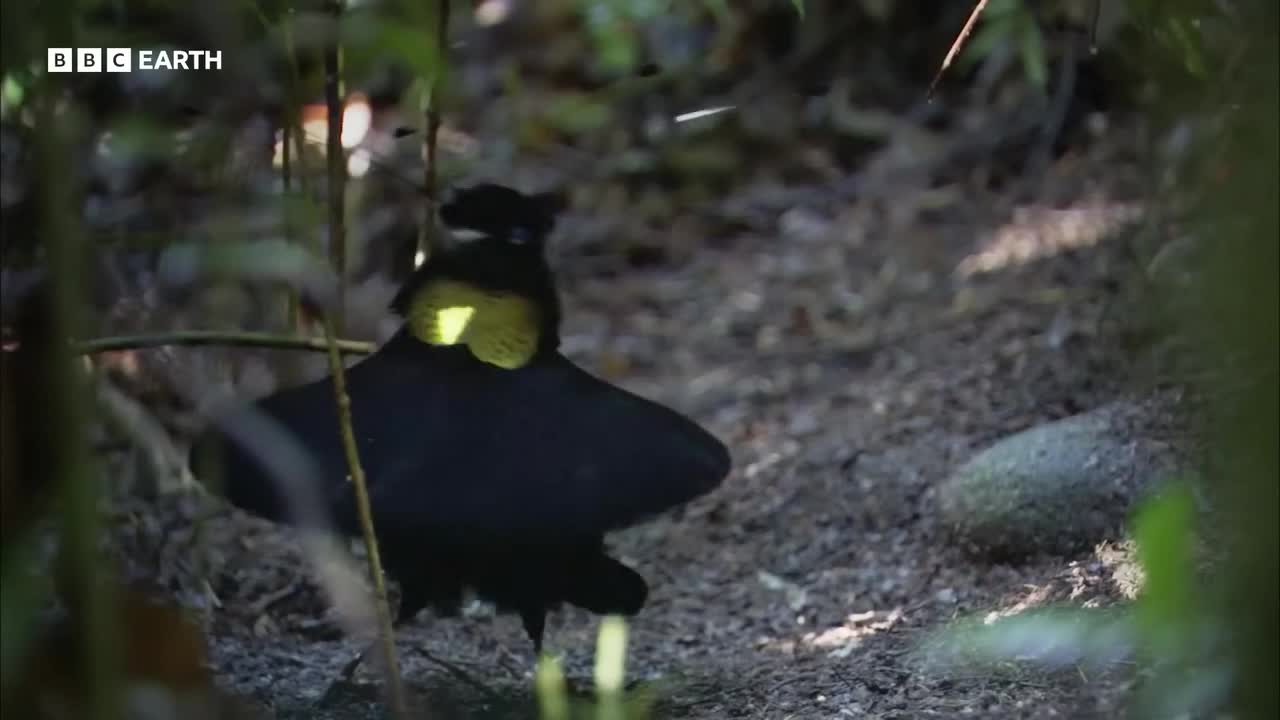
In the great island of New Guinea, there are 42 different species of birds of paradise, each more bizarre than the last.
This forest is so rich that nourishing food can be gathered very quickly.
That leaves the male six-plumed bird of paradise with time to concentrate on other matters like tidying up.
His display area is ready.
Very impressive, but no one is watching.
The superb bird of paradise calls to attract a female.
And he has more luck.
But what does he have to do to really impress her?
It's hard not to feel deflated when even your best isn't good enough.
It's March and light returns to the high Arctic, sweeping away four months of darkness.
A polar bear stirs.
She has been in her den the whole winter.
Her emergence marks the beginning of spring.
After months of confinement underground, she toboggans down the slope, perhaps to clean her fur, perhaps for sheer joy.
Her cubs gaze out of their bright new world for the very first time.
The female calls them, but this steep slope is not the easiest place to take your first steps.
But they are hungry and eager to reach their mother, who's delayed feeding them on this special day.
Now she lures them with the promise of milk, the only food the cubs have known since they were born deaf and blind, beneath the snow some two months ago.
Their mother has not eaten for five months and has lost half her body weight.
Now she converts the last of her fat reserves into milk for her cubs.
The spring sun brings warmth, but also a problem for the mother. it starts to melt the sea ice.
That is where she hunts for the seals.
She needs to feed her cubs and she must get there before the ice breaks up.
For now, though, it's still minus 30 degrees, and the cubs must have the shelter of the den.
For many, this is their first journey across the Himalayas.
For some, it will be their last.
The Golden Eagles have been expecting them.
The eagles work in pairs to separate a young crane from the flock.
It escapes the clutches of one and is caught by another.
But even a young crane is a heavy prize, and the eagle has to struggle to control it.
The mother can wait no longer.
This is a desperate race against worsening weather.
Ripening fig trees overhanging the water's edge provide welcome food for shoals of hungry fish.
The commotion attracts Dorado, known locally as the River Tiger.
They patrol the feeding shoals looking for a chance to strike.
And waiting in the wings, ready to pick off any injured fish, are the piranhas.
A feeding frenzy quickly develops.
Piranha can strip a fish to the bone in minutes.
Great numbers of fish sustain vast flocks of water birds.
The roseate spoonbill is just one of the 650 bird species found in the Pantanal.
They nest alongside wood storks in colonies thousands strong.
Spectacle caiman linger below, waiting for a meal to fall out of the sky.
Many caves are like islands, cut off from the outside world and from other caves.
This isolation has resulted in the evolution of some various strange creatures.
They are the cave specialists troglobites, animals that never emerge from the caves or see daylight.
These troglodytes from Thailand are possibly the most specialized creatures on Earth, for they live only in cave waterfalls.
The entire population of these cave angelfish seems to be restricted to just two small caves.
It's the same story with other troglobites.
There may well be less than 100 Texas cave salamanders.
And the Belizean white crab is another creature that is unique to just one cave system.
Living in perpetual darkness.
They have all not only lost the pigment in their skin, but also their eyes.
It takes thousands of generations for eyes to be lost, so these species must have been isolated for a very long time.
But the blind salamander has other highly developed sensory organs.
Receptors in the skin detect minute movements in the water made by its prey.
External gills help it to breathe in water that is particularly low in oxygen.
The cave.
Angelfish feed on bacteria in the fast-flowing water, keeping their grip with microscopic hooks on their fins.
Food is often in short supply and troglobites like the crab have to survive on whatever washes into the cave from outside.
A salamander might not encounter food for several months, so when something does come along, it can't afford to miss it.
It's astonishing that these extraordinary cave dwellers managed to survive at all.
There is no other species on the planet that responds as quickly and as dramatically to the good times as the desert locust.
Eggs that have remained in the ground for 20 years begin to hatch.
The young locusts are known as hoppers, for at this stage, they're flightless.
They find new feeding grounds by following the smell of sprouting grass.
Normally, it takes four weeks for hoppers to become adults.
But when the conditions are right, as now, their development switches to the fast track.
As the vegetation in one place begins to run out, the winged adults release pheromones, scent messages which tell others in the group that they must move on.
And when groups merge, they form a swarm.
An adult locust eats its entire body weight every day, and a whole swarm can consume literally hundreds of tons of vegetation.
They have to keep on moving.
The swarm travels with the wind.
It's the most energy-saving way of flying.
Following the flow of the wind means that they're always heading toward areas of low pressure, places where wind leads rain and vegetation starts to grow.
As they fly, swarms join up with other swarms to form gigantic plagues, several billion strong and as much as 40 miles wide.
They will consume every edible thing that lies in their path.
This is one of planet Earth's greatest specters.
It's rarely seen on this scale and it won't last long.
Once the food has gone, the steady roar of a billion beating locust wings will once again be replaced by nothing more than the sound of the desert wind.
The sun's heat and power to evaporate water has had a profound effect on the bodies and habits of everything that lives here.
This sun potentially is a killer.
And the red kangaroos must acknowledge that.
Right now, while the sun is low, there's no immediate cause for concern.
But this situation won't last long.
Australia is the world's most arid continent with blistering daytime temperatures.
Every hour the temperature rises by five degrees centigrade.
Soon the heat will reach a critical point.
Any kangaroo out in the open is in serious danger of overheating.
In the full sun, the temperature on the ground soars to 70 degrees.
By midday, the radiation is so intense, they must take shelter.
In the shade, they're shielded from much of the sun's energy, but their body temperature can still rise.
So they lick saliva onto their forearms, where there is a network of blood vessels close to the surface of the skin, and as the saliva evaporates, their blood is cooled.
This thermal image shows just how effective the process is.
The blue areas on the body are the cooler parts.
As the saliva dries, it has to be replaced.
And this is a real drain on the kangaroo's body fluids.
Even in the shade, the earth is baking hot.
So the kangaroos dig away the warmed topsoil to get at the cooler ground beneath.
By staying in the shade and licking to control their body temperature, kangaroos manage to get through the hottest part of the day without heat stroke.
But for the majority of desert animals, this strategy would not be enough for survival.
Exhausted from his swim, the bear must regain his strength.
The next day, a sea fog shrouds the island.
The wallaces sense that they're in danger.
Using the fog as cover, the bear approaches the herd.
The adults close ranks around their young, presenting a wall of blubber and hide.
He tests the barrel, but it stands firm.
It appears that the world's largest land carnivore has met his match.
There must be a chink in the armor somewhere.
Not here.
This female walrus is shielding her pup if he can just prise her off.
The bear's claws and teeth can't penetrate a thick hive.
With the herd retreating to water, the bear must move quickly.
Having failed with one, he heads straight for another.
The chance of his first meal in months is slipping away.
He seems increasingly desperate.
It's now or never.
He must avoid the stabbing tusks if he's to win.
The flailing walrus is immensely powerful and drags the bear away from the shallows towards the safety of the herd.
It slips from his grasp.