This message is from NPR sponsor Total Wine and More.
This summer season, with so many bottles to choose from, it's easy to find your favorite and more.
Find what you love and love what you find only at Total Wine and More.
Drink responsibly. Be 21.
You're listening to Short Wave from NPR.
Saad Bhamla is a scientist and a tinkerer at his lab at Georgia Tech. He leads a group studying the physics of life.
I'm very promiscuous in my organisms, so nothing is off the table.
The Bamla Lab studies the biomechanics — so the movement of different organisms. Springtails, flamingos, worms, cicadas.
A few years ago, Saad decided to turn one of his lab's research papers into a comic book.
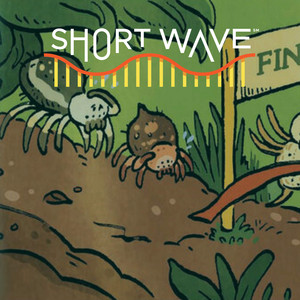
The curious zoo of extraordinary organisms. The slingshot spider.
This comic is set deep in the Amazon rainforest and it's all about the slingshot spider.
This spider has an amazing adaptation to turn its web into a high -speed trap to catch prey.
First the spider grips a silk line of its web with its pedipalps and front legs.
A portion of the web is bundled into a tight coil, a coil so tight the web takes the shape of a cone.
And when the spider senses a hapless flying insect, it releases the line with its front legs and flings itself on the web backwards to snack its prey.
Ack, eep. Those are the flies saying, Ack, eep.
It's the slingshot spider as it flies through the air like a daredevil.
And the illustrator, Lindsay Lee, drew it like a circus performer.
So the spider is being launched out of a cannon with a cape and a crash helmet.
In fact, it has the fastest full body motion of any arachnid.
What a daredevil. Whee!
Saad read me the whole comic.
It was awesome. It's based on actual research, a paper published in the journal Current Biology in 2020 that was led by Simone Alexander.
And for a lot of scientists, after publishing, they just call it a day.
But back in 2020 when Saad went to check if anyone had actually read the paper...
I think it was abysmal.
I think we got a few clicks on it.
The people reading and clicking were other scientists.
And it kind of dawned on me that forget other adults, no kid ever would go to currentbiology .org and actually download this and read this.
And so there was this lingering feeling that there has to be a better way to share this beautiful discovery.
So Saad decided that from that point on, for every research paper the lab published, they would also invest in creating a comic book.
Today on the show we jump into a biophysics comic book to learn how animals eject fluids and why a comic about butt -flicking insects is a valuable way to take science beyond the lab.
I'm Emily Kwong, and you're listening to Short Wave, the science podcast from NPR.
This message comes from Charles Schwab.
When it comes to managing your wealth, Schwab gives you more choices like full -service wealth management and advice when you need it.
You can also invest on your own and trade on thinkorswim.
Visit Schwab .com to learn more.
Support for NPR and the following message come from Edward Jones.
What does it mean to live a rich life?
It means brave first leaps, tearful goodbyes, and everything in between.
With over 100 years of experience navigating the ups and downs of the market and of life, your Edward Jones Financial Advisor will be there to help you move ahead with confidence.
Because with all you've done to find your rich, they'll do all they can to help you keep enjoying it.
Edward Jones, Member SIPC.
This message comes from Charles Schwab.
When it comes to managing your wealth, Schwab gives you more choices, like full service wealth management and advice when you need it.
You can also invest on your own and trade on Think or Swim.
Visit Schwab .com to learn more.
Okay, so, Saad, your comic series has It's a name.
It's called The Curious Sue of Extraordinary Organisms. And your main illustrators are Lindsay Lee and Jordan Culver, so shout out to them.
We're going to walk through a couple of the comics, starting with the one called Behold the Bug That Super Propells Pee.
And this comic is all about a bug called the glassy -winged sharpshooter.
Who is this character?
It's a tiny bug. They drink juices from plants like their xylem fluid and then they leave behind a gift, which is a bacteria called Xylella facetiosa, which creates a lot of problems across the United States from California for wines and then citrus from Florida.
But a beautiful bug, and it drinks a lot.
And uh it pees a lot.
So the co -creators of this comic, Jordan Culver and Rick Worth, depict this sharpshooter as an outlaw in a cowboy hat with a catapult on its butt to fling away a bead of P, and this is known as a butt flicker.
How did you figure out how the butt flicker works, and how do you even measure the speed at which this glassy winged sharpshooter ejects its pee into the world.
I was actually at my son's pre -K, who's five year old and showing this.
And he loves it and all the kids love it, because they've never seen pee.
Like to me, this is the most beautiful pee in the world.
It's like a perfect drop.
So we used macro lenses that allow us to zoom in, effectively a microscope, but with a high speed camera.
And that's where we kind of focus in on the business end of this bug, which is the butt flicker like you shared.
And yeah, it was it was so amazing for the first time to see how it flicks these droplets at such high speeds.
It's just incredible.
It ejects them, you write in the comic, 40 times faster than a cheetah accelerates.
And the droplet moves faster than the butt flicker.
And you compare it to like, as if a baseball were to move faster than the arm of the baseball pitcher.
How is that even possible?
How can the droplet like pick up speed in the air?
This was the whole conundrum, and my graduate student, Elio Chalita, who did this work, and he showed me this— I didn't believe it, and we checked again and again.
And the kind of aha moment, which is these droplets are compressible, they deform and squishy because of surface tension, so this stored energy by squishing it, just like if you had a jello.
Or like a water balloon.
Exactly, like a water balloon, so it can store energy by surface tension.
and that was why we called it super propulsion because it gets some energy for free by storing energy in the deformation or the squishiness of the drop.
And because they're so small, surface tension you're saying would keep the drop stuck to them, so it'd be like if our pee just like wouldn't come off of us, so they also need the flicker to just be like, eugh, get away!
Precisely, it sticks to them and so they have to give this flick.
Yeah and what's cool is in the comic you say that studying super propulsion like this could help us humans design devices to fling away liquid too.
A neat example of this is in your smart watches or hearing aids.
Smart watches, for example, have a button where after you go for a swim, you can press a button that ejects the water to protect the electronics.
We think we can learn a trick or two from the Shopshooter and improve the ability of these low -power electronics to eject water from tiny crevices and areas using very minimal energy.
And our friend, the glassy -winged sharpshooter, makes a return in the comic Captain Cicada and the Jestus League, which is based on two papers about fluid ejection and nature.
And I want to focus on the part in the comic that's a confrontation between our guy, the sharpshooter, and the much bigger Cicada.
So the sharpshooter and the Cicada, they meet on a tree branch and they're both chugging their Xylem beer.
And I want you read me what happens next.
Okay, will you play the part of Captain Cicada and I'll be Sheriff Sharp Shooter?
Yeah. Howdy cousin.
Word is that you're hogging all the xylem around these parts.
Oh no. You already have your comic.
It's my turn, Sheriff Sharp Shooter.
I think we need to settle this with a good old fashioned shootout.
How many pieces? And then what happens?
It's a battle of fluids.
It's... they're... they're shooting, shooting.
They're peeing on each other.
They're peeing on each other.
So they're both drinking xylem fluid.
But the cicada, because it's larger, it doesn't need to conserve energy and doesn't have these butt flickers.
So it, you know, loosely speaking, is similar to us or other mammals' different body structures.
But it can make jets at this point.
Yeah. Evolution is amazing because the comic then ends with all these other animals that can jet fluid, like, not just pee.
Yeah. Yeah. You have the archer for fish hunting, the octopus for deception.
Together, along with the spitting spider, they become the Jetstice League.
Did Marvel sue you over this?
That would be interesting.
I don't think they have even made it on their radar.
All right, got it. What is the feedback you've gotten on this?
One email I got, this is during the pandemic a couple of years ago.
This was around the time in Lebanon, there was the explosion and the economy was tanked and there was a lot of children who are now in refugee camps.
And so an educator who was doing this for nonprofit, reached out and said, Oh, I printed all your comics because many of these kids are now displaced and in refugee camps and we were having a hard time getting textbooks and teaching them and so the comics reminded them about kind of living systems and biology where in certain situations, they may not encounter them so they really were grateful and appreciate and made my heart kind of warm.
Mm. This comic work has garnered quite a bit of attention.
A National Science Foundation Career Grant.
You've received so many different forms of recognition for this work.
But when you step outside the scientific community, how do you see the comics in regards to like just people who perhaps don't know anything about science and don't trust science.
I'll tell you a recent story.
In December after Christmas break we were out camping in the middle of nowhere in Georgia at the State Park, Magnolia Springs State Park.
And so I met this local Georgian woman she lives in a farm nearby and enjoys and she said, well, what do you do?
And I explained I'm a scientist, and I study bugs.
And she says, why? as I really love animals.
And we were able to connect because she said, I'll tell you this but don't report me into animal control.
I was like, why, why would I do that?
She says, I love possums and I have three possums in my house, they're just like my pets.
And this is a person that I would never encounter in Atlanta, Georgia, right?
This is rural Georgia, middle of nowhere but we are still able to connect over our shared love of animals.
And I think sometimes it takes stepping out of these ivory towers that scientists put themselves in, write in these fancy journals that really exclude taxpayers, my neighbors who pay for this.
So I think a little bit onus is on us, is to step out of our comfort zone and not underestimate the average American.
But I think they're resilient, curious, and perhaps sometimes we hold ourselves back.
Saad, thank you so much for coming on the show.
Thank you, Emily. Thank you for doing what you do.
This episode was produced by Burley McCoy and Rachel Carlson and edited by our showrunner Rebecca Ramirez and Jeff Brumfield.
Tyler Jones checked the facts.
Quesi Li was the audio engineer, Beth Donovan is our senior director and Colin Campbell is our senior vice president of podcasting strategy.
I'm Emily Kwong. See you tomorrow on Short Wave from NPR.
car. This message comes from Mint Mobile.
If you're tired of spending hundreds on big wireless bills, bogus fees and free perks, Mint Mobile might be right for you with plans starting from 15 bucks a month.
Shop plans today at mintmobile .com slash switch. Upfront payment of $45 for three month, five -gigabyte plan required.
New customer offer for first three months only.
Then full price plan options available.
Taxes and fees extra.
See Mint mobile for details.
Support for this NPR podcast comes from Zscaler.
Reduce infrastructure costs by 90 % and improve networking and security agility by eliminating firewalls and VPNs with Zscaler Zero Trust plus AI.
Learn more at zscaler .com slash security.
This message comes from Mint Mobile.
Mint Mobile took what's wrong with wireless and made it right.
They offer premium wireless plans for less and all plans include high speed data, unlimited talk and text and nationwide coverage.
See for yourself at mintmobile .com slash switch.