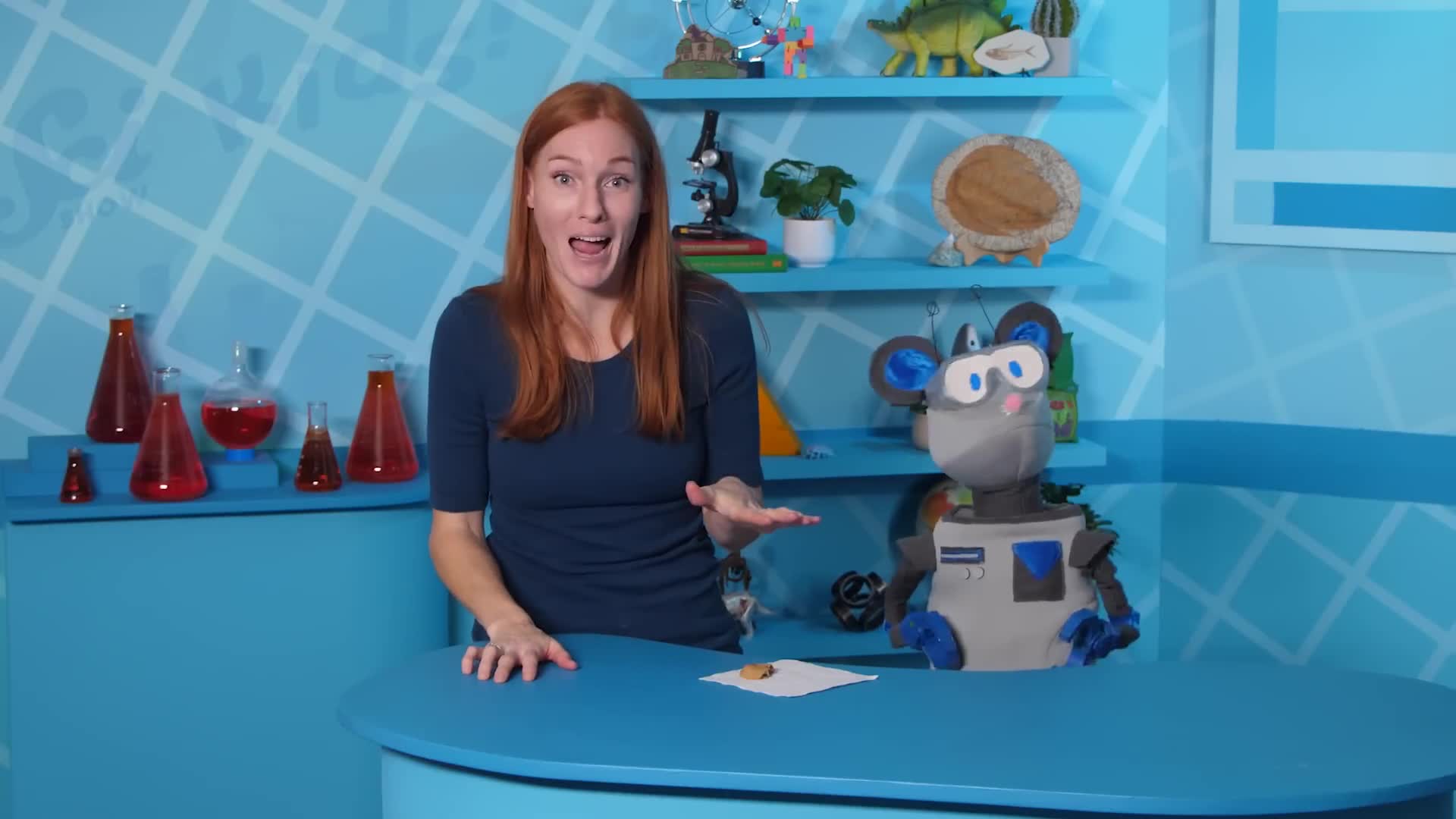
Look, Squeaks, you can see my teeth marks in this cookie.
Oh, hi there.
Squeaks and I were just talking about our teeth and all the amazing things they can do.
No, Squeaks, they're not just for looking good when you smile.
And they're not all the same either.
Squeaks has a lot of questions.
As a robot rat with no teeth, that makes sense.
Maybe this video will help.
I just can't stop smiling.
Do you want to know why?
Because I want to show off my teeth.
Teeth aren't just for smiles.
They're a really important part of one of my favorite things, eating.
What do you like to eat?
I like to eat carrot sticks, peanut butter and jelly sandwiches, pasta, and lots of other things.
So if you're like me, you probably eat lots of different kinds of food, and that's why we have lots of different kinds of teeth.
We use our teeth to chew our food.
Chewing takes food that would be too big to fit in our mouths or too hard to swallow whole, and breaks it down into smaller pieces.
You couldn't just open wide like a snake and swallow a whole pizza!
You need your teeth to rip it into bite-sized pieces first, and then keep making it smaller and mushier until you can gulp it down.
Our teeth are great at turning lots of different things into tasty meals.
They all have slightly different jobs and different shapes to help us eat all those foods.
Take a look inside your mouth, and the next time you lose a tooth, have a close look at it.
When you smile, you can see your front teeth really well.
They're called incisors, and you have four on the top and four on the bottom.
These are the teeth that help you take that first bite of food.
Think about chomping into a sandwich, or taking a bite out of an apple.
You use those front teeth first to cut into the food and break off a bite-sized piece.
And you can see another kind of teeth when you smile, too.
They're the longest and pointiest teeth in your mouth.
They're called canines, and you have four of them, two on the top and two on the bottom.
These teeth are especially good for ripping and tearing food.
They have long roots that go deep into your gums, so they can do a lot of hard work.
For example, how would you bite off a piece of something super chewy like a big piece of bagel or a hard sticky piece of taffy?
That's where your canines go to work.
These strong teeth can hold the chewy bread or stretchy candy in place even when you're pulling on it, so you can break off a piece to eat.
Now, if you look further back in your mouth, you can see teeth that are bigger, flatter and kind of squarish.
These are your premolar and molar teeth.
The premolars are a little bit smaller than the molars, but all of these teeth have wide bumpy surfaces instead of sharp edges.
Their shape makes them really great at grinding and crushing food, especially food that comes from plants.
Think about how long it takes to chew up a stalk of celery.
While the teeth in front are in charge of biting, these back teeth do most of the hard chewing.
They're the last teeth that your food will meet before you swallow.
We're lucky we have all these different kinds of teeth, because it means we can eat lots of different kinds of food.
Some animals only have one kind of tooth, or more of one kind than the other.
Their teeth are specially suited to the types of food they eat.
Animals like elephants and deer eat mostly plants, so most of their teeth are those big broad, lumpy molars to break down thick plants.
And other animals, like squirrels, eat plants, too.
But they don't just pluck a leaf off a bush.
Squirrels have to chew through the bark of a tree, or through hard seeds and nuts to get their food.
So these animals have molars and really big incisors.
The incisors help them chew through the tough stuff and their molars help them grind up the plant matter.
Now, other animals, like tigers, only eat other animals.
They eat meat.
So these guys need really big, sharp canine teeth to help them catch and tear into their prey.
Their teeth help them take food that's too big to fit in their mouths all at once and break it into smaller pieces.
So all animals have special teeth that match their diet.
Scientists can sometimes figure out what kind of food an animal eats based on the shape, size and number of teeth they have.
Luckily, we can eat all kinds of things!
Stretchy things, chewy things, soft things, tough things, slippery things, and lots of other things.
And that's something to smile about!
See, Squeaks?
Those of us with teeth think they're pretty important!
Squeaks wants to know why some of his young friends are missing teeth right now.
Those are baby teeth, which unlike permanent teeth, are supposed to fall out.
Don't worry, Squeaks.
I think this will explain everything.
Say cheese!
Oh, hi, guys.
Squeaks and I are just practicing our smiles for picture day.
You look great, Squeaks, but you're missing something.
Oh, I know. teeth.
When we smile, we usually show off our teeth.
But don't worry, Squeaks, you still look great, and you're not the only one that's missing teeth.
Maybe some of you are missing a tooth or two, too.
Have you lost a tooth yet?
If you have, you know what it feels like.
Your tooth starts to get a little bit wiggly, then a little loose, and soon you can twist it all the way around.
Then one day pop.
It's out of your mouth.
But don't worry, it doesn't hurt, and these teeth are supposed to fall out.
They're your baby teeth!
Some people also call them milk teeth, or primary teeth.
As a baby grows, these teeth slowly come in, do their jobs for a while and then get loose and eventually fall out.
Lots of other animals have baby teeth, too.
Have you ever found small teeth around your house as your puppies and kittens grow up?
Yep, those are just dog and cat versions of baby teeth.
But why do we have baby teeth at all?
Well, think of a little baby.
She's so cute and also so small!
A baby is much smaller than an adult, or even you!
The part of her head where her teeth grow, here, is called the jaw.
And a baby's jaw is so small that only baby-sized teeth can fit in there.
But when a baby is first born, her teeth haven't even grown in yet.
And that's okay, because what does a newborn baby eat?
Milk!
And you don't need teeth to drink milk.
But once a baby grows a little, when she's about six months old, her first tiny teeth will start to pop up.
Usually, the front teeth on the top and bottom are the ones to come in first.
When a baby has these teeth, she can start to eat soft foods like mashed up peanuts and carrots, or little bits of cereal or crackers.
Just a few teeth are all you need.
Then, once she gets to be about two and a half years old, she'll have all of her baby teeth, twenty of them in all.
Now, she can start to eat other stuff, like crunchy carrot sticks or stringy spaghetti.
You can't just swallow down that food.
It's time to start chewing!
But teeth aren't just for chewing.
Can you think of anything else we use them for?
Well, I'm doing it right now.
Talking!
We use our teeth to form shapes with our tongue and mouth, which lets us make the sounds that we use to speak.
So a little kid often starts to talk right around the time that she has her first full set of baby teeth.
Without them, talking would be really hard.
So baby teeth are small enough that they can fit into a little kid's mouth.
But they're strong enough to chew up all that new food that she's starting to eat, and they can help her start to talk.
But those first teeth won't be there forever.
As she keeps growing and growing, her head and jaw are growing, too.
And that means that she'll need more teeth, and also bigger teeth.
Those baby teeth will be just too small to get the job done.
So by the time she's about 10 to 12 years old, she will have lost all of her baby teeth.
And in their place, she'll have 32. bigger, stronger grown-up teeth.
These teeth are ready for anything.
Now she can eat crunchy celery, tough nuts, chewy jerky, and lots of other things.
But these teeth are permanent.
That means that she'll have them for the rest of her life.
So she'll have to take really good care of them to keep them strong and healthy.
So why do we have baby teeth?
Basically, because you get bigger.
So be sure to brush your teeth at least two times every day, especially after eating.
And floss, too, because a smile's only happy if it's healthy.
I'm glad those baby teeth falling out is nothing to worry about.
But kids do have to brush them, just like they have to brush their permanent ones.
You know the reason, Squeaks!
To keep bacteria from decaying the teeth and causing cavities.
It sounds like Squeaks is a little forgetful.
Let's remind him why it's so important to brush your teeth.
It's almost bedtime here at the fort, but before we get tucked in, we've got to brush our teeth.
Hey, that's a good question, Squeaks.
We do it a couple times a day, but we should really understand why we do it.
So why do we have to brush our teeth?
Well, have your teeth ever felt just yucky like at the end of the day or first thing in the morning?
I really like brushing my teeth because it gets rid of that icky feeling and it feels good because it is good.
We brush our teeth to keep them clean and healthy so they can keep helping us our whole lives.
After all, how would you crunch up a cracker or bite into an apple without them?
Without teeth, you'd have very few choices of foods that you could eat, so you've got to take care of them.
Now, you can't tell by just looking at them, but your teeth are actually made up of different layers.
The part that you can see on the outside is a super hard shell called enamel, which is mostly made of minerals.
Enamel is the strongest stuff in your whole body, even stronger than bone.
But unlike your bones, a tooth can't heal itself if it's broken.
And your teeth are not hard enamel all the way through.
Just below that tough outer layer, there's another layer called dentin that's not as hard.
And below that there's the inner layer of the tooth, called the pulp, which has blood vessels and nerves inside it.
And this part of your tooth is super sensitive.
So in order to protect the delicate pulp inside of your teeth, you have to take really good care of the outside.
And the best way to do that is to clean them up after you eat, because food can damage even those tough outer layers of your teeth.
How?
Well, you might think that you ate every last bite of those crackers that you had for a snack, but the truth is, some very small pieces of food are still hanging around in your teeth.
That's because your teeth aren't all shiny and smooth.
They have lots of bumps and ridges that help you grind down your food.
And there are lots of small spaces between them, too.
These are places where it's easy for food to get stuck and hang out all day, which is kind of gross.
But you know what's even more gross?
You're not the only one enjoying these leftovers.
There are lots of tiny little things that call your mouth home.
These are called bacteria.
They're way too small to see, but they're definitely in there.
And there are a lot of them.
In just your mouth alone, there are more bacteria than there are people on Earth.
Some kinds of bacteria are really good to have.
Others just kind of hang around and are neither good nor bad.
And then there are some who are pretty bad house guests and you don't want them staying in your mouth for too long.
One type of bacteria loves to eat the same stuff that you do, especially sugars and starches.
That means things like cookies, chips, bread, candy, and cereal.
These bacteria hang around on your teeth and in your mouth, basically eating your leftovers.
And once they're done eating those tiny bits of food, they release acid which can really hurt your teeth.
This acid can cause holes called cavities to form in the enamel of your teeth.
And cavities can really hurt.
They might even make it hard for you to eat if they get too big.
But the good news is that when you brush your teeth, you clean away the food that those bacteria love so much.
And you sweep away some of the bacteria themselves.
And with them goes that icky, gross feeling on your teeth.
So we brush our teeth before we go to bed to get rid of all those tiny bits of food we've been eating during the day and to clean out the bacteria that are hiding in our mouths.
Fewer bits of food in there and fewer bacteria mean you have less of a chance of getting cavities.
But you should brush your teeth in the morning, too.
Because, even though you brushed the night before, there are always some bacteria sticking around in your mouth.
And while you were sleeping, those little guys were partying it up.
So when you brush in the morning, you're starting the day off with a nice clean mouth.
That's why you should brush your teeth at least twice a day, in the morning and at bedtime.
Taking care of your teeth will make sure that they stay strong and healthy so you can keep eating good food, which keeps the rest of you healthy.
Once our teeth are clean, it'll be time for us to head to bed.
Oh, I know you wish you had teeth, Squeaks, but you're a robot.
Most animals do have teeth, and they can be pretty weird sometimes.
Really?
Animals have different uses for their teeth, so it makes sense that they don't all look the same.
Do you want to learn about some of the weirdest animal teeth on Earth?
Oh hey guys, you caught us on our lunch break!
Squeaks and I just stepped out of the lab to have a little snack.
Well, at least I'm having a snack.
And since Squeaks doesn't need to eat like I do, I was just explaining to him what teeth are for.
People have different kinds of teeth.
I have molars in the back of my mouth that help me grind up vegetables and other things, but I also have pointed canine teeth so I can tear through things like meat.
Being able to eat different kinds of food is really important to help you stay healthy.
Other animals have different kinds of teeth too, but while they're all super useful, Some of them can seem a little strange.
Like, we all know sharks have sharp teeth.
But did you know many sharks have five rows of teeth?
Sometimes even more!
A shark can go through thousands of teeth in a lifetime.
That's because, unlike us, sharks' teeth aren't rooted in bone.
Instead, their jaws are made of something softer, called cartilage.
That's the same flexible stuff that you have in your ears, or in the tip of your nose.
Since sharks' teeth sit in this soft cartilage, they can lose them pretty easily, especially considering how they eat.
Sharks feed by biting down hard on their prey, like seals or other fish, and they shake them from side to side with a lot of force.
This can make their teeth come loose or even fall out, so they need to be able to replace them easily.
Luckily for them, they have these rows of new teeth right behind the last ones, just waiting to move up.
When a shark loses a tooth, it's replaced by another one in just one or two days.
Other predators have different kinds of teeth for catching food.
Vipers, for example, are a kind of snake, and they have fangs.
When a snake is resting, these special teeth fold up inside its mouth so that they're out of the way.
But when the snake bites its prey, let's say, like a rat, No, not you, Squeaks!
Not a mechanical one.
A real one.
When it bites into a real rat, these teeth act like needles.
Toxic venom then travels from the snake's mouth through the hollow fangs and directly into the prey.
But teeth aren't just for eating.
Other animals use them for different reasons.
For instance, did you know tusks are teeth?
Walruses have tusks up to a meter long, and they keep growing throughout their whole life.
Male walruses sometimes use their tusks like swords to fight with other males.
But both males and females use their tusks for other reasons, too.
Like when they're swimming under the ice.
They can use them to poke holes in ice so that they can come up to the surface to breathe.
And they can even use their tusks to pull their big, heavy bodies out of the water.
But there's probably one animal that's more famous than any other for its unusual teeth.
That's right!
That's right!
I'm talking about…
Beavers!
Beavers are well known for their oversized incisors.
These teeth never stop growing, so beavers are constantly trying to wear them down by chewing on wood.
You might think that chewing on wood all the time would ruin the beaver's teeth, but the front side of their teeth actually has iron in it.
Iron is the same stuff that they use to make really strong metals, and it not only makes the beavers' teeth extra tough, it also gives them their unique rusty orange color, kind of like the rust you might see on an old car or bicycle.
So it's this extra strength that makes it possible for beavers to bite through wood for as long as they want to.
No wonder they can stay so busy, those busy beavers!
Wow, imagine what shark teeth would do to this cookie!
Oh, I don't think sharks go to the dentist, but maybe they should.
They have a lot of teeth, and everyone needs a cleaning now and then.
Speaking of cleaning, I should probably brush my teeth after eating this tree.
Thanks for watching, and we'll see you next time here at the fort.