Understanding the human body is a team effort.
That's where the Yakult group comes in.
Researchers at Yakult have been delving into the secrets of probiotics for 90 years.
Yakult also partners with Nature Portfolio to advance gut microbiome science through the Global Grants for Gut Health, an investigator-led research program.
To learn more about Yakult, visit yakult.co.jp.
That's Y-A-K-U-L-T dot C-O dot J-P.
When it comes to a guide for your gut, count on Yakult.
That's always been culture, our subjective experience in defining what we think is good and bad in society.
Pop art plays with that boundary between what is low art and what is high art.
If Andy Warhol were around right today, he would be making like skibbity toilet paintings.
The idea is that this is still a subjective thing at the end of the day, and image of a toilet is not neurologically bad for you any more than the word skibbity is bad for you.
For Scientific American Science Quickly, I'm Rachel Feltman.
If you've ever heard a kid say skibbity and found yourself lamenting the downfall of the English language, then today's episode might surprise you.
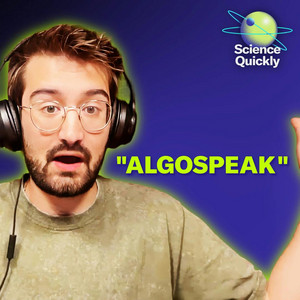
Our guest is Adam Oleksik, a content creator and linguist known online as the etymology nerd.
He recently wrote a book called AlgoSpeak How Social Media is Transforming the Future of Language, which looks at how algorithms are affecting the way we communicate.
It might feel like the rise of brain rot is literally rotting our brains, but it's not.
Adam argues that what we often treat as internet gibberish actually follows the same patterns of language creation that humans have followed for thousands of years.
The only real difference today is the speed and scale of how language changes.
And far from dumbing down the discourse, these new words and phrases often crop up to serve important social functions.
Scientific American associate editor and sometimes sub in Science Quickly host Allison Partial sat down with Adam to chat about this brave new linguistic world.
Here's their conversation.
How would you describe your linguistic upbringing in the Internet?
What was your like formative experiences there?
My first experience with the Internet was really Reddit.
I was very bookish and didn't interact with the Internet much until sophomore year of high school, where I started this etymology blog, which back then was called EtymologyNerdcom.
And I would post a word origin a day and I would start like looking around on the Internet for other like resources for etymology and I stumbled on the subreddit r slash etymology, and that was actually one of the best ones out there.
So that was kind of where I started dabbling.
I was posting there.
I was like oh, I like uh, the fake internet points.
Um started posting on some other subreddits.
I made maps and made infographics and so I would post those and they would do well, and then I started posting other stuff.
So that was my first experience like learning how to go viral on the internet.
But it was also just like my encounter with an internet as a person.
And then, I don't know, after high school I stopped going on Reddit.
I was pretty offline most of college.
And then, when I was graduating with a linguistics degree and didn't know what to do, a friend suggested hey, maybe you should try making videos.
And I was like, well, I know how to go viral.
I might as well give it a shot.
It's better than anything else.
Yeah, most anything else.
Yeah.
Were there any words that r slash etymology subreddit used that you remember?
Maybe not words, but just like particular ways of being and talking to each other?
I do remember early slang words and being fascinated by them.
And this was all from Vine, really, like on fleek or bae or fam, yeet. all of that.
There were the 4chan words bleeding into Reddit.
So I did see the words like pilled and maxing and that stuff before, like it started really leaking to the mainstream.
So that was definitely stuff I was aware of and interested in because I was interested in language.
Didn't really start like analyzing slang for my job until like after college, but like reflecting, like you really start to see wow, this is what was happening then.
And it's useful to have been in the weeds.
My crucible was tumblr and i'm using this like slightly as a segue, because one of the memes that i first saw in there that became like so popular even more recently to the point where it made the transition over to tiktok, was the mitochondria is the powerhouse of the cell meme.
This is like slightly self-referential because I recently learned that Scientific American coined that.
It was like the first use of phrase in 1957.
I'm curious, like not to put you on the spot, but I am curious if you know anything about that meme, or just like how you've encountered it, how it has changed over time.
Is that something that you know about?
There's a bunch of stock phrases that are humorous to people because of their over-representation in our culture.
And that's funny because obviously it showed up in all these early documentaries and we started making jokes parroting the fact that it's so present.
Honestly, that's what brain rot is too.
If we look at right now, there's uh, dubai chocolate, labubu crumble cookie, brain rot.
And that's funny because it's parodying this overrepresented thing in our culture.
And what was mitochondria, the powerhouse of the cell, before we had like, the viral algorithmic feeds bringing us the same recommended content over and over again.
What would we parody?
We'd parody mass culture.
We still are in many ways, but that is a time-honored linguistic process.
It's interesting because it seems kind of distinct from the other phenomenon you mention a lot in the book, which is like where something becomes popular because it was actually quite niche.
But then through many particular reasons, maybe it fills a lexical gap, or it just sounds funny like Dolulu.
It just gets picked up.
Do you think of those as two separate things or maybe two sides of the same coin?
Humans use words because they're funny or interesting or cool or fit a useful niche.
In the case of mitochondria as a part of the cell, it's funny to us.
And there's an underlying social reason for a funniness.
But no, I don't think it's really fundamentally new.
I think maybe because of the highly competitive nature of memes competing with each other in algorithmic environments, we do tend to feel like words seem funnier or there's more memes driving language than maybe there could have been in the past.
But in terms of the stock phrases, I don't know if you ever took the fitness gram pacer test.
The fitness gram pacer test.
The fitness gram pacer test is a multi-stage aerobic.
Yeah, exactly.
So like anybody growing up like our sort of age encountered that.
And that's a funny phrase.
And I've seen fitness gram pacer test memes on the internet as well.
Memes also call attention to shared realities, shared cultural backgrounds.
And it seems niche.
It seems like, oh, this is this small detail from our childhoods.
And yet it's calling back to this niche.
Shared experience feels like you're part of an in-group which, at the end of the day, is a repeated thing again.
Nothing is really that new.
It's the feeling of being in a group that defines how we interact with each other as humans.
And that's something I really try to explore in my book.
And that's something that is common to the mitochondria thing and the fitness gram thing.
It's calling attention to this very specific thing we all had together.
It reminds me a little bit of the day after the SAT, when obviously no one is supposed to be posting SAT memes online, but everyone is posting SAT memes online.
I would love going to the SAT memes subreddit.
Yeah, yeah, exactly.
It was like the most profound feeling of community that I can remember, at least at that point in my life.
And you're so disconnected, you don't know who these people are.
But yeah, that question did suck.
Yeah.
The best parts of the internet are when you feel that collective effervescence, because that's what drives us as humans, this feeling of connection to other people.
And Social media literally mediates that.
But it can make us feel that feeling, get that hit of dopamine.
And, um, when social media creates echo chambers or groups, or even, you know, before algorithms on reddit when we have these communities i found my community of etymology people and then there's the community of people who took the ap exam and you feel really good being in these groups and you feel really good in your tumblr niches i mean i think people even feel really good saying skibbity toilet sigma riz like and i'm curious that still defines an in-group of people who are in on the joke i mean all language at some level signals your belongingness to a group i remember when the oxford dictionary thing proclaimed 2024 the year brain rot and i feel like there was a lot of like hand-wringing and thinking about like oh this is rot and like even the way we talk about it is is like poking fun at a feeling of malice that a lot of us have but i am curious if you can talk a little bit more about why you think people are feeling not like people are pointing to that rot feeling but also why you kind of think it's wrong to think of it as like a degradation I think it's very important to separate language and culture here.
And I guess you can't fully ever.
But neurologically, with any word, there's nothing worse for your brain about that word than any other word.
Words don't rot your brain.
And so I think there's the implication to cast other cultural concerns onto the words that are associated with cultural phenomena.
Like Skibbity is associated with Skibbity Toilet YouTube short series, which is seen as brain rot because it plays into that idea of algorithmic feeds and shattered attention spans and declining literacy rates.
And it's those negative feelings.
And we cast those aspersions onto the idea of Skibity Toilet, which alone by itself is a piece of cinema.
It is.
I don't know.
Like you go to review it on Letterboxd.
It's just like what we culturally perceive as like, oh, this is a movie versus this is not a movie.
This is high art versus this is low art.
That's always been culture.
That's like our subjective experience and defining what we think is good and bad in society that we only then use to um like, create value judgments on.
I think like, look at, pop art plays with that boundary between what is low art and what is high art.
I think if andy warhol were around right today, he would be making like, skippity toilet paintings.
Oh, it's an image.
That's an image.
I'm picturing the face.
Yeah.
No, but just the idea is that this is still a subjective thing at the end of the day.
And the image of a toilet is not neurologically bad for you, any more than the word skibbity is bad for you.
However, we have these other cultural concerns that we port over.
We bring into this genre of comedy that we call brain rot brain rot to me.
I think the Oxford English dictionary.
When they did the word of the year, they got it mostly wrong because yes, it does mean this feeling of neurological damage caused by the internet, but more people use it to describe this comedic meme aesthetic of nonsensical repetition, calling back to the idea of rotting your brain.
But the meme itself doesn't do that.
You're not sigming yourself into some sort of like lower attention span or something that is Just like words we're using to describe something we're feeling, but the words themselves are not furthering any issue here.
Right.
The conversation about algorithmic media and how good or bad it is for society is a separate and important conversation to have.
But if I'm talking about language in this book, which is the main focus, I really want to try to separate that and say no, it's not wrong that your middle schooler is saying skibbity.
I'm sure.
I can't remember what I was saying then, but it was surely no more sensible.
Yeah.
Yeah.
I am curious about the algorithms.
Obviously, the title of the book is AlgoSpeak and that's referring to, if I understand correctly, how we change words to kind of get around censorship.
There are a few examples from your book that I loved.
I'm curious if you have any favorites of particularly interesting examples of the ways that people have adapted to the algorithms and the censorship to try to change how we speak.
Honestly, my favorite examples really only became mainstream after I finished writing the book.
The word bop, for example, is now widespread on the internet to mean promiscuous woman, but is commonly understood to mean like an OnlyFans creator.
And to older people, it used to mean, oh, a good song.
I didn't know about this.
No, bop, it means prostitute.
It means like OnlyFans creator.
And that is widespread how it's used on algorithmic media.
And it's an incredible example of algo speak because people don't even think of it as such.
That's how the creators are using it.
But ask any person in Gen Alpha and that's what the word bop means to them.
And this is perpetuated by influencers and content creators tapping into that engagement treadmill where they're trying to go viral by hijacking what is essentially.
It is a meme and it is content that uh circumvention at the same time and there's a viral bop house of like uh only fans content creator house that help perpetuate the meme further and individual people will self-identify themselves as a bop and this is just a thing that nobody did like a year before and people don't even think about it as algo speak, which makes it somehow better at being algo speak.
Well, it's like a double whammy.
It's like the algo speak to get around the censorship of saying what you really mean, that might get censored.
But then also it feeds into that other thing you mentioned a lot in the book, which is like turning the keyword into metadata.
That then feeds the cycle and feeds the morality.
I think that makes it more memetically fit to spread and to stick in our language.
You mentioned, like memetic fitness, and it reminded me about the ways that we talk about.
The spread of language is like viral and evolutionary.
I'm not a fan of that.
Yeah, I'm not a fan of that metaphor.
It's reductive.
You kind of have to use it because like, if I'm just shorthand talking in a conversation, I have to oversimplify.
But really, there is the ideas don't exist outside of our head.
The only way ideas spread is.
Somebody has a feeling about a situation and they want to express that feeling and they encode it into a medium.
This is also a metaphor here.
What that really means is I physically change reality in some way.
Right now, I'm articulating words, which is allowing you to understand my headspace.
That is a physical alteration in the universe that can then be re-uptaken by someone else.
In reality, this idea does not exist anymore.
And these sound waves I'm creating.
It's you now interpret it through your cultural appraisal, through your unique background and all your associations you have of language and all these words and you take a slightly different idea out of it.
And it can be a similar idea.
And we refer to these similar ideas as memes.
But memes only maybe compete inside any one individual's head.
You feel like you like a word better than some other thing, but it's not competing in the wild.
There's no idea space where these memes are. fighting against each other.
But we have to sort of use that metaphor because it's super difficult and hard to say.
I have a feeling about something and I physically alter the universe, and then you uptake your own feeling out of it.
And there's aggregate feelings of how feelings occur.
So not very useful.
But yeah, sorry to really put a disclaimer on the viral metaphor, which I think is a real hindrance to the field of memetics, which is, I think, a very important thing to be looking at.
But the metaphor of going viral, literally like a virus is problematic.
One of the things that stuck out to me a lot in the book was just this breakneck pace of how fast things are evolving right now.
Labooboos were popular.
I mean, this isn't really a word, but then the word itself does become a meme.
But now I feel like labooboos are over because I feel like people got onto it and it's done now.
And if I took one week off of social media I probably could have missed almost all of the labooboos.
When you think about how breakneck the pace is, What are you thinking of the consequences of that compared to what we used to do, which is like on fleek, is popular for moms.
Yeah well, on one hand, that just means we have to be more responsive as creators and as consumers of content to be tapped into the algorithmic trend which helps these platforms.
And this is fun to study for me.
Culturally, I am a little concerned, perhaps, that there's two types of communication, really.
Harold Ennis in his book The Bias of Communications breaks this down.
But there's Space-biased and time-biased communications.
Time-biased will last longer across time and space will just take up a lot of space right now.
But turn over quickly.
So like news cycles versus a book will stay longer but a news cycle will reach more people.
And viral communication reaches a lot of people really quickly, but it doesn't last long, like an oral tradition or something.
And the difference is like these oral traditions, these more time-biased forms of media are –
They're meant to build community.
The root of the word communication comes from the same root as community, because that's what the original purpose was building community.
And I worry that the surplus of this space-biased communication, which is just filling up, containing it's like the word content literally means it's something that just fills up space.
And I'm worried that means we have less connection to one another, perhaps through a media studies cultural theory angle.
Linguistically, again, it's just fun that we have new words.
Do you get excited every time there's a new word?
Totally.
I mean, it's just, well, it's good for me that I stay in business.
It's definitely good for... Another long day at the word factory.
Yeah, linguists be like, I have a word due at midnight.
No, it's a lot of fun.
It's sort of especially rewarding to see that this framework I outlined in AlgoSpeak continues applying to new situations.
I talk about some words that are already clearly outdated.
I mean, if Labubu is outdated already, Skibri sure as heck is.
But like it's not the words themselves that I use them to paint this picture of the algorithmic infrastructure underlying language, evolution is here to stay.
And it's going to keep affecting words in this way that I'm discussing.
We see that with the word bop emerging.
Now we see this with new trends of brain rot.
The iterations are following the same patterns, which is, in many ways, the same patterns that humans have always relied on to communicate with one another, but shaped uniquely by this new medium and its constraints and its advantages.
One of those constraints or advantages, or whatever um, that stuck out to me a lot as seeming pretty important, is the context collapsed, one where like, basically we never know who we're talking to or who is talking to us.
Can you tell me a little bit more about the ways that ends up impacting the words we use and how we feel about them?
Context collapse means you perceive something in a new context, right?
And you don't know where it came from originally.
And that means practically you lose the power that those words originally had.
Let's look at African-American English.
A lot of words that we use today, slay, serve, queen, ate, yas, bet.
Like a lot of these, come from the ballroom scene in New York city in the 1980s, which is this queer black Latino space.
And, um, there'd be like a regulatory function.
If you were a white girl saying slang in the 1980s, it'd be like strange.
People would look at you funny.
There's none of that because the context is different.
And what would happen on social media is People feel like they're speaking to one audience.
The algorithm is going to intercept that and distribute it to another audience.
That'll just make more money for the algorithm.
And that's where the context collapses.
Now you're a white girl looking at a mother in a ballhouse, say the word slay.
And you feel like, oh, this person's talking to me.
It's on my for you page.
It must be for me.
And you interpret that.
And then you now make a video of saying slay.
And then now only one degree removed.
Now we have a white girl saying slay.
And this is viewed by other white girls.
Maybe your video goes more viral and context collapses.
Nobody even knows that it came from like the ballroom scene ever because it just comes directly from the mouthpiece of the, the white girl saying slay.
Do you feel any particular type of way about this English being a lingua franca, where it's like, on the one hand, connecting more people, on the other hand, many languages are dying or being neglected and that's awful.
This double-edged sword.
Maybe there's no way to fully reconcile it, but it seems like, on the one hand oh, connecting so many people with cultures they wouldn't have seen before and, on the other, like a dilution of what those cultures want to be when they're separate.
Yeah.
Well, the way I reconcile it is, I think we should just make as many people as aware as possible of what's happening.
It's not my job as a linguist to tell you, this is what you're going to say.
This is what you're not going to say.
It's my job to like publicly observe these changes that are occurring, and you make your own judgments.
Again, separating the language and culture, but the culture is always there.
It's intertwined.
You should make your own conclusions about what you want to say.
I certainly do say or don't say certain words based on my value judgments of how much i like saying those words.
I think that's reasonable.
You have to do that, and i think everybody should be more informed about language so we can be more conscientious as communicators.
I want to wrap it up, but i also i think maybe a good place to to do that would be to ask a little bit more about one of the sentences that you have toward the end of the book, which you said we live with the algorithm, but our resistance to it is embedded in our counterculture.
I'm curious if you can tell me a little bit more about how you see us resisting the algorithm, or maybe how you feel like you try to resist the algorithm.
How do we live with this?
It's a fact that this is how most people are consuming information now.
It is also the best way to reach people.
And it is influencing our culture, whether you're on social media or not.
A lot of people aren't.
But you're still in a cafe or a bar and you hear like Sabrina Carpenter come on, and that came on because it's popular on the algorithm.
So your headspace is still being defined by this algorithm.
Influence of of social media and the language you hear people use around you and the language you end up adopting or your kids end up adopting, is still going to be coming from the algorithm, whether you like it or not.
Uh so yes, we live with it and it.
You can't just bury your head in the sand and pretend it doesn't exist.
But also it's valid to be upset about some of the things the algorithm is doing.
It's valid to be concerned how these social media platforms are trying to commodify our attention so they can sell our data and sell us more ads.
And all that is so valid.
And it is okay to resist that and push back, which is a human tendency to resist.
And when things feel like they're overly forced on us, we find the breaks in the category find ways to think laterally and come up with new ways to express ourselves and our concepts.
Brain rot is poking fun at algorithmic oversaturation.
A lot of our expression is a subtle resistance because language is never just one thing at a time.
I'm not just saying words.
I'm saying words in the context in which I'm saying words.
And the context is through the algorithm.
So if I'm an influencer trying to communicate to you right now, maybe I want to recognize on some level that I am forced to do so.
You get meta with it a little?
I try to in my videos.
Yeah, I think that works.
Our creativity, like you said, kind of knows no bounds.
And it's interesting that some linguistic contexts really allow for that.
But it seems like we'll find a way.
I also think we're always going to stay ahead of the large language models.
They're always trying to catch up to what humans are saying.
But you ask ChatGPT to generate slang words and it's going to sound stilted because it's devoid of context.
Humans are always, always a step ahead, because what these algorithms have is a map of language, not the territory of language.
And the territory is constantly evolving and pushing past new boundaries.
Like when you were mentioning earlier, I was thinking about the like your head to my head.
It doesn't exist outside of your head to my head.
But I think one of the reasons why I feel so unsettled looking at like ChatGPT written writing is it's pretending to exist outside of the head but it's not.
Yeah, that's just a bunch of numbers that are predicting a response that you want to see, that are mirroring your mannerisms.
Yeah, it's weird.
Well, I feel so simultaneously fond and love for internet culture.
And I always alternate between I'm not going to go on TikTok at all this week to I want to be on TikTok as much as possible because I want to feel like I'm part of it.
And I don't know if you have a way that you've come to reconcile.
That's the paradox.
I think central to interacting with the internet, right?
It's the best way to be tapped into the culture.
I think it's our moral duty to responsibly interact with culture and be aware of how you know the algorithm shaping us.
But I think ignoring the algorithm altogether seems sort of bad, because then you can be quickly blindsided by sudden cultural or political shifts.
You should be aware of what's happening and you should be generally aware of things in general.
So I think it's okay to interact with the algorithm responsibly, but again I come back to that idea that we should be as aware as possible.
I personally yeah, I doom scroll a little bit, but then I set my phone in another room when I go to bed and I read a little bit.
And that's a really good boundary for me, because now I'm able to still have my doom scrolling time in the morning or whatever.
But now I can accomplish something or feel like I'm mixing forms of media, or not just consuming one form of media or being controlled by the media.
All of that seems important simultaneously.
It's fascinating to me how we're all kind of feeling through the dark of navigating our own relationship with healthy boundaries for social media, on or out.
And it seems like I don't know.
It seems like we're all like sitting around an AA meeting, like trying to figure out how to make it work for us.
But I think culturally, we're still going to be grappling with this for a while.
Hank Green, I think, put it well when he called this a Gutenberg level shift.
We are experiencing a revolution in the media we're consuming.
And like, we don't even know Oh, how much should we be giving our kids technology?
How much should we be interacting with technology?
Should I go dumb phone?
Should I go flip phone?
Should I delete this app or keep this app or go grayscale?
And we're all very much figuring that out.
And I think it's not going to be solved and technology is going to keep advancing.
So we need to be extremely tapped into culture and to our own feelings and to the situation at large.
At the very least, I don't want to be caught off guard when my little cousin says the next version of Skibbity.
I don't want to look not cool.
Exactly, exactly.
Well, you're going to look not cool no matter what.
I know.
Our job is to look uncool.
You have to make peace with that.
That's all for today's episode.
We'll be back on Monday with our weekly Science News Roundup.
Science Quickly is produced by me, Rachel Feltman, along with Fonda Mwangi, Kelso Harper and Jeff Dalvisio.
This episode was hosted by Allison Partial and edited by Alex Seguira.
Shana Pozos and Aaron Shattuck fact-check our show.
Our theme music was composed by Dominic Smith.
Subscribe to Scientific American for more up-to-date and in-depth science news.
For Scientific American, this is Rachel Feltman.
Have a great weekend.