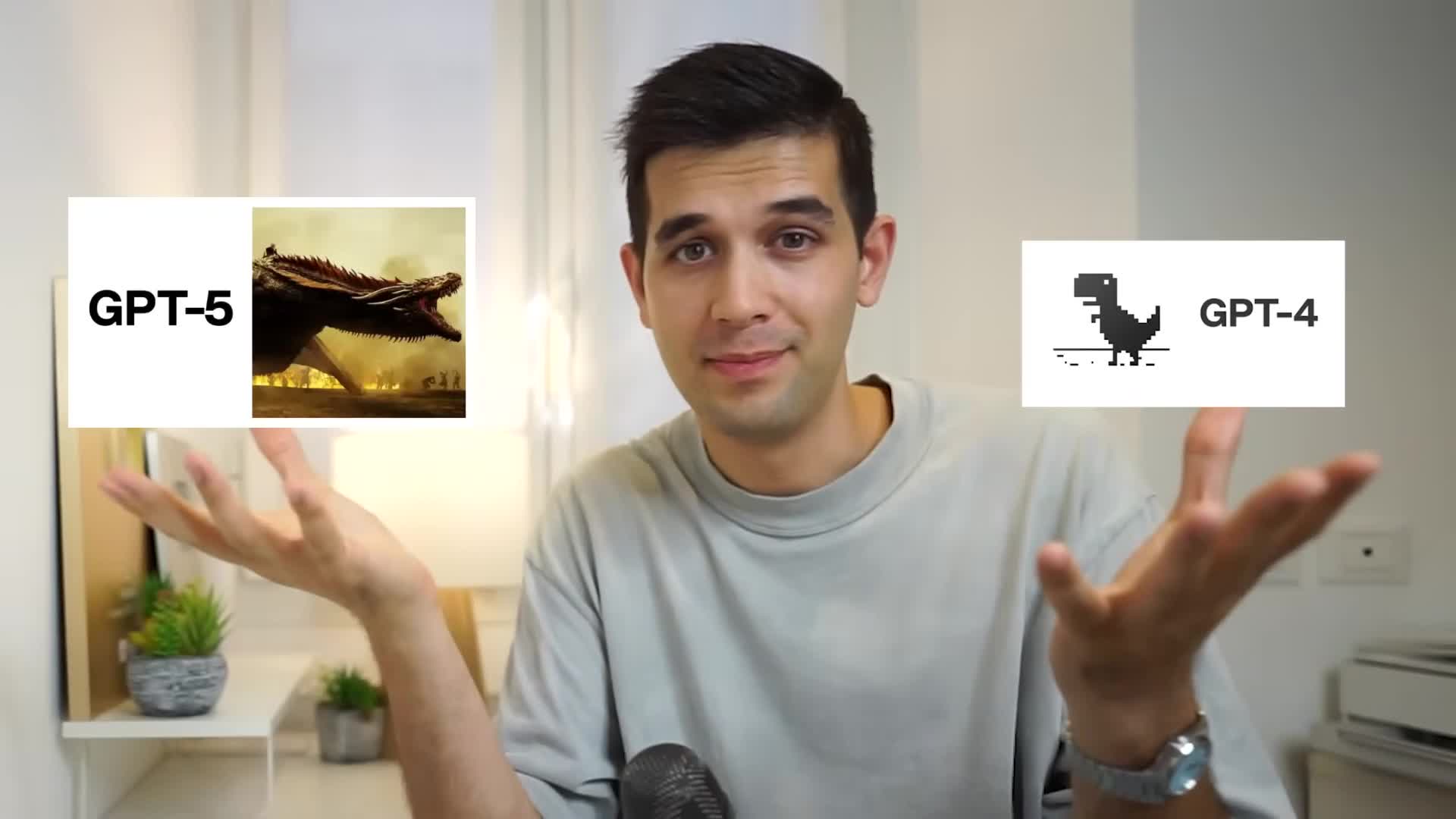
GPT-4, GPT-5.
That is how the internet talks about the latest model of OpenAI, which was released about a week ago.
And Sam Altman said, if GPT-4 was a college student, GPT-5 has a PhD in every possible subject.
So people have been testing GPT-5 in different areas, specifically in coding and tech.
But I've been thinking are we finally at a point where we can say that AI, specifically GPT-5, is a better alternative to books and overall, to traditional learning methods?
Now, this video doesn't have a script.
I only pressed the record button, but I have a fun test designed.
And we're going to do this together for the first time.
Let's get straight to it.
So what's the test?
I have GPT-5 here and I have a very good book here.
Now, this book is Objective Proficiency.
This was published by Cambridge University Press.
So it's one of the best books out there.
This is a very standard method for learning English.
And the book is quite old.
It was published in 2013, which is about 12 years ago.
It's a relatively old book with the latest AI model.
Now, I think a very good way to start the test is by grammar.
We're going to see if AI, well, GPT-5, is a better teacher of grammar or if the book is better.
Let's just start with GPT-5.
I'm going to ask ChatGPT to teach me future tenses I don't have any particular preference.
I can say future simple or future continuous, but overall let's begin the test with a simple prompt.
Teach me future tenses in English.
Okay, great.
I mean, a lot of people have tested this and said that this is much faster in producing a response compared to GPT-4.
But honestly, we don't care about how fast it is.
We are going to use it for learning a language.
So it's not important how fast it is.
It's important how good the explanation is, right?
Let's see.
So great, let's keep it simple and clear.
In English, we can talk about the future in different ways.
Will plus base form of the verb.
We use this for decisions now or future facts.
This is the simple future tense.
I'll call you tomorrow.
Great, I mean, it's amazing.
There is a, how many tenses are there?
Six tenses, six future tenses.
We have future simple, be going to for future plans or things we see are sure to happen.
We have present continuous for future.
This is amazing.
I only asked GPT to teach me about future tenses.
But it already knows, I mean, this is the latest model of OpenAI.
It already knows that present continuous and present simple can be used for future tests.
This is amazing, guys.
I have to tell you honestly in this day and age, if you still have any excuses as to why your grammar is not good or your English is not good, I would have to say that's on you.
That's on you because you have the best resources available.
AI is a huge thing.
So you can see six tenses.
For each tense there is a name of the tense, structure of the tense, how to use the tense and two example sentences.
The good thing about learning with AI is I can choose one of these and ask further questions.
For example, I'm going to choose the first one and click Ask, Chat GPT and say can you give me more examples?
There it is.
Yes, a lot of more.
Oh, great.
Actually, the examples are already categorized.
I haven't used the special prompt.
This is a very simple prompt.
And GPT, understood that I'm trying to learn.
So it already categorized everything for me.
And I think this is brilliant.
It's something that a lot of teachers don't do for their students.
And I think this is huge.
Decisions now.
I'm thirsty.
I'll drink some water.
Amazing.
Future facts.
Winter will start in December.
Promise, offer and request.
This is great, guys.
Fantastic.
You know what else you can do?
This is interactive.
That means if I want to learn more or practice more, I can say, generate some practice questions.
Awesome.
All right.
All right.
Here there are a lot of different questions.
And again I have to say, I have to say I'm surprised because, with a very simple prompt, GPT-5 is acting just like a teacher.
We have gapped texts.
We have multiple choice questions.
We have make your own sentence questions.
This is a three-year practice kind of exercise.
And this is amazing.
Use will to make a promise.
You know what else is great about AI?
If the book tells you to make a sentence, you would make that sentence, but probably you wouldn't be able to talk to the book and say hey book, i made this sentence, is it correct?
But ai will do that for you.
That's huge.
Now let's see how the book approaches the same thing.
We're going to see if the book has a different way of teaching us grammar.
We're going to go to Unit 2 of the book.
I know this book very well because I've been teaching it for quite a while now.
And I used to study this book myself back in 2013.
This was one of the books that really helped me.
I remember that Unit 2 of the, you see, I've studied this book.
Unit two of the book was about the future tenses.
So we're going to see the approach of the book and then we can compare it to ChatGPT, right?
So here's the thing.
The book begins with a couple of images and the speaking task.
The book asks you to look at the photos.
Talk to a partner about these photos and about your expectations.
Then there is a reading task.
And there is a passage of A, B, C, D, four paragraphs.
In the passage, this is what I want you to know guys.
Within the passage there are a lot of sentences in the future tense and with different future tenses.
Future simple.
Be going to future.
Perfect present.
Simple for future.
Present continuous for future.
Then there is a vocabulary part that teaches collocations with traveler and then discuss with a partner.
And finally, we get to aspects of the future, the grammar part.
Now, why did I mention this?
Why did I start from the beginning of the unit and then got to the grammar part?
Why did I not just open the grammar part?
Because in 2023, I attended a course which was called CELTA.
Let me explain what CELTA is.
CELTA is a course designed by Cambridge for teachers of English.
I'm an English teacher and I wanted to become certified by Cambridge University.
So I took the course and I finished the course with grade A.
Past grade A is the highest level of CELTA.
Now, why did I talk about CELTA?
Because in CELTA, one of the things that they tell us as teachers is to not directly jump to the topic of the lesson.
So if the lesson is a grammar lesson or a vocabulary lesson, it is completely wrong to start directly teaching that grammar point.
That's completely wrong.
So what is the right approach?
The right approach is what CELTA and Cambridge describe as lesson shapes.
Now, if the lesson is grammar, the correct approach would be to have a lead-in and then to have a gist task, and then to have a detail task, and then to have a notice-in task and finally present the language, followed by controlled practice and freer practice.
Now, why am I saying this?
I have a point.
Stick to the end of my argument.
This logical structure is absolutely crucial for you, a student of English, to understand how the tense is being used in real context.
If I jump directly to the grammar point and I explain it to you, you might understand it, but it will be hard for you to use it.
That's very important, guys.
But through the lesson shape and through this logical progression of tasks, let's say, you will learn how the grammar point is actually used in context, in what context it's being used, how is it being used, what's the structure, how to use it in sentences, in control practice and in freer practice.
Now, this is exactly what the book has done.
There is a text.
In the text, there are sentences with the future tense.
You see the text.
You see the context.
The context is about traveling.
And then we start with the aspects of the future.
So let's see what the book is saying.
Now, this book has started with a simple explanation.
Then there is a reference to pages 178, which is the lesson on grammar.
And then there are certain exercises.
Controlled practice exercises and freer practice.
What's the difference?
Controlled practice is when you don't produce the entire sentence.
You have a sentence.
You are given two choices and you have to choose one.
This is controlled.
It means you do not have to worry about how to structure the sentence.
Your only concern is to choose one.
Freer practice is like this.
The last exercise on this page says, Using a suitable tense or one of the expressions above, talk to your partner about the following
So a topic is given to you.
You have to decide what tense to choose and then how to say it, how to make the sentence.
You're absolutely free in what you want to say and how you want to say it, but you must use a tense.
Now, here's my idea.
It might not be a popular opinion, but this book, which was designed in 2013, 12 years ago, is much better than AI.
Now, hold on, hold on, let me explain.
Why is it better?
Well, the thing is, you cannot ask the book to give you more exercises, or to produce more exercises or to give you feedback, but the book comes with a structure.
That's what AI doesn't have.
Let's say you open your laptop, you go to ChatGPT, and you say, hey, I want to learn what?
What do you want to learn?
So you randomly would name a grammar point like, I want to learn the past tense.
Why did you say the past?
Why not the future tense?
Why do you want to learn the past tense now?
Why don't you want to learn the modal verbs?
You see, it becomes kind of random.
There is no structure.
You're just choosing one topic randomly, and then you ask GPT to teach you something in that tense.
And then what?
But with the book, starting from unit one, let me show you something.
When you're studying with the book, everything is designed in a specific way.
So, when you start from the first unit And when you go to the end of the book, which is the last unit, you follow a clear path that is specifically designed for you.
You don't have to worry about what grammar I should learn next.
What is better to learn after future perfect?
Well, you don't have to worry about that.
The book has already done that for you in 2013, 12 years ago.
But with AI, it's like somebody who knows everything but has no plan or no schedule.
There's no structure.
That's one of the things which I think is crucial.
Books are designed to teach you English.
AI knows English, but it's not designed to be a teacher.
However, does it mean that we only have to use a book and not AI?
Absolutely not.
As you can see, AI does not have the structure that the book has.
However, AI is interactive.
That means you can ask AI for feedback.
You can ask AI to give you more exercises.
You can ask AI to correct your sentences or, if you haven't understood something very well, you can ask AI to clarify.
The book cannot do that.
However, AI doesn't have the structure of the book.
So I want you to see it like this.
It is not a question of which one is better.
It's not a question of looking for a substitute.
AI is so good that books are now obsolete or books are so good that you shouldn't use AI.
I think the correct way to say this is as compliments rather than substitutes.
AI with traditional learning Together, they unlock a lot of potentials.
You can do a lot of things that you couldn't do in the past.
Now, we talked about grammar.
How about vocabulary?
I think it's exactly the same.
You can ask AI to teach me... Here's the prompt.
Teach me what?
10 collocations about... Collocations about what?
Collocations with the word job.
Before i send the prompt to gpt, i want to tell you one thing.
Why am i asking for this?
Why collocations with job.
That is so random.
As you can see, this request is not following any structure, but let's send it.
Amazing well, fantastic.
10 collocations get a job, look for a job, apply for a job, do a job, quit a job, lose a job, part-time job, full-time job, well-paid job, dream job,
Amazing.
This is fantastic, guys.
This is fantastic.
But again, this is so random.
First of all.
First of all, as a teacher, from what I have learned from Cambridge, you need to follow a lesson shape.
That means you shouldn't jump to the topic of that lesson, the target language.
If the target language is collocations with job, you do not start there.
You start earlier at the lead-in, at the gist task, at the speaking or writing task, and then you have a noticing task in which students would notice the different collocations used, and then you have the presentation of the language, followed by controlled practice and free practice.
There is a structure to that.
Jumping directly to the topic, what's wrong with that?
Well, I tell you what's wrong with that.
You will learn a lot of words, but then you will forget them or you won't be able to use them.
Let me tell you one more thing.
I don't have a dictionary here, but do you have a dictionary at home?
If you don't have the dictionary book, you can certainly use online dictionaries, right?
They're free.
You can go to Cambridge Dictionary.
Let me just show you.
You can go to Cambridge dictionary and that's it.
Yes, beat around the bush.
This is the Cambridge dictionary.
Now, all of the words in the English language are here.
All of the words.
So if I have this, why do I need a teacher?
Why do I need to go to an English school?
Why do I need to register in an online course?
Why do I need a book?
Why do I need AI in order to learn new words?
You have dictionary, don't you?
Here's your dictionary.
All of the words are there.
Do you see where I'm getting at?
In the dictionary, you have everything, all of the words.
But why don't you learn new words from your dictionary?
See, because it's not about memorizing the words, it's about learning how to use the words.
So you need a structure.
And that's what traditional learning provides.
And that's what AI does not provide.
However, again, Do not think in terms of substitution.
Think in terms of how good they are together, not which one is better than the other.
So with a book, I can learn new words.
With AI, I can practice.
I can ask AI to make sentences.
I can write a text and ask AI to correct it for me.
With the book, I cannot do that.
So far, we've covered grammar and vocabulary.
And I think it was obvious that The book is a much better starting point.
But after studying with the book, it's an amazing idea to go to AI, use any AI models GPT-5, what are the other ones, Gemini or any other AI models and to use them as further practice tools.
Oh, yeah.
Damn.
Damn, boy.
Damn, boy.
But... there is something that has been revolutionized by AI.
And that is how to learn and how to practice your productive skills.
Wait, what are productive skills?
You see, in English, we have four main skills.
Reading, writing, speaking, and listening.
These are the four main skills of English and any other languages.
Now, two of these skills are productive.
Two of them are receptive.
What are the receptive skills?
Reading and listening.
What does it mean?
It means you are receiving the information.
In a reading text, in a passage, The text is already there.
Everything is there.
You can see that you don't have to produce anything.
You just read the text.
You extract the information.
With a listening task, the same thing happens.
The audio file is there.
There are some questions.
You listen.
You extract the information.
And then...
You do the tasks.
But the other two skills, speaking and writing, these are productive skills.
That means nothing is produced for you.
You have to produce everything yourself.
In a writing task, you have to write the entire text yourself.
In a speaking task, you have to speak.
There is nothing given to you.
Maybe a cue card, maybe a question, maybe a riddle, but you have to produce everything yourself.
Here's the thing.
Books and, generally speaking, traditional learning methods are amazing for receptive tasks, for reading and for listening.
However, AI has revolutionized English learning.
For productive tasks, speaking and writing.
Ordinarily, if you want someone to give you feedback on your spoken or written English, you need to pay and have a teacher.
You need to join an institute.
You need to get a one-to-one class with a teacher.
You need to pay money.
But with AI, you don't need to do that.
That's something that books cannot do, but AI can.
I can simply go to ChatGPT.
Let's do this together.
And I want to practice my writing skill.
About the same thing.
Here's the beauty of AI.
First, I started by the future tenses.
Then I continued with collocations with job.
I want to mix the two in a writing task.
So here's a simple prompt.
Use the future tenses plus the collocations with job. and give me a topic to write a text about.
Sorry for the spelling mistake, but it doesn't matter, because I can already understand what you want to say.
So here are a few suggestions.
Topic four, your writing.
My future career plans.
You see, the future tense with the collocations of job, my future career plans.
And now it's amazing.
I mean, there are a few ideas here, which, well, I don't want to look at.
Your task.
Here's your task.
Write a short text eight to 10 sentences on my future career plans, using at least five different future tenses and some of the job collocations above.
This is fantastic.
You can write a text and you can ask AI to give you feedback.
This is something that a book cannot do.
This is something that would be really costly if you wanted to do this with a teacher.
But with AI, you can do this for free.
Now, this is for your writing task.
How about speaking?
Well, AI can also help you with that.
However, usually you would need to have a paid plan of.
I think you need to have the paid plan of GPT.
I read somewhere that with GPT-5, the advanced voice mode is now for free for everyone.
I'm not sure.
Go ahead and test it.
I have the pro version of ChatGPT and I'm going to use that pro version to practice speaking, right?
All right, I'm going to use the pro version of ChatGPT and we're going to speak with it.
Let me open GPT here.
There it is.
Okay, let's start.
We go to the advanced mode.
Hello, I am a student and I want to practice speaking English with you.
Can you help me?
Absolutely.
I'd be happy to help you practice speaking English.
Just let me know what you like to talk about or if you have any specific topics in mind, and we can start chatting.
Yes, my lesson is about the future tenses and also collocations with job.
Ask me some questions.
Of course.
Let's practice those together.
I'll ask you a few questions using future tenses and those job collocations.
This is fantastic.
Oh my God, I interrupted it.
But as you can see, this is huge.
This has revolutionized language learning.
I think that's enough for this video.
Let me summarize everything.
I think AI is amazing, but it's not a great tool to start with.
It's an amazing tool to practice with.
But if you want real learning, go with traditional learning methods.
Go to a classroom, register in an online course, go to a language institute.
Maybe you have something nearby and you can go there and you can register and you can attend lessons in person.
Or if you know a teacher, apart from me, to learn English.
You can register in their courses, you can register in their academy or you can ask for a one-to-one lesson.
Alternatively, you can self-study at home using course books.
But after you do this, make sure you open ChatGPT or any other AI model and you practice with it and you ask for feedback.
Make sure you practice writing and speaking with AI.
Make sure you don't see AI as a replacement for traditional learning.
But you see it as a compliment.
You see it as something that can make it even better.
Now, this was the first video of a series of videos I'm going to make on the topic of the uses of AI and the latest technology in learning a language, specifically English.
I'm going to make a new playlist.
I'm going to make a lot of more interesting, exciting and mind-blowing lessons for you guys.
So if you don't want to miss them, make sure you subscribe to my channel and turn on notifications.
Also, if you enjoyed this lesson, don't forget to give it a thumbs up and let me know what you think about AI and how you have used it in the past, and share your experiences in the comment section down below.
See ya.