So I think now we are just truly seeing this unlock where people who were like really close to problem domain expert and but have been blocked by, you know, technology barrier to sort of really express themselves, are using emergent to sort of build these things out.
There's just so much focus on AI is going to replace jobs, knowledge work is going away.
What's that going to mean for employment and civil unrest?
But no one's really talking about the fact that actually, if you have some agency of interest and you want to start your own business and have autonomy over your life, you are empowering that at scale.
Welcome back to another episode of the Lycone.
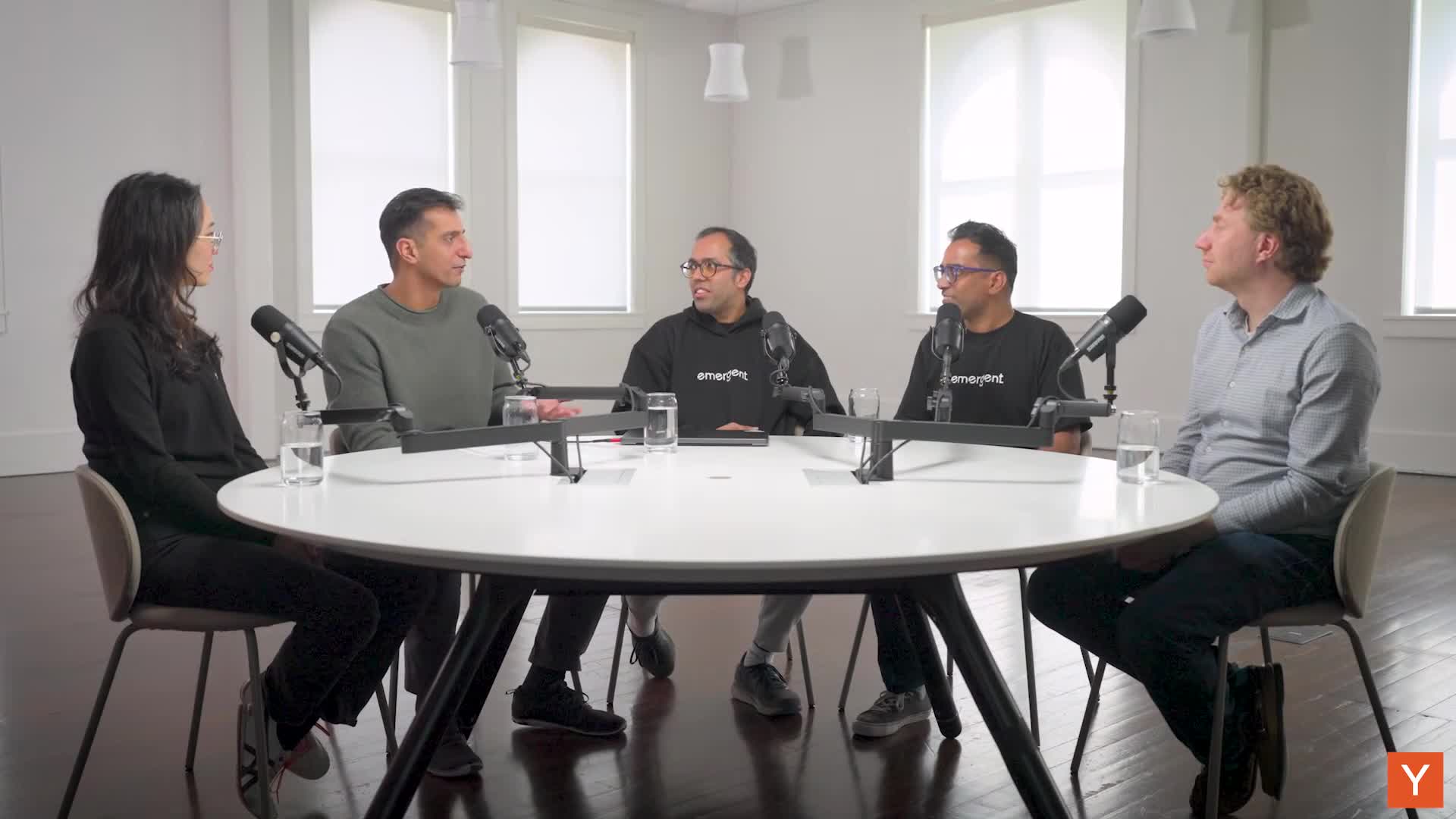
Unfortunately, Gary got called to jury duty and can't be here with us today, but we are really excited to be joined by Mukund and Madhav Jha.
They're both twin brothers and founders of Emergent. which went through YC in summer 2024.
Emergent's a platform that lets anyone build and ship production-ready software using AI agents.
You guys are actually one of the fastest growing companies I believe YC's ever funded.
I mean, the statistics you were telling us were mind blowing.
You have, in eight months since launch, 7 million apps have been built with Emergent.
Walk us through This incredible growth you're seeing.
Actually, when did that hit a real inflection point?
And how did that feel for you guys?
So we both are twin brothers.
We actually started programming when we were age 12.
Both of us came to US to do our PhDs.
I dropped out of the PhD program, joined Google, and Maddy went on to...
I was at Zenefits, then went on to start the deep learning team at Amazon.
And we've been meaning to do a startup together for a long time.
And before this I was running a startup in India called Dunzo, which was a hyperlocal quick commerce company.
And Dunzo was a big company actually, right?
Yeah, it was really big.
And we are almost a verb in India.
So when people ship things, they say, Dunzo it.
And I was managing a really large team of 300 engineers.
When, you know and we have been sort of watching the deep learning field for a while and we knew an inflection point is coming
One of the things that I observed when I was running this large engineering team was that software testing was the biggest bottleneck in shipping fast.
So when we started looking at, you know, what we want to build in AI, that was the first idea.
What year was this?
This was 23.
And yeah and, and so when we applied to yc, like we applied with this idea of automating software testing uh, that was the first idea.
In fact, we went to a lot of vcs with this idea.
They thought it was too crazy uh, you know, and and now looking back it almost looks uh funny.
And so we applied to yc with this idea and um, and when we were building this testing agents, we uh realized that if you can solve for verification, which is essentially you know, you can solve the testing part uh, you can actually automate all the software engineering.
That was sort of our key insight that, like you know, verification is the loop which sort of keeps agent running for a longer period of time.
And that's when we pivoted to looking at general coding agent as a space.
And we started building general coding agent.
And this takes us into 2024.
Yeah, tell us what the landscape looked like.
How big was Lovable at this point?
I mean, nobody had started.
Lovable had not started.
I think Cursor was just getting started and very, very early.
I think Devon had just come out, so really, really early.
And we looked at this benchmark called SweeBench, which is essentially a benchmark.
Now it's saturated, but at that point of time that was the benchmark where all of the coding agents were getting measured on.
And we took on this challenge of becoming number one on that benchmark.
And we sort of packed ourselves in a room, four of us, and said okay, let's just look at this benchmark.
How do we crack it?
That sort of set the foundation for Emergent.
And we built, you know, SOTA coding agents, which became world number one on SweetBench, you know, in two months of time.
And that was the time when we sort of discovered all of the fundamental truths about building with LLM, building with agents.
Your intended users at this point were presumably engineers.
Yeah, at that point we were like purely just a research company, just building coding agents.
We were not thinking about a product.
There was a time when we sort of invented the multi-agent system, we invented memory.
We invented like how do we do agent-to-agent communication?
How do you scale up test time compute?
A lot of those things which were sort of coming out like we would discover something and we'll see three months later something come out in a paper.
And that sort of set the foundation for us to.
So we were like cloud code. for Cloud Code was a thing.
A bunch of the paradigms like multi-agent orchestration, how do you use like different routings?
A lot of those things we sort of discovered.
I definitely want to come back to that.
I'm curious at this point in the story that when did you sort of pivot into becoming a tool for non-technical users?
Yeah, so we actually like, once we had this coding agent uh, we actually went the enterprise route.
That was the common wisdom at that point that hey like, go to enterprise, build for enterprise.
And we spent like two, three months trying to uh, you know, make our agents work within enterprise.
We found that it was too slow and at the same time, we were internally started using emergence platform to build internal tools, internal software.
And at that point, you know, we saw, like lovable is growing, like crazy, bolt was going like crazy uh.
So we thought hey, why don't we have this really strong coding agent?
How do we sort of package it and and and bring it out in the world?
And we launched a very small beta pilot almost in June last year, 2025.
And that really took off.
And since then, we've been just focused on solving problems for non-consumers.
We, in fact, taught a lot of technical people to use us.
But today, 80 of users who are on the platform are non-technical users with zero programming knowledge.
And they're building apps that run real businesses on top of today.
So it's almost been- And they're based all around the world, right?
Like how many countries- Yeah, yeah.
So they're all global audience, 80%.
70, 80% are in US, Europe, 190 countries right now.
Something that we have talked a bunch about at YC internally is just how does first mover advantage versus second mover advantage play out in the AI world?
Certainly something that we've noticed, like if we look at some of our companies, like Legora entered the legal AI space after Harvey but is like, growing incredibly fast.
So there was clearly it wasn't maybe as big of a moat around being a first mover um, as you traditionally think there is in software.
When you guys made that sort of the pivot, or the slight change in direction into non-technical users at a time where lovable and bolt are growing really, really quickly, how did you think about that?
There are like two, three different, different threads.
I would want to pull one.
Essentially is that i think the, the model uh, every new model generation actually is presenting a new opportunity of looking at the world like, for example, when we started GPT-4 was the first one that we started looking at.
And then the biggest problem that everybody was trying to solve was JSON parsing like a structured output format.
And we thought, okay, the next model is going to solve for it.
Let's not spend time on that.
And I think with every new model, what's happening is that you need to start re-imagining the world.
For example, Opus is a different class of model right now.
It's going to enable extremely long horizon task.
It's gonna enable multiple agents coordinating together.
And so I think one of the advantages of starting second is that you can actually one learn from what is not working for the current competition.
And also, I think you fundamentally start from a different starting point, where your approach of the world is very different.
Your imagination is really big.
And when we were starting Emergent, we realized that a lot of the users that were going to found these apps they wanted to actually really build an app that works right, and most of these were actually like really, really optimized for front-end prototyping at that point.
So we started fundamentally reimagining that okay, what would world look like if you could actually ship things to production?
And our key insight was that to automate all of software engineering, you will have to build a platform that replicates what best engineering team do, like code reviews, automated testing debugging deployment security, hosting.
So we reimagined the entire platform from ground up, saying what would an end-to-end platform look like?
And the real user need was actually to ship the product, not not just the front-end prototyping.
I think.
Second thing is like how do you sort of get the distribution?
Because you're coming from behind, right?
So even if your product is really strong uh, and fundamentally i think you'll have to enter the market with a really, really strong product which is, you know, head and shoulder above what what exists in the market today for people to take notice.
We were very confident about the product and so a lot of our focus in the early days, once we launched, was on how do we rapidly scale up distribution.
We built out a large influencer network, and that was our initial starting point for us.
We used TikTok, Instagram and partnered with a bunch of influencers to really spread the word out and that sort of kickstarted the whole thing for us.
To me, so building the influencer marketing engine is like, it's like tactics to land grab.
Like, were you also thinking about just focusing on personas and specific sub types of users you wanted to go after that weren't like, either weren't being targeted by Levelball or others, or Emergent was a better fit for them?
I mean, our thesis was that there are a lot of users who would want to build serious applications, right.
And that was our sort of target audience.
And a lot of our marketing, a lot of our initial messaging was around that.
Like, hey, come and ship real software.
What we did was a little bit broad-based marketing.
But users that were coming to the platform that we would convert were users who actually wanted to ship a real app on the platform.
And was that in the messaging then?
It was in the messaging, yeah.
So we would say, hey, come and build real apps.
We would also use the common errors that you would see on other platforms.
You know, like, hey, don't face this error on Emergent.
It seems like a key insight for you.
Basically, you went very hardcore in terms of being maximalist in engineering.
From your experience, having run large engineering teams of 300 engineers, having worked on deep learning teams at Amazon, you really knew how to architect the systems.
Can you maybe share a bit how you built it?
One of the cons of all these other big products like Level or Bolt is just that it's difficult to get those into a fully usable
You can get to a product type very quickly.
But yours, you went zero to 100% very quickly.
And that takes finesse.
It's almost like that 20% gets 80%. like the Pareto principle, but you did more than that.
The last 20% of that engineering to build production was a lot of work.
And that's a lot.
SHYAM GOLLAKOTA- Yeah.
And I think the last mile that you mentioned is always what people neglect.
That, hey, you need to make sure that not only app gets built, it also gets deployed.
And this is one of the conscious reasons why we chose to build our own infra on which the agent is running.
So we provide cloud sandboxes.
We don't outsource it to some third party sandbox provider, which was also pretty popular at that time.
So we built our own Kubernetes tech stack from ground up. the container tech stack.
And one of the insights here is that if you give your agents the same infra during the build time and the same infra during the deploy time, then during this deployment phase you don't encounter those many problems, right?
And the fact that we have our own infra also allows us to give rapid feedback to the agent.
So your agent is only as good as the feedback that you provide.
So we built this infra and agent co-build together from day one.
And to your point, because we focused on building ship-ready apps which are production-ready, which comes with backend and frontend and everything.
The tech stack we chose was also pretty unique to us.
We have a Python backend server.
We have a React frontend server.
Most people would typically go with a much more node-focused, node-heavy tech stack, and this like server client architecture, where you can have like, background jobs if you want to have background cues.
So we knew that you know users who would, who would use this app.
Their ambitions are going to go bigger and bigger, right?
Hey, i want to run a job which can like, do this asynchronous video processing, you know, and they're going to prompt it and we wanted to support it from day one right, and so It's the same tech stack on which emergent is built.
Is what we expose to our end users, is what we expose to our agents, right?
On the agent side, we were very early on the multi-agent architecture.
So we knew that you want to be very frugal about your context management.
So what you do is hey, let the main agent, the driving agent, handle the main routine, but any delegated tasks that you want to delegate, you delegate to a sub-agent, be it like testing, be it like hey, i want to do a design uh search.
Or i want to do, like you know, integration search, like how do i integrate this unique api.
And along the way, when we were like finding or doing all of this, we were able to figure out okay, all the trajectories that we are generating.
We can kind of aggregate over time and sort of build in a long-term memory for the agent, which is very unique in the sense that your agent learns not just from your own session, it learns across the sessions.
This is something I would say is one variant of continual learning that people are interested in now.
You would have noticed that people are interested in skills.
People create skills.
And there's a new benchmark called Skills Bench, which shows agent with skills outperform agent without skills.
And interestingly, those skills cannot be generated by agents themselves.
If you generate those skills by agents, they don't match up to the performance.
So we were able to do it in a way where the skills get generated based on previous trajectories.
And we run it through a CI-CD process and then add it to the long-term memory.
All of that compounds for us.
If your agent was struggling to do a calendar integration three weeks ago, today it is no longer struggling, thanks to the previous session where it was able to make it happen.
So it's fascinating.
So it learns on its own.
Because I think one of the challenges of all these vibe coding app platforms is, at some point the applications would get so complex that if you build it very simply, you would run out of the context window for all the models, because that seemed to be the bottleneck.
And I think you guys architected your way out.
So you kind of built a lot of what the state of their art is now, but way back a year before, our coding agent is so powerful that we basically internally use it as a replacement for cloud code as developers, right.
So we, we are so proud of that and but yet we don't want to expose that sort of you know powered tool to our end non-technical user.
And so, even though we have this VS code editor, we kind of hide it, because what we've noticed is that non-technical users they even get panicked as soon as they see a diff.
We had a fairly technical PM in our team And he doesn't like JSON.
He's like, no, don't show me.
I get intimidated.
So, building that user empathy where you have that user empathy, and building that agent empathy, you also have to empathize with your agents.
What is agent feeling like?
I mean internally.
I have a term called agent experience that we measure.
How is agent's experience on the platform?
Actually a really important point I think people don't realize is you guys actually.
You actually started out essentially as sort of Devon cursor in like the actual, like coding agent world for engineers.
You just made the choice to package it up for non-technical users.
Absolutely.
So you're sort of like moving almost in the opposite direction from like a lover board.
Like you have like the power, you have all of the actual like power.
You just need to simplify the user experience.
Whereas they like sort of have like start with the user experience and they're going to have to develop the power over time.
Right.
And I think fundamentally it's like, unless you start from, you know a starting point which which sort of solves all of these problems along the line, the whole software development lifecycle, it's actually really hard to come from the other side and solve these problems because you'll make some architectural choices which are very hard to reverse.
Do you have any more?
I'm really curious like any more examples of where sort of, as you were engineering the system, you just trusted in the model.
Like you mentioned JSON parsing, but was there anything else where you're like let's not invest time in that because like, Opus 45 will solve it?
Some of them has been, for example, library definition, some of the integrations that we have built.
We think that the next models are solving for ads.
Similarly, how do you generate unit tests?
Some of those things that we actually would have heavily prompted before.
And the other thing that we are very conscious of is that how do we give more and more autonomy to the models as the next generations come out?
And the more autonomy you're able to give to the models, the better they perform.
Initially, our harness was very strict, and we would tighten it up.
And slowly.
What we were observing is that, as these models are getting larger and larger, more efficient.
The more control you give to the model, the sooner making, the better the harness gets.
If we extrapolate that out or sort of like really far out, are you worried about where that sort of leaves you as a company versus the mod, like the models themselves, and the models get more powerful.
Yeah, I think there is this underlying current right now, right.
In the industry that that Hey like is is uh, you know, like and probably going to eat everybody up.
Yeah, I mean, our view is that I think the coding aspect is only 20% of the job.
I think taking an app to production is really, really hard.
And I think what matters is how closely are you working with the user?
How well do you understand their needs?
And I think, as the models are going to get more and more capable, I think the human desire is also continuously growing at the same rate.
So I think people are going to want to build more complex apps on the platform.
The other thing is that, at least with our harness, we're able to extract 23 more on top of these models.
And essentially, we can use multiple foundation models together to sort of extract more.
And I think we'll have to keep delivering more and more things to our users.
For example, now we're thinking about a lot of our users who have built the app, now want to help with distribution, now want help with growth, now want help with how do you manage users and things like that.
And I think for us, the spectrum keeps growing on that side.
I agree with it.
I mean there's another graph that I shared recently is just like the number of software engineering positions available is actually going up, right.
And I feel like at least internally at YC, we're experiencing this.
It's like the more powerful The tools get, the more ideas you get and the more work you want to do.
And it just feels like everyone here is working like more hours doing more stuff.
And it's just like the rate of like software that you're expected to ship per week just keeps going up and up and up.
It's a hedonistic adaptation to, you know, like, Hey, Oh, this is more powerful.
Now I can do more work.
Yeah.
It is really at Javan's paradox at play.
And I think there's a lot of concerns like, oh, the software engineering jobs will be gone.
I don't think that's the case.
I mean, based on everything that you're telling us and what we experience, I mean I think we are in an expanding market.
We are letting non-developers not be developers.
I think that market is expanding.
We also are internally seeing the roles sort of combining.
So a PM, a designer, engineer, a single person is doing work of all three together.
So we have a PM who's white coding internally.
And recently we are seeing this internally right now, where a lot of the work that was done by five, six people's team can now be just done by a single engineer or a single PM.
YC's next batch is now taking applications.
Got a startup in you?
Apply at ycombinator.com slash apply.
It's never too early, and filling out the app will level up your idea.
Okay, back to the video.
Could we see a demo of Emergent?
Oh, yeah, sure.
Yeah, so this is how what emergent interface looks like.
And I'm gonna like put a prompt where like, because we were coming for this podcast, we thought, like you know, there should be an app which lets you practice.
You know podcast questions, or maybe you're going to a job interview and you want to practice questions, right?
So you can build a full stack app on Emergent.
You can build a mobile app.
Our prompt engine is smart enough that once you give it a prompt, it will figure out that this is talking about a mobile app.
So it'll figure out like, hey, the right agent to use is a mobile app builder, right?
So even though you selected the wrong tab, it's just like, eh, I got you.
SHYAM GOLLAKOTA- Yeah, the behind-the-scenes auto, yeah, I got you, right?
So while this is running, let me quickly also show you a few user apps.
So this is by somebody based out of Illinois.
He has a business of audio-video setup that they do manually.
So basically, whatever this kind of like intake form they would have taken through spreadsheet and other calls, they basically build this out without any coding background knowledge, right?
Like, hey, this is the kind of AV setup I want.
So you go and you build your room and then you get it's a lead gen sort of a form, but this is a fairly full stack app.
One thing I noticed about that is like the design is really good.
Like the icons, like it just like, it looks like a well-designed app.
So we have actually spent a lot of time on making sure design is actually good.
So earlier, there used to be a big trade-off between design and functionality.
If you were optimizing for design, your functionality would not be that strong.
And so we had to figure out how do we share the context in a way where design also gets better.
There's another sort of person based out of Norway.
He sold his previous business to a PE and realized how much lawyers have to struggle with spreadsheets and other things.
So he built a CRM for lawyers.
He describes himself as like business developer.
I like the word he used, like I'm a business developer.
He doesn't have a programming background.
So a lot of CRM related apps, we are seeing small businesses.
It's your second monetization avenue, right?
And so like, one of the unique things to Emergent is that, before agent goes off to build things, it asks you for some clarification, because agent wants to make sure that it understood your requirements properly.
And another thing is that non-technical users probably don't know the concept of API key.
How do I get an OpenAI API key?
So in this particular case, I can just say, hey, use emergent LLM key.
So you don't have to worry about getting API key from third party.
This feels like a good example of what you were saying.
Because this is sort of like the ask user question skill in code, but you just like abstract that away.
But you just like build into the experience for someone who had no idea about Absolutely.
I can be very casual here.
I can say, hey, for the first one, use emergent API key, rest assume good defaults, and then go.
This is the first time I hand off the agent.
And at this point, I can just close my laptop.
We also have a mobile app so you can, on the go, keep trying to prompt agent if agent requires an additional thing.
Once it's done, you see a preview of your app.
So here, for example, in this case, I can practice what is my origin story.
I can record what my origin story is, and I can keep going to various questions eventually.
This is a podcast preparation app yeah, and then you can go ahead and revisit what answers you gave uh to your uh app, and so what we have noticed is that a lot of personal apps people use, people build mobile apps, but a lot of business apps, they would go and build a web app, right.
So uh, that's generally the trend we are seeing.
The only other thing i wanted to show was Uh, this is.
This is an actual Asana clone that our team built, like one of our QA engineers built internally.
And, uh, so this is actual real emergent data.
I'm curious what prompted that?
Like was there some?
Was there some feature that Asana was lacking or something it wasn't doing that made them say Hey, we should just build our own.
Yeah, it kind of started off as a QA engineer's curiosity.
His first prompt, I looked at his all jobs, the first prompt was clone Jira.
And then he just kept going with that.
And I think the other thing is we do things a little bit differently.
So for example, we ship three times a day, morning, evening, night.
So we kind of built it very customized to the way we do things.
We have a QA involvement in many, many ways.
And definitely when we were using Asana, it was very Like even to customize it to, to make it to your um work style was not easy.
And, and we, we are, we are also saving like, you know, like 3000, $4,000 a month in subscription.
This is really the world of personal software.
Yeah.
Has anybody actually edited the code for this or it's just 100% built with emergent?
It's 100% built with emergent.
And the good thing is that if I want to add a feature, I have to just go to that project and just add a feature and it just starts building.
It's probably useful for you guys to dog food the platform this way, because this is probably at the edge of the most complex apps people have built with Emergent, so it allows you to test what happens when people get to a very complex app like this.
In fact, a lot of the teams internally are now building apps using Emergent internally.
So we have a marketing team built out of complete CRM, completely built on Emergent.
Our customer support team is building customer support software, completely built on Emergent.
And the power is that these are people who are closest to the problem, who understand the problem really well and are able to now build these apps.
And the speed at which we are able to ship these internal apps is crazy.
How far down does it go though?
I'm curious even within the company, do you have people who want their separate versions of your internal Asana?
So currently, everybody in the company is using this one tool right now.
And it is being built collaboratively.
So a PM can give a feature, a QA can give a feature, somebody from our HR team can give a feature.
To sort of build that out right now.
How do you think this version control, feature flagging, all this stuff develops in a world where anyone could just write a couple of sentences to update the software they're using?
Yeah.
So there is a testing phase.
There's a deployment phase.
So we have different versions maintained.
And there is a primary owner of the software who actually manages this right now.
And so it involves somebody will make a feature request uh somebody will sort of build that out as the agent will build it out and then like once it's accepted then it'll go to the release it's not managed to get though it's like your own workflow thing So you can connect GitHub if you want to.
We internally connect GitHub for our projects.
And non-technical developers outside of Emergent, they actually call GitHub GitHub.
So they have very limited knowledge of GitHub.
And so we take care of versioning on our side, even if they don't connect GitHub.
Talking about how you run your team, the way you hire must be very different.
I mean, you're a very lean and small team.
How do you hire for engineering?
Yeah, so we actually, from day one, have been very conscious of the kind of team that we want to build.
And essentially like we index on two things.
One is problem solving, like how good are you at problem solving?
And second is ownership.
We think that people who can really take ownership, we index on that.
And a lot of our early hires were people, we were really obsessed with top 100 IT rankers.
So we had this program going on where I told our team that, hey, we must hire top 100 IT rankers.
Right now, I think we have IT Rank 1, IT Rank 12, all of those people working with us.
And a lot of the initials that also came from Danzo, because I was able to build a really really good team.
We were able to get some initial folks from that.
The focus that we have is essentially one or two people doing work of what a company would be doing.
For example, our deployment, which almost mirrors what Vercel would look like, is done by two people.
Our memory, where you have multiple startups solving for memory, is just built by one person.
So I think we give way more responsibility to people.
And I think people are generally attracted towards harder problems that they want to solve.
Where is your team located?
So most of the team right now is in Bangalore, in India office.
We have a very small office in SF, like three to five people here.
And you guys yourselves, you're kind of like split across both countries.
Can you maybe just explain how the setup works?
Yeah, so I mean, I live here in SF.
I've been in like, you know, Bay Area for like last 10 years.
I split half my time in SF, half my time in Bangalore, constantly jet lagged.
I think you guys are probably the most successful AI company.
It's obviously came from like it's an Indian company, but that's got like significant presence in India.
Why is that mean?
I think it's like when i went back to india uh, you know, after google, and i always had this thought that why is there no google or facebook from india?
Right so, like from day zero, i was thinking, you know, even though i started anzo, it was an india focused company at that time, and when i was starting uh, the second company, i always thought like hey, there has to be, you know, like we have so much talent, we have, you know, a lot of capital available, everything is available in india.
Like, why are people not building global, truly global tech first companies from India?
And and that was the ambition that that we started with and, in my opinion, I think a lot of it is with, you know, like just your ambition, like if you, if you just dream big, if you're able to sort of really really, um think uh, global from day zero.
I think now, because the internet is sort of fully penetrated people, people can actually get understanding knowledge from everywhere.
I think every single country has an opportunity to build for global audience.
And if you have that sort of mindset, that ambition, I think we'll see a lot more companies coming out of India doing the same.
I'm curious to hear what it's actually like sort of on the ground, running this sort of like split country company where the team is mostly in India but the product is overwhelmingly used in the U?
S and Eastern Europe.
It's not a private Indian market at all.
What is it like running this company?
How would it be different if you had built a normal Silicon Valley style company that was all based here?
Internally, we have like really really set really high standards, like as a as a global sort of product.
I mean both in hiring, both in like the way we sort of develop product uh, and i think us spending sort of time here also also helps.
Like one of the things that we do really religiously is everybody talks to a customer once a week, twice a week, like everyone in the entire company.
Right, they talk to a customer, everybody does customer support.
So like we were like a really really small engineering team, like 12 people team, and one person was always on call for customer support.
It was really hard decision for us because you know you're a really small team, you need to ship really fast and then move like one of your best engineers out to do customer support was really hard.
But i think that really really helped us build the customer empathy from day zero And I think, given that a lot of our distribution happens online, the teams are able to learn from digital things and build for it.
But I think us building that customer empathy from day zero, talking to our users, really helped us bridge the gap in terms of what our users want today.
It's funny because when we launched my first five days, I was just glued to a desk doing customer service support only.
And most of the customer requests were coming in a different language, like French German, because a lot of these are global.
And thanks to AI, we were able to understand that, reply to that.
And I think that is also helping us bridge the gap there.
And we are hiring here in SF.
So if anybody's interested in joining in various positions like research across the board, like backend engineers, frontend engineers we are hiring here in SF and in Bangalore.
I'd love to go back to what we were talking about regarding personalized software.
What do you think the implications are for SaaS in general?
The provocative question is, is SaaS dead now?
I mean, you guys essentially killed Asana for yourselves.
Is that bad for Asana and other SaaS companies?
I definitely think that the current way SaaS is existing today needs to change.
I feel there are two massive headwinds.
One is more and more of these SaaS workflows are going to get consumed by an agent.
Unless your SaaS company pivots into an agent-first company, I think that's going to be hard to survive.
And second headwind is obviously people would want more and more customized software which they can build on Emergent, just like we built our own DoIt project management tool.
And we are seeing a lot of these people building these internal tools, the software on platform like ours.
And I feel the nature of software itself is changing.
I think a lot more software will become agentic in nature.
A lot of people who are building on emergent today, roughly 20% of them are actually agentic apps.
So people are actually embedding our own emergent agent inside those apps to power a bunch of the workflows.
That sounds really cool and an interesting example that people do.
Yeah, I mean like the app that Maddy was just showing you know, the CRM for lawyers.
That is an agent tech app where you know an agent can take a workflow and run through the process.
The software itself is now morphing into, you know, agent tech.
Like a lot of people just want to build agents that can actually just do a lot more of the work on its own.
Where do you think this goes as agent's horizon for tasks gets longer and longer?
I mean, one of the meter chart is one of the ones that was very shocking recently.
Yeah, I think that's the chart of the year, I would say, like the meter's exponential growth.
And 4.5 was at, I think, four hours, and 4.6 is at 10 hours.
And we are internally now experimenting with agent swarms, where agents can actually work for a much longer horizon and multiple agents can sort of coordinate on a single task.
At least those are like pretty, pretty exciting.
You know, we'll see.
I think by the end of the year you'll have, you know, agents which are running 24 hours and like maybe hundreds of agents collaborating on the single task.
And that's where we sort of see the future going right now.
How are you building for that?
People's admissions are increasing.
We want to give agents more autonomy.
The main thing is to make sure that the trajectory doesn't get derailed.
You always want to have an overseeing agent.
Let's say, a few agents are collaborating and there is an overseeing agent as well which is parallelly monitoring the overall task.
So we are experimenting with many different architectures.
Something even as simple as just, you would have heard of this Ralph Wiggum loop kind of phenomena.
So the idea that, hey, just keep poking the agent, hey, continue until it's done.
And all of that is only possible if there is a good verification loop.
So it comes back to, hey, Are you able to give autonomous verification feedback to the agent?
Was the job done?
So a lot of our work internally right now is in fact still going on on building best verifiers.
There we are actually doing some custom fine tuning as well.
So we are very careful about not directly competing with the models, in the sense that we don't want to build an Opus 45 alternative right away, but we do want to augment it through our custom, fine-tuned verification layers.
So some of the fun stuff on the research side we are doing is on that side.
How do you think about some movement in the opposite direction?
I mean we talked about sort of like the models themselves maybe getting more powerful, and what does that mean for everyone building on top of them?
But how about?
At least some of the model companies are explicitly trying to build applications and own the application layer themselves.
If one of those companies decides, like you know, cloud code for non-technical users is a really valuable application to build, what implications does that have for startups in general?
Eventually, I think like, do you understand your customer's requirement really, really well?
Are you building closer to them?
I think all of those fundamentals of like startup building remains the same.
And I think you know like, for us like, As long as we're focused on really really understanding our users need really really best, I think we'll compete on the product side.
Do you think about all the model companies as the same or the differences between them?
If you look at the models themselves, they're very different.
For example, Opus is obviously a workhorse.
Codex is really good in back-end debugging.
Gemini is really good in front-end.
So I think all of these models have their own behaviors.
A good thing for us is that we can actually utilize these spikes that models have to provide the best experience to the user.
And I think eventually, at least my worldview is that most of these models are going to get really, really commoditized, where all of these models will have similar behaviors.
They'll have price competitiveness between them.
And you can already see open source is maybe three to six months behind.
And there's enough optionality for us to really really build the layer on top where We really meet the user where they are and sort of support them in sort of their journey.
Who understands the customer needs really, really well and is able to build for that is going to sort of win the space.
You just built 7 million apps with Emergent.
What are all these apps?
Who are the users and what surprised you seeing what people do with it?
The users who are coming to platform for us are generally people who want to build a series of apps, people who really have a business use case that they want to automate or they have a business idea that they want to launch.
Primary users who are coming to us are small, medium business owners.
They're running their business today on email, WhatsApp spreadsheet and would have gone to a dev shop to sort of build a custom software to run automate their business.
They're coming to us and if you look at the price point that you know we are bringing down, it would have costed you like five hundred thousand dollars to build the software.
Now you can build it for five thousand dollars completely on your own.
And that is the kind of, you know, like unlock that we are sort of bringing to the world right now.
Second, for example, this morning I was talking to user Christy.
She's based out of Alaska and she built this.
She's a clinical psychologist.
She's also a sports coach for equestrian the horse riding and she wanted to marry these two fields.
Like you know, like that, she has a lot of insights on psychology side.
She's a lot of insight on horse riding site.
And she said, she looked around everywhere to find an app that does that.
And she couldn't find one.
So she wanted to build one.
She actually went to a dev shop and she went to a dev shop in Nova Scotia and tried to find somebody who can build it.
They were charging her a bomb.
So she discovered Emergent, started building out and she just launched her app a couple of weeks back.
It's called Equimind on App Store.
It actually marries her insights in psychology and into this sports coaching.
She has hundreds of users right now using the platform.
I think that is a lot that we're trying to build.
People who would have been, who have had an idea for a long time, people who are really a domain expert very close to a problem, can now go and build things up.
We also have a lot of solopreneurs building on the platform who would have had to go and hire a technical CTO to build these apps.
And the success that we are seeing on the platform is recently somebody pinged me that hey, this company has raised 4 million on an ad that was built on emergent.
And I need to get their permission to share more, but yeah.
And so I think now we are just truly seeing this unlock where people who were like really close to problem domain expert but have been blocked by technology barrier to sort of really express themselves, are like using emergent to sort of build these things out.
And also, one thing these people tell us that it's not just about money.
Like, hey, I can give money to the dev shop.
But a lot get lost in the translation when you're trying to express your idea through a developer.
And they say, hey, I know what I want to build.
If I could just say it out loud myself, I would do a better job.
And so the norwegian person i was talking about, like he, said that hey, in my team i am the only builder.
I don't even bring in anybody else because i know exactly what to build and, like others, focus on the business aspects of it.
So this like single solopreneur sort of attitude of like i'm gonna do it myself, i have the domain expertise.
Nothing is lost in translation.
Uh, that kind of agency is what people are looking forward to with these kind of platforms.
Yeah, I think it's a really important story that doesn't get told enough.
Actually, is what you're building is really necessary for society?
There's just so much focus on AI is going to replace jobs, knowledge work is going away.
What's that going to mean for employment and civil unrest?
But no one's really talking about the fact that actually, If you have some agency of interest and you want to start your own business and have autonomy over your life, you are empowering that at scale.
It's so cool the amount of human creativity that you're unlocking.
Who would have thought that the thing that the world needs is an app that marries clinical psychology with horse riding?
And in a world of limited software, that app would never have been built.
But in a world of unlimited software you can build that and seven million other apps that, like nobody would have ever gotten to build before.
Yeah, we're getting to the niche of niches today.
I mean, so, Pete, this is, like, just an extension of the trend PG wrote about a while ago, right?
And so, like maybe coming out of the Second World War you had sort of like a few big companies and people were like built whole careers, hopefully staying at IBM or whatever, for a couple of decades and then retire.
Then the startup wave came along and suddenly the world becomes higher resolution.
People are like maybe I should start my own company or at least join a smaller company and work at multiple companies or found multiple companies.
And the next extension of that is just everybody runs their own business that's at the intersection of clinical psychology and horse riding and finds an audience and livelihood that way.
Yeah, I mean, we are excited about so many ideas coming to life.
We really want to reduce this gap between idea and reality and truly enable people to express themselves and really really have this camera explosion of ideas, which is great for YC.
I would argue it doesn't have to be actually.
I think it's really interesting the whole explosion of being able to start businesses that aren't venture funded, that aren't trying to raise lots of capital, that it's just one person following their passions and having control over their life.
I think it's a really uplifting message.
I think we're just in the early innings of this right now.
I think this exponential is going to grow and we'll see larger and larger projects being built on emergent
Okay, well, that's all we have time for today.
Mukunda Madhav, thank you so much for joining us.
It was a really fascinating conversation.
And congratulations on all the growth.
And we're excited to see where things go from here.
Thank you.
Thank you so much for having us.