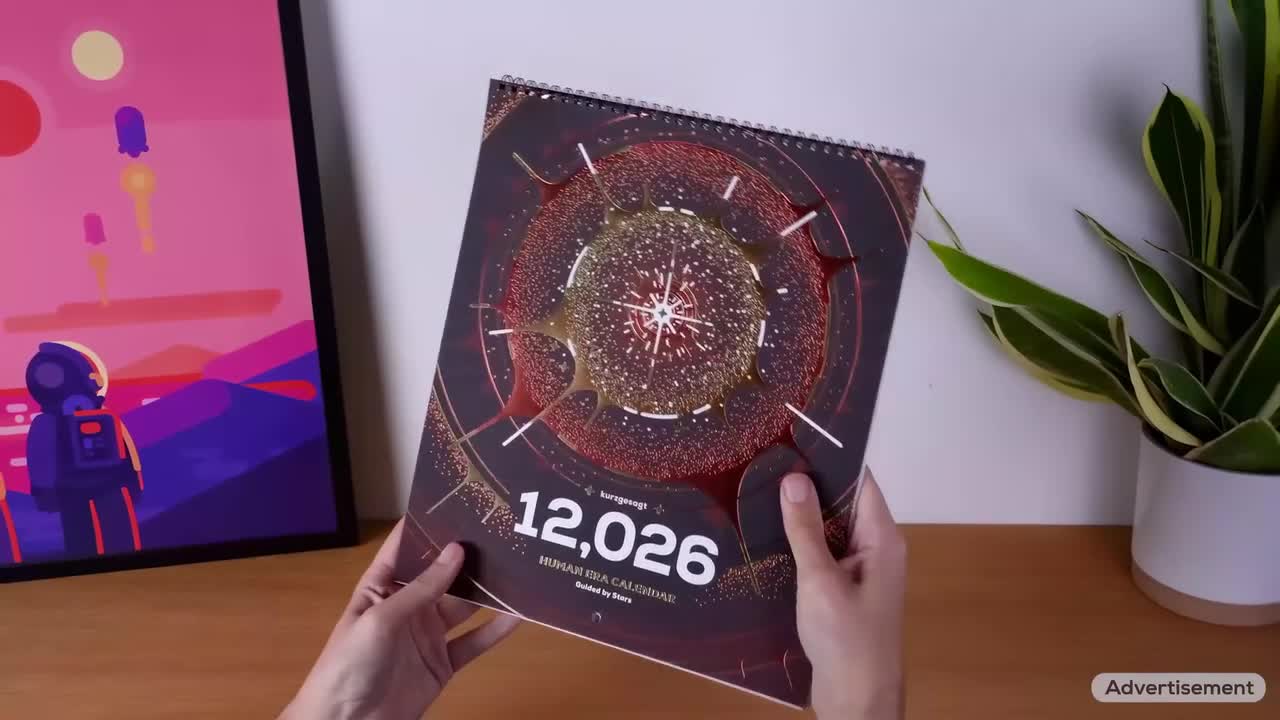
Our 12026 Human Era Calendar just dropped, and this year is extra special.
Stay tuned until the end for the reveal, or head straight to the shop to get yours.
AI slop is saturating the internet, and things are becoming dramatic pretty quickly.
In an online world where money is made with attention, fake users spread their slop in review sections, generate fake traffic or poison discourse.
AI has supercharged this and made slop much harder to spot.
Today, about half of internet traffic is bots.
The majority of them are used for destructive purposes.
It's never been easier to make mediocre content.
From the black hole of meaninglessness that is LinkedIn.
Low-effort short videos, just engaging enough to hypnotize kids and fry their attention spans, to endless soullessly rewritten books on Amazon.
AI music is invading streaming platforms.
Google AI is summarizing websites instead of sending traffic to them.
On YouTube, new channels publish long-form videos multiple times a week with AI-generated thumbnails, voices and scripts.
True crime, video essays, science.
No space is safe.
We're in the golden era of soulless slob.
And, sadly, actual creative human work is used to train these AI models.
Every Reddit comment, original YouTube video or human drawing on DeviantArt has been sold out to the AI companies or straight up stolen by them, without attribution or payment to the actual creators.
Creative theft on a scale where it's impossible to protect against it, already putting loads of creatives' work in danger, so AI companies can get rich.
While this is sad and frustrating, what's even worse is that generative AI truly has the potential to break the internet irreversibly by making it harder and harder to tell what's true.
At first, AI looked great.
A Kurzgesagt script starts with basic research that's turned into a script and then fact-checked in depth by two to three people.
We try to confirm our info with what we deem trustworthy ideally first-hand sources, ideally papers.
Then we get one to three experts for input and critique.
Fact-checking and compiling our sources alone takes around 100 hours per video.
Of course, we make mistakes or oversimplify, and you can disagree with our conclusions.
It's unavoidable, we're only human after all.
But it is fair to say that our process is extensive, and after a decade, we know what we're doing.
When AI appeared, we were very excited.
A mechanical brain able to super quickly collect information.
So we went to work, and it looked amazing.
And then we started fact-checking.
We didn't expect it to be perfect, but it was way worse than we thought.
Confidently incorrect.
AI is so bad at this.
We'll summarize and generalize our experiences over multiple projects and months condensed into one fake project.
A video about why brown dwarfs are the worst and should be ashamed of themselves.
So, we got all the pro accounts of all the AI models and got to work.
Using deep research tools to create a summary and overview of all the information about the failed stars.
Brown dwarfs.
And wow, it was great.
Dozens of pages of outlines with unique information nuggets and links to sources.
Then we started to look deeper.
More than 80 of the info and factoids were pretty solid and we could reconstruct where they were from.
Wikipedia, papers, legit articles.
What about the rest?
It was great stuff like the speed of brown dwarf superstorms, the nature of their insides or how disappointed their mums are.
But we couldn't find where the AI got this info from, which is not automatically a bad sign.
After all, the models contain pretty much all the internet and books ever written.
So we asked experts for input and they flagged the exact same facts, even asking where we found it.
To fulfill its goal.
To make us happy, the AI had invented or extrapolated information to make brown dwarfs more interesting than they really are.
Like a bad journalist making up details to make a story hit harder or fit a narrative.
Now we wanted to know more and dove in deeper, reading the seemingly more solid sources the AI had given us in full.
One was an article from a news site written by a human journalist.
Or was it?
It had a very familiar structure and surely purely coincidentally read like what you get if a human slightly changes AI wording.
An AI essay detection tool gave it a 72 match.
So an AI article without sources used as a credible source for AI research.
Which makes sense, since in 2025, there were already well over 1200 confirmed AI news websites publishing massive amounts of AI-generated misinformation and false narratives.
This mix of correct, dubiously sourced and straight-up made-up information also leads AI to present really shoddy conclusions that sound strong or novel but are often half-truths or misrepresentations.
Oh well, we salvaged what we could and went back to the drawing board.
And after a few weeks, it happened.
By pure stupid chance, we saw a brown dwarf video popping up by a relatively new channel.
It had hundreds of thousands of views and was pretty good, nice footage, great editing.
But we'd seen the structure and rhythm before.
And would you look at that?
It contained all the brown dwarf facts we'd flagged as unreliable or straight up made up by AI.
This is where the death of the internet begins.
Now, there's a proper source of brown dwarf misinformation online.
When the next AI repeats the same research, it will find a transcript from a video with a lot of views.
The misinformation is now true.
It will spread.
Even before AI, it was pretty hard to find the origin of facts that sound great but are not true.
Just watch our video about a 100-year-old lie.
As AI use goes on, it may become impossible to know what's true or not.
The most corrosive lie.
The problem with AI is how trustworthy it seems.
How it's correct enough to seem super smart and how incredibly confidently incorrect it is.
Casually lying to your face, often very subtly.
When you catch it lying, it immediately admits, it vows to never do it again.
And then it does it again.
As eloquent as current language models feel, there's nobody home.
No greater intelligence or consciousness is talking back to you.
Current AI is a very complex hammer that doesn't understand what it's doing or what nails are.
But we're letting it add new shelves to the library of human knowledge.
AI is changing quickly, so this may get better, but right now it's pretty grim.
Way too many people blindly trust AI.
Studies looked into the language of millions of scientific papers published before and after the rise of large language models.
They found an abrupt and sharp increase in the frequency of words that AIs like to use.
So it seems clear that now a significant portion of papers have been at least assisted by AI, usually without acknowledgement.
And just in July 2025, it was discovered that a number of researchers had started to sneak hidden messages into their papers.
In white text or too small for the human eye.
They prompted AIs to review them positively and not point out flaws.
As more and more people are using AI carelessly, the library of human knowledge is getting less and less reliable.
Which brings us to the last part, how are we using AI?
And will Kurzgesagt survive the AI slop age?
Will AI slop kill Kurzgesagt and artists?
On the internet there's only one truly valuable resource, human attention.
If current trends continue it's not that far-fetched that cheap slop content stuff just good enough will soak up the majority of human attention.
It could make us dumber, less informed, our attention spans even worse, increase political divides and make us neglect real human interaction.
If AI eats the majority of the attention pie, channels like ours will become unfeasible or forced to downsize or use AI themselves to be able to compete.
We don't want to play this game.
How will we use AI?
Like the Align tool in Adobe Illustrator.
If you have a bunch of boxes and you want to line them up, you can do this manually one by one.
Or you can just select them, click Align and have them perfectly aligned in an instant.
It's the same with AI programming tools for animation or using it as a faster Google alternative.
AI is a helpful tool, but the creativity and integrity is still ours.
So, dear Internet, here is what we're offering to you.
Kurzgesagt is made by humans for humans and it will remain that way.
We'll produce well-researched content and invest a lot of time and our human creativity in our illustrations and animations.
Put our creative soul into our work.
We'll continue to fact-check and discuss our research with human experts to give you the most trustworthy information that we can.
When we make mistakes, they will be our mistakes.
We would rather quit than make AI slop.
But to go on, we need your support.
Kurzgesagt is almost 70 full-time people and a lot of freelancers on top.
This is a lot of salaries, software licenses, laptops, rent and coffee.