In cybersecurity, the biggest risk isn't what you see.
It's what you miss.
Recorded Future, bringing clarity to the signals that matter most to your business.
Recorded Future.
Know what matters.
Act first.
Hello there, short ravers.
Emily Kwong here with a quick word before the show.
So this week is Giving Tuesday.
That is the global day of generosity that NPR celebrates every year.
But this year is different.
Because...
It is the first time in 50 years that NPR is operating without federal funding.
That is a huge deal and a big challenge but it is one that we can take on together.
At Shortwave, we bring you science coverage that is fun human, that introduces you to new ideas, amazing discoveries and everyday mysteries.
It helps you feel a little more connected to this planet and the people we share it with.
We know all of this matters to you, and that is why some of you have already stepped up to share in the cost of bringing you shortwave each week.
Like Gloria, a listener in Texas who says I would be less informed, thoughtful and interesting without Fresh Air.
ThruLine, Shortwave, and Up First.
I love these programs, and I hope they continue.
We are so grateful to listeners like Gloria who have stepped up to support NPR this year.
You can join them.
Sign up for NPR Plus and mark giving now.
Thanks again for your support.
Here's the show.
You're listening to Shortwave from NPR.
Hi, short wavers.
Emily Kwong, here with NPR alum, now independent science writer, one of our favorite reporters on the planet, Dan Charles.
Oh, you make me all choked up.
Hi, Emily.
Hey, Dan.
Okay, you've brought us basically a mystery novel.
Something about money and power.
Electric power.
I took a field trip the other day, Emily, and I made you a little audio postcard.
So here I am in Data Center Alley, Northern Virginia, Loudoun County.
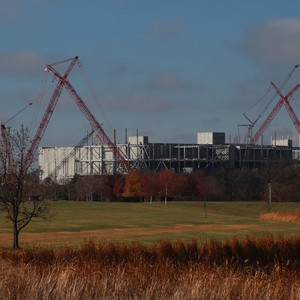
I'm standing along the road and there is not a person in sight, but I'm seeing these enormous buildings.
And along the road, there are these Enormous power lines, steel towers with wires hanging from them.
There is so much electricity flowing into this place, like rivers and rivers of electricity.
Yes, these are the buildings that are Full of computing equipment and are seeing a rapid increase in construction to power AI.
You've been poking around in them, huh?
Well, the specific thing I've been looking into is what is this doing to my electric bill?
Yeah, that's a real concern.
I was just reading there's this analysis from Carnegie Mellon University and North Carolina State University found that electric bills are on track to rise an average of 8 percent nationwide by 2030 and as much as 25 percent in places like Virginia, because of data centers and cryptocurrency mining.
Some of those forecasts are a little speculative.
They're based on models of future electricity markets.
But I found a guy who showed me how this is actually playing out right now.
I'm Mike Jacobs.
I work at the Union of Concerned Scientists.
And transmission topics are what I do here.
When he says transmission, he means electricity transmission.
Power lines. substations full of massive pieces of equipment called transformers.
This whole incredible network we call the electrical grid.
He's a grid geek.
So he sees things that go right by most people.
Like when he takes a flight?
I get a window seat so I can look for the transmission lines on the airplane.
And now they lead to wind farms.
So he's clearly dazzled by how the grid has changed.
Yeah, this is his world.
So a year or so ago Mike was looking at plans for new power lines and he saw a bunch of them were being built to supply data centers.
Oh, wow.
And he realized the data centers were getting these connections pretty much for free.
What do you mean for free?
Well, the data centers themselves don't have to pay extra to get connected.
But, you know, a famous economist once said, there is no such thing as a free power line.
So guess who's really paying the bill for this?
My guess is it's people like us, Dan. people who pay our utility bill?
Yeah.
The electric companies are adding the cost of building these power lines into their customers' electric bills, which Mike thinks is outrageous.
Dan, when I saw this and when I've showed it to my colleagues who work in the renewable field...
And they see you don't have to pay for it if you're a data center.
Just gets your hackles up.
It really was sort of a, this isn't right kind of moment for me.
And I'm Emily Kwong.
And I'm Dan Charles. and you're listening to Shortwave, the science podcast from NPR.
This message comes from AT&T.
America's first network is also its fastest and most reliable.
Based on RootMetrics United States Root Score Report 1H2025.
Tested with best commercially available smartphones on three national mobile networks across all available network types.
Your experiences may vary.
RootMetrics rankings are not an endorsement of AT&T.
When you compare, there's no comparison.
AT&T.
One of the hardest parts about B2B marketing is reaching the right audience.
That's why you need LinkedIn ads.
You can target your buyers by job title, company, role, seniority, and skills.
All the professionals you need to reach in one place.
Get a $250 credit on your next campaign so you can try it yourself.
Just go to LinkedIn.com slash NPR pod.
That's LinkedIn.com slash NPR pod.
Terms and conditions apply only on LinkedIn ads.
Okay, Dan, let's back up a little bit with Mike here.
When did he start investigating data centers?
Well, Mike's starting point was we need more clean energy, more solar and wind, instead of burning coal and gas, which pollutes the air and warms the planet.
In the future, we're going to have our economies run on non-fossil fuel.
And we're going to think it was so foolish to dig up ancient carbon and burn it.
But the thing is, solar and wind farms have to send that clean electricity to where people need it.
Right.
So we can charge our electric cars, cook our food, and it's power lines that's ultimately carrying that energy where it needs to go.
Yeah.
And, as a grid geek, Mike spends a lot of time looking at obscure documents on the websites of electric utilities.
These are the companies that build and maintain that network of power lines and send us an electric bill every month.
I was digging around these local plans and I started to notice these references about building for power.
So, for instance, he was going through this document from Dominion Energy, which serves most of Virginia.
It lists the projects they have in the works.
Page 36.
New delivery point to serve a data center customer in South Hill, page 48.
A request at the White Oak substation to serve a data center customer, page 58.
Serve a data center complex and data center customer.
I'm picturing him like with his mind.
So in this one document from 2024, a couple of dozen projects just in Virginia.
He went to similar documents from six more states in this same part of the regional electrical grid Pennsylvania Ohio Illinois, New Jersey, Maryland and West Virginia and he found 130 projects for data centers costing in total over 4 billion.
$4 billion.
Wow, that is a lot.
So a fleet of data centers is under construction, fueled by the ambitions of tech companies like OpenAI and, of course, the Trump administration's support for AI.
So, Dan, can you describe what one of these data center construction projects looks like?
Yeah.
So I picked one of the places in that list of projects that Mike saw and I drove out to Fairfax Virginia, to look at it.
I found an old warehouse, a parking lot, a big U-Haul center.
It all felt kind of sleepy, honestly.
But in a few years a data center and a substation are supposed to fill this space about the size of eight football fields.
And I'd arranged to meet a couple of people from Dominion Energy here, Ayesha Khan and Rob Richardson.
Have you come out here a lot?
Not for a while.
How about you?
No.
I mean, we've got a bunch of transition projects we're working on.
Rob set up a little tablet computer on the hood of his truck to show me the plan.
We're right here, right here by the U-Haul.
The Edsel substation would be here at this... Right where we're standing or down there further?
Nope, right about here.
Yep.
And then the transmission lines, you know, would come in right here by this creek.
It's going to be a big power line, big enough to power a small city. steel poles, 120 feet tall.
Together with the substation, this project is listed as costing $40 million.
Dan, is this power line just for one data center?
Yeah, so this is an interesting point.
I got slightly different answers from Ayesha and Rob about that.
It's to meet the growing demand here.
It's for reliability.
It's not just the data centers.
It's our hospitals, your schools, your churches, residents.
But the data center did ask for this, right?
I think the data center is largely driving the need for this project, yes.
So, honestly, there's really no question it is getting built because the data center needs it.
But Dominion argues that new power lines like this also make the whole power grid stronger and more reliable.
So everybody benefits, and that's why it makes sense for everybody to pay for it.
How exactly does Dominion get itself into a position where it can charge customers for this?
So electric utilities like Dominion Energy aren't like regular businesses.
They are regulated monopolies.
Right.
When I covered local governments, I saw this up close.
Like the local government regulators, they set the rates that companies like Dominion are allowed to charge.
That's right.
Dominion Energy sells electricity, maintains the grid, builds power lines when they're needed, and regulators let them charge consumers just enough to cover those costs and collect some profit on top.
So when Dominion spends more money building new power lines for data centers, that extra cost translates directly into a little boost in the rates that everybody pays.
Because the system is kind of set up this way.
So how much are data centers adding to people's electric bills right now?
So this is surprisingly hard to figure out.
This wave of new data centers is just starting, for one thing.
It's not exactly clear what the costs will be.
You have some people saying electric bills could jump a lot, like $70 a month.
And others say there could even be cases where data centers actually reduce people's bills if utilities can spread all their fixed costs across this growing base of customers.
But Based on what's happening in, for instance, Ohio and Pennsylvania, where utilities have proposed big increases in electricity rates, it seems like data centers, there at least, will likely cost an average household at least a few extra dollars every month.
Ultimate question, is this fair?
Well, Mike Jacobs sure doesn't think so.
This is not fair.
You know, this isn't right.
All the consumers of Virginia are subsidizing the business plans of these data center companies, which I would say is morally wrong and bad policy.
Interesting.
What does he think would make this fair?
Basically, Mike would like electric utilities to handle power lines for data centers the way they already handle power lines for solar and wind farms.
So here's an example.
Right now There's a company that wants to build a big solar farm called Cassius Blue in Southern Virginia.
That's named for a really pretty butterfly species, by the way.
Nice.
Okay.
So in order for Cassius Blue, the solar farm, to connect to the electrical grid, Huh.
Okay.
So it sounds like...
If you are a solar or wind farm generating electricity, you have to pay for the power lines.
But if you are consuming electricity like you're a customer, a big data center you don't have to pay for that upgrade.
Instead, everybody gets a rate increase tacked onto the their bill to build those power lines.
That is the way the system works right now.
Those are the rules.
And Mike says the rules should change, that data centers should have to pay up front for the power lines they need, just like solar farms.
What are the chances, Dan, that this will actually happen.
Yeah, it actually is possible, I think.
Data centers are not popular these days.
They're running into more and more opposition.
And just a few weeks ago, the Trump administration actually called for a new federal rule That would require new data centers to pay the costs involved in connecting them to the grid.
Oh, wow.
That's a big shift.
Yeah, it was kind of a shock because the Trump administration has been very enthusiastic about AI.
Yeah.
Mike Jacobs says it's not really clear if there will be any such rule, because this has always been something that state regulators had control over, not the federal government.
But they're asking for the right thing.
So we got a nice little fight unfolding over this very problem.
So all I can say is, Emily, stay tuned.
Dan Charles.
Thank you so much for coming on to share what's going on with data centers and people's electric bills.
Thanks for having me on the show.
And short wavers.
If you want to dig into the environmental impact of data centers, we have a two-part series for you that I reported earlier this year.
Visit our show notes to listen to it.
This episode was produced by Burley McCoy.
It was edited by Rebecca Ramirez.
Tyler Jones checked the facts.
Jimmy Keeley was the audio engineer.
Beth Donovan is our senior vice president of podcasting.
I'm Emily Kwong.
Thanks for listening to Shortwave, the science podcast from NPR.
The First Amendment protecting the right to free speech and a free press in the US came first for a reason.
It was a bold declaration that set the young republic apart.
Today, we ask you to make your own declarations.
Stand up for NPR and a free press by giving now at donate.npr.org.
Thank you. whose entire life took a sharp, unexpected, and very unpleasant turn.
And it did take me a while to realize that it's basically because the monkey pressed the button.
That's right.
Because the monkey pressed the button.
Surprising stories every week. wherever you get your podcasts.
You care about what's happening in the world.
Stay informed with NPR's State of the World podcast.
In just a few minutes, we take you to stories around the globe.
You might hear the latest developments in world conflicts or about what global events mean for the price of your coffee.
Listen to the State of the World podcast from NPR.