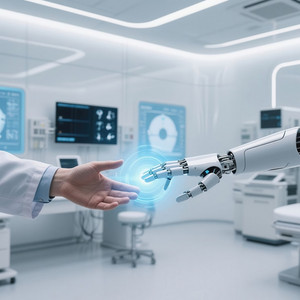
Discussion keeps the world turning.
This is Roundtable.
In China, cancer screening rates have long lagged behind some developed countries, and so have cancer survival rates.
But 2025 marks a turning point.
A new AI system called GRAPE is helping Chinese hospitals detect stomach cancer earlier and boosting detection by over 20 % compared to human doctors.
No tubes, no pain, just a scan.
Is this how AI begins to save millions?
Coming to you live from Beijing, this is Roundtable.
I'm He Yang. For today's program, I'm joined by Steve Hatherly and Yushan in the studio, first on today's show.
We've all seen how AI is making waves in healthcare from helping detecting breast cancer on screens to developing new drugs.
In 2025, something big is happening in China.
Doctors in two provinces started using AI with regular CT scans to screen for stomach cancer.
That's huge, especially since it could reduce the need for invasive tests like the gastroscope or 胃镜 in Chinese, which can be very uncomfortable.
And it's not just about stomach cancer.
AI is starting to change the entire field of oncology.
That's the study and treatment of tumors by spotting risks earlier, tailoring treatments, and offering new ways to screen without discomfort.
What is the latest breakthrough in China regarding AI and stomach cancer screening?
And why is it so significant?
Well, the new breakthrough is one AI system that's called grape that's designed by Chinese researchers.
And the grape is short for gastric cancer risk assessment procedure.
And what it does is it uses 3D or three -dimensional CT scans to spot and outline stomach cancer, even at its very early stages.
And this grape model is developed by Zhejiang Cancer Hospital and Alibaba's Damo Academy.
One providing the medical data and all all the images, scan images, while the latter provides the very advanced AI technology to analyze those data provided.
And the two collaborated together, released their study just last month via the Nature Medicine online journal, and this marks a major breakthrough in cancer detection, especially in the field of gastric or stomach cancer detection here in China.
know this is very difficult for doctors when we talk about the stomach and detection of cancer because the stomach its shape um it varies right it can be stretched out it can be wrinkled up the fullness can vary a lot so to solve that what they did was they matched contrast enhanced ct scans with non -contrast ones and that helps the ai to pinpoint the cancer locations with really really high precision.
The scans that we talked about, the contrast ones, that's where they use a special dye.
And then the non -contrast is where they use without that special dye.
And then what they do is they compare those.
And when they compare them, then the AI can learn exactly where the cancer is.
And that makes it much, much, much more accurate.
And also it's outperforming human just human eye detection alone.
It's outperforming a lot of human radiologists already according to the data.
So the GRAPE model, it was trained on nearly 100 ,000 scans and showed some pretty impressive results already.
It correctly identified early stomach cancer by 85 % of the time and rolled out healthy cases with about 96 .8, that's almost 97 % accuracy.
So that's already a big step up and that's outperforming radiologists by over 20 % in both sensitivity and and also 14 % in specificity.
That's really elevating, say, the quality of scanning for stomach cancer, at least at the current stage.
And in some real hospital trials in two hospitals that they've already practiced this out already, the system boosts detection rates to as high as 24 .5%.
So in the meantime, approximately 40 % of the detected cases were stomach cancer patients without symptoms. And that's according to the study.
Right. So that's really interesting.
And I'm once again, astonished by how fast AI and medicine has progressed.
I remember a few years years ago or a couple of years ago, it was certainly after the COVID, I remember us talking about on radio how AI was significantly helping radiologists to read the CT scans.
But at the time, there were no results saying, oh, if there were a competition of AI reading versus human doctor doctor reading, what would be the result?
And now, I guess it's pretty safe to say, well, yes, a robot beats humans.
Yeah, yeah. And those statistics are impressive, right?
So they loaded 100 ,000 scans in there, and then it correctly identified cancer 85 .1 % of the time.
That's really, really good.
It's also an advantage over something like an endoscopy, an endoscopy, excuse me, that's where they use a light and a camera and a tube, and they go in and they search that way as well.
And the difference here is that it's invasive versus non -invasive.
The endoscopy is an invasive procedure and it oftentimes makes people feel uncomfortable and it makes them perhaps not want to go ahead and get that check because of how uncomfortable it is.
That's fear -inducing for a lot of people to go into the hospital and have that kind of check.
It's an intimidating thing.
So when you can have this kind of non -invasive procedure and it helps improve upon the statistics in terms of accuracy and also in terms of not making mistakes, right?
Misdiagnosing something, then this is just a win -win.
And that's why they're considering this such a major breakthrough.
Right. So for an endoscopy, it goes from the behind, right?
As far as I know. Yeah.
And a gastroscope, it goes from your mouth.
Yeah, so from the behind, that is more focusing on looking into the intestines.
And with the gastroscope, it's more a clear look into the stomach. And both are absolutely critical in detecting early signs of cancer and if there are these these little bumps that might the doctor see during the checkup procedure.
And then what's really great about it is that the doctor can just take care of it in the process of.
But now it seems like I want to check with you, Yuxuan, about this, because I know you've done some research about this.
Is it too big of a push to say that these kind of AI new technologies can replace the gastroscope?
Is it more like it can help, but it can't completely replace?
What do you think? It's correct the way you put it.
It's not like we're replacing doctors and radiologists just once and for all simply because we have this new AI breakthrough.
through it's here not to help curing cancer but providing one extra more comfortable and faster more efficient way of screening cancer at its earlier stage and usually that earlier stage doesn't really have such an identical iconic symptom that can be visibly checked or can be diagnosed immediately from your like appearance or or whatever so that's where AI helps but it's not here to replace yet.
And as I said before, for doctors, the challenging part when it comes to the stomach is finding those nooks and crannies, right, where the cancer could be hiding.
And this is all about early stage detection, right?
So when you have this high accuracy rate, it means that the AI can catch those subtle kinds of cancer much, much earlier.
And that's such an important thing because early diagnosis for stomach cancer in particular, which is, by the way, the fourth leading cause of cancer related deaths worldwide.
If you can catch it early, it dramatically increases survival rates to over 90 percent.
Yes. So to understand the impact of this breakthrough, let's zoom out and look at the bigger picture.
Why stomach cancer is such a pressing issue in China in the first place.
And Steve, you've alluded to that.
Why are cancer survival rates lower in China compared to countries such as Japan and South Korea?
And how much of that comes down to screening and accessibility?
Well, that's such a great question that we need to kind of focus and look at at this point, because, well, this is from the lead researcher of the grape model.
His name is Cheung Xiang -Dung.
He's from Zhejiang Cancer Hospital.
And as far as he's noticed, countries in Asia, like Japan and South Korea, they began nationwide cancer screening program as early as in the 20th century.
For instance, Japan launched their stomach cancer screening in 1960, while South Korea rolled out such a nationwide endoscopy program back in 1999.
1999 so around 20 years ago countries including Japan and South Korea they're already doing this to their entire nation but for China the case is kind of different because most people remain to be you know kind of hesitant like Steve mentioned earlier about you know getting the checkups it's not necessarily included as part of our annual health checks yet it's not like mandatory that you have to go through every year so people with that choice that they think they're given they feel like I was so uncomfortable I have to go through fasting I have to bear that weird feeling of having a tube going
down my throat and sometimes people have to go through full anesthesia in order to do that and on top of that it's not really that cheap to get one of those checks sometimes I heard that without anesthesia it can go around a few hundred yuan but with anesthesia which probably is more thorough in a way, it's going to take around a few thousand, 1 ,000 or more, 2 ,000 yuan each time.
So with all that layers of elements, it's one big reason why Chinese people were not there yet to have this full nationwide awareness of taking this check.
Yeah, well, if it's not included in a national health program, you can have part of the medical bill reimbursed, but certainly not the whole thing.
and then it is like one separate thing that you have to clear your calendar for and we know it's uncomfortable so also just going for that annual health checkup is not what everybody does it kind of depends on your employer for most people if it's included into your employee benefit package then yeah that's one thing you sort of need to cross off the to -do list every year and get a health report and that's great um but you know even for that this um stomach situation checkup is not included so this is really not something that everybody knows and also i don't think everybody puts priority on um
early screening how this is you know because thankfully not you know you just think, oh, this won't happen to me.
But until sometimes it does.
It does. Yeah. And stomach and gastric cancer, it's one of the deadliest cancers, especially in Asia.
This is data from the National Center of China.
And it showed that here in China alone, there are 360 ,000 new cases and 260 ,000 deaths reported each year.
And most of those cases are diagnosed quite late.
And that That causes a five -year survival rate of under 30 percent.
But as I mentioned before, if you can catch it early, if you can catch it at stage one, it goes to 90 percent in terms of the survival rate.
So that's a very big deal.
Yeah, you're right.
I mean, if it's not part of the if it's not part of the mindset yet employers and, you know, that that aspect of it, then the aspect of, oh, it's intimidating and it's also expensive and it's also uncomfortable slash painful for some people.
It's not going to be at the forefront of people's minds as something, number one, that they want to do.
Nobody really wants to do this.
But number two, and this is the important thing, should to should do and have to do.
It's a smart thing to do for your health.
Yeah, like usually the sort of common recommendation is that if you reach the age of 40, if not older, then yeah, maybe include this into your yearly routine.
But if you're younger, there's hardly the recommendation that, oh, please do it kind of thing.
Of course, AI isn't just helping with stomach cancer.
It's already being used across many different types of cancer with some impressive results.
How is AI being used to screen, diagnose, and even personalize treatment for different kinds of cancer?
Well, first of all, AI really helps with processing massive amounts of data at a very fast time.
So it increases the efficiency for people's diagnosis and screening.
And with this incredible fast and sharp, say, professionality in detecting these issues, it can help a lot in analyzing medical images, like we mentioned earlier, when it comes to CT scans, MRIs, or tissue samples under a microscope.
So microscope, these models, these AI models, they can help spot patterns and just tissues that's not normal that shouldn't be there.
And that might be too subtle for human eye to spot in the first place.
So, for example, the U .S. National Cancer Institute, they supported one research that has shown that AI imaging algorithms not only improve breast cancer detection on mammography, but also helps the predict of long -term risks of invasive breast cancers for people that probably don't show enough symptoms yet.
So that's one way of screening cancer of all different kinds.
Yeah. And speaking of breast cancer, I mentioned invasive versus non -invasive procedures.
That applies here, too.
AI is enabling this new, much less invasive screening technique.
The doctors here in China, they've developed what they call infrared thermography or an AI IRT system for breast cancer screening.
And that allows users to check their cancer risk via a smartphone app, if you can believe that, linked to an infrared camera.
So that's just something so easy and so affordable to grab in some ways.
And in the meantime, AI can also provide personalized treatment.
Like you said, He Yang, it can help integrate diverse patient data, including genomic information.
That's the data about your personal genes to help predict treatment if that's effective for your personalized treatment plans.
And this includes optimizing radiation doses and assisting in surgical procedures and even making real -time adjustments to the treatment strategies itself.
So like we mentioned earlier, it's not always about the treatment or what medicines are being recommended.
It's more about helping in each and every step of the diagnosis.
Applies to pancreatic cancer, too.
There was a study a couple of years ago from Harvard Medical School, and what they did there was explore how AI could help predict that type of cancer, pancreatic cancer, which, by the way, is harder and it's also more expensive to screen for.
So what they did there was they analyzed disease codes and their timing for millions of different patient records.
And the AI model was able to identify which patients were most at risk, even though many of the symptoms weren't directly linked to the pancreas.
So, again, it's about that early detection and looking for signs that might be hard to spot for doctors and patients, too.
That's definitely a great thing to have. But also, the flip side of the coin could be, could this kind of thing lead to over hospitalization in a way when those with the means to have the early detection or to be identified as high risk individuals, and they would, and if they again have the means, and then they might go for it early.
And then I don't really want to look at this as a cost -benefit analysis overall because we're talking about people's health.
But, yeah, there's maybe overpouring of hospital resources, well, on the demand of these people.
Yeah, I think I see your point where when people become aware that this technology exists and these early screening processes are now more accurate.
And in what they're able to do, they might start to do that early.
Even if there is an over -dependence on hospital resources, I think it's hard to look at it as a bad thing because people are more aware of taking care of themselves and going in and checking their bodies to make sure they're okay.
I see your point, though.
Yeah, well, see, that reminds me of this is a little bit going into the celebrity gossip, but also news territory.
I remember a few years ago, Angelina Jolie, I think she went through a double mastectomy, like getting her breast tissues fully removed, I believe, because she's a daughter to well, she has a long history of family history of breast cancer.
And then therefore, she went in really early on.
I remember there was like a whole discussion because, you know, she's high profile personnel.
But yeah, it makes people wonder if here in our country one day we can get to that point where more people can be diagnosed earlier on.
And sometimes it's not like you see any symptoms. It's more like you're high risk.
And would you actually go in earlier than needed?
And if seen from a patient's side, that's very important that we have such technology available to people.
Because we're talking about one patient having cancer, but it's usually, at least here in China, it's usually a whole family behind that one patient trying to provide him or her the best treatment that could be offered.
And if it's spotted late enough, it's probably going to take years and years of treatment, costing, I don't know, hundreds of thousands of yuan, which is...
And also so much pain.
So the earlier the detection is always better when it comes to cancer treatment, as well as so many other health issues.
So where are we right now regarding the widespread adoption and integration of AI in cancer technology and treatment in China?
And how does it compare with global efforts?
So here in China, I know we've been talking about the grape model.
But before the grape model emerged, there's another one called the Demo Panda model model that got kind of popular a few years ago.
So the demo panda model, it's another AI model that's specifically for pancreatic cancer that's already being used in hospitals nowadays.
And in clinical trials, it showed a 99 .9 % of accuracy in detecting cancer.
And also So it earned a breakthrough device designation from the U .S. Food and Drug Administration, meaning that it has the potential to improve diagnosis and treatment for life -threatening diseases.
One real -time example is that using this PANDA system, the People's Hospital affiliated with Ningbo University, it already screened over 40 ,000 people and caught two early cases of patriotic cancer that routine tests had missed previously.
So one of them was just a very small 1 .5 centimeter lesion, which is a visible abnormal tissue that doctors can easily remove with surgery.
So you see when those kind of things, they're spotted, it's easy to remove when it's fine in an early stage.
So it doesn't necessarily have to cost everybody to flock into the hospitals and stay there for a very long time like they do if spotted late.
And this is great for China.
It's great for the medical world.
It puts China in a leading position in the development and deployment of AI in medicine, particularly in this topic that we're discussing today, the realm of early cancer detection.
But all that being said, the widespread integration, it still requires a lot of clinical trials.
It also requires the establishment of broadly accepted standards for AI performance because you're still leaning on AI here.
We're not replacing doctors, as we said, but we're still leaning on AI more so than we were in the past. Yes, as promising as AI could sound, it's not without challenges.
It's like any powerful tool does come with real questions, technical, ethical, and practical.
What are the biggest concerns around AI in cancer care from bias to data security and privacy?
How are experts addressing them?
AI models, when being used in a very practical way, it faces a huge potential in the lack of representativeness.
Because we know that all AI models they run or if they rely heavily on the quality, the quantity and the diversity of the data that they are being trained on.
So if data used to train these AI models are not, say, appropriately diverse or representative enough to present the real -time scenario for the broader demography of people, then these models, they can harbor medical bias for sure, and also potentially leading to less accurate or equitable diagnosis for certain patient groups in the future.
So that's a big, say, a gray area that people are still trying to research on since we're still at the early stage of not applying this in a wider national scope yet.
So I think there's still a lot of data to be collected in the future.
I think liability is a question too.
Right. Because if doctors are trusting AI or perhaps hesitant to trust AI and AI's recommendations, it becomes hard to figure out whose fault it is if if something goes wrong.
And that's why, you know, you mentioned we mentioned clinical trials before.
There needs to be more of those to test AI in in real world settings.
That's going to be a concern there.
Also, you have to develop explainable AI.
And that means making AI's decision making process really clear and really understandable so that doctors can understand how AI is making the decisions.
Because you need the doctors to not just blindly follow the AI's recommendations.
The doctors need to know where this is coming from, why these recommendations are being made so that the doctors can become better at assessing these as well.
Wow, Steve, you are pointing at something that I just never dreamt of, because I used to assume as much as I trust all doctors out there, I used to assume that, you know, if you were going to receive this AI assistant recommendation, as well as verified by doctor conclusion, inclusion, then the liability and responsibility, I thought, would just automatically fall on the hospital and the doctors, because ultimately, it's the doctor that's signing off and saying, you have this issue, x, y, z, and you need to receive treatment.
It's not like AI told me, even if, you know, the, that's like the difference between assistant and the full -on responsibility bearer, which is the doctor.
And I thought that this should be the status quo, the standard of how AI's participant should be in the medical decision process.
But you want AI to fit in well in terms of everyday healthcare practices, I think, and a lot of that is trust. And that goes back to the patient too.
Imagine you're a patient patient with something serious happening in your body and you go to the hospital and the AI identifies this within you, but you don't talk to the AI, right?
The AI is a tool for the doctor.
And then you'd ask the doctor, well, what's going on?
Why did they recommend this?
And if the doctor said, I don't know.
That doctor should be fired immediately.
But that's my point is that doctors also need to understand the relationship here between AI, the doctor, and the patient.
I think we're in the beginning stages here of using AI, relative beginning stages of using AI in the medical field.
And everyone needs to be on board. And that includes the patients, and that includes the doctors.
And that's why more and more and more and more clinical trials should be done so that we can see higher percentages of accuracy in diagnosis, because then that trust will be established.
But that will take more tests and more time.
But with more trials being done and more AI models coming out, there's one inevitable issue here.
That's the privacy and security issue of people's data.
Where are, where is all these data going or flying to?
That's where I think we kind of need to establish this secure data handling protocols.
Of course, patients, they know they're signing something I think it's something that's probably going to collect their personal health data and being used for research purposes.
Me personally, I do not have such a big, say, issue with signing something like that and offering my data.
But what if people hack into that system and take patients data and use it for illegal purposes in the future?
That's all like ethical issues that people need, especially the AI researchers, they need to pay attention to.
That's such a great point.
And that is so core to every technology we are enjoying that involves AI or data mining or the Internet.
And this is the most, this is about as personal as that data can get.
Exactly. And with the examples that we have been discussing on today's show, it's only two provinces in China and mainly two of the biggest hospitals in those respective provinces.
And then see, like there's this is a head scratcher for from the ethical point of view, from a personal health point of view, for this AI machine to be more accurate, you need to feed in more data.
And that's our individual personal health data.
And if it doesn't have enough information, it can't become more accurate.
And we want it to be accurate.
But what are we giving up?
You asked me before, you know, because this isn't, you know, can't pancreatic cancer, stomach cancer, that's not a Chinese issue, right?
This is a global issue.
And you asked me before, you know, what's happening, happening internationally.
There are plenty of organizations working on this.
The National Cancer Institute is also the Canadian Cancer Society.
They're funding numerous projects, leveraging AI for improving their diagnosis as well and also personalized treatment.
and enhance research. And this is what I want to say on the topic is that, you know, we, yeah, China's leading the way right now, but we don't need to be leading the way, right?
This is a global issue.
We want every country to be leading the way together, sharing the knowledge that they can so that we can help as many people as possible.
Yeah, it's a global collaboration and something that people all have to face, whichever country you come from, right?
And as AI technologies, they mature and just provide more efficiency, higher efficiency and more accurate diagnosis.
Then, of course, there's a big database that all people can share and try to learn more about cancer.
There's still not a cure for it, but there are multiple ways that we can screen and catch some signs early on.
Yes, and for countries like China, where late diagnosis have long been the norm, this might be the start of a new chapter.
AI or not, I would advise everybody to go get yourself checked up, that annual health checkup.
That is so valuable for everybody.
And this is the least you can do for yourself.
AI or not. Okay, I think this is not controversial at all.
Just do it.