This is Planet Money from NPR.
All right, Jeff.
You have summoned me here today because I understand you have a question for me about the economy.
Yes, it's the million-dollar question right now.
What do you got?
Are we in a bubble?
That's like a several trillion dollar question, I think.
Okay, but look at the stock market right now.
The S&P 500 is up almost 50% over the last two years.
Yes, it is absolutely bonkers.
Bonkers!
And what is even more wild is that if you look at what companies are mostly responsible for that growth, it's just a handful of them.
It's the companies doing AI stuff.
Yeah!
Yes, all this AI stuff, like Microsoft and Amazon and Meta.
People are calling them the Magnificent Seven.
Yes, and we would be remiss if we did not mention NVIDIA.
NVIDIA, of course, is the microchip company that's powering all this stuff, and its stock price I think it has almost quadrupled over the past two years.
It's wild.
It's so wild.
It's the most valuable company in the world.
Yeah.
Yeah.
All of that, it kind of makes you nervous, right?
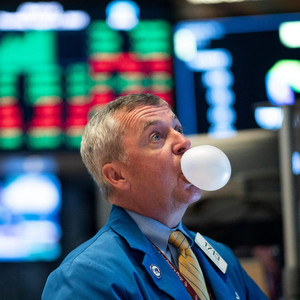
Because if this AI stuff turns out to be a bubble, it's like the biggest bubble our economy has seen in years.
Sure.
And we all know what happens eventually to bubbles.
Or do we?
Ooh, intriguing.
Hello and welcome to Planet Money.
I'm Nick Fountain.
And I'm Jeff Guo.
Today on the show, are we in a bubble right now?
Is it even possible to tell if you're in a bubble?
And if you are in a bubble, what does that mean for the rest of the economy?
Right.
We're going to look at some cutting edge research on bubble detection.
And we're also going to talk about this provocative theory which says that maybe some bubbles are not as scary as they seem.
All right.
Before we can talk about whether we're in a big AI bubble or not, we've got to start with some definitions.
What is a bubble?
Bubble is –.
I'm trying to answer your question without using the word asset, which is probably my favorite word in finance.
Robin Greenwood is a professor of finance at Harvard Business School, where for years he has been studying bubbles, especially bubble indicators like how you tell if something is a bubble.
Like at the gym at Harvard Business School, there's the saying.
Our gym is called Shad.
And there used to be a running joke that if you'd hear lots of talk about an industry and Shad in the gym, you know that's a good bubble indicator.
Now, the textbook definition of a bubble is that it's when people start buying and selling something at prices way above what it's actually worth.
When the price is so high, it just doesn't make any sense at all.
So a bubble is something that we can point to as being irrationally valued relative to the value that it delivers.
It's something where you're like, why are people paying so much money for this thing?
That's a bubble.
That's a bubble.
And with a bubble, that price just keeps going up and up and up until one day it pops.
The price comes crashing down to reality and a lot of people lose their money or lose their jobs.
Now, bubbles have always kind of puzzled economists because how could people be so delusional?
But the thing about bubbles is that they usually involve something new, something exciting or unknown.
The kind of thing that gets people buzzing about at the gym at Harvard Business School.
You almost never see bubbles forming in boring or familiar industries.
You're never going to see bubbles and say, ankle socks?
Yeah, it's pretty hard to get irrationally exuberant about ankle socks.
Whereas AI, on the other hand.
AI is new and exciting, and no one really knows how big of a deal it's going to be.
There's all this uncertainty.
That is what creates this fertile ground for the formation of a bubble.
And that uncertainty also makes it genuinely hard to tell if we're in a bubble or not.
Right now, investors think NVIDIA is worth $4.6 trillion.
That is 22 Disneys or five JP Morgan chases.
But is that a sign of a bubble?
Is a company like NVIDIA ridiculously overvalued?
Hard to say what the company should be worth.
Kind of depends on what story you believe about whether NVIDIA's AI chips will change the world or not.
Precisely because it is hard to figure out what the value of NVIDIA is, many different narratives about what NVIDIA could be can survive in the market.
Economists call it a bubble when the delusional narratives have taken over the market.
And economists have come up with all kinds of theories about why investors might be a little delusional or overoptimistic.
But it's really hard to tell when the market is being delusional when you're in the moment.
Yeah, this is one of the big challenges in economics.
How do you detect a bubble before it's too late?
And this challenge is so humongous that one of the most famous economists in the world is skeptical about whether bubbles even exist.
His name is Eugene Fama.
He's kind of a big deal.
He won a Nobel Prize for his theory that markets are mostly efficient.
Here at Plenty of Money.
We actually had Eugene Fama on the show way back in 2013, where he told us that in an efficient market, the price is usually right.
So how could bubbles exist?
I believe markets work.
And if markets work, those things shouldn't be predictable.
Fama was like sure.
It's easy to call something a quote-unquote bubble after the thing has already popped.
Hindsight's 20-20.
But if you really think bubbles are real, you should be able to call a bubble before it pops.
The word bubble drives me nuts, frankly.
You hear that?
Yep.
We played Robin from Harvard Business School.
Some of that conversation between former Planet Money host David Kestenbaum and Eugene Fama.
I'm not a believer.
I'm an empiricist.
What would prove it to you that there were bubbles?
Empirical evidence.
Such as?
Well, that you could show me that you can predict when these things turn in some reliable way.
We asked Robin for his take on Fama's hot take.
So are you familiar with that view that Fama's talking about?
I'm familiar with that view.
That view, and in fact maybe it's that quote, originally motivated us, because we wanted to rise to the Fama challenge of trying to statistically identify bubbles.
So it's possible there's a connection between this Planet Money episode and... Exactly, exactly.
You motivated this.
Robin and his colleagues at Harvard said, game on, challenge accepted.
And they set out to prove Fama wrong, to find a way to detect bubbles before they pop, before it's too late.
They started by digging through history, looking for everything that seemed suspiciously bubbly in the US stock market.
They looked at almost a century's worth of data and found all the times where stock prices in a particular industry suddenly doubled or more within two years.
For instance, there was this big run-up in electricity company stocks in the 1920s.
There was also a big run-up in healthcare stocks in the 70s.
They found 40 examples like this.
So we wanted to look at every situation that was maybe a bubble and to say, what happens next?
So what happens over the next 24 months?
And about half the time, there was no crash.
Investors were wildly optimistic, sure, but they turned out to be correct about their optimism.
Those high stock prices, they just kept going up and up and up.
But the other half of the time, those stock prices ended up crashing dramatically within a couple of years.
Those were the situations that economists would point to and say that was a bubble.
Yeah, what Robin and his colleagues wanted to figure out was what did these popped bubbles, what did they tend to have in common?
Were there any clues that could tell you when a bubble situation was happening?
We were hoping that there was going to be some change.
Amazing marker of a bubble.
We did not find like that one thing where it is a slam dunk.
What we did find was that there's a constellation of things happening around bubbles that does make them somewhat predictable.
Oh, so there are some clues.
They laid out those clues in a paper they called, and I love this, they called it Bubbles for Fama.
It's kind of cheeky, right?
Yeah.
So they published this paper in 2019 and it immediately made a huge splash, because here they were challenging the great Eugene Fama with some evidence that bubbles can maybe sometimes sort of be predicted.
And OK, here were four of the main clues that they came up with.
Drum roll, please.
Let's have them, Jeff.
Okay.
Clue number one, high valuations.
That's when you see companies with really high stock prices that aren't actually making that much money right now.
Right.
This is the classic price to earnings ratio.
You look at the value of the company and compare it to how much money it's making right now and say, does this make sense?
Yeah, a really high price earnings ratio is a sign of optimism about the future.
Clue number two is volatility.
That's when you see individual stock prices in an industry just jumping around a lot.
Yeah.
Clue number three is issuance.
That's when you have a lot of new companies going public or a lot of existing companies issuing new shares of stock.
So they're taking more money from public investors, from the public.
Right.
And finally, clue number four is what they call acceleration.
That's when you see stock prices not just go up, but go up faster and faster.
So the price kind of looks like it's ramping up rather than sort of going up steadily.
Oh, so like if you look at the stock price, it's not like a straight line.
It's more of like an exponential whoosh.
Exactly.
Exactly.
It looks like a whoosh.
Exactly.
We called that acceleration.
And we found that actually turned out to be one of the strongest predictors.
So?
Of course, we asked Robin to turn his bubble detection tools on what's going on right now with the stock market and the AI boom.
And Robin was like, OK, on one hand, we do have some companies with high valuations.
For instance, NVIDIA's price earnings ratio right now is in the 40s, which is elevated.
The average for companies in the S&P 500 is more like in the 20s.
Also, we are seeing some increased volatility in how the prices are fluctuating from day to day.
So check and kind of check.
Right.
But on the other hand, Robin says, there hasn't been that much new stock issuance.
The big companies involved in AI, like Meta and Microsoft and Google.
They aren't funding their new data centers by selling more shares to investors.
They're getting their money in other ways.
And also, there aren't that many private AI companies that are going public right now.
All right.
For those counting at home, two clues pointing towards a bubble, one not.
And as for the fourth, what he called the strongest predictor of a bubble, acceleration.
Stock prices for companies like Meta and Amazon.
They are going up, but recently they have not been going up faster and faster.
So we don't know is basically the answer.
Yeah, that's pretty much what Robin said.
So we have many, but not all of the things that you would look for to call the current AI phenomena a bubble.
Now we did press Robin on this a little and he says even though not all the warning signs are flashing right now, he still takes the warning signs we are seeing, especially the high valuations.
He takes them seriously.
If I had to say what I think it is, I would say we're early bubble.
Yes, okay, but here are the caveats.
Robin says you know, even though these clues they are real, they can help you predict a bubble.
They aren't that great either.
What Robin told us is that if you look back at all those price spikes in the stock market over the past century, these clues could help you pick out the bubbles, like maybe 60 of the time.
So, in other words, a little better than a coin flip.
Yeah.
And actually funny story here one of Robin's co-authors did go to Chicago at one point to present this paper, which remember they called it Bubbles for Fama, and the University of Chicago is Fama's home turf.
He's the big man on campus there.
And Fama went to this talk.
He was actually sitting right there in the front row.
Yeah.
I mean Fama is a data-driven person so was interested in the facts, but would have taken a different take on our observations.
So that was sort of where we ended up.
I'd say we called a truce.
Right.
A truce.
Because Robin's paper, it doesn't exactly prove Fama wrong.
It is still really hard to detect bubbles.
Now, there is another question that we haven't even talked about yet.
Even if we could see a bubble coming, should we try to do something about it?
As a society, how worried should we be about bubbles?
That is after the break.
When it comes to bubbles, there are basically two types of people who obsess about them.
There are, of course, investors who are worried about losing their money in a potential bubble.
But these days there's also big, important people in the government who are worried about what bubbles mean for, you know, the whole national economy.
And for these folks one of the main questions is what, if anything, should policymakers do about bubbles?
Gadi Bar-Levi is a senior economist at the Chicago Fed though, just to be clear, Gadi does not speak for the Fed.
These are his own thoughts.
And he has thought a lot about the question about bubbles.
Do you lean into a bubble or do you wait until it collapses and then you clean up after the fact?
That was the nature of the lean versus clean debate.
Hold on.
Who came up with this?
Was it really called lean versus clean debate?
Oh yes, it's lean versus clean.
I don't know who came up with the terminology.
It's pretty catchy.
I just want to be on the record in saying I think this metaphor is confusing.
I mean, you're probably right.
It is catchy, though.
But the basic idea is should the government lean against like push back against a suspected bubble and try to shrink it?
Or should the government just stand by and get ready to clean up after a bubble pops?
And this whole lean versus clean debate, this is a recent thing.
When Gotti was in grad school in the 90s, nobody thought bubbles were something that serious macroeconomists needed to be studying, especially not macroeconomists who were focused on the US.
It felt like economic bubbles is a thing of the past, that this was a feature of newly emerging financial markets, where people didn't know exactly what they were doing and you could get carried away.
But this is not an issue that would really be seen in well-developed and deep financial markets like the US.
That is until 2000, when the dot-com bubble burst.
All these new internet companies went bankrupt.
The entire NASDAQ index plunged 78%.
And that threw the whole U.S. economy into recession.
Several years later, there was another bubble in the US housing market.
The price of houses in the US kept going up and up and up to ridiculous levels.
And when that bubble popped, You know what happened next.
It kind of triggered the global financial crisis.
Yeah.
So all of a sudden, macroeconomists, they became very interested in bubbles.
Some argued that if we can spot a bubble, which is a big if but if we can, shouldn't we go in and fix it?
But the clean side of the debate was like, we are horrible at predicting bubbles.
And there's a good chance that if we step in, we'll just do more harm than good.
So let's just wait it out and we'll clean it up afterward.
Nowadays, Gotti says, what we really need to understand is just how bad can bubbles be for the economy?
And macroeconomists think there are basically two ways bubbles can hurt the economy.
We're going to run through them right now.
Right.
Number one, bubbles hurt the economy, of course, when they pop.
But not all bubbles cause the same amount of economic damage when they pop.
It depends on how that bubble is connected to the rest of the economy.
Like, who is investing in this bubble?
How many people are employed in the bubbly industry?
Gotti says another major risk factor is, are people borrowing a lot of money to fuel the bubble?
If there is a lot of borrowing... a lot of the people who borrowed end up defaulting on their loans.
Now, banks that have all these losses are more reluctant or perhaps less able to make loans.
Then you will have a more severe recession.
That's what happened during the housing bubble.
People were taking out mortgages from the bank to buy these overpriced homes.
So when housing prices collapsed, it wasn't just the homeowners that got hurt.
It was also their banks.
And when banks get into trouble, that causes a lot of pain for a lot more people in society.
So that's number one.
But even before bubbles pop, there is another more subtle way that they can hurt the economy.
When there's a bubble, that means a lot of companies are spending money on the wrong thing.
Like, bubbles can lead to a lot of wasted investment.
Yeah, and Jeff, you've talked to Gadi about a potential bubble.
That has been very much on your mind right now.
Yes, Nick, labubus.
You know, those scary little dolls that people are going crazy over right now?
I would argue that there is a bubble forming in labubus.
You see these collectors, right?
They are paying thousands of dollars for these rare labubus.
The actual valuation of labubus, as I understand it, would be the enjoyment that...
Kids get out of having labubus.
Well, it's adult humans, actually, who enjoy labubus.
I'm not a consumer, and so I will take your word for it.
But the whole idea of a bubble is we're creating more of these than is justified by the value that labubus bring to society.
Okay, let me make clear.
Economists do not care if people spend money on frivolous stuff that seems silly, as long as those people value that thing a lot right?
Then it's not misvalued.
It's not a bubble.
The problem is when people are buying labubus not because they love labubus, but because they think these labubus are going to be worth more later on.
Like they're buying them as an investment.
In that case, when the bubble pops, what do we get?
A bunch of labubus that nobody wants.
Actually, Jeff, I think the labubu bubble, the bubble, it might have already popped.
Resale prices have gone way down in the past few months.
There you go.
Right.
So, if it is okay with you, let's put aside the plushies dolls and let's try to apply these theories from macroeconomics to what is actually happening now in the stock market the AI boom.
Right.
OK, so there are two big questions here.
Question number one, if AI is a bubble, how bad is it going to be if it pops?
Obviously, investors will lose a lot of money.
One economist told our friends at The Indicator that an AI crash could erase 35 trillion from the global economy.
People will lose their jobs.
They'll be spending less money and the consequences will ripple out and affect all of us.
But there is also some reason to believe that this might not be as bad as 2008.
Because AI companies aren't really borrowing directly from banks that much.
They're mostly borrowing from investors, like from private credit.
So, for the moment at least, even if this AI boom is a bubble, it seems like less of a threat to the backbone of our financial system.
Though, to be clear, we don't really know how much private credit borrows from the banks.
Okay, and now for the second question.
If AI turns out to be a bubble, how bad is it that we are spending all this money right now training AI and building these AI data centers?
Because if this AI bet doesn't pay off all those billions of dollars, they could probably be spent better right now, you know, researching drugs or building solar farms or buying cat treats.
Yeah.
Yes, very Jeff Guo.
But here's a provocative idea.
If AI turns out to be a disappointment and we're left with all these unused data centers full of unused computers, how bad would that be?
Right.
Like computers are not labooboos.
They do have some other uses.
And actually, there's an interesting example from history here.
During the dotcom bubble, there was all this Internet hype.
So companies spent billions of dollars putting fiber optic cables into the ground, you know, to transfer people's data.
After the dot-com bubble popped, a lot of that fiber just sat there unused.
It was called dark fiber.
But that didn't turn out to be a total waste of money.
Eventually, companies did start using that so-called dark fiber.
It arguably catapulted us into the era of broadband.
A lot of that fiber is now carrying all the streaming video we're watching these days.
Yeah, and that example, the dark fiber example.
It's why some economists have recently started saying
All bubbles are entirely bad.
Maybe some have silver linings.
Maybe bubbles can even boost the economy.
And this theory, Gotti doesn't totally buy it, but it kind of tickles him.
He says the basic logic here goes back to the definition of a bubble.
A bubble is when investors are willing to pay a lot of money for something that isn't actually worth that much.
So you could have two different reactions to that definition.
One is you could say, wait, the price is wrong?
That's bad.
We need prices to reflect true worth, to send signals to people of how much to produce and how much to buy.
And so a price that's crazy, that's a bad thing.
But another reaction is, oh, this is awesome.
I just found a moneymaking machine.
Yeah, like maybe as a society, we can take advantage of bubbles.
Because there are often situations where, as a society, we aren't spending enough money on something.
Research and development is a good example.
Companies typically underinvest in RD because research is a public good and some of that research can end up helping their competitors.
Long-time Planet Money listeners will recognize this as the classic problem of externalities, in this case causing the markets to not create enough research.
It's a market failure.
Right.
But in theory and again this is kind of an out there theory if somehow there's a bubble in some high tech industry, investors will start throwing money at those companies.
And the argument is maybe society will end up with more of the R&D that we need.
And so, by encouraging what looks like excessive creation of an asset that, as far as society is concerned, is under provided to begin with, that might actually be a great thing.
So this is an idea that, okay, in real life, markets are not perfect.
There are flaws and imperfections.
And a bubble, through the power of its delusion, can fix some of these problems.
So it's like two wrongs making a right.
That's exactly right.
So, lots of different ways to think about bubbles and how they affect the economy.
But Jeff, the question I have for you is... Mm-hmm.
Can we tell if Dubai chocolate is a bubble?
And if so, what possibly could be the positive externalities from that bubble?
Everybody needs more chocolate in their life, Nick.
It's finding synergies in the cacao supply chain.
Finding synergies in my stomach.
You know what I always thought was a bubble?
Podcasts.
Hasn't popped yet, though.
And to keep it from popping.
We need you to help us boost the number of people who listen to Planet Money.
You can do that by telling a friend about the show.
You can send them this episode.
You can send them another one of your favorite episodes.
If you did it, we would be very grateful.
This episode was produced by Willa Rubin and edited by Marianne McCune.
It was fact-checked by Sierra Juarez and engineered by Sina Lafredo and Robert Rodriguez.
Alex Goldmark is our executive producer.
I'm Jeff Guo.
And I'm Nick Fountain.
This is NPR.
Thank you for listening, and thank you for sharing this with a friend.