What do you mean anti-human?
So let's dive into this.
There's something in economics called the resource curse.
So think countries like Venezuela or Sudan, where you discover that that country is sitting on top of a really valuable resource like oil.
And then, once a bunch of your GDP comes from oil and not from the labor or innovation or development of your people, You invest more in oil infrastructure and not investing in people.
You don't invest in education.
You don't invest in healthcare because oil is where you get your GDP and your growth from.
Okay.
Okay.
This is a well-known fact in economics.
It's called the resource curse.
There's a wonderful guy named Luke Drago who wrote a piece called The Intelligence Curse.
We're about to enter a world where GDP for countries comes more from data centers and intelligence and AI than is going to come from the labor of human beings.
So everyone's talking about how AI is going to automate all these jobs and then we'll all just like sit back with universal basic income and become painters and poets.
And is that actually what's going to happen?
Or when countries get almost all of their revenue from AI and a smaller and smaller percentage from people, do they have an incentive to invest in childcare healthcare education, the wellbeing of their people?
Or is it basically just hook them up to the social media addiction economy, keep them busy, while basically all the revenue comes from AI companies?
And so what I'm trying to get at is, This is not a human future.
This is not a future that's in service of regular people.
This is a future that's in service of eight soon-to-be trillionaires, who will consolidate all the wealth and disempower basically everybody else.
Because... Does that make sense?
It does.
Because previously, in order to... Can I get that in here?
It's high-powered stuff.
And yeah, this is a big conversation.
Yeah, exactly.
They've started a fucking trend.
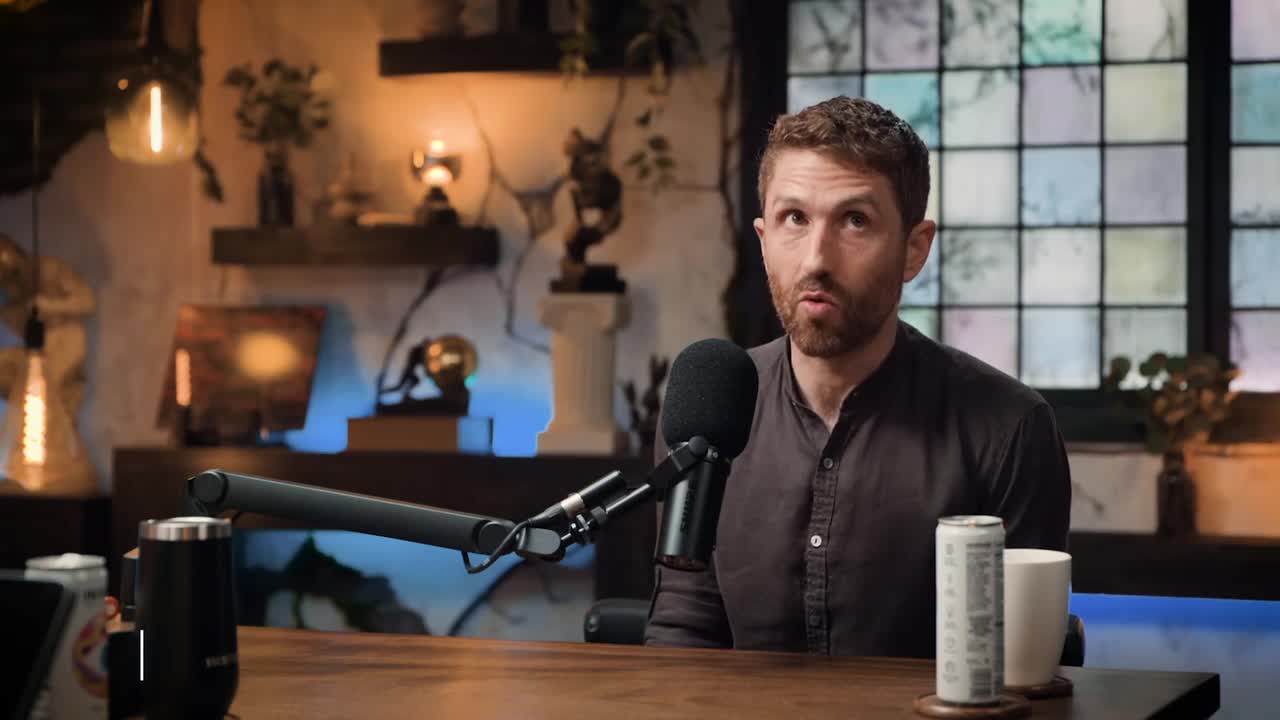
It's so funny when no one in the room wants to crack their can in case it interrupts the conversation.
So one goes and it's a Mexican wave of can opens around.
So previously you would have had to look after the humans. healthcare, education, quality of life.
Also, tax revenue comes from people, right?
Well, you would have to look after them because they were the primary economic engine.
That's right.
And so they feed themselves.
Yes.
Economically, they feed themselves.
Exactly.
People that are young help to support the people that are old.
That's right.
The ones that are entering the workforce and are driving innovation and are working...
40, 60 hour weeks, double jobs, all the rest of it.
Then there's old people who've got 401ks and pensions and shit like that.
Your position is that if we have a world where the human part of the contribution to economic growth and GDP is removed because it is humans consuming AI, but AI driving and data centers driving the revenue itself, beyond building the data centers, there's very little and I imagine much of that's done by robots in any case.
Well, we have this joke that most people's occupation in the future we're headed towards with AI is to become a coffin builder.
So in other words, your job is to create the thing that replaces you and obsoletes you.
So you are essentially building the coffin for your future obsolescence.
And so, if you're short term yes, we need the electricians and the plumbers and we're building data centers.
Short term, yes, you can be a programmer and get the benefit from vibe coding.
But then the AIs are learning on all the things that you're doing.
And it's taking all the training data of what you're doing with AI and it's using that to train an AI that can take your job.
So everybody using AI now to help them is also training the future AIs that will completely replace them.
And again, the explicit goal, this is not my opinion.
This is literally the mission statement of all of the AI companies, because the multi-trillion dollar prize at the end of the rainbow of owning the entire world economy is based on building this full replacement economy, because that's what will achieve the greatest growth.
And that's why these companies- Replacement economy?
Yeah, meaning that they're designing to replace all human labor.
They're not designing to augment and support and enhance human labor.
They're designing to replace all human labor, because that's what justifies the amount of money that they've taken on in debt, that they can grow into this like total ownership of the entire economy.
What else is there to say about the intelligence curse?
Well, it's just important for people to get that when the AIs are doing all the new scientific research, not humans.
You have an automated chemistry lab.
You have an automated biology lab.
You have an automated surgery.
When AI is doing all of that, again, the revenue is going to come from AI, not from people.
And what that means is all the wealth will go to a handful of like five AI companies.
And then how are you going to be able to make a living?
When in history has a small group of people ever consolidated all the wealth and consciously redistributed it to everyone else?
And if you think that might happen in the US, we'll do a universal basic income.
Just think about the entire world.
So right now, you have AIs that are automating, say, customer service jobs.
So let's say that that disrupts the Philippines, where 90% of the economy is customer service.
I don't know what the number is.
It's high.
What happens when an entire country's economy gets disrupted by AI?
Are a handful of US AI companies going to pay out and support the well-being and the livelihoods of all these other people?
And then, if people don't have money, how are they going to buy the goods in this future economy where it's all generated by AI?
Because now you don't even have an income.
So, essentially, we're on track to break the entire economy.
This is not in the interest of countries.
What's confusing to me about this is that I believe it only took something like 20 unemployment for a couple of years to lead to the rise of fascism in Germany.
You don't need everyone's job to be automated to get levels of political disruption.
I think it was only 20 unemployment that basically led to the French Revolution.
There's kind of a mutually assured political revolution that is going to happen for all these countries that are racing to build AI and deploy it to automate as much labor as possible to compete to boost their external GDP number.
Like.
The metaphor you can have in your minds is like the US and China are essentially racing to take steroids and pumping up the GDP and muscles of their economy, while they're getting internal lung failure, internal organ failure, internal brain rot failure because they're governing the internal impact of that technology poorly.
So it's a race for external power, while internal management of essentially, like you know, failure of your body organs.
Does it make sense?
Yeah.
What does external power look like in this context?
Well, you know, one of the reasons that people think of AI is so important for competition is, if you think about geopolitical competition with China, economic power precedes other kinds of power.
If I have a high growth rate economy, that'll lead to the ability to invest more in a bigger military, bigger weapons, more advanced science, more advanced technology, because you just have more money to deploy.
Economic competition is a precursor for geopolitical competition.
When we say competing for this external power, we mean competing for GDP growth.
But again, we're competing for GDP growth.
That doesn't mean what it used to mean.
I think a lot of people think okay well, if GDP is going up by like 10 because AI is automating all this growth, that sounds awesome.
I was going to say, increases in GDP are almost always a universal good thing.
They had been when it was humans that were generating that, and then it was coming back to humans.
Because the revenue is going to be consolidated in a very small number of people.
In this new case, we have five companies.
There's no intermediary between.
So who would be feeding the revenue in?
Because this revenue still needs to come from somewhere, even if it goes to a small handful of people.
Where does the actual money come from?
Well, this is the confusing thing.
What happens... Is that a stupid question?
No no, it's a good question, because you're saying basically, who's going to be buying the products when no one has a job and no one has an income?
And on the route up to that, yeah, fewer people have incomes and fewer people have jobs.
The bucket being poured into the top.
That's right.
It's going to stop being poured.
Yeah, yeah it.
This is the confusing and mind-breaking thing about ai and it just in general, like i think people have to get used to.
I mean, your podcast is called modern wisdom and i just think about this a lot like what are the wise capabilities that we need to have in order to make our way through this?
And one of them is the ability to be with something that sounds like science fiction and realize that it's actually real, like and not say, because it sounds like it's science fiction, that i can just like dismiss it and say that can't be true.
A lot of people do that.
They're like ais that are like breaking out of their container and hacking GPUs and mining crypto autonomously when no one told it to do that.
That's got to be like a made-up study.
But, as we know, there was an Alibaba study just last week where the AIs autonomously broke out of their system and started mining for crypto.
We need to round this out, and then I want to talk about that.
Sure, sure.
That story is fucking terrifying.
Yeah, yeah.
So where does the economy, who's pouring money in?
I mean, the truth is that I don't know.
I don't think anybody has an answer.
Is it just going to grind to a halt at some point?
I think something like that, yeah.
I mean, I don't think that there's...
I think something that people need to get is it's not like there's a plan for how to make all this go well.
This technology is being released in a paradigm-undermining way.
It's undermining the paradigm of economic assumptions and societal assumptions that have made the post-World War II order.
This is such a deep fundamental change to the restructuring of everything.
Our economic system, our relationships, our information environment.
It's not just like adding a new technology in the mix.
It's like fundamentally changing the structure of the entire world.
You would think that if we're about to do that, we would do that with more careful, more caution care, wisdom and restraint than we have with any technology we've ever deployed, if we knew we're about to undermine the paradigm.
But because of this arms race dynamic, we are deploying it faster than we deployed any technology in history and therefore undermining these things faster than we can have a plan.
A quick aside, most people think that they're dehydrated because they don't drink enough water.
Turns out water alone isn't just the problem.
It's also what's missing from it, which is why, for the last five years, I've started every single morning with a cold glass of Element in water.
Element is an electrolyte drink with a science-backed ratio of sodium, potassium and magnesium no sugar, no coloring, no artificial ingredients just the stuff that your body actually needs to function.
This plays a critical role in reducing your muscle cramps and your fatigue.
It optimizes your brain health, it regulates your appetite and it helps curb cravings.
I keep talking about it because I genuinely feel the difference when I use it versus when I don't.
And best of all, there's a no questions asked refund policy with an unlimited duration.
So if you're on the fence, you can buy it and try it for as long as you like.
And if you don't like it for any reason, they just give you your money back.
You don't even need to return the box.
That's how confident they are that you'll love it.
And they offer free shipping in the US.
Right now you can get a free sample pack of Elements' most popular flavors with your first purchase by going to the link in the description below or heading to drinklmntcom slash modernwisdom.
That's drinklmnt.com slash modernwisdom.