Look at that.
Look at that sauce.
Fully incorporated.
I'm sure the model labs love that that's the answer.
This is getting chaotic, dude.
This is fun.
Yeah, I want the verdict here.
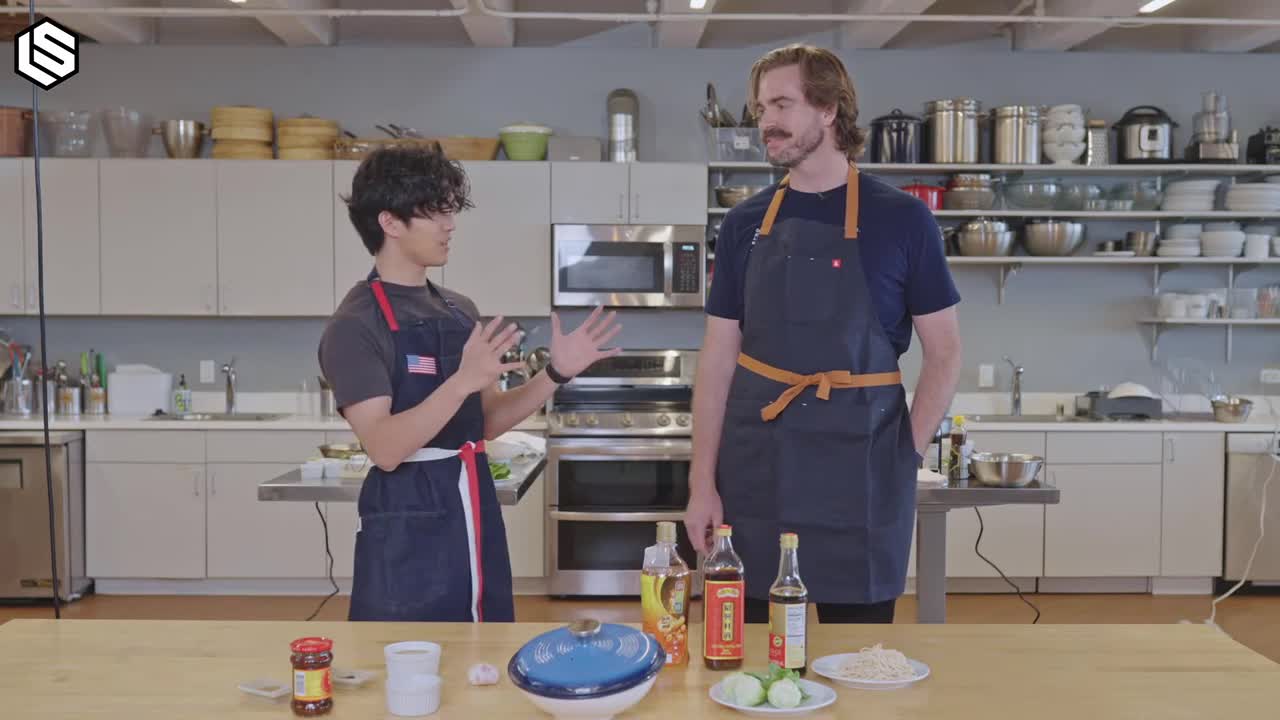
Hey guys, welcome to In Context Cooking, a show where we take one dish, taste it and try to recreate it with minimal help.
My name's Alan and today we have a very special guest the man behind context engineering, Dex Horthy, founder and CEO of Human Lair.
Welcome, Dex.
Dude, I'm so stoked to be here.
Yeah, I mean, I always start off with this.
So on a scale of 1 to 10, how would you rate yourself as a cook?
1 being bad, 10 being amazing.
I would put myself at like 7 or 8.
I don't cook that much anymore, and I do it because it's kind of like fun.
The idea of just following a process which is very deterministic but also kind of chaotic is a lot of fun.
Yeah, we like that.
Chaotic, but with some certainty.
Looking at these ingredients we have before us, do you have any guesses of the dish we're going to try and make?
I mean, clearly we're doing some sort of noodle.
I see some bok choy.
But yeah, I don't know a lot about noodle dishes, so I'm excited to see what we got.
Yeah, so the dish we'll be trying today is dan dan noodles.
Oh, nice.
I love dan dan noodles.
Yeah, we have a lot of protein here, some flavors.
Very simple to make at home.
But yeah, we'll taste it and then try to recreate ourselves.
Great.
Oh, that's fire.
I'm going to go for one more.
Are you also good with spice or are you?
Oh, I love spice.
Okay, great.
Because we do have some chili oil here.
I've read that you've started coding since you're 17 and you had an internship at NASA for the Jet Propulsion Lab.
Yeah.
So like how does a high school kid end up getting an internship at this very prestigious lab?
So they had this high school internship program where it was like they would take for a summer.
It was like summer after my junior year.
And they just like put us up in dorms at a local university that was kind of empty.
And so the reason why people want to go explore the south pole of the moon is because there's craters there that are so deep that there is frozen ice.
The moon's very dry.
But in these craters, there's water that has never been hit by sunlight.
And so it's there, has been frozen there since the formation of the moon, since it got like ejected from the Earth.
Oh, wow.
And so it's like, oh, we really want to go see what's in that ice and collect samples and study it.
Problem is very, very deep craters.
And so like most of the rovers can't do it.
And so we had to like we were basically like building some like pathfinding algorithms of like OK, given a rover and its current capabilities, and like what's the steepest hill, it can go up.
Like, I wanna go from here to here.
And I was 17, I didn't have a CS degree.
So we built a very naive implementation of Dijkstra's algorithm to find the shortest path according to some constraints of what the rover could do.
Great, yeah, I mean, that's a great start.
So we can now look at some of the spices.
So we have it in our context before we go off to cook.
Here we go.
I think we're ready to go.
Are you ready?
Do you feel comfortable when we get started?
Let's ship it, dude.
Let's go.
Dex, are you ready?
All right, tell me what we're doing here, baby.
Let's start with the meat first.
So you should probably see some pork.
Yeah, ground pork.
And so let's take one of the bowls and just mix some of put the pork in there.
I don't know how much pork you have.
I'm gonna try to put not too much to crowd it.
And then... Yeah, I believe we use the Chaoxing wine.
Okay.
Let's cut up the garlic.
How much garlic you going for?
Honestly, probably like three cloves, two, three cloves.
Three cloves?
All right, cool.
I'm doing six.
Okay.
How did you get into context engineering?
I feel like, you know, pointing the term.
Now it's like According to Swix, there are many people who Gemini thinks it was Andre Karpathy.
Okay, i mean, that's a very valid guess, yeah.
And then i, and then it had a crash out about andre carpathia.
Literally i have a screenshot.
It just like says the word andre carpathy like 30 times in a row because something gets.
Uh okay yeah, you know the standard gemini crash out.
Uh, Yeah.
So basically I was building like dev tools for AI engineers.
Okay.
And what happened was I like talked to all the best founders and engineers and founding engineers that would like take my call.
And I was like, hey, we're making this thing that helps you build better agents.
I won't go into like the specifics of it, but it was built of like.
I had this assumption about how people build agents.
And so I built tools to map onto that way of building agents, right?
And the problem was was that when I talked to all these people who were shipping real AI to the enterprise like reliable systems, it was like, I think,
I think I saw this.
It was like an old tweet from from like Swix.
Actually, it was this idea of like the way the top 1% build is so different from the bottom 99%.
You have all your like indie hackers and like open source frameworks that are very, very popular.
And like everyone uses and that's what you see in public.
And then you go see how real people are building stuff and getting reliability and it's completely different.
And so like- Why do you think there's such a discrepancy?
I think there's a difference between like people who want to build like reliable software and people who want to build a cool demo.
Okay, yeah.
I think that's the core of it.
The incentives are different.
The incentives are different, yeah.
The incentives are like okay, if this is right 80 of the time, that's fine, it'll look good on the demo.
Yeah.
But if you want to go sell something to a real company and like, charge them, you know, 100K a year, it's got to be much more Bulletproof and not as Yeah.
Okay, that makes sense.
So I learned all this stuff and I was like damn, I got a little bit like distracted by the like public hype machine and so I said okay cool, like I don't want anyone else to go through this.
So I wrote down everything that I learned and I called it, among other like there was 12 chapters.
There was only one of them was really about context engineering yeah, but that was the one that stuck.
And then you went through y combinator right in 2024.
Okay yeah, so this is.
This happened.
We did y combinator in fall of 2024 and this whole like 12 factor agents context engineering journey happened in like kind of like q1.
I wrote about it in q1 of 2025 and then it kind of like went viral in april.
Yeah, because you had a couple AI engineering talks that even recently, right in New York, No Vibes Allowed was it the title?
Yeah.
You know, had some good reception.
One thing that was very commonly said, even I think Swix had to talk about it, was about slop.
And I'm kind of curious, how do you define slop?
I mean, it's kind of fun.
The word has kind of evolved.
Yeah.
And like...
You know, it used to be like that's just AI slop, but now you can say slop about anything, I think.
Yeah.
Just like any like low effort or like contrived or derivative thing.
That is, like someone didn't put a lot of effort into
Yeah.
It's obviously most common when someone just like uses AI to write a ten page document that they didn't read and is like full of garbage.
Yeah.
But.
All right, so all the garlic's going in the meat?
Yes, all the garlic, you just put it in there.
We'll let the meat sit a little bit, and then we'll work on the sauce.
All right.
So you should have a bowl in front of you.
We can start off with a paste.
I believe this is the, yeah, sesame paste you smelled earlier.
Sesame paste, right?
Yeah.
Add like a spoonful.
Small spoon or big spoon?
Big spoon.
Okay.
Maybe like a big spoonful and a half.
That's a crazy statement.
Wow, Swix.
Okay.
Yeah, so sesame paste.
Can we quiet down in the back there, please?
Okay, we can add some sugar.
Okay, look at that.
Look at that sauce, fully incorporated.
Chili paste.
Do like a spoonful or two, depending on how spicy you like it.
I'm doing like two.
We're gonna go big here.
Yeah.
I didn't get my four cloves of garlic in, so.
Okay, let's move on to, we're on a time crunch, let's move on to cooking the beef.
Not the beef, the pork.
So turn on your induction stove.
You with me?
Okay.
I saw that you were at Replicate, was it, for seven years?
Replicate was dope.
I started as an engineer and we built a platform for How do we help?
If you have a SaaS application, people subscribe, they want to use it and then you want to sell it to a big enterprise like a bank or something.
They're pretty strict about data controls.
And so, instead of using your SaaS, they'll almost always ask you to send the app into their data center, into their AWS cloud.
And that's a very hard and expensive thing to build as an engineering team.
And so we built a lot of tools to help solve that problem.
Okay, would you say, there's a lot of learnings and you know experiences that you transfer, even today with human layer.
Um yeah, so i was an engineer there for like two years and then i, like i kind of always knew i wanted to be a founder.
What made you say that was there?
Just, it was just like i was just like i don't know.
I had a one of the guys i did all my cs classes with in college.
He would um, Are you going veg in first?
You put in the meat.
Oh, the meat in, okay.
Just the meat.
The veg we're saving for later.
Okay.
Like I said, I kind of like always wanted to be a founder.
And so I wanted to do all the other things.
So this opportunity came out to like basically do a more like salesy side of the job.
Gotcha. uh and i like jumped at it i was just like yeah i want to learn sales and i want to learn product and i want to learn all so like i ran i basically became the first customer facing engineer okay or uh yeah basically so uh and we had all these deals we had like parted ways with our head of sales so he had a bunch of deals on the like radar yeah for like hey we're gonna close and then like they've just been stuck for like nine months okay and i went and i met with all of them and we closed like i think we closed like 12 deals in three months oh wow and the ceo was losing his He's like, holy , the investors are taking my calls again, and we just made the quarter for the first time in a while.
And it was very exciting.
He's like Dex.
I know you want to get back to coding, but can you go hire three more people and turn this into a team?
Because whatever you're doing of going and onboarding into our stuff, it is working.
Gotcha.
So that's how I got pulled out of writing code all day and into helping other people use this.
Kubernetes Terraform deployment system.
Gotcha.
And even today, would you say your work is kind of distributed or less engineering, more salesy?
I still write a lot of code.
I brought on a technical co-founder over the summer, and he's awesome.
He is a much better engineer than me.
So I let him write most of the code.
Gotcha.
We like to joke.
It was like, yeah, we have the early... I was talking to some people last night.
I was like, yeah, we have an early product.
It's got a couple of bugs.
And he's like, and someone's like, yeah, all software has bugs.
I'm like, well, this isn't really bugs.
It's more like the features that Kyle let Dexter ship instead of building them himself.
Yeah, so I'm probably.
You know I'm spending most of my time I'm on the like Dan Dan Noodle CEO track where I'm just hanging out making noodles with cool people now.
We do a lot of workshops with customers.
What we're doing is there's a product that helps you do it, but there's also just a lot of whiteboarding that goes into helping people ship more code with AI.
We're focused on helping people ship.
How do we get coding agents to solve like hard problems in complex code bases?
Yeah.
And so that is, you can automate a lot of that with a product, but there's still like, just like trainings and stuff.
So I run those and I own those and like I travel around and like sit with our customers and help them like level up their engineering team.
In addition to like giving them a product that kind of like, when I leave they have kind of like guardrails and guidelines for how to do it.
Gotcha.
And are your customers mainly like more upstream, bigger enterprises, or are they also like startups a bit smaller?
We're doing a little bit of both.
You could argue that we should pick one and focus a little bit.
Yeah.
But yeah, at the moment it's really it's a mix of, like you know, 10 to 20 person engineering teams that like a bunch of bunch of random like YC startups.
Yeah, and then like a mix of, like you know, thousand engineer, like publicly traded companies that like have to figure out how to like standardize and adopt AI across their whole company.
Yeah, okay, that makes sense.
Your meat should also probably be cooked by this point.
You should take it off and turn off the stove when it's got a color, like a golden brown color.
I need a little more color on this.
I'm not happy with it yet, but keep feeding me instructions.
I will cue the messages.
Okay, yeah.
So once you have that, just put it into your main plating bowl and then The main what?
Plating bowl, the big white bowl.
Okay.
Yeah, it should be behind.
Yeah, see this?
This is not colored enough.
We're going to get a little more color on here.
We could talk more about your favorite, you know, context engineering.
How have you seen the craft of context engineering change over the past, I guess, year?
We had much smaller context windows, but then now we have a lot larger ones and so probably the needs change.
Have there been like big things that you've noticed?
Well, so I think there's two competing things here, right?
There's this idea of like as the models get better, you don't have to do as much context engineering to get the same quality of results.
Like I saw a lot, like a lot of my people who used to be like my favorite engineers that I looked up to and I still look up to them, but they were just like.
I thought about them a lot more in like 2015.
People who were like OG engineers on Docker and people like Mitchell Hashimoto.
Suddenly, there's this rap of all of the OG DevOps people.
When Opus 4.5 came out, they're like, oh, this is good enough.
This is a big change.
And I saw the things that they were shipping and I was like OK, but I know a bunch of engineers who got really good at context engineering and they were getting the same results from Opus 40 and Opus 41.
And so, even as the models get smarter, I wonder those people who were getting really good results back in the summer, what are they doing now with Opus 45?
What have they unlocked now that is not being like, oh my god, Opus 4.5 is AGI.
It's like, Opus 4.5 is AGI. for people who didn't want to put in the time to learn how to do it.
You know what I mean?
Yeah.
So would you say, a lot of these models are kind of capped by the users or an enterprise's ability to kind of properly context engineer.
Or do you think we'll kind of get to a point where there won't really need to be thinking about what goes into the context of your model with such huge context windows?
So there was a thing I said in my first AI engineer talk that was based on like an episode where, like the latent space guys, they interviewed the notebook LM team.
Yeah.
And I think it was Osama, said this thing.
That was like basically like there will always be a thing that the model can only kind of get right reliably.
You find a thing that's right on the boundary of the model's capabilities and you figure out how to get it right over and, over and over again.
Yeah.
And that's how you build incredible AI experiences.
Gotcha.
And I think that's still true.
It's just like that frontier of what's possible is constantly shifting outward.
And so it's still reasonable to know how to do these things.
Yeah.
Because at some point you might hit a problem that the AI can't solve, and then you have to go figure out how to solve it reliably anyways.
Yeah, no, that's fair.
You mentioned, I think, in the most recent AI engineering talk about, was it the dead zone?
Oh, the dumb zone.
Yeah, with 40% right of context.
I'm the dumb dude.
I know the dumb zone because I've spent a lot of my life in the dumb zone.
Let's put it let's just let's just be clear here.
So I guess for, like people who want to do simpler tasks or more advanced tasks, are there like heuristics that you advise, either like your work with human layer or just in general, on when they should kind of think about taking more time to engineer it versus just, you know, putting everything in context and not caring about like overfitting this whole space?
Yeah, I mean, I love that question.
I think I think I tweet about this a couple of weeks ago.
It's like the idea with the dumb zone is also like it's kind of meant to be a rule of thumb.
Like there are people I know who have been doing engineering for a long time who regularly push all the way to the end of the context window because they kind of like know what they're doing and what they want.
And like sometimes a good trajectory is worth, like you'll actually keep getting better results because your trajectory is really good.
So it's like if you don't know what you're doing and you don't really know what the ai model is capable of and you don't have a lot of experience, like you know, training wheels is like when you get to 40, start thinking about wrapping it up.
Or like like doing a, like you know intentional, steered compaction to where you want to be, but like depending on the model and what you're doing,
And if it's really simple, like I will regularly blow out to like 60 70 of the context window used.
But it's like if you don't know and you haven't developed the intuition, then like I tell people like, shoot for 40 if you're learning.
Gotcha.
And so how does someone even get familiar and build this intuition?
If somebody came up to you and says they want to take this more seriously and don't really know where to start and even when it comes to compaction, how to even assess like accuracy or relevance, or what to even consider and how to even judge whether compaction is useful um, what would you advise them?
Would you tell them to take specific steps?
Or you know uh yeah, talk to claude for 70 hours a week.
That's, that's how you do it.
You got to build intuition.
Use as much as possible.
Use as much as possible.
Make mistake.
I mean, like the thing that people actually ask me is like we developed this framework called, like research plan implement.
And I get this question a lot of like how do I know when to use research plan implement versus just talk to Claude right?
There's some issues that are really small and it doesn't really warrant the whole process of like okay, we're making a one line change.
The only way you learn how hard the problem is for AI is you're going to do too much sometimes.
You're going to be like, oh, that was way too much attention, and now I
I wasted a bunch of time on a thing that I could have just talked to Claude on.
And then you'll learn.
You'll be like, OK, next time I'm going to go to the other side.
And sometimes you'll go talk to Claude and Claude just flails and can't fix it, because it's too big of a problem or the context wasn't curated well enough.
And so the only way to know how much context engineering to use on a given problem, I think, um you just have to get some reps i don't i don't have a better answer than that i'm i'm sure the model labs love that that's the answer uh but uh yeah that's that's my biggest advice is like put in the reps and figure out what's possible and like try to push the boundaries gotcha oh yeah that's helpful definitely just using a lot more reps kind of like if you're going to the gym and trying to work out a muscle group Yeah, what do we call it?
Like the mind-model connection?
Yeah, the mind-model connection.
I guess, like on that, do you have predictions going into like 26 27, even the next.
You know a couple of years about how this industry will change.
That are top of mind.
I mean I think I mentioned this before is like the software engineering role is going to keep evolving.
I don't believe the like software engineering is dead and there will be more no more no more coders.
I think The way I would describe it is like the role of the software engineer will change from like write working code to like produce working code or like cause working code to be produced.
Gotcha.
And one of my biggest pet peeves is the people who run around Twitter talking about how much like cloud code they spent and how many tokens they did and how parallel their workflows are.
Yeah.
And don't talk about like yeah, I shipped a reliable product to people that like it and like maybe even are paying for it.
But it's like.
Stop.
We need to talk less about how much code we produce and how much we actually.
Guillermo Rauch talks about this.
He's like, there's a difference between coding and shipping.
Coding is like making the software work and maybe making it work on your workstation.
Shipping is like getting it into prod fixing the things that are broken, maintaining it over time and continuing to make it better.
And like that part is not quite solved by AI yet.
Maybe we'll get closer, but like I'm always looking.
I mean our company is called Human Layer because we used to do human to loop.
But now it's a little bit more like.
I think about it as like what is the high leverage things for humans to do?
And what is the things that we can like leverage AI for?
And it's kind of a dance.
There's like, if you're making code, there's like parts of it that AI just can't do right now.
And there's parts of it that it can do really well.
Gotcha.
Yeah.
So the compliment sounds like quality over quantity, especially with all the you know tweets about multiple cloud code instances and just shipping.
Things was like we're working with like big enterprises and like fintech and like other like spaces where it's like we can't afford to get it wrong.
There's no ship fast and break things.
It's great for all the indie hackers and vibe coders that they're shipping a bunch of cloud code stuff, but how do we make this stuff accessible and make it so that, like real production grade products can get access to the same games?
Okay, I'm in the assembling stage right now.
I'll give you like another minute.
I didn't realize we were on the clock, dude.
All right.
Yeah.
But no rush, of course, Dex.
And then how are you straining these noodles out?
I'm just taking a fork and just transferring it over.
Oh, no.
I tried to set this on 7, and it is still on 10.
All right.
We're going to take this off.
This is getting chaotic, dude.
This is fun.
Let's go.
All right.
We're going to just do a little sauce rift here.
Great.
All right.
Final plating.
My plating is not going to look as good as yours, but we're going to figure it out.
Yeah, taste is all that matters.
This is why I love cooking for myself, because I don't want to have to care what it looks like.
I'll eat the ugliest slop in the world if it's delicious.
All right, food's all plated?
No.
Nope.
Let me just wipe this off.
Let's get that fork out of there.
And we are ready to rock.
Great.
Let's rock.
Let me turn this off.
It's beautiful.
Look at that .
Great.
How was that, Dex?
Did you have fun?
It was a little chaotic, but it was a good time.
I'm excited to try these things.
Yeah, it was definitely a rush during the end, but we both finished, so both of our Dada noodles.
Let's see.
Okay.
Wow.
Yours is a lot prettier than mine.
At the last minute, I decided I was going to try to present it a little bit.
We should give it a try.
Let's give it a taste.
Are you going to try mine?
Yeah, let's try yours first, then we can try mine after.
Cheers.
All right.
Cheers.
Mmm.
Bartow has done very well.
Really?
Yeah.
If you had given me, if you let me take my time, I probably would have overcooked it.
I think I used too much.
I threw in some paste at the end.
I feel like I used too much of the sesame paste.
Yeah, I think yours is definitely a little spicier, but let's see how mine.
Mine's definitely a little more.
Great.
Cheers.
Damn.
Okay.
I really like the, like, something about this one is, like, it's more well-rounded.
It's just, like, the flavors all come together in a nice way.
This one feels a little sharper.
Yeah.
Let's try the reference.
Yeah, I'm definitely, like, a follow-the-recipe-once guy.
Yeah.
And then riff it myself.
Because, like, now I'm, like, I made this.
I was, like, okay, I can think of, like, four things I would change next time.
Yeah.
Cheers.
Cheers.
I feel like this one just has less flavor than both of them.
Yeah.
It's just a little more, like, mild.
I think this is, like, very, like, safe.
Yeah.
If I was making food for other people, I would make that, and then I would put the chili oil on the side and be like make it more fun if you want to.
Yeah, add a little extra spice in there.
So this one's mine, this one is Alan's, and that's the reference one.
Any call-outs?
I'm on Twitter, at Dex Horthy.
You can get my weird unfiltered brain trace as I go through the world of building agentic IDEs and playing with coding agents and keeping up with all the new things that all the labs are shipping.
And then we just rebuilt our product from scratch.
It's an agentic IDE.
It's coming out soon.
And you can go sign up at humanlayer.dev.
And we'll shoot you a note when it's ready.
Yeah, great.
Well, Dr. Judges, are you guys?
Yeah, I want the verdict here.
So I give Dex the slight win here.
They all use the same video.
You're going to be very comparable.
But I just like the texture and the flavor.
And also, I really like the extra protein.
You just went all out with the flavor.
I took a bunch of noodles out.
I was like, I want more pork.
I want the ratio.
The ratio is just very different, and I like that.
Okay.
I have to agree.
Dex's is more meatier.
Aw.
Yeah.
That's good.
Sorry, Alan.
Win any cooking competition with this one weird trick.
Just make more meat on the plate.