Hello, and welcome to the NVIDIA AI Podcast.
I'm your host, Noah Kravitz.
Agentech AI is reshaping the pharmaceutical landscape, from streamlining clinical trials to enhancing patient engagement.
Global healthcare intelligence company IQVIA processes data from over 1 billion non-identified patient records across more than 100 countries, making our guests uniquely positioned to discuss how intelligent automation can transform healthcare outcomes at scale.
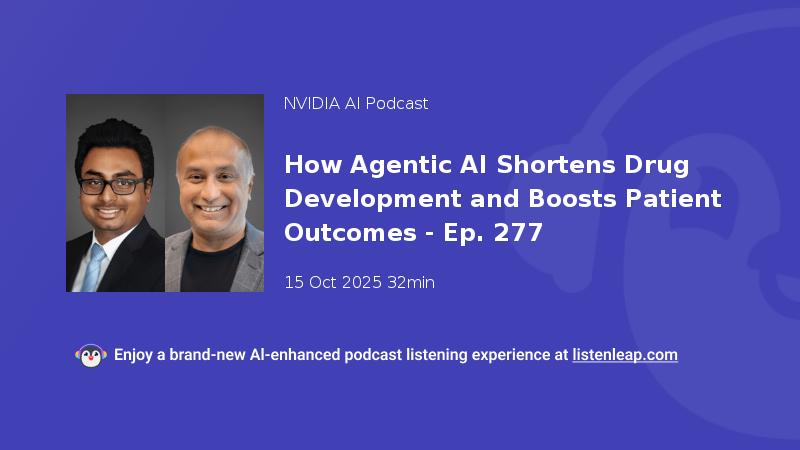
Raja Shankar serves as Vice President of Machine Learning at IQVIA, where he spearheads the application of artificial intelligence to transform research and development workflows in the life sciences industry.
His expertise lies in developing AI solutions that accelerate clinical research and drug development processes.
Avinabh Roy is vice president of commercial analytics solutions at IQVIA, focusing on how AI can revolutionize pharmaceutical commercialization strategies.
He brings extensive experience in leveraging advanced analytics and machine learning to optimize brand outreach and market access in healthcare.
Gentlemen, welcome to the NVIDIA AI podcast, and thank you so much for taking the time to join.
Thank you for having us.
Thanks for having us.
Absolutely.
I really appreciate it.
I know you're calling in from different time zones.
Had to kind of move some things to get this to work.
So I appreciate you guys rolling with us to get the podcast out.
Let's start with the basics.
Maybe Avinash, you can start and just tell us a little bit about what IQVIA is for listeners who might not know, and then a bit about your own role.
Then, Raja, maybe you can talk about your role as well.
Definitely, Noah.
It's a pleasure to be here.
IQVIA is a leader in using data tech and analytics to accelerate innovation from clinical to commercial, to drive life sciences pipeline.
If you think about this, The main objective is how do we bring the drugs that are crucial for patients faster, quicker and when they need it right?
And IQGO is the engine that is working with every life sciences company and healthcare organization to make that dream come true, right.
With the power of the data and analytics, which is now the way to approach this problem statement.
In my role, I've primarily focused on the commercial business, which is basically once the drug is approved.
Now you have to actually take this drug and make it available for the patients.
So in that, you need to understand where are your patients?
How do you reach them?
What's the messaging?
How do you make sure that every patient in every direction gets those drugs at the right time for their disease landscape?
And my job is to bring the tech and analytics together with the power of the data to make that happen.
And Raja, on your side of the house?
So I'm the counterpart to Avinash more on the R&D side.
So, just as he mentioned, we start early from a clinical development and a clinical trial perspective.
We run clinical trials. to get the drug to market, and then Avinop takes over.
In my role.
What I am leading is all of our AI and agentic AI program to transform how clinical development is done and how clinical trials are run.
So how can we improve the quality of clinical operations and clinical trials?
And how do we speed the time it takes for a drug to get to market so that patients can have it quicker?
Healthcare is one of the industries that is being most impacted and advanced and kind of evolved by AI, machine learning, all the things we talk about.
We've talked a lot about agentic AI this year in general.
Could one of you maybe, before we dig in, just kind of give an overview of what agentic AI means in IQVIA in the healthcare landscape, as opposed to other forms of AI machine learning that have been in play up until recently?
I mean IQVIA.
And we have built machine learning models or supervised machine learning models to do diagnosis prognosis, patient finding and so on.
Then, of course, with ChartGPT, generative AI came in and everybody is now aware of the ChartGPT function, how we can generate documents summarize, have a conversation and so on.
The key thing with agentic AI is because you can interact with the AI in natural language and it can output in natural language and it can also call upon tools, look at data and do different tasks.
This allows us to build more complex systems with multiple agents, where different agents do different tasks and they talk to each other.
The output of an agent can be the input to another agent.
And specifically within the context of R&D in clinical trials, we have very complex workflow.
Today, they are very manually driven workflows.
And what we are able to do this with agents is look at entire processes and say which of these aspects of these processes could be done by an agent and could be done faster by an agent.
It could be things like document generation.
It could be things like how can we track what is happening at a site level and ensure that it is ready to enroll patients faster, or everything is going fine at a site level?
We can talk a little bit more in detail about the agents in the future, but essentially take complex workflows and have agents execute them faster and better.
Very simplistic and very nicely articulated.
The way I picture this one is The ML model.
When we were doing the statistical model, AI ML, it's like showing an image of the car and asking is it a car?
Then we went into a generative AI where it says show me a car and it basically shows you an image of the car by predicting it.
And now you're asking, drive me to the work and the car actually takes you.
There's the next era of it, right?
So I think every aspect of the workflows within life sciences is trying to be identified, right?
Wherever there's a task that's repetitive, with human driven.
For example, you are about to launch a product and you're trying to understand the disease landscape, patient burden, access control so that you can launch your product with the right success right.
So that it can reach the patient.
Think about commercial operations.
You build a strategy, you have a great plan, you know who to reach out, but operational breaks down right.
How do you actually reach out to the patient?
Who are the HCPs that you need to call upon?
How do you pass on your message to your KOLs?
And it happens today so rigorously, with a lot of manual efforts, a lot of Excel SQL agents coming in and being a companion, helping the commercial ops to get there faster right.
And then end of the day, the engagements, right?
How do you make every engagement count and make it impactful?
So, across the value chain from the commercial space, agents are going to make every process squeeze the time.
And at the end, you're getting the drugs to the right patient at the right time, right?
So that's where we see agent engagement.
Yeah.
What's the current state of agentic AI adoption across pharma?
Are we super early stages?
Are we a little ahead of other industries?
What's the state like?
I think my point of view on this one is we are breaking that pilot barrier and try to enter into full-blown adoption and scale.
But that being said, there's a lot of stats out there that It's not going very well.
You know, the pilots are roaring success.
But when it comes to large-scale adoption, large-scale operationalization, companies are struggling right.
And like any change, It's a tough thing, right?
But here, one of the greatest things that has happened is this technology has been so easy to adopt and so reachable.
And it's really, that's why we all are talking about this, right?
Sure.
But the flip part of it is, it is doing what human does, right?
And try to be part of your equation.
So you have a new member coming and joining your house and now you need to adjust with them, right?
Takes time, yeah.
It will take strategy.
It will take an organization.
So it will take the whole village to come together to bring the new digital persona into your home.
As you guys were talking, I was thinking about how I actually need to make a doctor's appointment.
And I know this isn't quite life sciences, but I was thinking man, I need an agent that can make the appointment for me and get me to the office.
That's what I need on my end, right?
Yeah.
And then there's the other side of the equation, which is the compliance, governance, regulations.
To your point, how do you make sure that it suggests the right doctor with the right speciality to treat your specific one?
This is not one of the areas where you take a few shots and one of them hits at your success.
You need to make sure every shot counts.
Those, I think, are the barriers that are yet to be uncovered in a full potential realization.
Raja on the RD side, where do you see the biggest opportunity for agentic AI to enhance life science workflows?
I think there are two big types of transformation that are likely to happen with AI and agentic AI.
When I look at AI, it's also these kind of generative models that have a lot of power.
And these two opportunities are going to be clinical development simulation, which means can we simulate what is going to happen in clinical development and clinical trials before we spend tens or hundreds of millions of dollars on it, so that we are more confident of success, of how we design and execute the trials, both from a trial design perspective in terms of efficacy safety inclusion, exclusion criteria as well as a trial strategy perspective into which countries and which sites do we do trials?
That's one thing.
Can we increase the chance of success?
And then the second big opportunity for me is clinical trial automation with agents.
So every clinical trial has a lot of processes.
There are hundreds and hundreds of processes and they're very manual and time-consuming and repetitive and sometimes could be mind-numbingly boring.
Things that people have to do, like look at documents and insert that in another file after looking at that.
So this is completely ripe for agentification and if we're able to do that we could reduce the time of clinical trials, which is a big win to sponsors, because every six months they get to market faster than the NPV, extra NPVs and the hundreds of millions of dollars for them.
And Avinabh on your side.
On the commercial side, where do you see the biggest opportunities for wins with agentic workflows?
I think it's the same chain with the links, right?
So if Raja can make the trials go faster and the products comes out quicker, our journey on the commercial side starts from there right.
How do we make sure that we reach the right patients, right?
The one thing on the commercial side is commercial side is very rich on data.
All right.
Fundamentally, if you think about this, behavioral data, consumer data, execution data, clinical data and you keep on naming them.
The challenge is too much data leads to chaos.
Right.
We have data all over the places.
People are trying to stitch this data together before they can strike the insight.
And your launch is stalled because one single decision on those data points can lead to a multimillion dollar or even billions of dollars lost with your launch.
Right.
So, with all the launches that are planned over the next I would say five years across all formal life sciences are very, very critical.
Right.
So the way I see agent ecosystem and the ecosystem evolving is on the three parts of the equation that I mentioned earlier.
One as the launch happened understanding where to launch, how to launch and how do you make your strategy impactful.
Right.
How do you create baseline forecast and then reiterate them very, very quickly to create scenarios?
How do you identify where is the unmet need of your patients?
How do you understand what is the peers are looking for in your differentiation messaging of your drug right?
So, building the upfront strategy, can agent bring this all structured unstructured, heterogeneous data at a global scale and enable you to give that insights when you need it?
The second part of the equation is, good, you have a strategy, you have to operationalize it.
How do you create your, you know, your standard call plan, segmentation, territory design, right?
Who are the FCPs that you need to, you know, enable to have those conversations, right?
So your operational plan.
And then the last is your engagement.
Good that you have a strategy.
You made a plan.
Now you're operationalizing it.
But You know, at the end of the day your HCPs need to be aware of your drug.
Your patient need to be onboarded.
They need to be compliant, adherent, right?
So who are those people?
They are your front-facing, you know, communication.
So how do you make your marketing channels much more automated?
How do you create much, much HCP-driven engagement, which are faster, quicker, right?
So when you combine all these three parts of the strategy, we see agent-to-KI transforming every aspect of insight generation, task automations and workflow executions.
To your first point Abhinav, about the data, we recently did an episode with another health tech company, healthcare AI company called Cytoreason.
And they were talking about the guest.
Shai was talking about what he called the data insight gap and talking about how each year I mean each moment really right.
There's so much more new data being produced and generated that the chances of finding insight with kind of the ratio of like overall data to insight keeps growing and that those insights are, if not harder to find, they're just buried under more and more data.
And I always find it interesting because there's talk kind of in the broader community, or there has been talk this year about, you know, AI running out of data to train.
And you talk about these giant foundational models and where are we going to get more data and synthetic data and all of that?
In the healthcare space is there, I don't want to say too much data, but is the problem sort of inverse?
Is the challenge in that sense finding ways to keep up with the data and find insights?
Or how do you look at sort of the current state of all the healthcare data available and how to turn that into, you know, actionable insights, to use that term.
Yeah, that's a very good question and very timely.
We did a market research with roughly 107 odd life sciences executives, right?
And we asked this question.
Are you missing data or do you think data is going to be a critical factor of your AI success, right?
And the response was really interesting and very in line with what we are seeing in the industry is people are saying they are not missing data right.
Yes, there are some pockets of areas where you have a panel gap, you have a channel gap, right?
You are not able to collect the data.
But most of the executable says the gap is connecting the data, right?
Bringing the data together for the right use case to drive the right insight.
So it's that inverse curve, right?
80% of the time is just stitching the data and finding where it is.
And then 20% of the data is making sense out of it.
So to answer your problem, I don't think so that, so obviously the data will evolve.
We need more data always, right?
So that we understand every aspects of it.
But right now for AI, the problem is how do you bring the right data into the system so that you can generate the insight that the business needs right?
And don't wait for a year to create, you know, multi-mega data lakes and data system.
That has always been a journey that we always take right.
Every transformation.
So on this question Noah yes, there is some issue when companies like OpenAI or Anthropic or Google are training on the internet data, and maybe I don't know if data is running out, but there's a lot of the new data that is being created.
It's the same distribution of the old data.
So there is no new insight likely to come, because it's AI creating data, but it's a similar kind of thing.
But there is a lot of data that sits within enterprises like Acuvia, or in health systems et cetera, which dwarf the public data in some sense.
And the AI has not been trained on this data.
So there is information that is available in this data that is not there in these public models.
Now, one way that people are approaching this, including ourselves, is okay, let's take these public models and build agents that can scour our data and generate insight from it and help you make And here we are addressing.
The challenges that Avinash was talking about is how do you get the agent to go to the right data source?
How do you connect across multiple data sources?
How do you have multiple agents, data agents, et cetera that bring insights from multiple data sources?
I think that will take us quite far in generating insights from this data.
But I also think we need to be thinking about domain-specific data foundation models like say, AlphaFord from Google, where we train models on this domain-specific life sciences or healthcare data.
And some of this has started to happen, but not at scale which allows us to understand the underlying distribution in this data and compress this data to get information from this data that we can't get from agents.
Because agents, by definition, will only be able to look at a subpart of the data distribution.
For every task, they cannot look at the entirety of the data.
So I think there are these two things that we need to do the agents to generate insights from the data as it is and better connect the data, but also think about domain-specific models that we build.
And we need to do this relatively quickly.
And to Arvind's point, a lot of companies have spent time.
Let's build this beautiful data lake.
Let's get all this data together, connect them, and so on.
To me, that's like a fool's errand. to try to do that.
I think let's get going with the data that we have and connect and prepare and do this fast.
I'm speaking with Raja Shankar and Avinabh Roy.
Raja is Vice President of Machine Learning at IQVIA and Avinabh is VP of Commercial Analytics Solutions at IQVIA.
And we've been talking about the healthcare space as relates to agentic AI specifically.
And everything that comes with working with processing, mining data for insights, as Raju was just saying.
Certainly no shortage of data.
But one of the big challenges now is figuring out how to generate the right insights from that data.
And training specialized models, as we were talking about, is one of the paths right now that lots of folks are focused on.
Wanted to ask you.
You know, the whole point of healthcare right is serving the patients, patient outcomes, patient impact.
So, knowing that that's the end goal here for what IQV is doing, what your partners and customers are doing, how will actioning these opportunities, how will developing agentic AI systems really, in the end, support patient outcomes?
Think about it this way, Noah.
Today there are so many treatments available for patients, but there's a very heterogeneity of how physicians prescribe these patients today.
We have enough data in the EMR systems and others to determine, even with the treatments available today, to optimize the treatment regimen and the treatment sequencing for each patient to optimize their outcome.
Like for this cancer patient, should I start on an immunotherapy or a combination immuno plus chemotherapy and then go on to something else?
That information exists today.
Similarly, we have information in the thousands and thousands of half a million or more clinical trials that have been conducted today as to what works and what doesn't work.
But unfortunately, this data is silent.
Every sponsor has their own clinical trial data.
If they were able to pull this data together and run AI on this, we would design much better clinical trials than we are able to today.
We would reduce the rate of failure of clinical trials and we would make sure that the right patient gets the.
So the AI has a lot of potential here to completely change this.
The challenge is not the technology.
The technology exists today.
The data exists today.
The challenge is partly organizational and partly the silos that exist in the industry.
Couldn't agree more with this one.
And the similar thing goes on the commercialization, right?
I think how do we serve the patient?
End of the day, everything that we are doing is not about quicker volume, higher volume of revenue.
It's more about serving right patients and at the right time, right?
So, if you think about as identifying where the unserved patients are, where the underserved populations are, and you know, triaging your Drug launches your drug messaging towards those patient population.
So your launches, not just you have a successful launch in terms of volume.
You have a successful launch because you're reaching the right patients right.
Personalized engagement making sure that the HCPs who are actually serving those patients understand your drugs right.
Bring them to the efficacy and the compliance, right?
And adherence, right?
So that The patient just don't take the drug once and then fall off.
They understand and they get educated, right?
And then the continuous feedback loop, because these agents are learning from the real-world experience of what worked, what didn't work right.
So as you give more data and you give more domain expertise to it, it's getting much more smarter and giving much more better insights and much more better workflow orchestration.
And just on that.
One other thing I wanted to raise is Often people talk about like we talked about the silos.
That's one piece.
There's also data that exists in national health systems like the NHS in the UK and other countries.
But there's a lot of reluctance, sometimes justified, to apply AI on this data because there are fear of data privacy, data leakage security, all of these issues.
And these are legitimate concerns.
But we really need to overcome these concerns because by not applying AI to these data sets today, it's costing lives.
If we actually generate this insight, say for cancer patients or diabetes or cardiovascular, we could change the treatment paradigms.
We could see more patients quicker.
And this has an impact on actually quality of life as well as the length of life. that patient has.
So this is the balance side.
How do we balance the data privacy and security versus the actual clinical outcomes for patients?
We haven't got that balance right today.
The technology exists and we need to figure it out.
Along that theme of balance, but from a different perspective, companies that are thinking of adopting new technologies, adopting agentic AI, maybe adopting very specific agentic AI workflows for clinical trials or for any of the things that we've been discussing.
How do the companies have confidence in new solutions, in leveraging, deploying an agentic AI workflow?
You know how does a company?
We've talked a little bit about the data side and other sides, about how you know we're making progress, but maybe not quite 100, with some of these different ways of doing things we've been talking about.
What advice do you give to an end user, a customer, a company, when they're thinking about deploying an agentic AI solution and want to figure out well, how do we measure ROI?
How do we think about success, you know, short term, longer term?
What advice would you have for you know, an IT leader, a company thinking about embarking on a journey like this?
I can only imagine, yeah.
But I think the answer to this one is very simple, right?
Which is start with a clear business problem.
Don't get excited because it's a new AI.
Where can I fit it in, right?
It's like I have a hammer looking for a nail.
First understand what's the problem, how the AI use case that you're trying to go after fits with your strategic goal.
And strategy goal KPIs can be, how can we be launching our product time to market quicker?
Or can I increase my engagement lift with my HCPs?
Or how can I have per cost acquisition of a marketing campaign be lower?
So you need to have a clear definition of a KPI.
So your problem doesn't disappear just because you have an AI.
You start with the problem.
Second question is, Fail quickly.
It's good to have the holistic picture of the use case.
Run some quick pilot right with a clear goal that how you're going to take decision of gate.
Review those pilots and take quick decisions right.
People struggle because they keep on, you know, extending the pilot to POC, POC to something else, before they can call it a full-blown operation, right?
Third one is, I would say, ensure your data readiness, right?
Yeah, I have the AI.
I got the tool from OpenAI.
I have a business case.
Let's run.
We don't have the data. or data ecosystem.
But when I say we don't have the data, I don't mean then let's invest five years of creating data lake.
That's not what I mean.
I mean, in order to drive this, do we have a compliant data sources?
Do we have access to this data?
Do we have enough metadata to train the models?
Do we have enough documentation to talk about the process workflow that you're trying to organize with the agents?
That's where I feel like many of the use cases struggle.
Because if you can't tell the agent what to do, like a human will instruct, right?
Agent can't automatically do that stuff.
Last but not least, I would say design to scale.
Don't think from a POC.
Like one of the key things that we learned is POCs are very simple, right?
It creates a huge amount of motivation.
Oh my God, it can do a specific task.
The important part is that last mile taking the agent to the operationalization.
That is the hardest part.
So think about scale not just from a tech standpoint, but also from your organizational readiness standpoint.
Are you ready to adopt this?
What is your change management strategy looks like?
Are you hiring the people for the next generation who will be working behind or beside the agents?
What will that ecosystem look like?
So it's a transformational change that people need to adapt to, rather than an empirical change that you're making within silos of an organization.
There's a couple of things from that I would like to emphasize.
One is on the KPIs.
Aside from the KPIs of speed and productivity.
Often the question is how do I know that this agent works as it's supposed to do?
Yeah.
Then related to that is then you say okay, let's find some ground truth data and then see if we can compare the performance.
But what the challenge we have found is when we have done this manually.
There is no gold standard of performance, because we don't know what is good look like, because different people writing the same document will write it differently, or creating different insights will create differently.
There is no benchmark saying, is this 90% accurate or 70% accurate? we don't have any benchmarks.
So sometimes we actually have people saying don't use the historical information as ground truth because we don't know if it's good enough.
With an agent, at least you can measure that performance.
So one of the things that's going to change over time is we will start to get metrics of what good looks like in many different areas, which we didn't have before.
So that's one thing I really wanted to emphasize as we As we think about KPIs.
No, absolutely.
It's great to point out.
As we start to wrap up our conversation here, I want to ask you about the partnership, the relationship.
NVIDIA, IQVIA have a great working relationship together.
Can you speak a little bit to that, but through the lens of what comes next?
And you know it's about the partnership but it's more about the technology, where this is all going online, where the industry healthcare is such a broad industry.
So many ways to look at this.
But you know where healthcare is going.
Life sciences are going through the lens of being able to do more and more with the data, as hardware, as software, as the whole AI stack evolves.
Where do the two of you see?
You know, maybe speak to the relationship just a little bit now, but where do you see it headed over the next few years?
Yeah, I mean, I think this is a This is a partnership made in heaven, I would say.
Our goals are same.
Our objectives are driven, which is, how do we make life sciences go and do what they're supposed to do quicker, right?
Which is putting the drugs to the patients at the end, right?
And serving the broader population for health.
And if you think about this, I mean NVIDIA.
Like We all know right, they have great capability when it comes to AI, highly optimized to run on scale.
So I'm not going to talk about all the great capabilities that they bring to the table with their microservices, with their DGX clouds and their multiple Nimrotron models that we are utilizing.
I think for me, the core thing when I step back is our vision is to bring agents to life which are life sciences specific, who are trained on life sciences, understand what it takes to drive insights and mine data to serve broader population of the life sciences workflows right.
Which is the digital workflows.
How do you make that happen?
In order to make that happen, you need three things, right?
I think we need the data, you need the domain, and you need the tech.
But how do you infuse that, right?
Everybody talks about this, but how do you infuse that?
So I think the way we see it is what I think NVIDIA calls the data flywheel.
You get the data, you train the model, you have our domain experts use this day in, day out.
You capture that knowledge, and then you keep refining that agent.
Okay.
It's like you know you have a graduate graduating from a university, with all the theoretical knowledge.
That's the agent on day one.
And then they go 10 years of learning of the domain, right?
But that agent can learn it in 10 days, right?
Given our use case, right?
So I think that's where this infusion of this data tech and domain really comes to life for us right.
And if we can accelerate that journey, that's the goal.
And that's the motto I see that IQV and NVIDIA are locking together.
Fantastic.
Raja?
So for me, everything that Avinash said, I agree with.
I'm looking to the future.
I think we need to think about these kind of partnerships differently.
So NVIDIA has one advantage, right?
It's not a competitor to any industry.
It's an enabler of any industry because it's providing the infrastructure and support.
Similarly, if we look at parallel to IQVIA, IQVIA, as Avinash's boss actually said this once, IQVIA does everything that a pharma company does, but without having the truck, which means that we can provide support to every life sciences company without competing with them.
So their objectives and our objectives are 100% aligned.
Same as NVIDIA's objectives and its industry partners' objectives are 100% aligned.
So in that kind of context, can we think of new models of partnership where NVIDIA and IQVIA can come together to catalyze the building of agentic platforms that can serve multiple life sciences customers together?
Because we're enablers, we're not competitors to life sciences.
So thinking about seeding and even bringing sometimes different life sciences companies together, because A company that has to build any kind of platforms, they have to build a regulatory platform or a commercial operations platform.
The ROI for every company to build its own platform is not that high unless you have, like hundreds of molecules that you are selling.
Whereas if they work with us and NVIDIA to build this kind of common platforms that can accelerate everyone and they only are paying for a part of it, they get a whole value of it.
I think there is new models of partnership we need to think about.
And this is something we are working with NVIDIA on, like how can we jointly enable acceleration in life sciences for all of our customers?
That's the perfect place to wrap.
That's the goal.
I love it.
Raja, Avinash, this has been fantastic.
Again, thank you so much for taking the time.
A lot of really interesting.
You know, the technical stuff obviously is what drives this all in a lot of ways, but a lot of interesting considerations.
I think what you're talking about at the end, Raja, about new ways of thinking about partnerships.
It's kind of an era that we're entering into across industries and certainly in the life sciences.
There's a lot on the line.
I'll leave it that way.
It means a lot.
For listeners who would like to learn more, the IQVIA website, IQVIA.com.
Also, you have a big presence on LinkedIn.
Good place to go.
Yes.
Fantastic.
Well, gentlemen, again, thank you.
It's been a great conversation and we appreciate it.
And obviously, as somebody who depends on the life sciences and health care myself for a lot of things, we appreciate all the work you're doing and best of luck going forward.
Let's do it again.
Thank you, Noah.
Thank you so much, Noah.