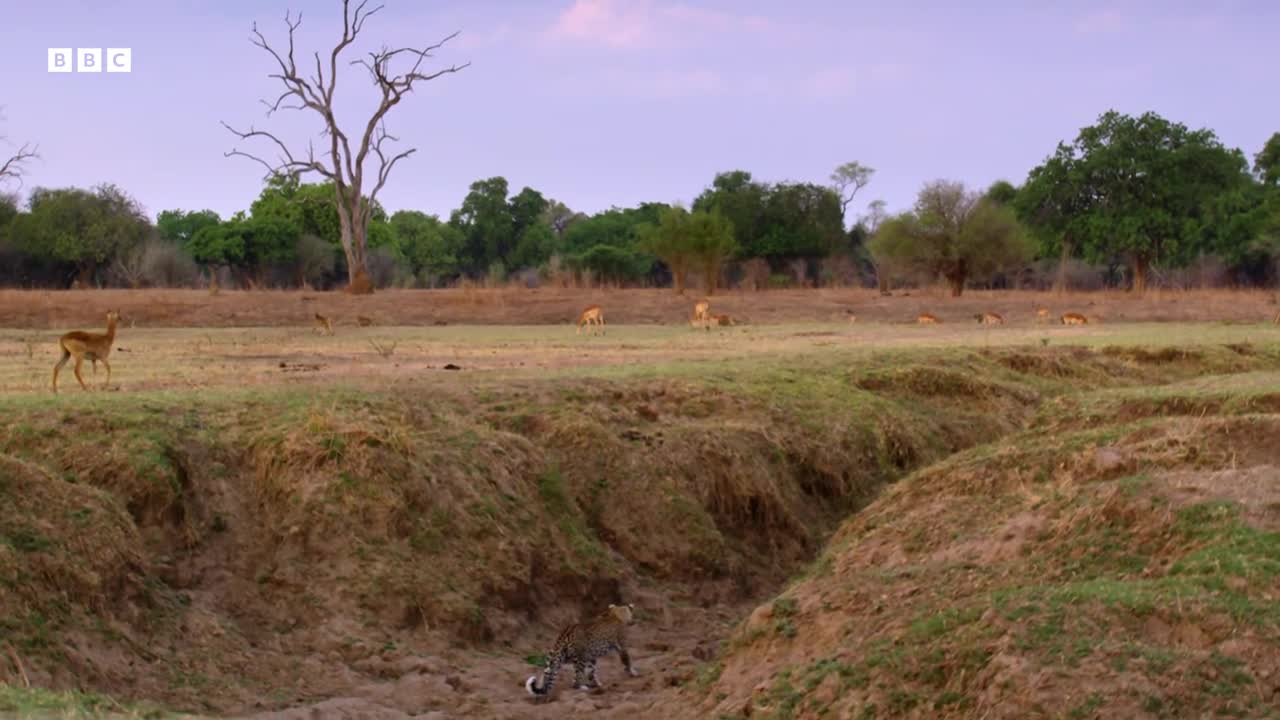
But leopards are the most versatile of all, the big cats adept at finding cover in the most unpromising places.
The steep walls of the gully are now her cover for an ambush.
The male puku is close enough, but he's too big to tackle.
She needs to slip past him without being seen. he'll blow her cover.
Slowly does it.
To succeed here, she needs to find prey grazing close to the edge or, better still, in the gully itself.
Success would have staved off hunger for a week.
But while there's prey around, there's hope.
Peeking over the top is a risk, but it's the quickest way to find a new target.
A burst of speed of 65 kilometers an hour, and it's all over in less than six seconds.
Except it isn't.
Dazed and disorientated, the impala makes a miraculous escape.
Somewhere along this seemingly barren stretch of sand, there is food in great quantity.
Cape fur seals.
There are around 10,000 of them here.
Adult seals are large and strong. but their pups are neither.
The youngsters are closely guarded by their mothers.
The hyena, however, knows to be patient.
Sooner or later, seal mothers must return to the ocean to cool off.
A single seal pup could feed a hyena and her family for days.
But finding food is only half the battle.
It now has to be carried back.
A jackal is here too.
And it's not alone.
If a hyena loses her kill, she'll have nothing with which to feed her cubs.
The jackals won't follow her very far from the coast.
It's too hot for them in the desert interior.
Only by making these long journeys can brown hyenas manage to survive in the middle of the Namib.
In just three weeks, half a million calves are born on these ash-rich plains.
That's 24,000 a day.
A thousand an hour.
Calves stand up within a few minutes of being born, though some need a little more time to find their feet.
But a mother won't let her calf suckle until it's mastered a few physical skills.
Walking.
Trotting.
And running.
Wildebeest calves must run if they're to stay alive.
For these planes also support the greatest assembly of hunters on the planet.
Each species has its own special hunting technique.
But all have the same aim.
To make the most of this brief superabundance of life.
Oh, shit.
Only one in ten wildebeest calves will survive to adulthood.
But that is enough to maintain the million-strong herd of wildebeest.
And the planet's highest density of predators.
And many animals here choose the simplest option of all staying hidden all day and only venturing out in the cool of the night.
As darkness falls, animals appear from seemingly nowhere.
And among them, inevitably, are hunters.
One of the most voracious nocturnal predators is also one of the hardest to see.
This mysterious creature hardly ever appears on the surface of the dunes.
But there are signs on the sand that can give it away.
It lives only here, where the sand grains are so perfectly dry and polished that they flow almost like water.
It's no bigger than a ping-pong ball.
A golden mole.
It's totally blind.
But there's nothing to see underground anyway.
Instead, it has superb hearing.
Its entire head acts as an amplifier that picks up vibrations through the sand.
So to locate prey on the surface of the dune, it has paradoxically, to thrust its face into the dune.
Not easy to catch when you're blind.
Far better to go into stealth mode.
Once below the sand, it can detect the slightest movement, allowing it to strike with pinpoint accuracy.
Well, most of the time.
It can travel a kilometer a night in search of its dinner.
And right now, it has just detected its main course.
Little wonder it's sometimes called the Shark of the Dunes.
The lions are surrounded by wildebeest on their annual migration.
A quarter-ton bull would make a good meal for all ten of the pride.
But even though Charm is an experienced hunter, most attempts end in failure.
Charm uses her hind legs to knock the wildebeest off balance.
The smallest cubs won't be able to catch food for themselves for another 12 months.
Their ever-growing appetites mean that Charm and Sienna have to hunt around the clock.
The females are often forced to head out alone.
Tonight, it's Sienna's turn.
Sunrise.
Sienna is seriously injured.
She's too weak to move.
A lone lion is always at risk of attack by buffalo, hyenas, even other lion prides.
It's evening.
And Sienna hasn't returned to her family.
Now, everything depends on charm.
For many years, Blacktip has lived in peaceful coexistence with her mother.
Each with enough territory to survive.
But Blacktip's pack has grown huge.
It's now 30 strong.
For the first time, she needs more territory if she's to feed her growing family.
Normally, a daughter would not invade her mother's territory.
However, with hyenas ruling to the south and humans having taken the hunting lands to the west, Blacktip has no choice but to turn her sights east, towards her mother's lands where, after a morning's hunt, Tate and her pack are resting.
Blacktip's pack outnumbers her mother's by more than two to one.
This has now become Blacktip's territory.
A brief but bloody battle.
Tate and her pack are now homeless.
She retreats eastwards.
But this is dangerous country.
The Namib Desert, one of the most exposed places on Earth.
As the sun climbs high, everybody takes cover from the extreme heat.
Everybody except the hot rod ant.
As others take refuge, their day is just beginning.
Cleaning out the nest. the sand can reach a scorching 70 centigrade.
The ants' long legs raise their bodies above the surface, where it's 10 degrees cooler.
But if they stand still, they will fry.
They must keep moving or risk the same fate as their quarry, the creatures that have collapsed from heat stroke.
Too deeply buried, but a good place to cool off.
Foraging decisions must be fast.
Too big?
Perfect.
Back to the nest before they also die. but they've strayed into a minefield.
Each of these strange cone-shaped pits is a death trap.
With a brutal predator at its center.
Here lie antlion larvae, tiny ambush predators with venom-filled pincers.
Some ants manage to escape, but the antlion has other tricks.
Flinging sand into the air, it creates an avalanche.
In this cone of death, the walls are so angled that the sand slips beneath the ants' feet.
As boulders rain from the sky, escape seems almost impossible. the Kalahari Desert.
Here, food is more plentiful, but it's hidden.
She can collect food that others can't reach.
A keen sense of smell enables her to detect the presence of ants and termites in their nests beneath the sand.
Her sticky tongue, some 30 centimeters long, enables her to collect them from deep underground.
And she's being carefully washed.
The drier it gets, the deeper the termites live.
Many are way beyond the reach of even a pangolin.
But not of an aardvark.
It's the world's largest burrowing animal.
Its sense of smell is extremely acute.
Shovel-like claws and powerful legs enable it to dig down to depths of five or six meters.
A full-grown aardvark needs to eat about 50,000 termites every day.
Termites are highly nutritious and full of moisture, and they can be collected here year round.
Aardvark are usually nocturnal.
But the fact that this one is foraging in daylight is a sign that food is scarce.
Recent droughts in the Kalahari have led to low termite numbers and, as a consequence, aardvarks here are close to salvation.
Changes in the world's climate are affecting many of Africa's animals.
It's predicted that in the next century, Southern Africa will warm twice as much as the global average.
The future will be bleak for those that cannot adapt fast enough.
A giant tortoise.
These creatures can float and live without food or fresh water for long periods of time.
This isolated atoll is the perfect refuge.
Their only enemy is the sun.
Without shade, a tortoise risks being boiled in his shell.
So, after feeding in the cool of the morning and before the sun becomes too crushingly hot, they have to find cover.
There is very little vegetation, but caves in the coral rock can provide the shade they so badly need.
He's nearly there.
All that is left is a white knuckle ride Thousands of others are still out in the sun.
This tree could shade a couple of hundred if they pack tight.
It's bumper-to-bumper parking.
Within an hour or so, all must find shade of some sort, if they're to survive.
But the future for Aldabra's tortoises is far from certain.
The climate is changing, sea levels are rising and Aldabra's tortoises may soon have to find a new refuge or drown.
Lions will normally avoid hunting in such heat. but they're also opportunists.
The lions will need to bring him down quickly before they overheat.
Even away from the herd, a bull is a formidable opponent.
It could gore and kill a lion.
Close to overheating, they finally succeed in bringing him to the ground.
But the massive bull is not giving up.
Against the odds and the full weight of the lions, he regains his feet.
And it is now that the tables turn.
The lions are exhausted.
After a 20-minute struggle, only the bull has the energy to finish the fight.
In such exposed and extreme conditions, the challenge for predators and their prey is at its most intense.
The temperature has reached 50 degrees.
Still, Black Kip pushes her pack on in pursuit.
They're closing in just a kilometer behind Tate.
But finally, the heat is just too much.
Blacktip is forced to call a halt.
But danger is approaching.
The pack are scattered.
And now the lions will try to pick off the puppies.
There's only one adult with pups.
That won't be enough to save them.
But this might.
Buffaloes and lions are always in conflict.
To charge in alone is very unusual.
But it certainly saved the pups.
As they mature, young males begin to explore the boundaries of the pride's territory.
Red has ventured out alone. and London straight into the middle of the hyena.
He's trapped by over 20 of them.
The pack tries to wear him down.
This number of hyenas could kill him.
Ah!
Ah!
It's impossible to fight them all at once.
He can't keep them at bay for much longer.
He's tiring fast.
His ally, Tartu, has heard the commotion.
Now the odds have changed.
Even for 20 hyenas, a pair of male lions is too much to take on.
Red is lucky.
Tartu has saved his cousin's life.
Every lake and river has a resident population of hippos.
They too are social creatures, but they are also territorial.
Spy Hippo is going where few others dare to go.
He needs to be cautious.
His subjects are notoriously bad-tempered.
And they could be anywhere.
It's never a good idea to get on their wrong side.
Spy Hippo has been given a warning.
He must avoid sudden movements.
As he gets closer, ear wiggling shows confidence.
Facing one of Africa's most dangerous animals, spy hippo must hold his ground.
The pod is made up of females looked over by a single male.
Fortunately, females are less aggressive.
Spy hippo is already capturing some of the closest views that have ever been seen.
But hippos spend much of their time below the surface.
As the hippos dive, so must Spy Hippo.
He mimics their movements.
Rather than swim, hippos walk underwater.
Through the murk, Spy Hippo glimpses an extraordinary sight.
The fish are shadowing the hippos every move.
These are barbs.
They usually feed on the riverbed, but when the hippos appear, they shoal around them.
As Spy Hippo moves closer, it's clear that their skin is a maze of cuts and scratches.
These fight marks easily become infected and parasites can also invade.
This is where the fish come in.
Together, they set up an underwater clinic with the hippos as willing patients.
The barbs may be skin specialists, but they'll try a bit of dental hygiene too.
After having a full body treatment, the hippos seem to enter a trance.
She's the biggest meerkat they've ever seen and requires serious examination.
She's been made to smell like the colony, so this reassures them.
Each day, different volunteers set up a creche giving all the child support a mother could wish for.
They share roles, including sentry duty.
It demands concentration and it's easy to lose focus.
And sometimes it's good to have someone watching your back.
Being a sentry is a risky business as they are easy targets for predators.
But with young pups to protect, they take greater risks by climbing higher.
Here, they can see predators earlier, but are vulnerable to birds of prey.
Their self-sacrifice is about to be tested.
But this is no ordinary cobra.
It's a spy cobra.
With no regard for her own safety, she prepares to face the snake.
She reacts as she would to the real thing, bravely protecting the colony, with no thought for herself.
Her aim is to harass the snake into leaving.
But with Spy Snake holding its ground, the meerkat calls for reinforcements.
This is where fraternity comes into its own.
An intimidating wall of meerkats face up to spy Cobra.
They push their luck as far as they dare, goading the snake to strike.
Real snakes tire easily, so it's a matter of wearing it down.
But one meerkat senses there's something different about this serpent.
It may look and move like a real snake, but it shows no sign of leaving.
Spy Snake has been well and truly rumbled.
Satisfied he's harmless, the meerkats go back to what they enjoy best.
Relaxing among friends.
To help with the filming, Spy Egret has backup.
This is Dung Cam, a camera based on a pile of elephant poo.
It even smells the part.
It's designed to film on the move.
Its zoom lens can capture the elephant's every move.
That's not all.
It can release a team of spy dung balls to litter the savannah with yet more cameras.
One dung ball is radio controlled and can travel without any visible moving parts.
With the action covered from every angle, it's time to see what this elephant family gets up to.
The babies must learn the rules of behaviour at an early age.
Wrestling older siblings is a favourite pastime.
They learn their own strength and, crucially, how to play nicely with each other.
It's the older elephants who make sure they don't cross the line.
It takes a few years before they're big enough to do real damage.
But as they get older, they need to be reined in.
Those who overstep the mark soon know it.
The rules are strict for everyone when the family is on the move.
To follow them, Spy Egret and Dunkham join forces.
For their own safety, the babies must stay next to their mothers in the centre of the herd.
The elephants are heading to the swamp. a place to cool off as the day heats up.
But the mud can be treacherous and babies must only enter with their mums.
But this little one seems to have forgotten the rules.
Chasing egrets is irresistible.
But as the herd enter the swamp, the baby is being left behind.
Realizing his predicament, he looks for his mother and thinks he's found her.
He tags along as the group head into the swamp, but he's following the wrong elephant.
With his mother nowhere to be seen, he's lost in a confusion of trunks and legs.
The elephants head into the swamp without him.
The baby is now alone and afraid. while his herd appear to have forgotten him.
He can smell that his mother is out there, somewhere.
But entering the swamp alone could be deadly for one so small.
He's really starting to panic now.
His mother is inexperienced.
She's only just realized her mistake.
Both will have learned from what happened.
He won't misbehave while the family are traveling again.
These bizarre little birds are baby ostriches. desert survivors.
But in the Kalahari, these early days are perilous.
Like leopards and meerkats, adult ostriches can extract all the moisture they require from their food.
The chicks, however, won't survive much more than another day without water.
But there's none in sight.
How can their parents conjure up water out here?
The youngsters follow their parents as they head out onto a featureless wasteland.
It seems like a suicidal journey.
The Etosha salt pan.
Here, water is more often a mirage than reality.
It's now well over 40 degrees centigrade.
Their father shades his chicks from the midday sun.
Another mirage?
No, the ostrich family is not alone out here.
Surrounded by the vast expanse of sun-baked mud, sweet, fresh water wells up from deep below ground.
Like a miracle.
Deep below lies a secret.
One that was discovered only 25 years ago.
Humid air rushing to the surface gives this place its name, Dragon's Breath Cave.
The shaft descends for 60 meters until it meets water.
Here there is a massive chamber big enough to swallow three jumbo jets, nose to tail filled with cool, fresh water.
The world's largest underground lake.
This is fossil water.
It's been trapped here undisturbed for thousands, if not millions, of years.
We have no idea how deep the lake is.
Divers have been down to 100 meters, and still there's no sign of the bottom.
Remarkably, dragon's breath is part of a vast cave system that extends beneath the Kalahari for thousands of kilometers.
Even here, in this lonely cave, Golden catfish, only found in this one cave.
They're the rarest and most isolated fish in the world.
Life down here is as challenging as it is in the desert above.
There's no food, except the debris that occasionally falls onto the surface.
And these catfish are totally blind.
The only world they know is the one they sense through touch.
A blind fish living in perpetual darkness, deep beneath one of the most arid regions of Africa.
The old bull won't tolerate a rival.
Pushing and shoving, they size each other up.
The young rival seems to think he has a chance and attacks.
The first few blows usually settle things in such battles, but here the stakes are high.
To lose means exile in the desert.
Neither will back down.
As the fight intensifies, they change tactics.
The young male aims for the rump.
The old bull targets his rival's legs.
The old bull is down.
Is this the end of his reign?
He knows a knockout blow is coming.
But the old bull ducks.
And strikes a blow to his rival's underbelly. out for the count.
The old bull is victorious, but only just.
This agama lizard has spotted an opportunity.
Only one thing attracts more flies than the wildebeest.
Lions are famously bad-tempered.
They could swat the lizard like the flies he's hoping to ambush.
Or her.
Maybe...
To be within striking distance, he's got to hold his nerve.
Got one.
Now he's getting his eye in.
But this might be a bit ambitious.
It may take courage to hunt on the back of a lion.
But it takes sense to know when to run away.
The wildebeest won't stay for long, and when they leave, most of the flies will follow.
Among the steaming geysers of Lake Bergoria, over a million lesser flamingos bathe and feed in the caustic water.
They gather whenever the algae bloom.
These huge numbers create one of the greatest wildlife spectacles on Earth.
Almost all the world's lesser flamingos live on this chain of lakes, moving from one lake to another as the amount of algae in each changes.
All along the lake shore, volcanic vents are a reminder of the forces that continue to change this land.
And a streak of color on the horizon signals that relief for the parched plains is on its way.
A crowned eagle has been desperately waiting for what she hopes the rain will bring food for her hungry chick.
Nesting here has been her biggest gamble.
Her chick's life depends on the arrival of creatures from the far rainforests of the Congo.
Her wait will soon be over.
The largest mammal migration in Africa is on the move.
Ten million fruit bats are drawn to this tiny forest on the edge of the eastern savannah.
The bats flock here to gorge themselves on fruit.
It's what the crowned eagle and her chick have been waiting for.
But they're not alone.
Other eagles have flown in from miles around fish eaters, marshal eaters, and they're all after the bats.
The gamble the crowned eagle took months ago by nesting here has paid off.
She is the only eagle to actually nest in this forest, the only one who took the risk to breed here well before the trees came into fruit and the bats flooded in.
She only breeds once every two years, so her timing must be perfect.
In a few months, the bats will leave.
But her gamble means her chick will have the best possible start in life.
But their secret is out.
Nothing is safe in this forest.
Chimpanzees love hunting.
She seems oblivious to danger.
A fall from up here could be fatal.
But she does need a bigger stick.
Only a chimp has the ability to break into a stingless bee's nest as well hidden as this.
Chimps are extremely intelligent, but none is born with the skill to use a tool.
Youngsters like this one must learn by watching.
She uses special tools, one after another, to get all the honey she can.
And in a few minutes, she destroys what took the bees years to build.
In the rainforest, nothing is safe.
The top at last.
But he's late to the party.
The higher a male sits, the further his voice will carry.
So the top slots are worth fighting for.
And he's won.
He has the top place.
So now it's time to sing.
And a white-bellied female responds.
They join together to mate.
The loser will have to wait for the next storm before he sings again.
She lays her eggs on a blade of a long leaf.
And he, using his back legs, folds it over and glues its two edges together, shutting the eggs inside.
This sealed nest is the safest place these leaf-folding frogs can find to protect their precious brood.
Within days, the eggs are developing.
The rain washes away the glue and the tadpoles slip out of the leaves into the growing puddles below.
The precious salt and the chance to socialize bring in elephants from far and wide.
If an elephant is in the mood to mate, this is the place to be.
This young bull is in a state of musth, a kind of sexual fury.
He is so pumped up by hormones and the excitements of the crowd that he seems to have taken leave of his senses.
But will throwing his weight about impress the females?
The cows only become fertile once every two years, so opportunities to encounter one at the right time are not common.
This could well be the first chance this young male has had.
He's lucky.
And there are no older bulls around to put him in his place.
Just for a moment, he is king of the by.
But his rule doesn't last for long.
Enter another lusty bull.
And a much bigger one.
But the young bull is still charged up with testosterone.
Bold or foolish, he's going into battle.
Thank you.
She never really had a chance.
Few creatures start life with the odds for success so heavily stacked against them.
Yellow-billed kites.
Pied crows.
But so many of these hatchlings appear together that predators can't catch them all.
Last out, this baby might seem doomed.
But struggling out late could just give her a chance.
The crows seem insatiable.
Even those that reach the sea aren't safe.
This female has to make a dash for it.
She's still in danger, and not just from above.
The ghost crab may be smaller than the hatchling, but it has the strength to drag her into its lair.
Not this time.
At last, the sea.
She has to catch her breath if she's not to drown, but the pounding waves make it desperately difficult.
Beyond the surf, calmer water.
But even here, the hatchling is not out of danger.
She dives... just in time.
After the rains, butterflies have emerged together in huge numbers.
As soon as their wings dry out, they will take to the air.
Their goal?
To find a mate.
But how?
There may be thousands close by, but the foliage is so thick it's difficult for them to find each other.
They have a remarkable solution.
They follow rivers upstream and travel to higher ground.
The journey can take hours of determined flying.
Eventually, they emerge into the only open space there is.
The treeless peak of Mount Mabu.
Up here, free from the confines of the forest, they hold a butterfly ball.
Now the butterflies have all the space they need for their aerobatic courtship.
The male's strategy is simple.
Fly higher and faster than the competition, and just maybe you'll win a virgin female.
This spectacular gathering, unseen by outsiders, until now, happens for just half an hour each morning and for just a few weeks in the year.
Once mated, the females descend back to the rainforest to lay their eggs.
A forest that only exists because of moisture rising from the warm Agulhas current, hundreds of miles away in the Indian Ocean.
A dense coat of feathers that keeps her warm in cold seas now stifles her.
On these exposed rocks, she must shade her eggs instead of keeping them warm.
Everything here seems the wrong way around.
For some, the soaring temperature is too much.
A neighbor deserts his nest.
His egg will not survive.
He's not the only one to give up.
Some years, not a single chick is reared.
Penguins are adapted to withstand temperatures of 40 degrees below zero.
Not 40 degrees above.
Now, at the hottest part of the day, the very worst time, her chicks are hatching.
Just when they need her most, she's reaching the limit of her endurance.
After ten days of intensive fishing, the chick's father comes back to take his turn at the nest.
But will he be too late?
He greets his young for the very first time.
A lone Grevy's zebra.
He weighs close to half a ton and could go for three days without drinking.
Like the macaques, his forebears were refugees from the advancing Sahara.
The land is scrubby and dry.
But this stallion has claimed it as his own.
He's been waiting months for visitors. female visitors.
If they like his territory, they might stay a while.
It's his first chance to mate for a very long time.
Hardly a success.
Perhaps his visitors are looking for a more impressive partner.
There's another setback.
The females were being followed.
A posse of young males.
Everyone a rival.
It's time to separate the men from the boys.
One by one, the stallion sees them off.
The females had ringside seats.
And his prowess has not gone unnoted.
Machismo gives way to Tentenus.
This oasis is fed by a hot volcanic spring.
Slightly away from the stream of near-boiling water, it's cooler and fish can live.
These are tilapia.
Hatchlings stick close to their mother.
There are other dangers here beside the scalding water.
Particularly at night.
And the tilapia are almost blind in the darkness.
In panic, they all leap to escape the hunter's approach.
But this female can't abandon her brood.
The crocodiles won't be thwarted.
They too can leap.
With first light, the crocodiles lose the element of surprise, and the battle is over for now.
The mother fish has survived, but where are her young?
All present and correct.
They spent the whole night sheltering in her mouth.
The contest will be repeated at sunset.
There is nowhere else to go.
It's approaching midday.
A fringe-toed lizard is hungry.
He's on a stakeout.
Flashy scales reflect some of the sun's rays.
Nevertheless, the heat is almost unbearable.
His prey hasn't left home all day.
The lizard is the last animal still out on the dunes.
But even he can't take it anymore.
To survive longer, you'd need a space suit.
And in a way, that's what these insects have.
Silver ants' armored skin reflects light.
They can tolerate temperatures that would kill any other land animal.
Even so, they can only survive for less than 10 minutes in the midday sun.
Time is precious.
The ants race to find food as soon as their predators go to ground.
They can't afford to waste a second getting lost.
So they spin to take a bearing from the sun.
They log every change of direction, every footstep, in order to know exactly where they are and where their nest lies.
Only four minutes to spare, and they found a victim of heat stroke.
A meal. but it's going to take a monumental effort to get it home.
Three minutes to go and they're nearing their maximum temperature, an astounding 53 degrees Celsius.
But there are already casualties.
One minute left and they're not going to make it.
Something has to change.