This message comes from the Center for U .S.
Voters Abroad Foundation.
If you're a U .S. citizen living abroad, the Center for U .S.
Voters Abroad Turnout Project's online form will walk you through requesting your ballot in just five minutes.
Visit internationalvoter .com.
This is Planet Money from NPR.
Of all the homegrown American art forms, like jazz or tap dance or abstract expressionism, is there anything more quintessential American than advertisements for lawyers?
Yes. Here is one for a lawyer in Texas.
He's called the Texas Lawhawk.
He's wearing a suit and tie, trying to convince the citizens of Texas to call him when they get in trouble, all while riding a mini dirt bike.
Dude, cross this. Dude, wheelies.
Another great one is from Lerner and Rowe Law Group out of Arizona.
Every time you hit the road, you're faced with a lot of possible danger.
This is two grown men, distinguished members of the bar, dressed up as Mario and Luigi, driving around in like Mario Kart cars.
If you're hurt in a wreck and you don't call Lerner and Rowe, it's...
It's a me, your lawyer.
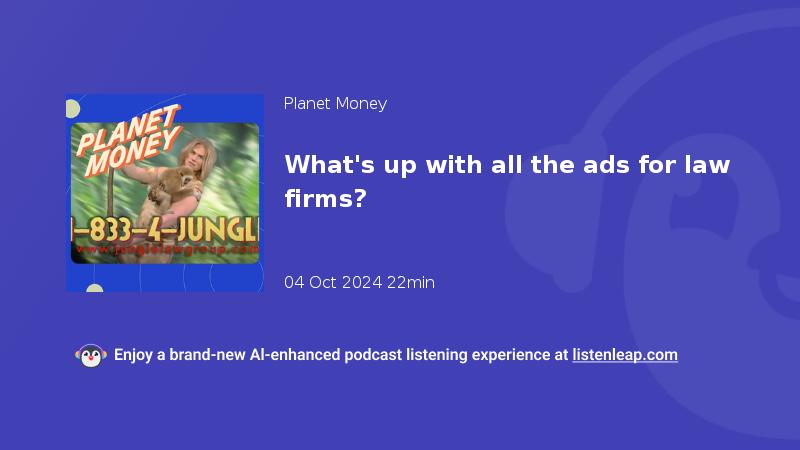
But my all time favorite is this one from a firm in Missouri that calls itself the Jungle Law Group.
Lost in a legal jungle?
Have no fear. The lawman is here.
Yeah, here is a lawyer swinging across the screen on a vine like Georgia the Jungle style.
And he's like half naked.
Call me. 1 -833 -4JUNGLE.
The lawman never sleeps.
But it wasn't that long ago that none of these ads would be allowed.
Not because they're tacky, but because for most of the 20th century, lawyers were basically not allowed to advertise.
Until a few of them did the unthinkable.
They put this ad in a newspaper.
This sounds so quaint now.
Do you need a lawyer?
Legal services have very reasonable fees.
Divorce or legal separation, uncontested, $175 plus $20 court filing fee.
Preparation of all court papers and instructions on how to do your own.
Hello and welcome to Planet Money, I'm Nick Fountain.
And I'm Jeff Guo. There was a time back in the day when lawyers couldn't come out with clever TV ads or billboards or bus station ads.
It was all forbidden.
Today on the show, how that changed, how we went from a boring ad in a local newspaper to lawyers who will do things like swing through a fake jungle on a fake vine.
And how along the way, the right to advertise got put on the same level as some of the most important fundamental rights we have.
This message comes from Indiana University.
Indiana University performs breakthrough research every year making discoveries that improve human health, combat climate change and move society forward.
More at IU .edu slash forward.
It's a high stakes election year.
So it's not enough to just follow along.
You need to understand what's happening so you are fully informed come November.
Every weekday on the NPR Politics Podcast our political reporters break down important stories and backstories from the campaign trail.
Do you understand why it matters to you?
Listen to the NPR Politics Podcast wherever you get your podcasts.
Support for NPR and the following message come from the Walton Family Foundation working to create access to opportunity for people in communities by tackling tough social and environmental problems.
More information is at waltanfamilyfoundation .org.
The story of how the US got blanketed with advertisements for lawyers on billboards and bus stop ads and TV and radio starts in the 1970s in Phoenix, Arizona.
Two young attorneys had just started a new firm.
Their names were John Bates and Van Osteen.
The first decision they had to make according to John Bates, what to call their new firm?
Bates and Osteen or Osteen and Bates?
So he said, okay, here's what we'll do.
We'll flip a coin. And the person who wins has the choice of even have their name first or they can have the nicest office because we had one office that was much better.
So I won and I said, okay, it's legal clinic of Bates and Osteen.
And he got the nice big office.
So that's fine. That's how that got started.
The idea behind Bates and Osteen was to create a low cost law firm for the masses.
This was kind of revolutionary at the time.
The rich of course had access to lawyers.
Absolutely, no problem.
They just go and ask their rich buddy at the golf course, you know, who do you recommend?
And boom, they got somebody.
And for the poor, there were public defenders and legal aid.
But for the rest of the population, AKA the vast majority of people, hiring a lawyer was an ordeal.
John says the middle class just didn't have that many options.
There was nothing out there, nothing.
There was not only an ability to find one, but there were no specialized law firms dealing with the problems of that segment of society.
So you had that too.
Bates and Osteen would not be like the other law firms.
No, they were gonna be like an assembly line for everyday legal needs.
They were gonna specialize in simple cases that they could get done quickly and that they could charge a small fee for.
Divorce, adoptions, name changes, bankruptcy, stuff like that, maybe some landlord -tenant stuff.
So you were creating just a workhorse law firm.
Yeah, I mean, it was devoted to kind of common problems that people had, you know.
It was a volume business.
Well, that's the problem.
Yeah, pretty soon John and Van realized they had a big problem, the classic problem of any volume business.
When your margins are low in order to make a profit, you need to get a lot of people in the door, but they couldn't find clients, or rather, clients couldn't find them.
And the reason is, well, that is what this show is all about.
They couldn't advertise.
In the early 1970s, lawyers were essentially banned from advertising.
I'm assuming you couldn't go out into traffic with a big sandwich board and say, the legal clinic of Bates at O 'Stead, no?
No. Can you put your name on a pencil, give that out?
No, no. Can you advertise in a newspaper?
No. Can you advertise on TV, on the radio?
Oh, no, of course not.
You would be disbarred for that, yeah.
Disbarred is a pretty big deal in the law.
Very serious thing.
This anti -advertising rule came from the Arizona Bar.
The bar is like a professional guild, every state has one, and they control who gets to call themselves a lawyer and practice the law.
In fact, full disclosure, I'm a lawyer, and I had to join a bar.
Yes. Now, every state bar at the time had rules banning lawyers from advertising.
The reason they gave was that advertising was unprofessional, ungentlemanly, maybe even unethical.
In their minds, advertising would lead to this race to the bottom quality -wise and create an industry full of skeevy lawyers.
It was a slippery slope from advertising to ambulance chasing.
Instead, the state bar expected lawyers to attract clients by getting referrals from other lawyers or in the oldest fashioned way, just waiting for clients to waltz into their offices.
But from John's point of view, the bar's ban on advertising made it much harder for new law firms, like his and Van's, to get clients.
It was a barrier to them, and to new entrants in general.
Well, yeah, it was monopoly.
Pretty much, sure. Yeah, I mean, most attorneys wouldn't have tried to start their own firm.
They'd say, wow, you're gonna start your own firm?
How are you gonna make that happen?
You're just a young guy at a law school.
Nobody knows you're there.
How are you gonna start?
That was exactly the problem that John and Van were running into.
Without advertising, they couldn't get enough clients to make their business work.
And so, they make a fateful move.
They decide, screw it, let's risk getting in trouble with the bar and put an ad in the newspaper.
The one we heard in the beginning.
Divorce or legal separation, uncontested, $175, plus $20 court filing fee.
And this right here, this is the ad that changed everything.
Information regarding other types of cases furnished upon request.
Legal clinic of Bates and Osteen.
God. Anyway, that's what it was.
John knew they'd immediately get in trouble with the Arizona bar.
In fact, he was kinda hoping they'd get some free publicity out of it.
So, when the Arizona bar hauled them before a disciplinary committee, they were ready.
They'd already lined up their own lawyer.
And they filed an appeal, saying that the bar's ban on advertising was illegal.
Might even violate the constitution.
Their case went to the highest court in Arizona.
They lost. But that meant they could take it all the way to the Supreme Court of the United States.
That is after the break.
. . . . . . . . . .
. . . . . . . follow up and we bring you along to hear what we learned.
Get closer to the issues, the people, and your vote at the NPR Elections Hub.
Visit npr .org slash elections.
This message comes from 60 Minutes, A Second Look.
Journey through the vast 60 Minutes archives, unearthing never before heard audio to give fresh perspectives on the people and events that shaped the world.
Listen to 60 Minutes, A Second Look wherever you get your podcasts.
If you enjoy Planet Money, you should try out NPR Plus.
With Planet Money Plus, you get sponsor -free listening and exclusive bonus episodes from just this show, but you can upgrade to the NPR Plus bundle and access perks from over 20 of NPR's most popular podcasts and more.
Give a little, get a lot in return.
Visit plus .npr .org.
So, it's a bitterly cold day in January in 1977.
John and Van are headed to the Supreme Court.
They put on their suits and ties, they walk up the marble steps, and they sit down on the long wooden benches.
John says, kinda felt like going to church.
Everybody who's ever visited the Supreme Court will tell ya it's a lot more intimate than you'd expect.
The judges are pretty much in your face, all nine of them sitting in a row.
The Chief Justice announces the case.
We'll hear arguments next in 76, 316, Bates and others against the state bar of Arizona.
The Chief Justice of the United States was saying your name.
Yeah, I think that's right, yeah.
John and Van's lawyer gets up, he goes up to the lectern and starts making their arguments.
Mr. Chief Justice, may I please the court?
John says you could hear every creak of the benches and cough from the audience.
Yeah, it was so quiet that when John turned to Van to say something, one of the court police immediately noticed.
John had violated the number one rule of being in the audience, which is don't talk.
Right away the guy, the guard, said, pointed at me, said, you, one more time, you know?
And I was thinking, wait a minute, I'm the guy, you know, it's me that this is all about.
You can't throw me out.
I'm the Bates, it's me, Bates.
Yeah, yeah, yeah. That's the thought that went through my head, I thought, boy, you better watch out, you only got thrown out of your own case, because I would have been thrown out of it.
Now, the lawyer representing John and Van, he tried a couple different arguments that day, but the most interesting one and the most controversial was based on this brand new, kind of wacky legal theory that advertising is protected by the First Amendment, you know, free speech.
Yeah, John and Van had landed themselves in the middle of this huge revolution in how we think about the First Amendment.
Up until this point, when people thought about the First Amendment, they were thinking like, newspaper editorials or political cartoons, not ads for Kleenex or whatever.
But in the courtroom that day, sitting on the benches, there was this guy, a guy who had been quietly working to change all of that.
Alan Morrison, A -L -A -N Morrison, gotta get that spelling right.
Alan is the person who came up with that weird new legal theory about the First Amendment.
I won't agree that it's weird.
I'll say it's innovative.
And that's what we tried to be.
And we're gonna spend some time with Alan, because this idea that he came up with, it's become kind of legendary.
It's low -key changed how the economy works.
The story goes like this.
Back in the early 70s, Alan was this hotshot young lawyer working for the consumer rights crusader, Ralph Nader.
They ran this law firm that represented consumers and the public.
They would sue big corporations, big government agencies.
The ideology was, we were little guys, we were gonna sue the big guys.
A big focus for Alan was ending this ban on lawyer advertisements.
He had started looking into it years before John and Ben got in trouble with the Arizona bar, but Alan came at it from a different angle.
Yeah, from the side of consumers.
Alan thought that a lot of advertising was good for consumers, could give them valuable information about the market, even help drive down prices.
And Alan had the perfect lawsuit to test this idea.
He'd been cultivating a very interesting case in Virginia.
It was about pharmacies.
Right. Back in the 1970s, lawyers weren't the only ones who were banned from advertising.
There were statutes in Virginia and I think 35 states that made it illegal to advertise the price of prescription drugs.
The pharmacist couldn't advertise that will sell this insulin drug for X and our competitors are selling it for X times two.
Absolutely forbidden.
And Alan being the consumer rights lawyer that he was, he thought this was terrible for customers.
Yeah, when pharmacists can't advertise their prices, it's much harder for customers to comparison shop.
This is where Alan came up with his revolutionary idea.
His new idea was that advertisements were so important that they should be protected by the constitution, by the First Amendment.
And you have to understand at the time, just how absolutely wackadoo this idea was.
Yeah, cause the way people had always thought about the First Amendment, it was about securing democracy.
It was about giving people the right to criticize their government.
It wasn't about commercial speech.
It wasn't about advertising.
In fact, Alan's idea went directly against Supreme Court precedent.
The court had literally said, nobody has a First Amendment right to advertise.
But that was not gonna stop Alan.
He was a hot shot young lawyer who wasn't afraid of any precedent.
And one day he thought he might have found a workaround.
I felt like, you know, oops, we got an idea.
You see, most of the time when courts talk about the First Amendment, they're talking about someone's right to speak, to say something.
But Alan was like, hold on.
There's this other side to the First Amendment.
The people who want to hear you, the listeners, they have First Amendment rights.
Alan's idea was to focus on the listeners.
So instead of arguing that pharmacists in Virginia have a First Amendment right to advertise, he argued that the pharmacist customers, the people of Virginia, had a right to listen, to receive and have access to information about drug prices.
Drew? Advertising. And yeah, that was a controversial idea.
I remember I had a conversation with a neighbor of mine.
It was a lawyer at a big firm.
Nice guy, very smart.
And I told him about the case.
He said, ah, you have no chance of winning.
I said, well, I don't know about that.
And I was right, and he was wrong.
Yeah, this Virginia pharmacy case went all the way to the Supreme Court.
And Alan won. He got the court to basically overturn its own precedent.
And in the end, what really seemed to convince the justices was this economic argument that Alan had made.
The Federal Trade Commission had done a study, and the study showed that in the states where advertising of prescription drugs was permitted, the price of those drugs dropped dramatically as compared to the states where it wasn't permitted.
Basically, free speech through advertisements equals lower prices.
Alan had convinced the court that free speech wasn't just important for politics or democracy.
It was also important to the economy, that the free flow of economic information was essential to having a free market society.
Alan's weird legal theory had become the new Supreme Court precedent.
Advertising or commercial speech, that was now protected under the First Amendment.
Which brings us back to John and Van's argument at the Supreme Court.
Remember, their goal was to make it possible for lawyers to advertise.
And their lawyer gets up there and basically says, if pharmacy ads are protected by the First Amendment, then lawyer ads should be protected, too.
I submit that all of the elements which the court found commanded First Amendment protection in Virginia State Board of Pharmacy are present in this case.
And it works! The justices vote 5 -4.
And the majority felt like these advertisements were protected speech because they spread useful information about prices and legal services.
John and Van had won their case.
Lawyers were now allowed to advertise.
And initially, ads for lawyers were kind of quaint.
But they soon spread from newspapers to billboards to the radio and to television.
These days, to be a successful lawyer, it's often not enough to just be good at the lawyering part.
You also have to be good at selling yourself.
Maybe even swing on a vine half naked.
The lawman never sleeps.
Every time you hit the road, you're faced with a lot of possible dangers.
Counts of justice! At the same time, advertising has created a world where there are just much more low -cost legal services out there.
People have more access to lawyers.
There's more competition in the market.
And that commercial speech doctrine that Alan pioneered and John and Van pushed forward, where the government has to tread lightly when regulating advertising, it kind of took on a life of its own.
Yeah, Alan's Virginia Board of Pharmacy case went way beyond just pharmacists or even lawyers.
This is a case that is taught in every law school because it completely changed how companies are allowed to talk to their customers.
Yeah, it has been used to defend ads for liquor and cigarettes and gambling.
It's one of the reasons we have so many drug ads on television these days.
Alan's case opened up a kind of Pandora's pill box.
So are you the person who is responsible for all of those prescription drug commercials we see on TV now?
Like, xylantimam may give you heartache and dizziness.
That's you. You opened the door to that.
Yup, I guess, I guess.
But one of the great inventions of modern times is the mute button.
Alan says, yeah, when he's watching TV nowadays, he does find some of those ads distasteful.
But in the end, he has no regrets.
Should we do the credits double speed, triple speed like in the pharma ads?
We can try it, Nick.
This episode was produced by Sandy Lawrence -Kistler with help from Sean Saldaña with edited by Jess J and fact -checked by C .R.
Waters. I'm going to do that again slow because they deserve it, they deserve it.
This episode was produced by Sam Yellowhorse -Kessler with help from Sean Saldaña, who was edited by Jess J and fact -checked by C .R.
Waters. Engineering by Valentina Rodriguez Sanchez.
Alice Goldmark is our executive producer.
Special thanks to Van Osteen.
He declined a recorded interview, but he kindly talked to me about the story.
The Supreme Court audio you heard today comes from Oye, a free law project at the Legal Information Institute at Cornell.
I'm Jeff Glow. And I'm Nick Fountain.
This is NPR. Thank you for listening.
One year ago, the event that changed a region.
Heavily armed Palestinian militants in Gaza flew across the border.
The October 7th Hamas attacks on Israel.
Israeli ground troops have entered Northern Gaza.
The war unfolded and where it could be headed.
Pagers carried by Hezbollah members.
They began exploding in cars.
Listen to a special episode of the podcast, State of the World from NPR.
Abortion is one of the most contentious issues in America.
Now, some anti -abortion activists have set their sights on IVF.
And so we're calling upon the parents if they have children inside of the freezers to go inside and get their babies out.
On the Sunday story from Up First, a look at a movement that says embryos must have the same rights as you or me.
Listen now on the Up First podcast from NPR.
Support for NPR in the following message come from Yarl and Pamela Mohn, thanking the people who make public radio great every day and also those who listen.