Before today's episode, you're going to hear some advertisements which help make it possible for me to do this as my job.
But, if you want to support me and would rather not hear adverts, I completely understand.
You should try EASY STORIES IN ENGLISH PREMIUM.
Premium means extra special, and by joining you not only get all the episodes without adverts but also extra special bonus content, like extra stories and conversational podcasts.
Just go to easystoriesinenglish .com slash support, S -U -P -P -O -R -T, to start your seven -day free trial.
If you're listening on Apple Podcasts, just click try free at the top of the episode list to join.
And now, a word from our sponsors.
It was so convenient.
Just like that? Yep.
No hassle? None. That is super convenient.
Sell your car to Carvana and swap hassle for convenience.
Pick up these Mayapplie.
Hello Hello my lovely learners and welcome to Easy Stories In English, the podcast that will take your English from OK to good and from good to great.
I am Ariel Goodbody, your host for this show.
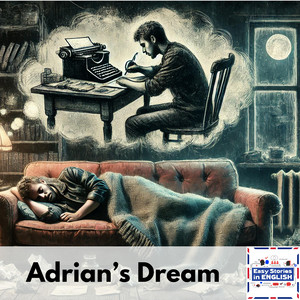
Today's advanced level story is called Adrian's Dream.
As always the transcript and PDF are available at easystoriesinenglish .com and you can find link in the description.
So I'm trying something very different today, and when I say very different I mean it's fundamentally changing the format of the show.
Don't worry, it's not going to be that crazy, but it's gonna be a bit different.
Normally when I present a story on the show, I try and grade all of the language to a certain level, and then I have about 10 or so new vocabulary items that are higher level that I define before the story.
Today's story is different.
Today I just wrote as I would write normally if I were writing for other native speakers, for other speakers of English so the idea is instead of defining some words, I'm going to read through the story twice.
The first time I read through the story I will stop to explain the meanings of words and cultural references.
Then once we've gone through the story and I have explained all the difficult bits, I will read through it again without any explanations so you can just sit back and enjoy.
So why am I doing this?
Well, there are several reasons.
One, it gives me much more freedom as a writer.
Sometimes I struggle when writing stuff for the podcast because I write a story that I really love but the content is kind of too difficult to use on easy stories in English, or if I want to use it I have to heavily edit it.
Basically I have to take native speaker level content and take away a lot of the richness in the language but then also think about cultural references that maybe a lot of people won't know.
This also allows you to get more authentic material.
When we talk about authentic material in language learning we mean stuff that native speakers would read and listen to.
Now sometimes people put too much focus on authentic material and say that if you're grading language, if you're making language more accessible for learners, that it's not useful.
Obviously I disagree because I grade language all the time on my podcast, but I do think there is a good space, a good time and place for this authentic material.
And I think it's useful for you to have a variety of material from me.
I've spent over six years doing the stories in just one way and I think it's about time I experimented with something different.
I've also been inspired to try this because I've been doing exactly the same process in my teaching outside of the podcast. I've been going through some quite challenging short stories with students and explaining it as we go along, so I think it's a really useful way to learn.
Generally, when we talk about reading in a language.
We have intensive reading which is very focused, there's maybe more words that you don't know.
And then we have extensive reading which is when you're reading things that you understand 95 % to 100 % of so you can read much more quickly and you don't have to look up words in the dictionary.
Now both are important, both are useful, but extensive reading is far more useful for building up language quickly.
Which is why I've spent six years making stories that hopefully will allow you to read extensively in English.
However, I'm hoping that this more intensive style of storytelling and reading, and listening, will be useful for a lot of you, especially because I know a lot of you started listening to the podcast as beginners and you've levelled up to intermediate or even advanced level.
And when you're at intermediate to advanced level, there's this annoying thing where you want to understand things for native speakers, you want to read native level books and listen to the radio and and watch TV, but they're just a bit too difficult.
There's just too many new words and too many cultural references.
So hopefully with this kind of episode, I can be the bridge in understanding between that upper intermediate and native level.
Plus it's just easier to explain cultural concepts as they come up.
Plus I kind of just want to show off about my writing skills.
So... So, how should you listen to this episode?
Well, of course you're free to listen to it however you want, as you normally do.
But, probably the recommended study method is to open the transcript and read along.
So, go to easystoriesinenglish .com slash dream and read the story along with me as I explain the vocabulary and the meanings of various things.
And then when I read through the second time you can either read along or just listen.
It's up to you. So I'll do things a bit differently on the transcript this time.
I'll put the story up at the top and then afterwards I'll have all of the conversational part and me explaining the meaning.
Again this is an experiment, and we'll see how it goes, it's going to probably be more challenging than some of my other episodes, but a little challenge is always good once in a while, and I think you'll get a lot from it.
Okay, without further ado, let's get into the story.
Adrian's Dream Adrian always wrote best in the morning.
If he timed things right and woke up in that half dreamlike state and then went straight to his desk and wrote, he always produced something highly original." Okay, this is quite a long sentence.
So if he timed things right, if he timed it so that he woke up at the right time in that half dreamlike state, you know sometimes you wake up and you're still kind of in a dream and your mind works very freely.
That's the state that a lot of writers use.
Personally, I also do this, I get up first thing and writes, and then later I look at it and think, Wow.
I wrote that, I didn't remember writing that.
That's crazy, because the critical parts of your mind haven't woken up yet.
So when he does this, he goes to his desk, he writes, and produces something highly original, very original, very good.
However, there were a few problems with this.
Problem number one, Adrian could not perfectly time his alarm to match his circadian rhythm.
So, your circadian rhythm, this is a concept in biology, so a rhythm is like a beat in music.
And your circadian rhythm is the rhythm of your body according to the daylight.
So our bodies have this natural rhythm that matches the daylight so that we are awake and have energy when it's daytime and we're tired and we want to go to sleep when it's nighttime.
However it's a bit complicated because, you know, we have to wake up to go to work and sometimes it's not the right time with our circadian rhythm.
So because we go through these sleep cycles, right, there's like several stages of sleep.
So the entire sleep cycle ranges from 70 to 100 minutes and it's made of four stages.
So the first two stages are not very special, sorry to those sleep stages you're just not that interesting and then stage three is your slow -wave sleep or your deep sleep that's the sleep that's very important for feeling refreshed and restored in the morning and then stage four is REM sleep or rapid eye movement sleep and REM sleep is when we dream so writers, I guess, ideally want to wake up during the REM stage?
Maybe? I don't know exactly, but anyway, there are these different stages of sleep, and Adrian struggled with matching his alarm to the right stage of sleep.
Sometimes he woke up too early and felt nothing but a sore tummy and utter exhaustion, and sometimes he woke up too late and felt deeply refreshed but creatively void, like ice cream scooped out at the perfect temperature that leaves no residue.
Okay, another long and complicated sentence.
So, sometimes he woke up too early and felt nothing but a sore tummy, a tummy ache, a belly pain, a pain in his stomach, and utter exhaustion.
Extreme exhaustion.
– sometimes he woke up too late and felt deeply refreshed, very refreshed, but creatively void – so when you're void of something, you are empty, you don't have that thing.
So when you're creatively void, you have no creativity.
Like ice cream scooped out at the perfect temperature that leaves no residue.
you. So you know when you have a box or a tub of ice cream and at first it's quite hard to scoop but if you get it at the perfect temperature where it's just melted around the edges you can scoop it out all in one go and it won't leave any ice cream in the tub, that's residue.
Yeah residue is something left behind so it's like you completely scooped out, it's completely empty.
So it's a metaphor for how creatively empty he feels.
So when he sleeps really well, he wakes up feeling not tired but he has no creativity which obviously is not good if you're a writer.
Problem number two.
Since this dreamlike state did not coincide with full restfulness, Adrian's weaker self would often take over in the morning.
And instead of going to the desk and writing, after switching off his alarm, would immediately crawl back into bed to return to sleep.
So, problem number 2, since this dreamlike state did not coincide with full restfulness, it didn't go along with full restfulness, Adrian's weaker self, so, when we talk about your weaker self, it means the weak parts of you, the parts of you that aren't so good.
So often when we wake up and we're very tired, our weaker self takes over and says, I'm not going to work out I'm going to go back to bed, for example.
So his weaker self would take over and instead of going to rights after switching off the alarm would crawl back into bed, crawling like an animal on the ground, yeah because you're tired, to return to sleep.
Adrian tried all sorts of tricks, leaving a trail of alarms which led to an old fashioned wind -up clock on his writing desk throwing a heavy rock onto his bed as soon as he got out of it and getting a friend to phone him five minutes after waking up to check he hadn't gone back to bed.
So he tried all sorts of tricks.
He tried lots of different strategies.
He tried leaving a trail of alarms, a row of alarms leading to an old -fashioned wind -up clock on his writing desk.
You know those old alarms you see in films where you wind up a key and then when it's time for the alarm, the alarm shakes and bells ring?
I love the idea of having one of these alarms, but it seems to be very difficult to purchase them these days.
So that was his first trick.
The second trick he tried was throwing heavy rock onto his bed as soon as he got out of it.
So, if you throw a rock onto your bed as soon as you get up, you won't be able to go back to bed, because there'll be a rock on it.
And finally, the third trick is getting a friend to phone him after he wakes up to check he hadn't gone back to bed.
The results of these were, however, a trail of broken clocks, a dent in his mattress, and a ruined friendship.
So these strategies didn't work.
The first one meant he broke all the clocks because he was tired and angry.
He broke the clocks.
The second one just left a dent in his mattress.
A dent is like a bump.
Yeah when you hit something and it presses inwards, it leaves a dent.
If you hit your car into someone else, your car will have a dent.
And finally, clearly he got angry at his friend on the phone because it also left him with a ruined friendship.
Problem number 3. Adrian had a job, and his job didn't leave him much time to write.
He already had to wake up at 6 to show up to work on time, and if he got up any earlier he'd have to go to bed at 8 or 9pm to get enough sleep.
I'm sure many of you know that problem where you want to get up early to get to work on time, so you're not rushing, but if you get up too early then you have to go to bed really early.
And Mrs Barnsley downstairs still had the TV blaring at that time before she inevitably fell asleep to Cory and her grandson turned it off.
So in London it's very common for houses that have two floors to be converted into two flats.
So I imagine that's the situation here.
Adrienne lives on the top floor and then Mrs. Barnsley is an old woman who lives downstairs and she has the TV blaring, the TV playing really loudly late at night, before she always, before she inevitably falls asleep to Corey.
Corey is short for Coronation Street.
Coronation Street is a very popular soap opera like a drama series and it's not particularly good quality but it's one of those shows that's on every day.
And then finally after she falls asleep her grandson turns off the television, so I guess he lives with her.
Eventually Adrian settled on the solution of naps so he chose to take naps as his solution to have a little sleep.
He'd come home from work and head straight to bed.
Of course, problem number one still remained, but because he'd only be going through one sleep cycle, he could use a diagnostic framework to determine exactly how long it would take him to get to sleep.
So if you're napping, you're only well, unless you're taking a very long nap, you're only going through one sleep cycle.
So you can decide exactly at which stage you wake up.
So he could use this to make sure he wakes up in exactly the right frame of mind and to do this he developed a diagnostic framework.
So a diagnosis is when a doctor tells you, this is your illness, I diagnose you with this.
So a diagnostic framework is like a series of questions to diagnose something.
So he's He's basically created a system that helps him know exactly how much sleep he needs in order to wake up in the most creative state.
Thereby ensuring he woke up in the optimum state for creative output.
I'll just read that whole bit again.
He could use a diagnostic framework to determine exactly how long it would take him to get to sleep, thereby ensuring, making sure in that way, he woke up in the optimum state, the best state for creative output.
The framework involved questions such as, what is the state of your stomach?
And did Linda complain at you during lunch?
And what is the current phase of the moon?
So I guess if he has some indigestion, he's not going to sleep so well.
Well, if his coworker Linda has complained at him he might sleep badly.
And I don't know, maybe the phase of the moon affects it as well.
Problem number 2, the problem of not wanting to get out of bed in the cold dark morning was equally solved.
Was also solved. As by that time of day, Mrs. Barnsley had her heating on full blast. She had her heating on the highest temperature.
up, so it was easy to get up because it was nice and warm and the heat travelled through the floor.
And work, the most depressing part of the day, was long past satisfying Adrian's weaker side and preventing him from returning to bed.
So because he'd already finished work today, he didn't feel that hopelessness that made him want to go back to bed in the morning.
Again, I'm sure some of you can understand this.
And not only was problem number three hearing Coronation Street blasting through the floorboards, not only was problem number three irrelevant, so it didn't matter anymore because it wasn't happening in the afternoon.
By napping after work he could also stay up later reading without feeling tired the next day.
Which I also wish I could do these days when I read in bed I fall asleep so quickly and I wish I could read all night long.
So Adrienne's literary output flourished so your literary output is how much writing you produce, how much writing you put out and when something flourishes it grows really quickly and dramatically.
Day after day he followed his plan producing an early evening dreaminess that buoyed him reliably into the rapids of a writerly flow state.
okay so day after day he followed his plan producing an early evening dreaminess so a dreaminess is that state when you're half dreaming that buoyed him so boy BUOY is that floating orange thing you have see for safety reasons at beaches and stuff but boy as a verb means to kind of float on water so basically when something boys you into something it carries you gently along so he produced an early evening dreaminess that buoyed him reliably that always buoyed him into the rapids so rapids are water that flow really fast you get them I guess around mountains if you are canoeing or kayaking it
can be really fun to ride down rapids but they can be quite dangerous into the rapids of a rightely flow state so a flow state is when you are completely focused on something and hours pass without you realizing it and that's what's all artists aspire to all artists try to get into a flow state so that they can create fluently, so basically this is saying that his plan allowed him to always create this dreamlike state that led him reliably into a good writing session.
All the projects he'd been dawdling on for years, all those projects he'd been procrastinating for years, began to reach completion.
Like a fairy tale thread that spun itself into gold.
So thread is like a long, thin thing that you use in sewing, or I guess knitting to create clothes.
And you have it often in fairy tales that someone has to spin something.
So spinning is not something most people do these days because we have machines that do it, but you basically - for example, you take wool from a sheep and then you spin the wool to make fibers which you can then use to make clothes.
So it's a way of processing materials to create thread, I guess.
I guess in fairy tales they don't actually spin thread, they usually spin straw or something.
Look, I don't know that much about textiles and creating clothes, but basically, it's like all of these projects were just finishing themselves like some magic thread that turned itself into gold from a fairy tale.
He got so ahead with his writing that he even got over his fear of showing people his work – many amateur writers are scared of showing their work to people – and started querying agents on his lunch break, so when you want to become an author, when you want to publish novels you often find an agent and the agent is the person who represents you to talk to publishers so you send your manuscript you send your finished novels to agents and hopefully eventually you find an agent who wants to take you on and then they will present you to publishing houses so when you are looking for agents you query
agents a query is like a question so you send them your work and you say are you interested in me that's querying so he was query agents on his lunch break hook line sink up okay so this is like a metaphor with fishing you have a fishing rod that has a hook at the end and then you have the line that you throw out to the water.
And if a fish bites the end of the hook and then you can reel the fish in, then you can catch the fish, then obviously the end of the fishing rod, the hook will sink under the water.
So when we say hook, line, sinker, it's like you've completed a series of actions and it's all gone really well and it's leading to success, you're catching the fish.
So, hook, line, sinker.
Somehow it was all coming together.
Agent contract book tour.
Okay, so he's found an agent.
He has signed a publishing contract, so he signed a contract for his books, and he's going on a book tour.
So he's going to promote his book, to talk about his book, to answer questions, and probably to do signings.
Signings. So book signings is where people buy a book and you sign it as the author, you give your signature.
Agent, Contract, Book tour.
With a nap and a writing session between signings.
Of course. Yes. Adrian had made it.
So, when we say someone has made it, it means they have succeeded in their career.
Picture it now. Imagine it now.
A room bathed in camera flashes.
Yeah, so many camera flashes, it's like a bath of camera flashes.
Crowded with bespectacled book bloggers.
Crowded means filled with people.
Spectacles is an old -fashioned word for glasses, so when someone is bespectacled, they are wearing glasses.
So bespectacled book bloggers are people who blog about books, and people who read a lot of books tend to have glasses, they tend to be bespectacled.
One asks, Mr. Carole, most debut authors, so debut authors are authors who are publishing their first book, most debut authors toil for years on a single manuscript, they work hard for years on a single manuscript, and then act surprised when their publisher asks for the sequel, So, many writers work on their first book for ages and then they don't think about what happens next and they don't prepare any other work and often publishers want the sequel because if the first book sells well they want to put the second book out as soon as possible.
You've come out of the gate, so when you come out of the gates you start doing something really successfully immediately.
You've come out of the gate with a trilogy and a collection of short stories.
A trilogy is a series of three books.
Just how do you do it?
Adrian smirks. So a smirk is a smile where you're like, yeah, I'm great, look at me.
I'm smirking. Adrian smirks and composes himself for the photograph that will accompany this interview.
So he kind of poses because he knows someone is going to take a picture.
I sleep on it. He says it wisely.
So normally when we say to sleep on something it means you have a big decision to make and it's good to sleep and then see how you feel in the morning.
So that's sleeping on something like oh I don't know whether to go to Spain or Turkey on a holiday.
I'll sleep on it. But in this case he's making a pun, he's doing some wordplay, because he's talking about sleeping on his writing.
Tens of thousands of pounds and months of travel later Adrian returns home.
He's kept his day job because he doesn't want to jinx things.
So your day job when you're an artist, often you don't make money from your art, so you have your day job, the job you do during the day to make money.
So he's kept his day job because he doesn't want to jinx things.
So jinx is kind of like a curse.
Often it's when two children say the same exact words.
They go, oh jinx. Because it's like, oh it's like a magic spell or something.
So if you jinx something, you say, oh, I'm such a successful writer.
I'm going to quit my job.
And then as a result, you stop being successful as a writer.
that's an example of jinxing it.
It's like a superstition okay, so you shouldn't say the thing you want to openly, for example.
Miraculously, his boss was okay with him taking months off to launch his books.
Maybe because she's a failed artist herself.
He's seen her doodling on notepads when nobody's looking.
So a is drawing little pictures.
So he's seen his boss drawing little pictures doodling on note paper when nobody's looking and so he understands that oh she's a failed artist and that's maybe why she's okay with me taking all this time off to go on book tour.
Adrienne does his first day at work showers in the praise and curiosity of his colleagues, so not literally showers but just kind of takes in all the praise, and heads home for his first nap post -success.
For his first nap after being successful.
He completes the diagnostic framework on autopilot.
So when you do something on autopilot you do it without thinking.
Autopilot is when a car drives itself or a plane flies itself, and curls up with the alarm set for 33 minutes later precisely.
So when you curl up you get really comfortable under the covers you push all your body together maybe you have a stuffed animal or something okay so he curls up with his alarm set for a 33 minute nap he's all confident that it's going to work just like before.
He performs his usual sleep meditation and nothing, he's still awake.
It happens sometimes.
He starts counting sheep.
I don't know if this is a universal thing, but culturally, it's like a common method to get to sleep if you can't sleep, they say count sheep.
So you imagine sheep in your head going into a field and you count them.
One, two, three, four, five.
Five hundred and eighty three sheep later, and he's wide awake, with the clock beside him ticking.
So when a clock ticks, it goes, to mark time passing.
Did he make his calculations wrong?
Today has been an unusual day with him returning from tour, but he's had unusual days before, like that time a terrorist group attacked his workplace.
And he still managed a good two thousand words that day.
So this is a bit of surrealist humour, just a random terrorist group attacking his workplace.
Why not? And writers are often obsessed with word count, like, how many words Can I write in a day?
So even when a terrorist attacked his work, he still wrote 2 ,000 words.
So this shouldn't be a problem.
Maybe something is wrong with his body, but he doesn't need to pee or eat, and his pillows are soft enough.
So peeing is something you do when you go to the toilet.
So finally, Adrian does something he hates doing.
He explores his emotions.
Generally, he tries to keep a layer of separation between him and them, so generally he tries to avoid his emotions.
As if anger and fear and sadness were frogs trapped beneath the surface of a frozen pond in winter.
Okay, so another metaphor here.
He's imagining this separation, this layer between him and his feelings, is like the surface of a pond.
So a pond is a small lake, people might have ponds in the gardens and often frogs, and newts, toads, small animals like that live in ponds, and in winter the surface of a pond might freeze.
So he's imagining all his feelings are like these frogs under the surface of a pond that has frozen in winter, but just this once he pokes at the ice, just this once he touches the ice to see what will happen with those emotions, and makes an awful discovery.
Its success, where previously a great black hunger yawned.
So yawn means to go but it It can also mean just for a large gap to exist, like a really big hole, a chasm.
So a great black hunger yawned, ready to be padded with sleep, or food, or praise.
So he had this kind of hunger inside him, this metaphorical hunger, and it was ready to be padded, it was ready to be fed so it could go bigger with sleep, food, or praise.
so this might be familiar to some of you like when you're depressed and all you want to do is eat and sleep and have people say nice things so where previously this great black hunger yawned they're now thrums a hearty unrelenting fire so thrum means to kind of go mmm like vibrate like when you play a violin string it thrums. A hearty fire is a big strong fire and an unrelenting fire is a fire that won't stop.
So this horrible feeling of emptiness from before he published his books has gone and now he feels this strong, creative fire.
These past few months he has been lauded, feted, challenged, entertained and most unusually of all, accepted for who he truly is." So he has been lauded, he has been praised, feted, so fete comes from the French word for a party.
So when you are feted you are invited to lots of parties and given food and alcohol.
He's been challenged, entertained and accepted for who he truly he is.
And now he cannot sleep.
And he most certainly cannot write.
He hasn't tried it yet but he just knows, just like how he got so intimate with his characters last year that he heard their voices while brushing his teeth.
So some writers get really close to their characters and they can hear their characters talking in their head.
That's never happened to me, probably a good thing.
His heart is full with reader's comments and positive reviews and emails between him and his publisher, and most of all with the feeling of being done.
And that fullness is keeping him awake.
Without an empty page?
How can a writer write?
Adrian's empty page was always his dissatisfaction.
His ink, the drips of fantasy that leaked into his grey world.
So basically, his dissatisfaction, his unhappiness, was what gave him the ability to write.
And the ink that went on the page, the writing that went on the page, was all of this fantasy he had in his head.
So his writing was what made his grey world come to life.
Now his world is in colour and the ink has turned to grey.
So now, being a successful author is more interesting than the actual writing itself.
They always say follow your dreams but sometimes it's better to stay asleep.
The end. Well done for listening through to the ...
annotated, the explanatory version of the story and now we're going to go straight into the story again with no interruptions.
We're so done with New Year, New You.
This Year is more you and Bumble.
More of you shamelessly sending playlists, especially that one filled with show tunes.
More of you finding Gemini's, because you know you always like them.
More of you dating with intention, because you know what you want.
And you know what? We love that for you.
Someone else will too.
Be more you this year, and find them on Bumble.
So listen, and enjoy.
Adrian's Dream Adrian always wrote best in the morning.
If he timed things right and woke up in a half -dream -like state, and then went straight to his desk and wrote, he always produced something highly original.
However, there were a few problems with this.
Problem number one.
Adrian could not perfectly time his alarm to match his circadian rhythm.
Sometimes he woke up too early, and felt nothing but a sore tummy and utter exhaustion.
And sometimes he woke up too late, and felt deeply refreshed but creatively void.
weed, like ice cream scooped out at the perfect temperature that leaves no residue.
Problem number two.
Since this dreamlike state did not coincide with full restfulness, Adrian's weaker self would often take over in the morning, and instead of going to the desk and writing, thing.
After switching off his alarm, he would immediately crawl back into bed and return to sleep.
Adrian tried all sorts of tricks.
Leaving a trail of alarms which led to an old -fashioned wind -up clock on his writing desk, throwing a heavy rock onto his bed as soon as he got out of it, and getting a friend to phone him five minutes after waking up to check he hadn't gone back to bed.
The results of these were, however, a trail of broken clocks, a dent in his mattress and a ruined friendship.
Problem number three.
Adrian had a job, and his job didn't leave him much time to write.
He already had to wake up at 6 to show up to work on time, and if he got up any earlier he'd have to go to bed at 8 or 9pm to get enough sleep, and Mrs Barnsley downstairs still had the TV blaring at that time, before she inevitably fell asleep to Corey and her grandson turned it off.
Eventually, Adrian settled on the solution of naps.
He'd come home from work and head straight to bed.
Of course, problem number one still remained, but because he'd only be going through one sleep cycle, he could use a diagnostic framework to determine exactly how long it would take him to get to sleep, thereby ensuring he woke up in the optimum state for creative output.
The framework involved questions such as 1.
What is the state of your stomach?
and 2. Did Linda complain at you during lunch?
and 3. What is the current phase of the moon?
The problem of not wanting to get out of bed in the cold dark morning was equally solved, as by that time of day Mrs Barnsley had her heating on full blast and work, the most depressing part of the day, was long past, satisfying Adrian's weaker side and preventing him from returning to bed.
And not only was problem number three – hearing Coronation Street blasting through the floorboards – not only was problem number three irrelevant – by napping after work he could also stay up later reading without feeling tired the next day.
So Adrian's literary output flourished.
Day after day he followed his plan, producing an early evening dreaminess that bawied him reliably into the rapids of a rightely flow state.
All those projects he'd been dawdling on for years began to reach completion, like fairytale thread that spun itself into gold.
He got so ahead with his writing that he even got over his fear of showing people his work work, and started querying agents on his lunch break.
Hook, line, sinker.
Somehow it was all coming together.
Agent, contract, book tour, with a nap and a writing session between signings of course.
Yes, Adrienne had made it.
Picture it now, a room bathed in camera flashes, crowded with bespectacled book bloggers.
One asks, Mr Karolei, most debut authors toil for years on a single manuscript and then act surprised when their publisher asks for the sequel.
You've come out of the gate with the trilogy and a collection of short stories.
Just how do you do it?
Adrian smirks and composes himself for the photograph that will accompany this interview.
I sleep on it he says wisely.
Tens of thousands of pounds and months of travel later, Adrian returns home.
He's kept his day job because he doesn't want to jinx things.
Miraculously, his boss was okay with him taking months off to launch his books, maybe because she's a failed artist herself.
He's seen her doodling on notepads when nobody's looking.
Adrian does his first day at work, showers in the praise and curiosity of his colleagues, and heads home for his first nap post -success.
He completes the diagnostic framework on autopilot and curls up with the alarm set for 33 minutes later precisely, he performs his usual sleep meditation and nothing.
He's still awake, It happens sometimes.
He starts counting sheep.
One, two, three, four, five.
583 sheep later and he's wide awake, with the clock beside him ticking.
Did he make his calculations wrong?
Today has been an unusual day with him returning from tour, but he's had unusual days before, like that time a terrorist group attacked his workplace, and he's still managed a good 2000 words that day.
Maybe something is wrong with his body, but he doesn't need to pee, or eat, and his pillows are soft enough.
So finally, Adrian does something he hates doing.
He explores his emotions.
Generally, he tries to keep a layer of separation between him and them, as if anger and fear and sadness were frogs trapped beneath the surface of a frozen pond in winter.
But just this once, he pokes at the ice and makes an awful discovery its success where previously a great black hunger yawned ready to be padded with sleep or food or praise there now thrums a hearty unrelenting fire these past few months he has been lauded, feted, challenged, entertained, and most unusually of all, accepted.
For who he truly is.
And now, he cannot sleep and he most certainly cannot write.
He hasn't tried it yet, but he just knows.
Just like how he got so intimate with his characters last year that he heard their voices while brushing his teeth.
His heart is full, with readers' comments, and positive reviews, and emails between him and his publisher.
And most of all, with the feeling of being done.
And that fullness is keeping him awake.
Without an empty page, how can a writer write?
Adrian's empty page was always his dissatisfaction, his ink the drips of fantasy that leaked into his grey world.
Now, his world is in colour, and the ink has turned to grey.
They always say, follow your dreams. But sometimes it's better to stay asleep.
THE END So I've written a string of stories recently that I feel really revealed a lot about what was going on in my head.
There was this story, Adrian's Dream, The Shape of Art, and another story which I've written which hasn't come out on the podcast yet.
But yeah, I seem to keep writing these stories about artists who feel frustration or they have success in ways that they're not expecting.
I talked about this on the episode The Shape of Art so I'm not going to go too much into it.
But it's just interesting because I guess I'm at a point with my writing where I can see the common themes that emerge.
Ultimately, most writers have certain topics that they write about again and again, and even when you're writing something very different from your normal work, those influences are still going to come through.
So my two main influences, my two main themes in writing seem to be the philosophy of being an artist and viscera, viscera is a formal word for blood and guts so basically anything that comes out of the body, blood, snot, organs are all viscera and I don't know I guess it doesn't come up on the podcast that much but certainly in my other writing I can be writing like a fairy tale and it's like oh maybe someone stabs the witch and pulls out her heart.
or oh there's a story set in London and then maybe there's a demon that's shooting blood everywhere you know a student even asked me the other day why do your stories always involve guts?
why do they always involve intestines?
so I think I just have to accept that Viscera is my stamp as a writer.
actually this story has like even another meta layer to it because i wrote it just after waking up from a nap while feeling creatively dissatisfied.
The first few months of this year i was just really busy with work and i just moved so i wasn't doing as much writing as i wanted and then one day after work i was at home and i still had some tasks to do but i was really tired so i went for a nap.
It wasn't 33 three minutes it was maybe more like 25, but after I woke up I was like, oh I feel creative and I just grabbed my notebook and wrote out the whole story and on that note I am writing basically by hand at the moment.
I think maybe because I use computers a lot for my editing work and I just don't like staring at a computer screen plus there's all the usual distraction of social media and YouTube I just find I'm writing better by hand.
I'm much more focused and obviously you have to write more slowly when you write by hand but actually it produces better work because you give your ideas time to kind of form and you get less of that doubt of should I be writing this because you have to commit to writing a sentence and then by the time you've finished writing it usually the next one is kind of come into your head, that's kind of something I would generally recommend to any artists who are listening, maybe if you're new to creating art, a big part of it is just trusting yourself, so often when I'm writing I write a sentence and I
think, what happens next?
And theoretically there are thousands of possibilities, but usually one possibility comes into my heads and so often I say no but it shouldn't be that oh why why is it that but who is that person what are they doing here but if I just listen and trust the creative process and say okay that's what's in my head I'm going to write it it always makes sense later it always comes together and maybe sometimes I finish the story or the chapter and I go back and edit it and oh Part of it needs to be changed, but you only see that later.
When you're in the process, when you're in the store, you just have to keep going and follow that instinct.
So anyway, I'm doing much better creatively at the moment.
Unlike our friend Adrian, I am writing first thing in the morning, I leave my composition book, my notebook on my desk with my pen, and I wake up first thing, and get to writing.
which is much easier now than it would have been before, because the days are finally starting to get longer with the arrival of spring, so I can have a bit of sunshine and daylight while I write.
So, I would love to hear what you thought of this episode.
How did you find the difficulty of the story?
It was a very difficult story, even with the descriptions and the explanations, but hopefully you found it interesting.
Do leave a comment and let me know what you think, or on Spotify there's a poll and you can give your thoughts there.
I would love that, thank you so much!
And, thank you for listening to this episode!
I would like to remind you that you can join my email newsletter at easystoriesinenglish .com.
Recently whenever a new episode comes out I've been sending an email to remind you and then writing a little kind of diary entry, a blogpost talking about my life and my feelings.
It's a different way of getting to know me, reading a bit of my thoughts, there's something about writing that's a lot more deep and mysterious and pensive than talking on a podcast so I really do recommend joining the newsletter and that will motivate me to write lots more interesting deep thoughts there.
Oh I'm so Oh, thinky!
I'm so pensive, I'm thinking so much!
Ow! My brain hurts!
Time for a nap methinks!
And on that note, goodbye!