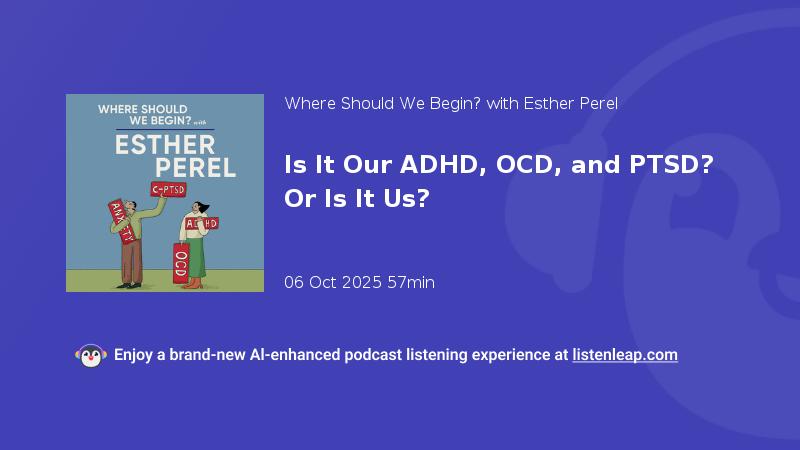
None of the voices in this series are ongoing patients of Esther Perel.
Each episode of Where Should We Begin is a one-time counseling session.
For the purposes of maintaining confidentiality, names and some identifiable characteristics have been removed, but their voices and their stories are real.
Support for Where Should We Begin comes from The Guardian.
Not all journalism is the same.
Take The Guardian.
Their coverage has something special, fierce independence.
Nobody owns them or tells them what they can and cannot say.
So they seek to report the whole picture.
They connect what's happening in Washington to the rest of the globe, expose corruption wherever they find it and give fresh perspectives on everything from wellness and soccer to culture, the climate and more.
Read, watch, and listen to The Guardian for free at theguardian.com.
This episode is brought to you by LifeLock.
It's Cybersecurity Awareness Month, and LifeLock has tips to protect your identity.
Use strong passwords, set up multi-factor authentication, report phishing and update the software on your devices.
And for comprehensive identity protection.
Let LifeLock alert you to suspicious uses of your personal information.
LifeLock also fixes identity theft, guaranteed or your money back.
Stay smart, safe, and protected with a 30-day free trial at LifeLock.com slash podcast.
Terms apply.
So the big one, of course, is the child.
She's 18 months old and she's our first child.
We're never prepared for what kids are going to bring up in us.
Since having a kid, he was in basically the worst depression of his life.
Tons and tons of crippling anxiety.
You know, she got pregnant quickly and here we go.
And in response to that, my anxiety and depression just shot through the roof last year.
Everything became just so anxiety-provoking around our child's sleep, around her eating enough, like everything.
And I was kind of in the opposite world where I wasn't anxious and I wasn't super overwhelmed with it.
And even to the point where I actually really want to have another child, and he's like do you remember what it was like for me?
A lot of that comes down to money as well and where we are with money.
She decided early on that she didn't really want to continue work as it was and she wanted to be a full-time mom and wanted to move into illustration and being an artist.
That's been a slow process.
I have wanted to be an artist and an illustrator for my whole life.
He can't support us on his income only.
So he's really pushed me and asked me, hey, it's time.
If you want this dream, you have to choose it now.
And then I will get mired in self-doubt and say that I will do things.
And then I have a lot of trouble actually doing them.
There's issues of neurodivergence.
My partner's ADHD and my what might be neurodivergence or CPTSD or both.
The last piece that's very big for us is our non-neurotypicalness.
I have ADHD.
He believes he has autism.
And so both of us have very different ways of relating to the world.
And that also plays into our struggles with communicating, with being kind to each other and supporting each other.
When I read the intake interviews about the changes that had happened in this couple's life.
They have an 18-month-old, they experienced the transition to parenthood, they experienced changes in their professional lives, but they also had a lot a lot of jargon, a lot of therapy speak, a lot of words that are meant to help understand the other person.
But in fact, they muddle it.
It becomes a conversation of acronyms.
ADHD, CPTSD, autism, neurodivergence.
And there is definitely a need to attend to any of these acronyms.
But also there's a need to understand the role they play in a relationship and the way that sometimes they are used between partners.
All right.
Let me do a quick pulse check with each of you.
Where are you?
Where do I find you?
Not just geographically, but also mood, relationship, internal weather.
We're in our house.
I'm in my daughter's bedroom.
And I'm feeling a little bit nervous, excited.
How old is your daughter?
She is 18 months.
And is she there?
She is gone with a friend.
Wonderful.
This is the first time that we've actually put her in someone else's charge for this long of a period.
And you experience relief freedom space, or you experience primarily anxiety worry, concern at your daughter being with a friend, or even joy, for that matter.
Joy.
Yeah.
Joy, yeah.
Joy.
Faciousness.
Great.
It's been a thing for a long time where I really felt like we need to create that space with her.
I was ready for not the right reasons, maybe.
What does that mean?
What are not good reasons?
To make my anxiety go away.
My anxiety about... literally everything.
Yes, but what is the problem with doing things that diminish your anxiety?
Why is that framed as something negative?
Because What I've learned this year is that anxiety is a block to being able to live life in some capacity.
And this year has been showing up to those scary things in service of the life that I want.
In the past few days.
I just had a meeting with my business coach and he brought me to saying something about that not only dissolved all my imposter syndrome, it also dissolved this very powerful story that I'm pointless, that my life is pointless, that I'm never going to be the person that I'm supposed to be.
And it all came out in this one very simple phrase.
And the phrase was?
The phrase was, I help people solve their problems.
And it didn't require me to be anything but what I was.
I identify as an Enneagram 4, so there's a lot of staying in my own world and feeling lack and loss and grief and non-inclusion.
And that's what's really changing this year after a really, really horrible year last year.
Is it important for me to know about last year or is there a different place for us to start?
I wish we had recorded literally the...
30 conversations we've had approaching this time.
Maybe I want to start asking you about that.
How did you prepare and what has come up?
Like, what is the session that you have had or the sessions in preparation of this session?
Do we want to just like rattle them off?
There's so many.
There was the one And this is kind of a little self-serving.
There's the one where she for the first time turned to me and said I'm pretty sure I have OCD and I've been very controlling about things.
And that has been something I've been waiting to hear and just have a shared understanding around so we can move through it.
I often say in the beginning of a session that I'd like to meet the people before I meet their problems, because I sincerely believe that we are more than just the problems that we face.
And the same is true for our diagnosis.
It is helpful to know if we struggle with ADHD or if we have neurodiversions or if we are on the spectrum.
All these terms that have really proliferated in the last years have helped us articulate ourselves, make sense of who we are, understand our relationship to others and to ourselves.
But I sometimes use them more cautiously because we sometimes also can run into the danger to collapse a person into a diagnosis, to see them only through one lens.
Many people live with health and mental health conditions.
That doesn't define their entire being.
It says a lot about them, but it doesn't say everything about them.
And the last thing I would want to do in my work is curb the curiosity for knowing more because we think we know, because we have the refuge of the labels.
There's another conversation where we both acknowledge that, for as much as we love and care about each other, we've been so focused on our own survival that we've treated the other person's coping mechanisms as a problem.
And I was setting up a dynamic where I responded to her with judgment annoyance, trying to change her, shaming her, telling her she's doing it wrong.
So that became a standard way of our interacting.
So we had two accountability sessions and you connect them to the fact that we were going to have our conversation today.
Why?
I tend to be the space taker and so I would really like to create space for her to share.
For her?
Yes.
This was a very nice move on his part to know that he had had a chance to express himself at quite some length and to just basically say I know I can take the space.
I want her to join us at this moment.
And I didn't say it, and I'm saying it now.
I feel like the two of us are really committed to each other and really invested in each other.
And we've spent a long time in our relationship caring about one another's struggles and But we also feel so stubborn and so adamant about ourselves getting heard and feeling like we're really being taken seriously by the other person.
I think that's a huge part of why we just keep running into the same problems in pretty much every area of our lives is that we both care about each other deeply, but we don't trust each other to really care about the other person as much as we want them to.
Say that again.
We care about each other deeply, but the other person doesn't trust it.
Yeah.
So I care about you, but you don't trust that that's what I do.
Yeah.
And how does that distortion get created?
What is it that you do, each of you, that lets the other person think you don't have my back?
I think our actions and our words are different.
I certainly know that for myself.
With my adhd, i struggle to actually do the things that we've spoken about in our partnership as important.
Uh, he used to ask me for a monday meeting every single week where we would sit down and we would talk together about what's coming up during the week, what we're going to do.
And I think I made that Monday meeting a priority, maybe twice in the many, many months that we tried to do it.
Something would come up.
I need a snack.
I need to go to the bathroom.
I could barely sit still.
And I don't know why that was always happening at these Monday meetings that were very important to my partner.
And I wanted them to be a priority.
And I felt so... Rebellious.
Yeah, yeah.
Rebellious is a huge part of my life.
So would it be accurate to say we care about each other deeply, but we don't necessarily support requests of our partner, because we also experience these requests as controlling.
Yes absolutely okay, absolutely.
So we are very kind, compassionate people who get into power struggles, but we don't name them as power struggles.
Well, we do actually, okay.
Um, because one of the things that i have said is that i feel like i have no agency, that she wears the pants in the family and i often state it in very either harsh or just like big energy, but it's like they're angry ways, because i feel small, because i don't think they're going to be listened to and respected, so then i'll say something like well, this isn't going to work anyway, or you're not going to do this, or i don't know what the point of this is, and then she complies, She complies.
She basically acts in a way that completely agrees with what you just said.
It's not going to work.
Nothing's going to happen.
Yes, she complies with that.
She complies.
Yes, yes.
It's interesting to hear him say that he doesn't feel he has agency in the relationship, especially after both of them have just acknowledged that he can shrink her into a tiny shrimp.
He can make her doubt herself.
He can tell her that she's not proactive enough, that she's not confident enough about her job.
He can rattle down a list of things that she does wrong.
But in his mind, he's doing that because he feels small himself.
And as a result, he tries to bring her down to the same level where he is.
And what's very interesting for me in listening to them is that they are full of self-awareness.
And they even have a lot of awareness about what they do to each other.
But it doesn't serve them.
We have to take a brief break.
Stay with us.
Support for Where Should We Begin comes from Shopify.
Starting a business means that there's a never-ending to-do list, so finding the right tool that can help you simplify everything can be life-changing.
For millions of businesses, that tool is Shopify.
Shopify is the commerce platform behind businesses around the world and 10 of all e-commerce in the US, from household names like Mattel and Gymshark to brands just getting started.
They have hundreds of ready-to-use templates to help design your brand's style.
And they can make marketing easier by creating email and social media campaigns.
And best yet, Shopify is your commerce expert, with world-class expertise in everything from managing inventory to international shipping, to processing returns and beyond.
If you're ready to sell, you're ready for Shopify.
You can turn your big business idea into a big success with Shopify on your side.
You can sign up for your $1 per month trial and start selling today at Shopify.com slash Esther.
Go to Shopify.com slash Esther.
Shopify.com slash Esther.
Support for Where Should We Begin comes from Babbel.
Do you want to learn another language?
Let me ask you why.
Is it because you're dying to memorize grammar tables?
No, of course not.
It's to be able to speak in the real world, with real people.
For that, there's one choice, Babbel.
Learning a language with Babbel is all about small steps, big wins and progress that you can actually track and feel.
They even offer a large collection of podcasts where Babbel experts reveal language secrets and offer an inside look at local cultures.
I like the Babbel podcasts because language is a gate into cultures.
And it's a great way to dive into those cultures with stories that are told by actual native speakers.
Here's a special limited time deal for our listeners.
Right now, get up to 55% off your Babbel subscription at babbel.com forward slash Esther.
Get up to 55% off at babbel.com forward slash Esther.
Spelled B-A-B-B-E-L dot com forward slash Esther. babbel.com forward slash Esther.
Rules and restrictions may apply.
At Blinds.com, it's not just about window treatments.
It's about you, your style, your space, your way.
Whether you DIY or want the pros to handle it all, you'll have the confidence of knowing it's done right.
From free expert design help to our 100 satisfaction guarantee.
Everything we do is made to fit your life and your windows.
Because at Blinds.com, the only thing we treat better than windows is you.
Visit Blinds.com now for up to 50% off primetime deals and free professional installation.
Rules and restrictions apply.
You know, I had a period, I tried to set up a lot of systems because I'm a systems thinker.
But yeah, it was that sense of like, okay, we'll try this.
Okay, we'll try this.
Okay, we'll try this.
And then...
None of the things worked out and I felt very alone.
And the metaphor that I've been using a lot lately the idea that I'm running around plugging holes on a boat left and right, and that's my entire existence.
And I can imagine you saying, where is she on this boat?
And I'm like oh, she's up at the top deck pointing it at all the beautiful islands that she wants to go to and grabbing the steering wheel and sort of pulling it left and right, while I'm down here by myself being like there's this massive hole and now there's all these other little holes that keep popping up every day that I have to keep fixing, keep fixing, keep fixing which, as you can tell, anxiety.
And really the question that I felt like we could bring to you was like how do we get it?
So we're steering the ship together and plugging the holes together.
That's your question.
That's my question.
What's your question?
I want to know What's it gonna take for us to trust each other?
I think the way that we communicate feels like we don't believe each other's on the same team.
And so I really wanna find a way that we can connect and care about each other in our everyday life.
Instead of what do you do?
It feels like now everything that I say to him, he's taking it as I'm judging him.
I'm telling him he's wrong.
I'm telling him he did something that isn't working.
You know, I will say something to him like oh, I'd really like for the baby's food to be cut a little smaller.
And he'll say, I've got it.
I know what I'm doing.
Don't tell me what to do.
And he's always feeling it seems like he can never do something right for me.
And I think if we trusted each other more, he would know I wasn't coming from that space.
I was just sharing my preference.
In highly reactive couples, this is very common.
If somebody says something about the food, the other person hears it as if it's about them.
Everything gets personalized and seen as an attack.
They talk about trust.
They talk about vulnerability.
They talk about anxiety, depression.
They don't talk about aggression.
But in fact the relationship is permeated by aggression, covert and overt, and i think they're trying to behave very well in front of me.
But when they say these things to each other, as she just said, around the cutting of the food, and he says you know, once again it's not the right, i'm imagining in myself a reaction in him where he feels attacked.
It's that differentiation that needs to happen.
That is, first and foremost, to distinguish between a criticism and a request, And at this moment this is blurred.
And the other way around, how does it go?
Yeah.
I feel like I'm pretty generous with the requests he makes, but I often question them.
And that also creates a lot of distrust.
He brought something to me a couple of weeks ago and said I'd really like to consider this as a new way of thinking about our child's sleep.
And I said, well, I don't really believe that.
I don't really see it that way.
And when I say something like that, he'll often say I really would have appreciated if you had said wow, that's a great insight.
I'm so glad you're learning that.
That is so cool.
I really want to support you.
And I don't know that I trust that or that's not my opinion.
But I often come back immediately with a response, with some kind of triggered way of being that is just not appreciating and acknowledging him for the work that he's done.
When he says I've got this, I know how to cut the food, you think oh, how could I say something and he not take it so personal?
Or you get annoyed?
Probably both.
I wish that I could say something in a way that didn't make him feel bad about himself or wrong for doing something.
But I also recognize that I comment on pretty much everything.
And that's not necessarily helpful in a relationship.
If when I sit with a couple and I see one person putting the other one down there is a sense of oh that's the direction of the arrows but then if you wait long enough you suddenly realize that actually the other person is doing something quite similar so they are symmetric they are both doing the same thing to each other that's part of why they're both able to recognize we don't trust each other enough we care deeply about each other but in fact in our interactions that's not what we end up experiencing And yet they both say, we have this deep connection and we could do better.
And they find themselves a bit miffed that they are derailing and they don't understand why they're at each other's throat much of the time.
You know, you talk a lot about issues of trust. but I'm sensing other things as well.
And I have a bit of a dilemma because you are very articulate people and you are extremely jargonized.
You have internalized the entire vocabulary of modern psychology.
You label every behavior, you label yourself.
It's like, you're not unhappy, you're depressed.
You're not worried.
You're anxious.
You're not rebellious.
You're ADD.
You're not pissed that he's telling you what to do and you absolutely don't like anybody telling you what to do.
And so it becomes OCD.
And my reluctance is I don't want to add to that.
Because I want to create more air and space between the two of you that isn't.
Psychologizing, jargonizing, and pathologizing.
Because that, I don't see where that helps with trust.
Sometimes it's good to know and to name things.
Don't misunderstand me.
But this, it's like everything is labeled.
So in effect, you never say what you feel.
You know, when you say I'm a systems guy, she's rebelling and you are saying I have better systems.
And you're not actually reading when she says, I don't want all these structures.
Don't tell me what to do.
Then you suddenly start to feel depleted and defeated.
It becomes depressive energy.
It's a dance between the two of you that has a few elements.
A it has pieces of power struggles, but not acknowledged as such, spoken about in the language of compassion or lack of compassion and trust.
But in fact there's controlling issues and that doesn't mean one of you is controlling.
It means the other person experiences your requests as controlling.
Two everything gets personalized, cut it differently, becomes i can't do it right, rather than are you concerned that she could choke Or come back with the pieces and say I did the right measurement, missus.
Basically, you can regain a lot of power and a lot of control with humor, because humor brings perspective to this.
Instead of, oh, now I've been pierced with a dagger again.
I can't even cut the food.
And I'm thinking, this guy needs a lot of humor to diffuse this because he takes it so personal.
And the third element is is there's very few things that one of you can feel or do or say that doesn't elicit a reaction in the other?
You're too close.
Now it's a terrible thing to say to people you're too close, because we supposedly all strive for a certain kind of closeness.
This is too close.
That closeness leads to personalizing rebellion, friction in order to create more distance, and so you each are constantly pushing your elbows to say to the other give me space, give me room.
I have a thing i call toxic coaching that i do only with her, where it stops being about me helping, it starts being about why isn't she getting this?
And um, When we got together, I felt what we could be together.
I felt my potential.
I felt her potential.
And you're absolutely right that there has been something with her where I've been so impatient and so intolerant.
But I was so scared last year that we were going to run out of money and that all these other things were going to happen.
Part of the thing that kept me down last year was the feeling that not only was I unemployable which I have a history related to that but basically she's unemployable because of the ADHD, because of the challenges of being on time.
It created enough fear in me that I didn't know she would actually be able to earn money, although she has earned money in the past and actually a large portion of our relationship has been the major breadwinner in her own way.
That's fine.
But, you know, she's been saying she wanted to be an artist for 10 years.
And then now it's like, in a more impatient way, I'm like, okay, what are you doing?
Just choose to do it.
The word anxiety, which he uses frequently, is so important to decode, because he sees himself filling the holes in the ship and he describes it as his being anxious, at the same time as he says I am responsible.
I'm looking at all the fractures in our relationship and she is dreaming about islands.
She's clueless, which is part of the putting her down And experiencing himself as the one who does it all when, at the same time, she has been the primary provider and he has struggled with work.
And so part of what he wants is he wants her to be productive accomplishing confident, to compensate for what he feels he doesn't have inside of him.
I mean, it's a very interesting thing that he coaches her when she's the one who's actually been doing quite well.
She may be in transition.
She has questions about if she wants to be an artist as a career or if she wants to be artistic.
But fundamentally, she's done quite well.
And that is covered up all the time.
We'll be back with a session right after this.
And while we love our sponsors.
If you want to listen to this session ad-free, click the Try Free button to subscribe to Astaire's Office Hours on Apple Podcasts.
This episode is brought to you by State Farm.
Listening to this podcast, smart move.
Being financially savvy, smart move.
Another smart move having State Farm help you create a competitive price when you choose to bundle home and auto.
Bundling, just another way to save with a personal price plan.
Like a good neighbor, State Farm is there.
Prices are based on rating plans that vary by state.
Coverage options are selected by the customer.
Availability, amount of discounts and savings and eligibility vary by state.
Right now at the Home Depot, shop fall savings and get up to 40% off select appliances like Samsung.
Upgrade your kitchen this fall with the Samsung bespoke four-door refrigerator.
Now featuring the dual auto ice maker with sphere ice.
Only at the Home Depot.
You'll have perfectly chilled drinks for every gathering.
Don't miss fall appliance savings at the Home Depot.
Offer valid October 2nd through October 22nd.
U.S. only.
See store online for details.
Imagine fast hydration.
Combined with balanced energy.
Perfectly flavored with zero artificial sweeteners.
Introducing Liquid IV's new energy multiplier sugar-free.
Unlike other energy drinks you know the ones that make you feel like you're glitching it's made with natural caffeine and electrolytes.
So you get the boost without the burnout.
Liquid IV's new energy multiplier sugar-free hydrating energy.
Tap the banner to learn more.
I feel pretty scared about my own inability to do what I want to do.
And my partner is sort of like naggingly in the background going.
Well, you said you wanted to go in this direction and you're not.
What are you doing?
And when I became a mother, I felt that magical flow of, of, oh, this feels really good.
Like I'm challenged in a really good way all the time, every day.
And I'm not feeling that about my illustration or art.
And so I think it's feeling stagnant and I don't quite know how to get to the next place with it.
And I am really afraid of disappointing my partner and disappointing the narrative that I'm gonna become this successful illustrator.
There is your pursuit of art as an identity.
There is your using your talents as an artist to have a career, which may not be the same.
And then there is what do you both need in order to provide for your family and for your life?
And do you have an understanding that this is a joint endeavor that you expected both of you to be financially providing?
And if you do that, then your questions about your art.
You can do as much thinking about that as you want.
It's yours.
You can basically say to him we agree that I need to provide this amount of money, and that's what I do and how I do it.
It's my business.
At this moment, everything is constantly bleeding into each other.
Child, family, mother, artist, illustrator.
It's all flowing as if it's a delta.
And therefore he needs you to be the successful artist, so that he doesn't have to feel that he's the sole provider.
I'm trying to do a little storage arrangement.
Because you talk about one thing, you talk about six things.
Yeah.
And the challenge is, you know, I talked about I'm a systems person and I found it very helpful.
And that hasn't really worked for her or with her.
What happens, though, is that you're so invested.
It's like a parent who wants their kid to do their homework more than the kid should want themselves, or play the piano, or go to the baseball or whatever.
You can't want more for the other person than the other person wants for themselves.
If you want it so much more than them, then something happens inside of them where their preoccupation is less about the issue itself and more about how to get you out of the system.
Yeah.
And I appreciate that.
I think the question is how.
How are we steering the boat together?
Yeah.
That's what I want to know.
I don't know how.
Let's go very concrete and basically practice other vocabularies than the primary one that you both are in.
And that is fine, by the way.
It's just that it's too dominant, this kind of ongoing processing.
Can I bring up the example?
Sure.
The example I really wanted to give, which happened recently, is I wanted to take our child to the pool.
And we also had a dinner to go to right afterwards.
And it's about an hour before we have to leave.
And he says, that's not enough time.
That's too rushed.
This is what you always do.
What if something goes wrong and we can't quite make everything on time?
He's often telling me I don't really think through how long does it take to get ready for something?
How long does it take to prepare for the next thing?
The moment he starts talking about that, my brain is going.
I can't concentrate on what you're saying.
I need to get ready.
I need to get our child ready.
We need to get out the door.
We're going to make this happen.
I want to make my dreams come true.
Everything's going to happen and it's going to be great.
And he says to me, hey, You're not acknowledging that I'm here having a little bit of a freak out.
I need you to pause, take some time to acknowledge that I just said this is really too much for me.
I need you to honor that and say, I hear you.
I really get it.
And basically have some compassion for him in that moment.
This has happened millions of times.
And I sit there and I kind of freeze up and I'm like, How do I get this all done?
And now he's upset and now it's my fault and I've only got 20 more minutes and I just want to make him happy and feel better.
So I'll just say, I hear you.
Okay.
Okay.
It's fine.
I won't be late.
And that really triggers him because he'll say I don't trust that you actually care about me right now.
It feels like you don't care that I'm overwhelmed and you don't care that this is having an impact on me.
So this is a perfect moment where they illustrate how it doesn't matter the situation.
The form is going to be the same.
When she says, can you cut small pieces?
He personalizes it as if he can't cut the food for his child.
When she says, let's go to the pool, he says to her, you are a klutz with time.
You can't schedule.
You have no sense of chronology.
And that's, for me, the moment when she said, it doesn't matter.
This happens all the time.
It's always the same.
This is the moment when they are describing to me the always the same.
Did you go to the pool?
Uh-huh.
Yeah.
And did you go to the dinner?
Uh-huh.
Yeah.
And did it work out?
Yes.
The thing that jumped at me when you told this beautiful example, because it's very rich.
This could be a few hours just on that, you know.
The first one is I want to go to the pool and he says but you will never plan, you are obviously late.
So, You start with an activity and it becomes a rant about your personality.
There is no longer a discussion about timeliness or ability to put two activities.
It's not about the subject anymore.
It instantly goes to the person.
And then once it becomes about the person, the sad piece is that she tunes you out.
She recruits you and she tunes you out.
And that's confusing because she brings you in, you play your part, you do the reasonable person and then she basically tells you you're a bore.
She tells me that who I am and what I am doesn't matter, and that's back to my past.
Okay, let's go there.
So there you go.
Go ahead.
I was raised in a house where I was provided for materially but lived in fear, particularly of my stepfather and of the day that the verbal harassment and yelling would turn violent.
It didn't, at least not physically.
But the story I always tell is that I had fashioned some weapons that I kept under my bed and I had planned out in my head how I was going to stop him, if I needed to stop him.
That never happened.
But you kept yourself small.
I was scared all the time, constantly.
And then my mother, who I am not in communication with.
I was provided for materially, but it was like there's no emotion to it.
It was me being an emotional, sensitive, scared child.
I was just met with this constant questioning of who I was and what I was about, and whether it was okay.
And it was actually my mother who chose to break off contact with me after an incident, and extremely unreasonably So to me her not taking literally 30 seconds to tune in, say I hear that's true for you and I care.
What can we do and or is it still okay if we move forward?
Now I see you shake your head.
So that means you know that?
That if you actually took a moment yes, that if you took a moment to acknowledge him, That would dissipate.
Oh, yeah.
Okay.
I've had a couple of therapists say, you know exactly what he needs.
So if I can stop and take a moment and really drop in like hey, I notice you're feeling alone right now.
I'm really sensing that you're feeling anxiety or fear.
And how can I support you?
I've had many people just say like, it's so clear what he needs.
And I just have this tendency to want to say, it's not my responsibility.
I don't want to have to do that.
Like I told him there's an hour before we have to go.
Let's get ready and do it.
Why does he need so much support right now?
And that I feel terrible about that.
And I also feel somewhat justified because it comes up almost every time we have to go anywhere.
Actually it's gotten a lot better, but it used to be that he, like viscerally, didn't want to go most places.
So he would actually get really upset and he would come to me and say I actually feel so anxious and I'm so uncomfortable and I don't know if I can go.
And I would say, we have 20 minutes to get ready.
I hear your social anxiety or whatever's coming up.
I have to get ready.
I can't be there for you in this moment.
Have you ever tried the other direction?
Actually stopping?
No.
Instead of, I can't help you.
We've got 20 minutes.
I've got my own stuff to deal with.
The other direction would be, you'll be fine.
You often have a little freak out just before, but we have a beautiful community.
That's where you're going.
You say, I don't want to be in the deficiency.
I don't want to have to take care of something that's not my responsibility.
Nobody says it's your responsibility.
It's just a nice thing to do.
So you don't want to parent him in that moment.
You have a kid.
You don't want another kid.
Get it.
But you can reassure somebody very quickly.
And just say, shall we put a good piece of music?
What's a song that can accompany us?
Not talk about it necessarily.
Put a good piece of music.
Say just something about how much fun it was when you went the week before.
And then name this anxiety.
Give that anxiety a name and just say, you know, Mary came for a visit again.
We should tell Mary that she's not invited tonight or something, whatever the name you want to give to.
But this anxiety needs to become named and externalized, rather than constantly seen as invading your entire being.
And then you just say, oh, Mary, come on.
What are you doing?
But now you're talking to Mary rather than to him.
There's a ton of different ways to respond that are A, more fun, B, more productive, and kinder.
And probably more effective.
You know, a kiss would actually really help me in this moment.
A hug, a smile.
But it's about diffusing.
It's not about not taking these things seriously.
But it's also about not letting them run the show.
Yeah.
Yeah.
I'm feeling some dance-off energy.
Yeah.
I think we're just getting into it.
It's like, nope, time for a dance-off.
Yes.
Let's do it.
But the point is to cut it short, because you spent too much time in there and then you become more defiant and more rebellious to him because every situation becomes a 10 very quickly.
You first need to change the intensity, the predictability, the rigidity and the reactivity, and then we can go to the content.
One of the issues of the content is We have a kid.
We think about financial stability differently from before.
The goal is not that your identity needs to be connected to your career, needs to be connected to your income.
And if he's not a good advisor, you find someone else.
That's fine.
It's not a personal rejection.
I would like that air.
I would like to not have to take on that piece.
I want to trust her that she can do this.
No, you don't have to trust her.
Okay.
No, you don't.
You may.
But you don't have to.
You may think that you don't really know if she will one day pull through on this and throw herself into it.
I don't need to trust that she's going to make an art career.
It's actually a little more fundamental.
I've seen her work patterns and they're not all great with late invoices and all of that.
And it drives me bonkers.
And could you help her in that area?
Okay, don't do it.
Then she'll hire someone.
She'll hire a bookkeeper for two hours a week.
Yeah.
But what I'm hearing that you say as well is you get good advice.
You go to therapy.
You have other people telling you what would help.
And then you say, why should I?
You do solicit and dismiss.
Like you do with him, you probably do with the therapists too.
You may want to ask yourself.
How do I step out of that?
I ask for help and then I defy the help.
Yeah.
I mean, I've had multiple therapists where I said, I really want help with ADHD.
I want help with specific things in my relationship.
And I asked them for help and then I decide not to work with them anymore.
But I just kept coming up against I'm the only one who has the answers.
They're not giving me enough information.
It's not helping me.
Yeah.
So have you had this running text today as well?
No, actually.
I really appreciate the humor idea.
And this idea of enmeshment is huge.
I mean, we joked that we...
We're spending every day with each other.
We never were apart for years.
We lived together in a really small space, often in tents, because we were farming together.
And so we would live in these tiny places with each other and rarely do anything apart.
And that was something we liked.
But I think at a certain point in our relationship, we realized... is actually really unhealthy.
One of the most important tasks in every relationship is how we straddle autonomy and togetherness.
This is what you're going to have with your child too.
You're good at how to create the togetherness.
You are new and gradually learning to create separateness independence individuality freedom, air space differentiation, as we would call it.
So I have a question.
What's a good piece of music that you like, that when you start to feel like you're getting all entangled, you would say time for.
I can think of like five or six songs that would make me happy.
I'm starting to think of ones that would also make her happy too.
What would make you happy?
No, it's not happy.
Disentangle us, stop us in our tracks.
Yeah, shift the mood.
If you shift the mood, then you can shift the dynamic.
Yeah, and whoever initiates the disentanglement needs to be met by the other who says okay, Because you have to see this as a maneuver to help the relationship.
It stops us from going down that rabbit hole.
And no talking.
Because in those moments, talking is not helpful.
Yeah.
We used to have moments where we would light a candle, turn off all the lights, play music.
It would often not be when it was super heightened, but more when it felt like he was in need of a break, like let's take a pause and we're about to cook dinner, we're about to get into the next thing.
Let's just beautiful and probably more helpful than we should have a monday meeting to discuss a week.
Yeah, the meetings was just more about slowing down.
I know the planning and the this and what are we doing?
This and oh, this.
And it's to the point where it's like I just want to say good morning to her and have a kiss and like try that, instead of literally her coming down and saying like hey, do you know where?
So and so is, or I have to do this thing you need.
Slowing down is important okay, but it's slowing down and it's reintroducing some ritual.
Hmm, You have rituals with your daughter and you have routines for yourself.
Rituals are routines that are imbued with creativity and intention.
You probably have rituals if you go to dinner with other people and you do your holidays, but you don't have enough rituals that create an enshrinement around the two of you.
I think that's so helpful.
Because the alternative is this feeling of like things are always falling forward for me.
And it's like, can we pull back and like in the morning, kiss the morning, before we say anything else.
But if she's not giving you the kiss, give the lead with a little more spice so that it doesn't come from that place of I feel neglected.
I feel unseen.
I am upset.
Oh, and now she has to decide if she wants to get into a caretaking session and all of that.
Use your spunk.
How would that be?
Can you come down a second in the way that he thinks is too fast, too busy, too distracting?
Give him the lines.
Oh, like... This is a scene, so we may just as well... Yeah, we're pre-acting now.
So I walk downstairs into him and our daughter having breakfast and...
I say, oh, you know, I forgot that I told this person we were going to get there at 3 p.m.
And he says, can we just stop?
Can we just connect and say good morning and be present with each other?
But I'm already stressed out by that time.
Right.
All right.
But I totally hear what you're saying.
So, instead of me saying the thing that she said, what's coming to me now is I would turn to our child and I'd be like hey baby, I'm going to kiss you because mama doesn't want to kiss.
And it's a little shaming, but it would be very playful.
I'm not trying to shame her.
We'll see how it lands.
But, you know, just bringing a little joy, bringing a little connection.
And then she'd get the message, I think.
And kind of snapping her out of her thing, but without taking it personally.
Yeah, yeah, totally.
Totally.
The essential word is playful.
I have a feeling that some of the trust that you're talking about is more likely to come back with playfulness than with rules.
And for that, there needs to be a little bit more space.
The space is in order to come closer but differently.
Mm-hmm.
I only have one session with this couple, so I'm not going to be able to transform the whole culture of the relationship.
But I do introduce the notion of playfulness, because when you play you can say a lot of things without taking them too seriously.
When you play, you have the license to be slightly aggressive or hostile, but it's for fun.
When you play, it's when risk taking is fun.
I'm trying to first create a different mood between them, because they take it very literal, because the enmeshment is such where everyone is experiencing the reality of the other as if it was their own.
It's that kind of loss of boundary.
And so playfulness actually introduces a boundary, but the boundaries in order to create a more healthy space where people can actually connect.
Where Should We Begin with Esther Perel is produced by Magnificent Noise.
We're part of the Vox Media Podcast Network in partnership with New York Magazine and The Cut.
Our production staff includes Eric Newsom, Destry Sibley, Sabrina Farhi, Kristen Muller and Julianne Hatt.
Original music and additional production by Paul Schneider.
And the executive producers of Where Should We Begin are Esther Perel and Jesse Baker.
We'd also like to thank Courtney Hamilton, Mary Alice Miller, and Jack Saul.
Thank you.